≥99% pour les flux de travail chromatographiques et analytiques sensibles nécessitant une interférence de ligne de base minimale.
🌡
Stockage & expédition
Room temperature Expédition Normal. Consultez le COA spécifique au lot pour les spécifications exactes.
📋
Documents qualité
SDS, COA, fiche technique et fiche de spécifications disponibles au téléchargement. COA spécifique au lot accessible via la recherche par numéro de lot.
📚
Preuve documentaire
Cité dans 2 publications à comité de lecture couvrant la chromatographie, la synthèse organique et les réactions de couplage croisé.
This compound belongs to the class of organic compounds known as alkyl-phenylketones. These are aromatic compounds containing a ketone substituted by one alkyl group, and a phenyl group.
External Descriptors
resorcinols - dihydroxyacetophenone
1. Djoumbou Feunang Y, Eisner R, Knox C, Chepelev L, Hastings J, Owen G, Fahy E, Steinbeck C, Subramanian S, Bolton E, Greiner R, and Wishart DS. ClassyFire: Automated Chemical Classification With A Comprehensive, Computable Taxonomy. Journal of Cheminformatics, 2016, 8:61.
Determine the necessary mass, volume, or concentration for preparing a solution.
Dilution Calculator
Determine the dilution needed to prepare a stock solution.
Reconstitution Calculator
Avis
Avis des clients
Application Protocols
No assay-specific or platform-specific protocols are provided for this item in the Product Data.
General laboratory usage examples (literature-informed, to be adapted and validated by the user):
Stock solution preparation for screening:
Dissolve at 10–100 mM in DMSO or ethanol. Filter (0.22 µm PTFE) if needed. Store aliquots to avoid repeated freeze–thaw. Confirm solubility at working temperature.
Synthesis of a 2,4-dihydroxychalcone (example):
Combine 2',4'-dihydroxyacetophenone (1.0 eq) and an aromatic aldehyde (1.2 eq) in ethanol (0.2 M). Add KOH (2.0 eq, 2 M aq). Stir at rt for 4 h. Quench with dilute HCl to pH ~6 and cool to induce crystallization. Collect, wash, and dry. Optimize stoichiometry/temperature for your substrate set.
O-Methylation (selective):
Suspend substrate (1.0 eq) and K2CO3 (2.0 eq) in acetone. Add MeI (1.2 eq) dropwise and reflux 3 h. Monitor by TLC/LC. Work up and purify by crystallization or chromatography. Exercise appropriate safety for alkylating agents.
These are illustrative and not validated protocols for this specific lot. Always perform small-scale trials and consult the SDS/CoA.
Biological Roles
Applicability note: This product is supplied for research use only (per Product Data). The information below is general, literature-based chemical biology context and not a statement of suitability for biological or clinical use.
Literature context for phenolic aryl ketones:
Redox/antioxidant chemistry: Phenolic hydroxyls can donate hydrogen atoms to neutralize radicals in chemical assays (e.g., DPPH, ABTS). The 2-OH adjacent to the carbonyl may display enhanced acidity via intramolecular H-bonding, impacting radical scavenging rates.
Metal chelation: o-Phenolic/carbonylic motifs can chelate transition metals in vitro, modulating redox activity. Such chelation underlies analytical colorimetric/fluorometric assays and can alter spectroscopic signatures.
Enzyme interactions (in vitro): Polyphenolic ketones often interact with oxidases and transferases in biochemical studies, serving as substrates, inhibitors, or probes in mechanism elucidation. Specific target data should be derived from primary literature for the chosen system.
Photophysics: Aromatic phenols exhibit UV absorption; deprotonated phenolates show bathochromic shifts, useful in pH-dependent spectroscopic probes.
Caveats:
No medical, diagnostic, or therapeutic claims are made. Biological responses are highly context-dependent (species, cell type, concentration, formulation).
If using in biological matrices, confirm purity, endotoxin levels (if relevant), and solvent vehicle compatibility. Always perform preliminary cytotoxicity/assay interference controls.
Buffer Applications
Not typically used as a buffering agent. 2',4'-Dihydroxyacetophenone is an aromatic phenolic ketone without a conjugate acid/base pair suitable for maintaining physiological pH in aqueous systems.
Practical notes for labs nonetheless handling it in aqueous settings:
Solubilization: Poor water solubility at neutral pH; solubility improves in basic buffers (e.g., carbonate, pH > 9) by forming phenolate salts. Reprotonation upon neutralization may precipitate the compound.
Spectrophotometric studies: If using buffer systems to monitor ionization/UV shifts, choose buffers with minimal UV absorbance near 250–350 nm and avoid buffers that chelate or react with phenols (e.g., borate can form complexes with diols/phenols and alter apparent pKa).
For true buffering needs, use standard systems (phosphate, Tris, HEPES) appropriate to your pH range; this compound itself is not designed for buffering.
Green Alternatives
This product is a solid reagent. Greener practice focuses on solvent/catalyst choices and process design rather than substituting the reagent itself.
Greener process options (literature guidance):
Solvents: Prefer low-toxicity, biorenewable, or low-VOC solvents when feasible.
Ethanol or isopropanol instead of DMF/DMSO for base-catalyzed condensations.
2-MeTHF or CPME as alternatives to THF/Et2O for extractions or O-alkylations (check solubility and base compatibility).
Water/ethanol mixed media for Claisen–Schmidt condensations, leveraging in situ formation of phenolates.
Catalysis and energy:
Use solid bases (K2CO3, basic alumina) or recyclable ionic/basic resins to minimize aqueous waste.
Employ microwave or flow conditions to reduce reaction times and improve energy efficiency.
Workup and purification:
Favor crystallization or antisolvent precipitation over silica chromatography when possible.
Synthetic intermediate: 2',4'-Dihydroxyacetophenone serves as a versatile building block to access chalcones, flavonoids, benzofurans, and aurones—scaffolds frequently explored in medicinal chemistry programs. Its substitution pattern enables regioselective derivatization and late-stage diversification.
Analytical reference: Can serve as a reference standard or impurity marker in stability studies of related polyphenolic compounds, owing to its defined UV signature.
Materials and coatings research: Phenolic ketones may be incorporated into UV-absorbing resins or chelating polymer matrices; suitability depends on polymerization strategy (e.g., O-alkylation to install polymerizable handles).
Compliance note:
For research use only (per Product Data). Not intended for human or veterinary use, drug substance, or excipient applications unless otherwise validated and supported by regulatory documentation outside this listing.
Physical Properties
Item-specific (from Product Data):
Appearance: Not specified for this item; refer to CoA/Spec Sheet.
Molecular formula: Not specified for this item; refer to CoA/Spec Sheet.
Molecular weight: Not specified for this item; refer to CoA/Spec Sheet.
Literature/general reference values (for context; not item specifications):
Molecular formula (literature): C8H8O3
Molecular weight (literature): 152.15 g/mol
Physical state: crystalline solid (literature for resacetophenone)
Melting point: typically reported ~145–150 °C (literature, varies with purity and form)
Boiling point: not commonly distilled; tends to decompose/sublime before boiling at 1 atm (literature)
Density: ca. 1.3 g/cm3 (estimated; literature/computational)
pKa (phenolic OH): first deprotonation often reported in the range pKa1 ~8.5–9.5; second pKa2 ~11–12 (literature, solvent/ionic strength dependent)
LogP (octanol/water): ~1–1.5 (computed/literature, depends on ionization)
Solubility (qualitative, literature): sparingly soluble in water at neutral pH; freely soluble in polar organics (ethanol, methanol, acetone, ethyl acetate, DMSO); solubility increases in basic aqueous media due to phenolate formation.
UV-vis: aromatic phenolic ketones show strong UV absorption in the near-UV; exact λmax depends on solvent and ionization (literature).
Always verify item-specific properties on the supplied CoA/Spec Sheet before use.
Quality and Grades
Item-specific (from Product Data):
Grade/Purity: Not specified for this item; refer to CoA/Spec Sheet.
General guidance on quality considerations for 2',4'-dihydroxyacetophenone:
Common research grades: “Reagent grade” typically supports general synthesis; “≥98–99% purity” lots are often preferred for kinetic studies or materials applications where trace impurities (e.g., mono-/tri-hydroxy isomers, unreacted precursors) affect outcomes. HPLC-grade specifications are uncommon for solids of this type but may be relevant when UV background or trace fluorescent impurities matter.
Identity verification: 1H/13C NMR should show characteristic phenolic OH signals (often downfield, may be broad and solvent-dependent), acetyl methyl singlet (~2.5–2.7 ppm), and aromatic pattern consistent with 1,2,4-substitution. IR: strong C=O ~1650–1680 cm−1; broad O–H stretch 3200–3600 cm−1.
Typical impurities (literature): regioisomeric dihydroxyacetophenones (e.g., 2,5- or 3,4-isomers), unreacted hydroxyacetophenones, residual inorganic salts from synthesis, and moisture.
Stabilizers/additives: None typically required for phenolic ketones; if any are present, they will be listed on the CoA.
Documentation: For this specific catalog item, rely on the CoA/Spec Sheet for actual purity assay, residual solvent levels, metal content, and chromatographic identity. Do not infer absent specifications.
Reaction and Applications
Summary: 2',4'-Dihydroxyacetophenone (resacetophenone) is a versatile phenolic aryl methyl ketone used as a building block in aromatic condensation chemistry, heterocycle formation, and as a ligand precursor.
Claisen–Schmidt (aldol) condensations: Condensation with aromatic aldehydes affords 2,4-dihydroxychalcones, valuable intermediates to flavanones, aurones, and other polyphenolic frameworks. The 2-OH can engage in intramolecular H-bonding, influencing E/Z selectivity and reactivity.
Cyclizations to heterocycles: Intramolecular o-hydroxyl assistance enables formation of benzofurans/aurones under oxidative or dehydrative conditions (e.g., with iodine/DMSO, POCl3, or basic cyclodehydration).
O-Functionalization: Selective O-alkylation or O-acylation (mono- vs di-) using alkyl halides/anhydrides with carbonate bases in polar aprotic solvents. Protecting the more acidic 2-OH first can direct selectivity.
C-Functionalization: Electrophilic substitution directed by the phenolic groups; Fries-type rearrangements on O-acyl derivatives enable ortho-acyl phenols.
Metal complexation: The catechol-like arrangement (when converted to o-dihydroxy via tautomer/chelation) facilitates formation of O,O-chelated complexes; the 2-OH/ketone can form six-membered chelates with metals (e.g., Al3+, Cu2+) used in analytical chemistry and materials.
Analytical utility: Strong UV absorption; often used as a UV-active handle in conjugates and to benchmark phenolic oxidation in electrochemical studies.
Practical tips:
Drying: Brief vacuum drying at ambient temperature removes residual moisture/solvents (verify on CoA).
Base handling: Under basic conditions, phenolates form rapidly; control equivalents to steer O-alkylation vs C-alkylation.
Protecting groups: Methyl/benzyl ethers stabilize phenols during cross-couplings or lithiation steps.
Reaction Conditions
General literature guidance (illustrative; optimize for your substrate set):
Claisen–Schmidt condensation to chalcones:
Typical: 2',4'-dihydroxyacetophenone (1.0 eq), aromatic aldehyde (1.1–1.5 eq), base (KOH or NaOH, 1–2 eq) in ethanol or methanol (0.1–0.5 M). Stir at room temperature to 50 °C for 2–12 h. Work up by neutralization and filtration/crystallization. Reported isolated yields commonly 60–90%, depending on aldehyde electronics.
Alternative greener medium: EtOH/H2O (1:1) with catalytic Na2CO3 under microwave heating (80–120 °C, 10–30 min) delivering comparable yields.
O-Alkylation (mono- or di-):
Base: K2CO3 or Cs2CO3 (1.5–3.0 eq) in acetone or acetonitrile; alkyl halide (1.1–2.5 eq). Reflux 2–8 h. Control stoichiometry/temperature for selectivity (2-OH often more acidic/reactive). Phase-transfer variants use K2CO3/tetrabutylammonium bromide in toluene or 2-MeTHF.
Aurone/benzofuran formation:
Oxidative cyclization of chalcones using I2/DMSO or PhI(OAc)2 in acetonitrile at rt–60 °C, 1–6 h. Alternative: base-induced cyclodehydration with POCl3/pyridine.
Oxime formation (for derivatization/analysis):
Hydroxylamine hydrochloride (1.2 eq), pyridine or EtOH with NaOAc, rt–60 °C, 1–3 h; typically high conversions.
Metal complexation (analytical prep):
Adjust to basic pH (8–10) to form phenolates; add metal salt (e.g., Cu2+, Al3+) under controlled stoichiometry to afford O,O-chelates; monitor by UV-vis/fluorescence.
Note: Conditions are representative literature examples; always adapt to scale, purity, and equipment. Confirm the item’s quality attributes on the CoA before critical experiments.
Safety and Handling
Item-specific hazard data (from Product Data):
Signal word: Not specified for this item; refer to SDS.
H-statements: Not specified for this item; refer to SDS.
GHS classification and pictograms: Not specified for this item; refer to SDS.
General safety guidance for dihydroxyaryl ketones (literature-based; not item specifications):
Expected hazards: May cause skin/eye irritation; dust may irritate respiratory tract. Phenolic compounds can be harmful if ingested in quantity. Avoid inhalation of dust and contact with skin/eyes.
PPE: Safety glasses with side shields, lab coat, appropriate chemical-resistant gloves (e.g., nitrile). Use dust control measures (weighing in a hood) if handling powders.
Handling: Avoid generating dust. Use local exhaust ventilation. Prevent contact with bases/acylating/alkylating agents unless intended; phenolic O–H is reactive under basic conditions.
Storage incompatibilities: Strong oxidizers (can react with phenols), strong bases (form phenolates), acyl/alkyl halides (O-acylation/alkylation under basic conditions). Keep away from strong reducing agents that could affect the carbonyl.
First aid (overview, defer to SDS):
Eyes: Rinse cautiously with water for several minutes; remove contact lenses if easy; seek medical attention if irritation persists.
Skin: Wash with soap and water; remove contaminated clothing.
Inhalation: Move to fresh air; seek medical attention if symptoms occur.
Ingestion: Rinse mouth; do not induce vomiting; seek medical advice.
Fire: Organic solid; combustible. Use CO2, dry chemical, or foam extinguishers. Thermal decomposition may release irritating fumes.
Consult the product SDS for authoritative hazard classifications and response procedures.
Solvent Selection
Applicability: This product is a solid reagent, not a solvent. Solvent selection guidance below addresses dissolving 2',4'-dihydroxyacetophenone for reactions, purification, and analysis.
Polarity and interactions (literature):
Capable of hydrogen bonding (2 × phenolic OH) and dipolar interactions (aryl ketone). Moderately polar aromatic compound.
Solubility/miscibility tendencies (literature):
High solubility: DMSO, DMF, acetone, acetonitrile, ethyl acetate, methanol, ethanol.
Low solubility: water at neutral pH; solubility increases in basic aqueous media (formation of phenolates).
Typical choices by application:
Base-catalyzed aldol/Claisen–Schmidt condensations: ethanol or methanol with aqueous/base co-solvent; or polar aprotic media (DMF) for less soluble partners.
O-alkylation/acylation: polar aprotic solvents (acetone, acetonitrile, DMF) with mild base (K2CO3, Cs2CO3).
Metal-catalyzed couplings or cyclizations: polar aprotic solvents (DMF, DMAc, DMSO) or greener options (2-MeTHF, Cyrene) where compatible.
Crystallization/purification: ethanol, isopropanol, ethyl acetate/hexanes systems; water addition can induce precipitation from alcohols when deprotonated then reprotonated.
Small comparison (literature trends):
Ethanol: green, good solubility, compatible with base; may participate in H-bonding.
Acetone/MeCN: good for O-alkylation; volatile and easy to remove.
DMSO/DMF: excellent solubility; harder to remove; consider greener substitutes if possible.
Storage and Reconstitution
Item-specific (from Product Data):
Storage conditions: Room temperature.
Shipped in: Normal conditions.
General handling guidance (supplementary; not item specifications):
Container: Store tightly closed in a dry, well-ventilated place. Use amber glass if long-term storage under lighted conditions; phenolics can slowly discolor upon prolonged light/air exposure.
Moisture considerations: As a phenolic solid, it is not highly hygroscopic, but minimizing moisture ingress preserves reproducibility, especially for base-sensitive applications.
Reconstitution/stock preparation:
Prepare stocks in dry polar organics (e.g., DMSO, DMF, ethanol) at convenient concentrations. For water-based work, dissolve in a small volume of solvent then dilute into buffer; solubility increases in basic media due to phenolate formation.
Filter sterilization (0.22 µm PTFE) if particulate-free solutions are required for assays.
Stability: Generally stable at ambient temperature when dry. Avoid prolonged exposure to strong light, heat, and oxidants. For long-term storage of solutions, prefer freezer temperatures and protect from air/moisture; assess stability by LC or NMR before critical use.
Always defer to the product’s CoA and SDS for definitive storage guidance and any lot-specific precautions.
Structure and Identity
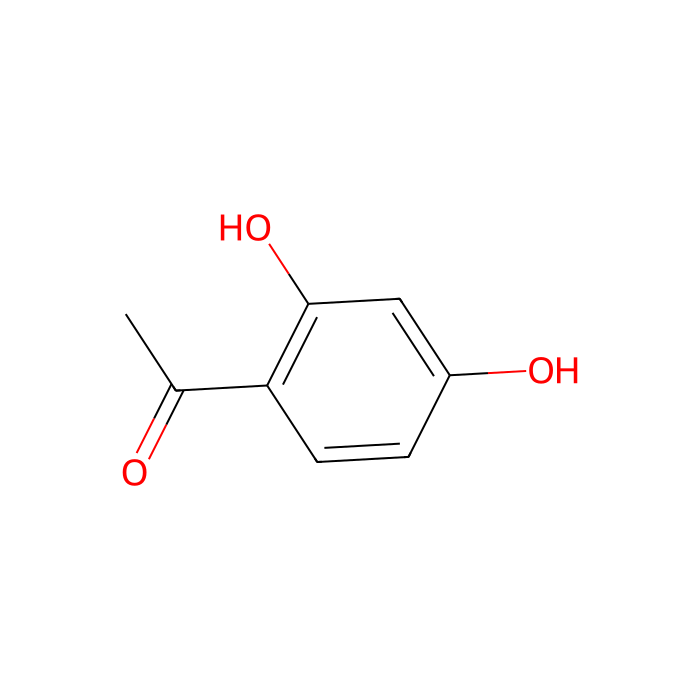
Brief overview: 2',4'-Dihydroxyacetophenone is a dihydroxy-substituted acetophenone (phenyl methyl ketone) bearing hydroxyl groups at the 2- and 4-positions relative to the acyl substituent; commonly known as resacetophenone.
Item-specific (from Product Data):
Product name: 2',4'-Dihydroxyacetophenone
CAS: 89-84-9
CID: 6990
InChIKey: 345730 (as provided)
SMILES: Not specified for this item; refer to CoA/Spec Sheet.
Literature/Computed identifiers (for reference only; not item specifications):
Aromatic ring (benzene) bearing a methyl ketone (–COCH3) para to one phenolic OH and ortho to the other.
Functional groups: phenolic hydroxyls (two H-bond donors/acceptors) and an aryl methyl ketone (carbonyl H-bond acceptor).
Intramolecular hydrogen bonding between the 2-OH and the carbonyl is commonly observed (literature), influencing acidity and spectroscopy.
2D description: a benzene ring with –COCH3 at position 1, –OH at positions 2 and 4 relative to the carbonyl-bearing carbon.
Note: Item-specific identifiers not provided above should be confirmed on the CoA/Spec Sheet.
Synthetic Utility
Key functional groups and reactivity (literature):
Phenolic OH (2- and 4-positions): nucleophilic after deprotonation; readily O-alkylated/acylated; engage in hydrogen bonding and metal coordination. The 2-OH forms a stabilizing intramolecular H-bond to the ketone, modulating acidity and directing reactivity.
Aryl methyl ketone: undergoes typical carbonyl chemistry (oxime/hydrazone formation, halogenation at the methyl under basic conditions—haloform-type pathways in certain conditions), and serves as an electrophile in aldol condensations.
Representative transformations:
Claisen–Schmidt condensation to chalcones, followed by:
Cyclization to flavanones/aurones/benzofurans under acid/base or oxidative conditions.
Selective protection strategies:
Differential O-protection exploiting acidity differences (e.g., transient silylation of 2-OH vs 4-OH) to control subsequent functionalization.
Electrophilic aromatic substitution:
Phenolic activation directs to ortho/para positions; with this substitution pattern, further substitution often occurs at the 3- or 5-positions depending on conditions.
Cross-coupling after pre-functionalization:
Convert phenols to aryl triflates/mesylates to enable Pd-catalyzed C–C or C–N couplings.
Chelation-assisted processes:
The 2-OH/ketone motif can transiently chelate metals to assist ortho-metalation or cyclization in directed metallation protocols.
Utility in synthesis planning:
As a masked 1,2-dioxygen motif for ligand/complex synthesis.
As a modular source of 1,2,4-trisubstituted benzenes, enabling divergent routes to polyphenolic natural product analogs.
Target Specificity
Not applicable. This product is a small-molecule reagent, not a biological affinity reagent or antibody. No target, epitope, clone, isotype, or species reactivity is specified for this item.
For studies involving biochemical targets, consult primary literature for binding/kinetic data specific to your system and verify compound identity/purity on the CoA.
Foire aux questions
What is the purity of this product?
This product is supplied at ≥99% purity (chemical assay). Lot-specific values are stated on the Certificate of Analysis.
How should this product be stored?
Store at room temperature.
How is this product shipped?
This product ships under standard ambient conditions. No temperature-controlled packaging is required.
What are the CAS number, molecular formula and molecular weight?
The CAS Number is 89-84-9, the molecular formula is C8H8O3, and the molecular weight is 152.15 g/mol. InChIKey SULYEHHGGXARJS-UHFFFAOYSA-N.
What documentation is provided?
Available product documentation, including Certificates of Analysis (COA), Safety Data Sheets (SDS), and specification sheets, is shown in the product document area. Document availability and access follow the current site policy.
Nous utilisons des cookies pour garantir le bon fonctionnement du site et, lorsque cela est autorisé, pour améliorer votre expérience. Vous pouvez gérer vos préférences à tout moment dans les Paramètres. Pour en savoir plus, consultez notre Politique relative aux cookies.
Souhaitez-vous que nous vous envoyions un message lorsque des réductions seront disponibles?
Me rappeler plus tard
Merci ! Veuillez vérifier votre boîte de réception e-mail pour confirmer.
Products are supplied to verified businesses, institutions, and qualified professionals for research and development use only. Not for use in humans, animals, diagnosis, or therapy.

 C2201560