Determine the necessary mass, volume, or concentration for preparing a solution.
| Activity Type | Relation | Activity value | Units | Action Type | Journal | PubMed Id | doi | Assay Aladdin ID |
|---|

| Activity Type | Relation | Activity value | Units | Action Type | Journal | PubMed Id | doi | Assay Aladdin ID |
|---|
| Activity Type | Relation | Activity value | Units | Action Type | Journal | PubMed Id | doi | Assay Aladdin ID |
|---|
| Activity Type | Relation | Activity value | Units | Action Type | Journal | PubMed Id | doi | Assay Aladdin ID |
|---|
| Activity Type | Relation | Activity value | Units | Action Type | Journal | PubMed Id | doi | Assay Aladdin ID |
|---|
| Activity Type | Relation | Activity value | Units | Action Type | Journal | PubMed Id | doi | Assay Aladdin ID |
|---|
| Activity Type | Relation | Activity value | Units | Action Type | Journal | PubMed Id | doi | Assay Aladdin ID |
|---|
| Activity Type | Relation | Activity value | Units | Action Type | Journal | PubMed Id | doi | Assay Aladdin ID |
|---|
| Activity Type | Relation | Activity value | Units | Action Type | Journal | PubMed Id | doi | Assay Aladdin ID |
|---|
| Activity Type | Relation | Activity value | Units | Action Type | Journal | PubMed Id | doi | Assay Aladdin ID |
|---|
| Activity Type | Relation | Activity value | Units | Action Type | Journal | PubMed Id | doi | Assay Aladdin ID |
|---|
| Activity Type | Relation | Activity value | Units | Action Type | Journal | PubMed Id | doi | Assay Aladdin ID |
|---|
| Activity Type | Relation | Activity value | Units | Action Type | Journal | PubMed Id | doi | Assay Aladdin ID |
|---|
| Activity Type | Relation | Activity value | Units | Action Type | Journal | PubMed Id | doi | Assay Aladdin ID |
|---|
| Activity Type | Relation | Activity value | Units | Action Type | Journal | PubMed Id | doi | Assay Aladdin ID |
|---|
| Activity Type | Relation | Activity value | Units | Action Type | Journal | PubMed Id | doi | Assay Aladdin ID |
|---|
| Activity Type | Relation | Activity value | Units | Action Type | Journal | PubMed Id | doi | Assay Aladdin ID |
|---|
| Activity Type | Relation | Activity value | Units | Action Type | Journal | PubMed Id | doi | Assay Aladdin ID |
|---|
| Activity Type | Relation | Activity value | Units | Action Type | Journal | PubMed Id | doi | Assay Aladdin ID |
|---|
| Activity Type | Relation | Activity value | Units | Action Type | Journal | PubMed Id | doi | Assay Aladdin ID |
|---|
| Activity Type | Relation | Activity value | Units | Action Type | Journal | PubMed Id | doi | Assay Aladdin ID |
|---|
| Activity Type | Relation | Activity value | Units | Action Type | Journal | PubMed Id | doi | Assay Aladdin ID |
|---|
| Activity Type | Relation | Activity value | Units | Action Type | Journal | PubMed Id | doi | Assay Aladdin ID |
|---|
| Activity Type | Relation | Activity value | Units | Action Type | Journal | PubMed Id | doi | Assay Aladdin ID |
|---|
| Activity Type | Relation | Activity value | Units | Action Type | Journal | PubMed Id | doi | Assay Aladdin ID |
|---|
| Activity Type | Relation | Activity value | Units | Action Type | Journal | PubMed Id | doi | Assay Aladdin ID |
|---|
| Activity Type | Relation | Activity value | Units | Action Type | Journal | PubMed Id | doi | Assay Aladdin ID |
|---|
| Activity Type | Relation | Activity value | Units | Action Type | Journal | PubMed Id | doi | Assay Aladdin ID |
|---|
| Activity Type | Relation | Activity value | Units | Action Type | Journal | PubMed Id | doi | Assay Aladdin ID |
|---|
| Activity Type | Relation | Activity value | Units | Action Type | Journal | PubMed Id | doi | Assay Aladdin ID |
|---|
| Activity Type | Relation | Activity value | Units | Action Type | Journal | PubMed Id | doi | Assay Aladdin ID |
|---|
| Activity Type | Relation | Activity value | Units | Action Type | Journal | PubMed Id | doi | Assay Aladdin ID |
|---|
| Activity Type | Relation | Activity value | Units | Action Type | Journal | PubMed Id | doi | Assay Aladdin ID |
|---|
| Activity Type | Relation | Activity value | Units | Action Type | Journal | PubMed Id | doi | Assay Aladdin ID |
|---|
| Activity Type | Relation | Activity value | Units | Action Type | Journal | PubMed Id | doi | Assay Aladdin ID |
|---|
| Activity Type | Relation | Activity value | Units | Action Type | Journal | PubMed Id | doi | Assay Aladdin ID |
|---|
Find and download the COA for your product by matching the lot number on the packaging.
| Lot Number | Certificate Type | Date | Article |
|---|---|---|---|
 E2609312 | Certificate of Analysis | Apr 22, 2026 | D104371 |
| E2609311 | Certificate of Analysis | Apr 22, 2026 | D104371 |
| E2609313 | Certificate of Analysis | Apr 22, 2026 | D104371 |
| C2631103 | Certificate of Analysis | Apr 06, 2026 | D104371 |
| H2126082 | Certificate of Analysis | Jun 09, 2025 | D104371 |
| C2127026 | Certificate of Analysis | Jan 13, 2025 | D104371 |
| I2510126 | Certificate of Analysis | Dec 16, 2024 | D104371 |
| C2512647 | Certificate of Analysis | Dec 16, 2024 | D104371 |
| C2512648 | Certificate of Analysis | Dec 16, 2024 | D104371 |
| K2427397 | Certificate of Analysis | Nov 18, 2024 | D104371 |
| C2421317 | Certificate of Analysis | Mar 02, 2024 | D104371 |
| C2408209 | Certificate of Analysis | Feb 28, 2024 | D104371 |
| C2408230 | Certificate of Analysis | Feb 28, 2024 | D104371 |
| A2009124 | Certificate of Analysis | Oct 07, 2023 | D104371 |
| B2327035 | Certificate of Analysis | Mar 01, 2023 | D104371 |
| B2327188 | Certificate of Analysis | Feb 17, 2023 | D104371 |
| B2327189 | Certificate of Analysis | Feb 17, 2023 | D104371 |
| B2327197 | Certificate of Analysis | Feb 17, 2023 | D104371 |
| L2322160 | Certificate of Analysis | Feb 25, 2022 | D104371 |
| C2219488 | Certificate of Analysis | Feb 25, 2022 | D104371 |
| C2219479 | Certificate of Analysis | Feb 25, 2022 | D104371 |
| B2301555 | Certificate of Analysis | Feb 25, 2022 | D104371 |
| B2327036 | Certificate of Analysis | Nov 10, 2021 | D104371 |
| B2301230 | Certificate of Analysis | Aug 12, 2021 | D104371 |
| Solubilité | Soluble in 95% ethanol (50 mg/ml), ether, alcohols, water (8 mg/ml at 20 °C), and water (70 mg/ml at 70 °C). |
|---|---|
| Sensibilité | Light sensitive. |
| Point de fusion (°C) | 218°C |
| Poids moléculaire | 154.12 |
| XLogP3 | 1.600 |
| Hydrogen Bond Donor Count | 3 |
| Hydrogen Bond Acceptor Count | 4 |
| Rotatable Bond Count | 1 |
| Exact Mass | 154.027 Da |
| Monoisotopic Mass | 154.027 Da |
| Topological Polar Surface Area | 77.800 Ų |
| Heavy Atom Count | 11 |
| Formal Charge | 0 |
| Complexity | 157.000 |
| Isotope Atom Count | 0 |
| Defined Atom Stereocenter Count | 0 |
| Undefined Atom Stereocenter Count | 0 |
| Defined Bond Stereocenter Count | 0 |
| Undefined Bond Stereocenter Count | 0 |
| The total count of all stereochemical bonds | 0 |
| Covalently-Bonded Unit Count | 1 |
H315:Causes skin irritation
H319:Causes serious eye irritation
H335:May cause respiratory irritation
P261:Avoid breathing dust/fume/gas/mist/vapors/spray.
P264:Wash hands [and …] thoroughly after handling.
P271:Use only outdoors or in a well-ventilated area.
P280:Wear protective gloves/protective clothing/eye protection/face protection.
P321:Specific treatment (see ... on this label).
P302+P352:IF ON SKIN: wash with plenty of water.
P304+P340:IF INHALED: Remove person to fresh air and keep comfortable for breathing.
P305+P351+P338:IF IN EYES: Rinse cautiously with water for several minutes. Remove contact lenses if present and easy to do - continue rinsing.
P362+P364:Take off contaminated clothing and wash it before reuse.
P405:Store locked up.
P403+P233:Store in a well-ventilated place. Keep container tightly closed.
P501:Dispose of contents/container to an approved waste disposal plant.
P264+P265:Wash hands [and …] thoroughly after handling. Do not touch eyes.
P337+P317:If eye irritation persists: Get medical help.
P332+P317:If skin irritation occurs: Get medical help.
P319:Get medical help if you feel unwell.
No item-specific tested application protocols are provided for this product; refer to CoA/Spec Sheet.
General usage examples (literature-based; for research use only):
Always adapt conditions to your system and consult primary literature/SOPs.
This section provides general biochemical context for 2,4-dihydroxybenzoic acid; it does not imply biological/clinical use of this catalog item.
Notes:
Not typically used as a primary buffering agent. While 2,4-dihydroxybenzoic acid has multiple acidic protons (carboxyl and phenolic), standard biological buffers (e.g., phosphate, Tris, HEPES) offer superior buffering capacity and compatibility.
Practical notes (general):
Context: This product is a solid building block rather than a solvent; green considerations focus on solvent and reagent choices during its use and on sourcing.
Greener choices (general guidance):
Illustrative comparison (general; example choices):
Sourcing considerations:
No item-specific pharmacopeial status or excipient use is specified for this product; refer to CoA/Spec Sheet if applicable.
General context (non-clinical, formulation/manufacturing focus):
Compliance note: This material is provided for research use only and is not intended for human or veterinary use or for incorporation into finished drug products without appropriate qualification.
Item-specific specifications: Not specified for this item; refer to CoA/Spec Sheet.
Literature/general physical data (typical values; not item-specific):
Notes for use (general):
Item-specific grade/purity information: Not specified for this item; refer to CoA/Spec Sheet.
General guidance on grades for solid organic building blocks:
Stabilizers/inhibitors:
What to check on receipt:
Expanded application context (general; literature-based):
Practical tips:
General literature guidance (illustrative; not item-specific specifications):
Fischer esterification:
Steglich/EDC esterification:
Amide coupling:
O-Alkylation of phenols:
Acid chloride formation:
Metal complexation (salicylate motif):
Item-specific hazard classification: Not specified for this item; refer to the SDS for authoritative information.
General GHS considerations for phenolic carboxylic acids (literature-based guidance):
Personal protective equipment (typical laboratory practice):
Handling and storage:
First-aid overview (general):
Disposal: Dispose in accordance with local regulations; phenolic acids are typically managed as organic laboratory waste.
Always consult the product’s SDS for definitive hazards, exposure limits, and emergency measures.
Applicability: As a solid phenolic carboxylic acid, solvent selection concerns its dissolution for reaction or analysis rather than its use as a solvent.
General solubility/polarity guidance (literature):
Selection tips:
Quick comparison (general):
Item-specific storage and shipping (from Product Data):
General storage guidance:
Reconstitution/preparation notes (general):
Freeze-thaw considerations:
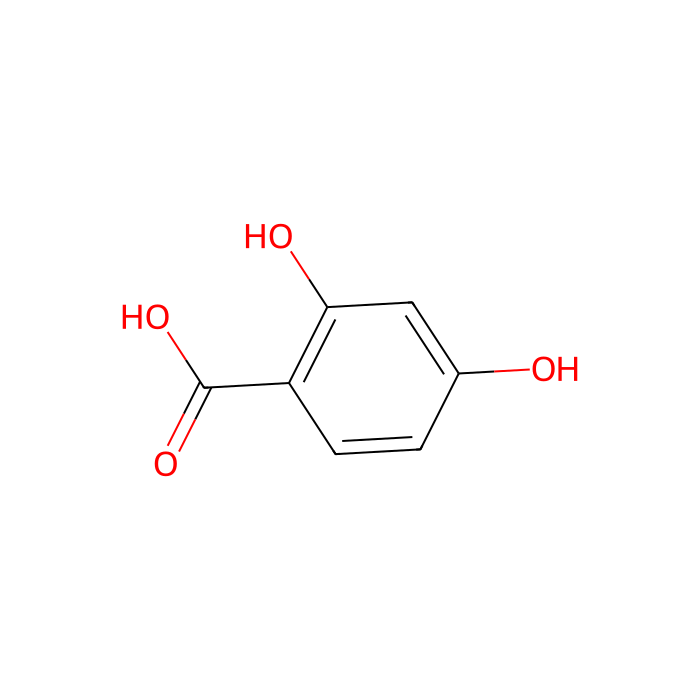
Brief description: 2,4-Dihydroxybenzoic acid is a dihydroxy-substituted benzoic acid (a phenolic carboxylic acid) with hydroxyl groups at the 2- and 4-positions relative to the carboxyl group.
Item-specific identifiers (from Product Data):
Literature/general identifiers and composition (for reference; not item-specific):
Structural features (general description):
Functional group portfolio:
Representative transformations (literature):
Retrosynthetic value:
Not applicable. This product is a small-molecule chemical and is not an antibody, enzyme, or biological probe with defined target specificity. For functional uses, see Reaction & Applications and Synthetic Utility.