≥98%(GC) for sensitive chromatographic and analytical workflows requiring minimal baseline interference.
🌡
Storage & shipping
Room temperature Ships Normal Check lot-specific COA for exact specifications.
📋
Quality documents
SDS, COA, datasheet, and spec sheet available for download. Lot-specific COA accessible via lot number lookup.
📚
Literature proof
Cited in 0 peer-reviewed publications across chromatography, organic synthesis, and cross-coupling reactions.
Vue d’ensemble
Product Application 2,5-Dichlorobenzyl bromide may be used in the synthesis of methyl 5-(2,5-dichlorobenzyloxy)-2-hydroxybenzoate and methyl 4-(2,5-dichlorobenzyloxy)-2-hydroxybenzoate via chemoselective alkylation of the hydroxyl group of the corresponding ester.
This compound belongs to the class of organic compounds known as dichlorobenzenes. These are compounds containing a benzene with exactly two chlorine atoms attached to it.
External Descriptors
Not available
1. Djoumbou Feunang Y, Eisner R, Knox C, Chepelev L, Hastings J, Owen G, Fahy E, Steinbeck C, Subramanian S, Bolton E, Greiner R, and Wishart DS. ClassyFire: Automated Chemical Classification With A Comprehensive, Computable Taxonomy. Journal of Cheminformatics, 2016, 8:61.
Determine the necessary mass, volume, or concentration for preparing a solution.
Dilution Calculator
Determine the dilution needed to prepare a stock solution.
Reconstitution Calculator
Avis
Avis des clients
Application Protocols
No biological assay protocols (e.g., WB, IHC, IF, FC) are applicable to this small-molecule reagent. For synthetic use, see Reaction Conditions and Synthetic Utility tabs for literature-based procedural guidance.
Manufacturer Applications: Not specified in the Product Data; users should design protocols appropriate for their nucleophile and desired benzylation or downstream cross-coupling sequence.
Biological Roles
This product is a small-molecule synthetic reagent, not a biological buffer or metabolite. No endogenous biological role is expected.
General context (literature):
Benzylic halides are not naturally occurring metabolites; they are synthetic intermediates used to install benzyl groups or dichloroaryl motifs in probe and ligand synthesis.
The 2,5-dichloroaryl motif occurs in various research ligands and materials; however, the benzylic bromide itself is typically a transient reagent and is hydrolytically unstable under physiological conditions.
The benzylic moiety can increase compound lipophilicity and membrane affinity when incorporated into small molecules, which may be of interest in medicinal chemistry SAR programs (no therapeutic claims implied).
Biochemical handling:
In aqueous/biological settings, benzylic bromides are reactive alkylating agents and generally unsuitable for direct biological assays; derivatives (e.g., benzylated products) are used instead.
Conclusion: Consider this compound solely as a chemical building block for research synthesis. For any work intersecting biology, fully quench and purify products before testing; do not introduce the benzylic bromide reagent into biological systems.
Buffer Applications
Not typically applicable. 2,5-Dichlorobenzyl bromide is a reactive organic electrophile, not used as a buffering agent or pH control component.
Guidance: For aqueous or biological buffer preparation, select established buffering systems (e.g., phosphate, Tris, HEPES). This reagent should be handled in dry, non-aqueous organic media to avoid hydrolysis and undesired alkylation.
Green Alternatives
Greener choices focus on solvent replacement, phase-transfer strategies to minimize polar aprotics, and alternative benzylating methods that reduce halide waste. Trade-offs are highlighted below (literature guidance).
Solvent replacements:
2-MeTHF or CPME vs THF/toluene: Similar solvency with better safety/renewable profile; often effective for PTC or base-mediated benzylations. Water content must be controlled.
Propylene carbonate vs DMF/DMSO: High-permittivity, low-toxicity alternative; good for SN2 with inorganic bases; higher viscosity can slow mass transfer.
Ethyl acetate or MeCN (low-toxicity, recyclable) for some O-/S-alkylations.
Alternative benzylation strategies:
Benzyl carbonates or benzyl alcohols under catalytic activation (e.g., Mitsunobu-free oxidative methods, borrowing-hydrogen catalysis) can avoid halogenated waste, but may require precious metal catalysts and tighter condition control.
Use of phase-transfer catalysis with aqueous carbonate base reduces need for polar aprotics and eases workup.
Comparison (general):
Conventional: 2,5-dichlorobenzyl bromide in DMF/DMSO — high reactivity; concern over solvent toxicity and halide waste.
Greener: Same electrophile in 2-MeTHF/CPME with K2CO3 + PTC — good yields, easier solvent recovery, lower worker exposure.
Greener (alt electrophile): 2,5-dichlorobenzyl alcohol with catalytic activation — reduced halide waste; may lower reactivity/selectivity and increase optimization burden.
Recommendation: Start with MeCN or 2-MeTHF + K2CO3 (or Cs2CO3) at 40–60 °C and compare to DMF benchmarks; evaluate E-factors via simple mass balance.
Pharmaceutical Uses
No direct excipient or formulation use is expected for this reagent. It is intended strictly for research and laboratory synthesis.
General industry context (literature):
Benzylic bromides are often route intermediates for installing benzyl protecting groups or dichloroaryl benzyl fragments during API or agrochemical synthesis, followed by further transformations (e.g., hydrogenolysis of benzyl ethers or cross-coupling on the aryl chloride sites).
Not listed as a pharmacopeial excipient and not suitable for direct inclusion in dosage forms due to reactivity and irritancy.
Process considerations:
When used in GMP settings upstream, typical controls include residual benzylic halide limits in final APIs (ICH M7-related considerations), rigorous purging studies, and validated analytical methods (GC, LC-UV).
Research Use Note: For research use only; not for human or veterinary use.
Physical Properties
Item-specific specifications: Not specified for this item; refer to CoA/Spec Sheet.
Literature/general values (for reference only; not product specs):
Molecular formula: C7H5BrCl2 (literature)
Molecular weight: ~239.92 g/mol (literature)
Physical state/appearance: Typically a colorless to pale yellow liquid for many benzyl bromides; actual appearance for this item: Not specified.
Expected behavior: Benzylic halides are generally moderately volatile oils with characteristic lachrymatory odor; dichloro aryl substitution typically raises boiling point relative to unsubstituted benzyl bromide (literature trend).
Solubility: Typical of benzylic bromides—miscible with many organic solvents (e.g., dichloromethane, toluene, THF, acetonitrile) and essentially insoluble in water; hydrolyzes slowly in aqueous basic media (literature).
Partitioning: Aryl dichloro substitution increases hydrophobicity (higher logP than benzyl bromide), but exact logP: Not specified here.
Other properties (bp, mp, density, refractive index, UV cutoff): Not specified for this item; refer to CoA/Spec Sheet.
Notes for practice (general): Handle under dry conditions to minimize hydrolysis to the corresponding benzyl alcohol; avoid prolonged exposure to moisture and nucleophilic impurities which can consume the reagent.
Quality and Grades
Item-specific grade/purity: Not specified for this item; refer to CoA/Spec Sheet.
Context for professional users (general guidance):
Grade meaning: When specified, grades such as “Reagent,” “ACS,” or “98%+” indicate minimum assay and impurity controls. For benzylating agents used in synthesis, the key quality attributes typically include:
Assay (GC, NMR) of the benzylic bromide content
Residual solvents profile (GC)
Hydrolyzable halide and benzyl alcohol impurity levels
Color (APHA) and UV absorbance baseline (if used near detection wavelengths)
Stabilizers: Some benzylic halides are offered unstabilized; absence/presence of stabilizer should be stated on CoA. For this item, stabilizer: Not specified.
Impurities of concern (general):
Corresponding benzyl chloride/alcohol, dibenzyl ether (from self-condensation), and ring-chlorinated byproducts. For sensitive alkylations, trace alcohol significantly impacts performance.
Selection advice:
For O-/N-/S-alkylation steps in route-critical synthesis, request CoA/SDS to verify water content, assay, and color.
For chromatography or photochemical work, low UV-background and low peroxide content (if any) can be relevant—though peroxides are not typical for benzylic bromides.
Reaction and Applications
2,5-Dichlorobenzyl bromide is a versatile benzylating agent; the benzylic bromide functions as an excellent leaving group, enabling rapid substitutions with a wide range of nucleophiles.
O-Alkylation of alcohols/phenols to give benzyl ethers; bases: K2CO3, Cs2CO3, NaH; solvents: DMF, MeCN, acetone; 20–80 °C.
S-Alkylation of thiols to thioethers; proceeds rapidly at rt–50 °C with NaH/K2CO3 or in biphasic PTC conditions.
N-Alkylation of amines/amides/carbamates to form benzylated nitrogen derivatives; control mono- vs di-alkylation via stoichiometry and base.
Formation of benzyl esters via carboxylate substitution (e.g., silver or cesium carboxylates in polar aprotics).
Radical chemistry: Under photoredox or radical initiators, benzylic bromides can participate in radical substitutions or polymer initiations (literature), though aryl chlorides remain intact under typical radical conditions.
Synthetic advantages of 2,5-dichloro substitution:
Provides a pre-installed dichloroaryl motif valuable in SAR exploration; the ring chlorides can be leveraged in downstream cross-couplings (e.g., Buchwald–Hartwig, Suzuki) after benzylic derivatization.
Increased lipophilicity can enhance phase partitioning and crystallization behavior of products.
Practical notes:
Use dry conditions; hydrolysis produces the corresponding benzyl alcohol, diminishing yield.
For hindered nucleophiles, elevate temperature or switch to a more polar aprotic solvent.
Monitor by GC/HPLC; benzyl bromides often show distinct UV response around 210–254 nm.
Reaction Conditions
General literature guidance for using 2,5-dichlorobenzyl bromide as an alkylating agent. Optimize per substrate and scale; monitor by TLC/GC/LC.
O-Alkylation (alcohols/phenols):
Base: K2CO3 (2–3 equiv) or Cs2CO3 (1.2–2 equiv)
Solvent: DMF or MeCN (0.1–0.5 M)
Temperature/time: 25–80 °C, 1–16 h
Typical outcome: Benzyl ethers in good to excellent yields (often 75–95%)
S-Alkylation (thiols):
Base: NaH (1.1–1.5 equiv) in THF or K2CO3 in MeCN/PTC
Temperature/time: 0–25 °C to control exotherm; 0.5–4 h
Notes: Very fast; minimize over-alkylation for secondary thiols.
N-Alkylation (amines, amides, imides):
Base: DIPEA or K2CO3; for imides, NaH or Cs2CO3
Solvent: MeCN, DMF, or toluene/PTC
Temperature/time: 25–70 °C, 2–18 h; control stoichiometry to suppress dialkylation.
Carboxylate alkylation (esters):
Base: Cs2CO3 or Ag2CO3
Solvent: DMF or MeCN
Temperature: 25–60 °C; often requires longer times (6–24 h).
Phase-transfer (biphasic):
Organic: toluene or DCM; Aqueous: 1–2 M K2CO3 or NaOH; PTC: TBAB (5–10 mol%)
Temperature/time: 25–50 °C, 2–8 h; efficient for phenoxides and thiolates.
Workup/purification:
Quench with water or aqueous NH4Cl; extract with organic solvent; wash with NaHCO3 and brine; dry (Na2SO4); purify by column. Residual benzylic bromide can be scavenged by thiol resins.
All parameters above are literature guidance; adjust based on substrate reactivity and safety considerations.
Safety and Handling
Authoritative safety information for this specific item is provided in the product SDS. The following are general precautions for benzylic bromides and halogenated benzylating agents.
Item-specific hazard data (from Product Data):
GHS classification: Not specified for this item; refer to SDS.
Signal word / H-statements / pictograms: Not specified for this item; refer to SDS.
General hazards for benzylic bromides (literature/analogous compounds):
Often strong irritants and potent lachrymators; may cause skin and eye irritation and respiratory discomfort.
Harmful if swallowed or inhaled; can cause burns to mucous membranes on contact.
Reactivity: Undergoes exothermic reactions with strong nucleophiles and bases; slowly hydrolyzes to benzyl alcohols under moist conditions.
Incompatibilities (general):
Strong bases (promote elimination/polymerization), strong nucleophiles in uncontrolled settings, aqueous media (hydrolysis), strong oxidizers, and active metals without proper control.
Recommended PPE and engineering controls:
Use in fume hood; wear chemical-resistant gloves (e.g., nitrile), safety goggles/face shield, and lab coat.
Have an eyewash and safety shower accessible.
First-aid overview (general guidance—defer to SDS):
Skin/eye contact: Immediate decontamination with copious water for ≥15 min; remove contaminated clothing.
Inhalation: Move to fresh air; seek medical evaluation if symptoms persist.
Ingestion: Rinse mouth; do not induce vomiting; seek medical attention.
Spill/cleanup:
Absorb with inert material (e.g., vermiculite), avoid vapor/tear effects, and place in halogenated waste.
Waste disposal: Treat as halogenated organic waste per institutional and regulatory guidance.
Solvent Selection
Solvent choice for 2,5-dichlorobenzyl bromide revolves around promoting efficient SN2/SN1 benzylation while controlling side reactions (elimination, hydrolysis) and ensuring substrate solubility.
Polarity/miscibility (general profile):
Expected to dissolve well in common organic solvents: dichloromethane (DCM), toluene, THF, acetonitrile (MeCN), DMF, DMSO, acetone (literature).
Immiscible with water; hydrolyzes in aqueous basic conditions.
Typical solvent strategies (literature guidance):
Polar aprotic (DMF, DMSO, MeCN): Enhances SN2 rates for deprotonated alcohols (RO−), thiolates (RS−), and secondary amines; often combined with inorganic bases (K2CO3, Cs2CO3, NaH).
Biphasic/phase-transfer: Toluene or DCM with aqueous base (K2CO3, NaOH) and a quaternary ammonium PTC (e.g., TBAB) for O-/S-alkylations at mild temperatures.
Nonpolar aromatics (toluene, chlorobenzene): Useful for higher-temperature reactions or when substrates poorly dissolve in polar media; suppresses competing solvolysis.
If nucleophile or product is base-labile, consider milder bases in MeCN or use carbonate bases in DMF.
For green chemistry aims, consider 2-MeTHF or CPME in place of THF/toluene, or propylene carbonate for polar aprotic conditions (see Green Alternatives).
Practical tips:
Dry solvents (molecular sieves) limit hydrolysis to benzyl alcohol.
Degassing usually unnecessary unless using transition-metal catalysis with the aryl chlorides.
Storage and Reconstitution
Item-specific storage: Room temperature (per Product Data). Shipped under normal ambient conditions.
Container and atmosphere (general best practice): Store tightly closed in amber glass to minimize light exposure; use dry inert headspace (nitrogen/argon) if storing long term to limit hydrolysis to benzyl alcohol.
Stability notes (general): Benzylic bromides can slowly hydrolyze or discolor on exposure to moisture and base. Minimize contact with protic solvents and avoid prolonged storage with nucleophilic impurities.
Handling tips:
Dispense using dry syringes or pipettes in a fume hood.
For multi-gram storage, consider aliquoting to reduce repeated headspace exchange and moisture ingress.
Reconstitution: Not applicable; supplied as a neat reagent. If solidification occurs at low temperature, gently warm to room temperature and swirl to homogenize before use.
Freeze-thaw guidance: Not relevant; do not freeze unless necessary for stability studies. If crystallization occurs upon cooling, redissolve by warming and/or adding a small amount of dry solvent (e.g., DCM, toluene) prior to use.
Always consult the product CoA and SDS for authoritative storage, stability, and safety information specific to this lot.
Structure and Identity
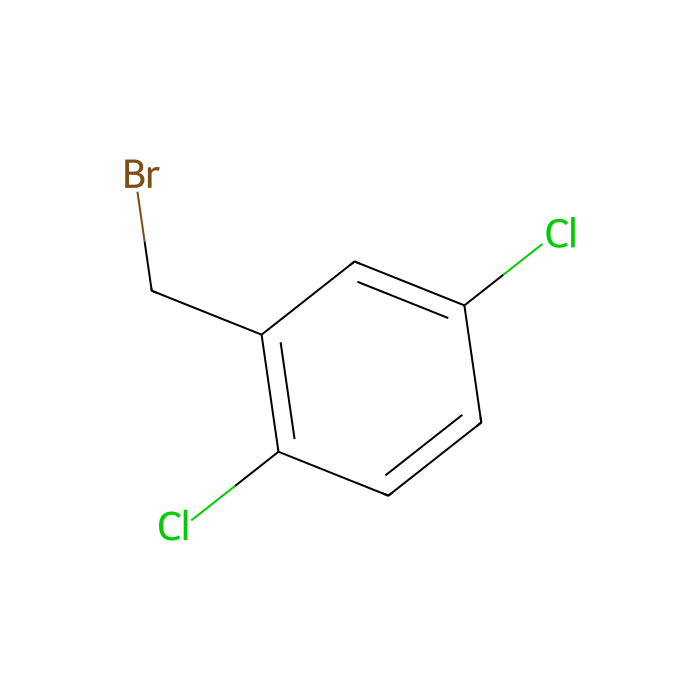
Brief overview: 2,5-Dichlorobenzyl bromide is a benzylic bromide bearing two chloro substituents on the aromatic ring (at the 2- and 5-positions). It is a highly effective benzylating agent for O-, N-, and S-nucleophiles.
Item-specific identifiers (from Product Data):
SKU: D136909
CAS: 85482-13-9
PubChem CID: 3495744
InChIKey: 369813 (as provided)
Storage: Room temperature; shipped at ambient conditions
Category: Chemical and Biochemical Reagents; For research use only
Literature/computed structural data (informational, not item specifications):
Core: Monosubstituted benzyl bromide (Ph–CH2–Br) with two ring chlorides at ortho (2) and para (5) positions relative to the benzylic substituent.
Functional groups: Benzylic bromide (good leaving group); aryl chlorides (deactivating, ortho/para directors for SEAr; possible handles for cross-coupling under Pd catalysis).
Electronic effects: Ring dichloro substitution is overall deactivating and increases lipophilicity; benzylic position remains highly reactive in SN1/SN2 due to benzylic stabilization.
Stereochemistry: None (achiral); reactions at the benzylic center proceed via SN1/SN2 pathways depending on conditions.
2D description in words: A benzene ring bearing chlorine atoms at positions 2 and 5, with a –CH2Br substituent at position 1.
Synthetic Utility
Key reactivity arises from the benzylic C–Br bond, which is activated toward substitution and radical processes, while the aryl chlorides provide orthogonal functionality for subsequent cross-coupling.
Functional group behavior (literature):
Benzylic bromide: Excellent leaving group for SN2 with O-, N-, S-nucleophiles; amenable to SN1 under strongly ionizing conditions generating benzyl cation.
Aryl chlorides (2,5-): Deactivated toward electrophilic aromatic substitution but engage in Pd-catalyzed C–N, C–O, and C–C couplings with suitable ligands (e.g., BrettPhos, XPhos systems) after initial benzylation steps.
Retrosynthetic value:
Serves as a linchpin to introduce the 2,5-dichlorobenzyl fragment late-stage onto nucleophilic partners, enabling rapid library diversification.
Orthogonal manipulation: After nucleophilic substitution at benzylic position, ring chlorides allow site-selective cross-coupling to elaborate the aryl core.
Protecting group chemistry:
Formation of 2,5-dichlorobenzyl ethers/esters as protecting groups; removal via hydrogenolysis (Pd/C, H2) or oxidative methods, providing chemoselective deprotection handles.
Additional transformations:
Formation of benzyl Grignard or organozinc reagents from benzylic bromides is known (literature), but the presence of aryl chlorides requires careful control to avoid metal–halogen exchange on the ring; specialized conditions/ligands recommended.
Target Specificity
Not applicable. This product is a small-molecule reagent (not an antibody, enzyme, or biological targeting agent). No antigen/epitope, clone, isotype, or species reactivity information applies.
We use cookies to ensure the website functions properly and, where permitted, to improve your experience. You can manage your preferences at any time in Settings. Learn more in our Cookie Policy.
Shall we send you a message when we have discounts available?
Remind me later
Thank you! Please check your email inbox to confirm.
Products are supplied to verified businesses, institutions, and qualified professionals for research and development use only. Not for use in humans, animals, diagnosis, or therapy.

 G2215266