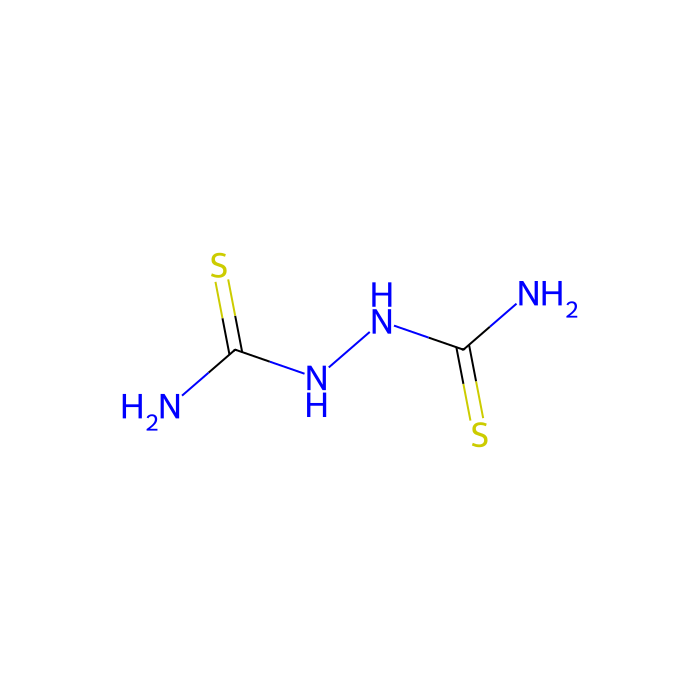
This compound belongs to the class of organic compounds known as thiosemicarbazides. These are compounds containing a derivative of thiosemicarbazide with the general structure R1N(R2)N(R3)C(=S)N(R4)R5 (R1-R5=H, alkyl, aryl) where the ketone group has carbonyl group has been replaced with a thiocarbonyl group.
External Descriptors
Not available
1. Djoumbou Feunang Y, Eisner R, Knox C, Chepelev L, Hastings J, Owen G, Fahy E, Steinbeck C, Subramanian S, Bolton E, Greiner R, and Wishart DS. ClassyFire: Automated Chemical Classification With A Comprehensive, Computable Taxonomy. Journal of Cheminformatics, 2016, 8:61.
Determine the necessary mass, volume, or concentration for preparing a solution.
Dilution Calculator
Determine the dilution needed to prepare a stock solution.
Reconstitution Calculator
Avis
Avis des clients
Application Protocols
No validated bioassay or immunoassay protocols are provided for this product in the catalog entry.
General laboratory usage examples (non-validated, for planning only):
Preparation of metal complexes: dissolve the ligand in ethanol/water or DMF, adjust pH, and add metal salt solution dropwise under stirring; isolate complex by precipitation or crystallization.
N-acylation: dissolve in dry DMF, add base (e.g., DIPEA), cool to 0–5 °C, add acyl chloride slowly; quench and purify by crystallization.
For any application requiring validated conditions, develop and document method-specific SOPs and consult primary literature.
Biological Roles
This product is offered strictly for research use. No biological function or role is specified for this catalog item.
General context (literature; not item-specific claims):
Thiourea-derived scaffolds are widely studied as ligands in bioinorganic models, as hydrogen-bond donors in supramolecular assemblies, and as precursors to sulfur- and nitrogen-containing heterocycles relevant to chemical biology probes.
The multiple –NH– donors enable strong H-bonding and anion recognition, which can be leveraged in sensor development and host–guest systems.
Interaction with metal ions (e.g., soft metals) is common; any biological investigations should carefully control metal content and speciation.
No biochemical pathway participation, receptor binding, or enzymatic activity is assigned to 2,5-dithiobiurea in this listing. Consult primary literature if exploring mechanistic bioactivity, and perform appropriate safety and hazard assessments before any biological testing.
Buffer Applications
Not a dedicated buffering agent. Dithiobiurea-type compounds do not form standardized buffer systems with well-defined pKa pairs in common laboratory ranges.
Practical notes:
If used in aqueous experiments, select a compatible external buffer (e.g., phosphate, acetate, HEPES) that does not strongly coordinate to metals of interest or react with thiocarbonyl groups.
Avoid highly basic buffers that may deprotonate –NH– groups and alter compound integrity; monitor by IR/NMR.
For pH control or ionic strength adjustments, rely on established buffer systems; this reagent serves as a substrate/ligand rather than a buffer.
Green Alternatives
Selection of solvent and process conditions largely determines the environmental profile when working with dithiobiurea-type reagents. Where feasible, prefer low-toxicity, biodegradable solvents and minimize energy input.
Greener solvent choices (general guidance):
Water or aqueous ethanol/isopropanol: first-line options for extractions, crystallizations, and certain condensations when solubility allows.
Ethanol (bio-based): suitable for many recrystallizations and reactions; lower chronic toxicity vs. DMF/NMP.
2-MeTHF or CPME: greener replacements for traditional ethers in biphasic workups; note that substrate solubility may be limited.
Comparison snapshot (general):
Water/ethanol: low environmental impact; may require pH control to prevent decomposition of C=S under strongly basic conditions.
DMSO: excellent solubilizer, relatively benign, but persistent and challenging to remove; consider waste volume.
DMF/NMP: high performance but with significant regulatory and worker-safety burdens; avoid where alternatives suffice.
Process intensification:
Employ room-temperature reactions where possible; C=S-containing substrates can be heat-sensitive.
Use catalytic rather than stoichiometric metal salts for complexation studies to reduce heavy-metal waste.
Implement solvent recycling and crystallization-driven purifications to minimize chromatographic media.
Note: Green alternatives must be validated for the specific transformation and purity targets; confirm by small-scale trials.
Pharmaceutical Uses
No pharmacopeial status, excipient role, or formulation use is specified for this item.
Context (general, non-clinical):
Thiourea-type compounds can appear as intermediates in API process chemistry and as ligands/additives in catalytic steps during manufacturing development. However, this product is supplied strictly for research and process R&D investigations, not for human or veterinary use.
If employed in process screens, ensure removal to ICH-acceptable residual levels through appropriate workup and purification.
Regulatory note: Do not use in drug products. For any GMP-related applications, obtain and qualify full documentation (CoA, TSE/BSE statements if applicable) and perform method-suitable impurity profiling.
Physical Properties
Item-specific physicochemical specifications (BP, MP, density, solubility, UV cutoff, metals/peroxides) are not listed in the Product Data for SKU D106544.
Melting point (item-specific): Not specified for this item; refer to CoA/Spec Sheet.
Boiling point (item-specific): Not applicable/Not specified; thermal decomposition typical for thiourea derivatives (literature, general).
Density (item-specific): Not specified for this item; refer to CoA/Spec Sheet.
Solubility (item-specific): Not specified for this item; refer to CoA/Spec Sheet.
pKa/logP (item-specific): Not specified for this item; refer to CoA/Spec Sheet.
General/literature-based expectations for dithiobiurea-type compounds (for planning only; verify experimentally):
Aggregated hydrogen-bond network in the solid state; moderate polarity with multiple –NH– donors often leads to appreciable solubility in polar protic solvents (e.g., water/alcohols) and polar aprotic media (e.g., DMSO, DMF), with limited solubility in nonpolar hydrocarbons.
Thermal behavior: progressive darkening and decomposition on heating; sublimation is uncommon due to association.
Spectroscopy: strong C=S stretching in IR typically observed near 1200–1050 cm⁻¹ region (literature, general for thioamides); N–H stretches broad in 3300–3100 cm⁻¹.
Tautomerism: thione ↔ thiol tautomerism may subtly affect NMR chemical shifts and IR band positions (literature).
Note: For quantitative values required in regulated methods, consult the specific CoA/SDS accompanying the shipped lot.
Quality and Grades
Grade/Purity: Not specified for this item; refer to CoA/Spec Sheet.
Interpretation and implications (general guidance):
When purity is not explicitly stated, review the lot-specific CoA for assay, residual solvents, loss on drying, and chromatographic purity. For spectroscopic or catalytic studies, impurities such as residual thiourea, isothiocyanates, or inorganic salts can influence outcomes.
If an inhibitor/stabilizer is used (e.g., to limit oxidative degradation), it will be listed on the CoA/SDS. None is specified here.
For chromatography-sensitive applications (UV detection), verify baseline UV absorbance of the chosen solvent with dissolved material; thiocarbonyls can have non-negligible n→π* absorbance.
Metals/ash content, halides, and water content: Not specified for this item; refer to CoA/Spec Sheet. If metal complexation is part of your workflow, pre-drying and metal scavenging may be advisable.
Batch-to-batch reproducibility: Confirm melting behavior and HPLC/GC trace against the CoA; polymorphism/hydrate state can modestly shift observed melting range in hydrogen-bonded solids.
Reaction and Applications
As a bifunctional thiourea derivative with two C=S groups and multiple –NH– donors, 2,5-dithiobiurea-type scaffolds are versatile in coordination chemistry and heterocycle synthesis.
Metal complexation/precipitation: acts as a soft-donor ligand (S,N) toward Cu, Ag, Pd, Pt, Hg, etc., used in analytical separations and as precursors to metal–sulfur clusters. Complexation can be tuned by pH and solvent.
Heterocycle construction: serves as a sulfur/nitrogen donor in syntheses of 1,3,4-thiadiazoles, triazines, and thiohydantoins via condensation with di/tri-electrophiles (e.g., diacyls, dihalides, carbonyl diimidazole).
Thiourea catalysis analogs: while classic bifunctional organocatalysts use urea/thiourea motifs, dithiobiurea backbones can provide enhanced H-bond donation and anion-binding for proof-of-concept catalysis (literature demonstrations).
Crosslinking/curing: potential additive in rubber chemistry and polymer modification as a sulfur donor/accelerator analog (application-dependent; verify stability and compatibility).
Analytical derivatization: reacts with electrophilic carbonyls/isothiocyanates to form intensely colored complexes/condensation products, enabling colorimetric assays (method-specific).
Practical tips:
Drying: desiccate under vacuum at ambient or mild heat to constant mass prior to stoichiometric use.
Avoid strong oxidants and nitrosating conditions that can degrade C=S or generate undesired diazene species.
For metal-binding studies, pre-standardize pH and ionic strength; record spectral changes (UV–vis/IR) upon titration to map binding stoichiometry.
Reaction Conditions
Because item-specific parameters are not provided, the following are literature-based, general guidelines for dithiobiurea-type chemistry. Optimize per substrate and scale.
Solvents: polar protic (EtOH, iPrOH) for condensations and recrystallizations; polar aprotic (DMF, DMSO, MeCN) for N-alkylations/acylations and metal-complexation.
Bases: mild, non-nucleophilic bases (e.g., DIPEA, K2CO3) for N-functionalization. Avoid strong bases (alkoxides, NaH) unless necessary due to potential C=S degradation.
Acylation/alkylation: 0–25 °C to control selectivity; 1–6 h typical; monitor by TLC/HPLC. Use stoichiometry to bias mono- vs. di-substitution.
Cyclizations: 60–120 °C (sealed tube or reflux in high-boiling solvent) with di-electrophiles; catalytic acid/base may be required; 4–24 h common in literature. Watch for sulfur extrusion under harsh conditions.
Metal complexation: room temperature in ethanol/water or DMF; pH 5–8 often optimal; titrate metal salt slowly to avoid precipitation artifacts. Characterize by UV–vis, IR (shifted C=S), and elemental analysis.
Workup: quench bases/acids carefully; filter hot to remove insolubles during crystallizations; avoid exposure to strong oxidants.
Expected outcomes (literature ranges): moderate to high yields for N-acylations (50–90%); variable yields for heterocyclizations (30–80%) depending on electrophile and conditions.
Safety and Handling
GHS classification, pictograms, and H-statements are not provided in the Product Data for this item. Handle under prudent laboratory practices and defer to the SDS for authoritative safety information.
GHS/SDS: Not specified for this item; refer to SDS.
Likely hazards (general for thiourea-class compounds; not item-specific): skin/eye irritation, potential systemic toxicity on ingestion/inhalation; many thioureas are harmful to aquatic life and may affect thyroid function in animal studies (literature, general). Do not extrapolate to this specific item without SDS confirmation.
PPE: lab coat, safety glasses, appropriate chemical-resistant gloves (e.g., nitrile). Avoid dust generation; use local exhaust or fume hood.
Handling: minimize contact with oxidizers and strong acids/bases; avoid heating above decomposition temperatures. Prevent moisture ingress if material is hygroscopic (check CoA).
First aid (general):
Inhalation: move to fresh air; seek medical attention if symptoms persist.
Skin/eye contact: rinse with water for at least 15 minutes; remove contaminated clothing; obtain medical advice.
Ingestion: rinse mouth; do not induce vomiting; seek medical attention.
Spill/cleanup: avoid dust, collect mechanically or with HEPA vacuum, place in compatible container for disposal. Prevent release to the environment.
Storage incompatibilities: strong oxidizing agents, nitrosating agents, and acid chlorides (general guidance for thioamides).
Solvent Selection
Dithiobiurea-type compounds are polar, hydrogen-bond-rich solids. Solvent choice should account for both solvation of multiple –NH– donors and the sensitivity of C=S groups to strong bases and oxidants.
Polarity class: polar protic and polar aprotic solvents typically perform best.
Commonly effective media (general):
Water and aqueous alcohols for dissolution when ionic strength or pH adjustment is acceptable.
Methanol, ethanol, isopropanol for recrystallization and routine handling.
DMF, DMSO, NMP for high-solubility stock solutions and metal-complexation studies.
Limited solubility in ethers, chlorinated, and hydrocarbon solvents is typical.
pH effects: Basic media can deprotonate –NH– groups and alter solubility/reactivity; strong acids can protonate and increase water solubility but may promote side reactions.
When to choose alternatives:
For greener processing, consider water/ethanol or water/2-propanol blends over DMF/DMSO when feasible.
For moisture-sensitive transformations of the substrate, use dry, oxygen-free polar aprotic solvents.
Mini-comparison (general):
Ethanol: good balance of safety and solubility; supports recrystallization.
DMSO: maximal solubilization; can complicate downstream isolation and metal-binding equilibria.
DMF: strong solvent power; consider toxicity and regulatory scrutiny.
Always verify solubility and chemical stability experimentally before scale-up.
Storage and Reconstitution
Storage conditions (item-specific): Room temperature (as provided in Product Data). Protect from strong oxidants and excessive humidity. Store tightly closed.
Shipped in (item-specific): Normal.
Appearance: Not specified for this item; refer to CoA/Spec Sheet.
Reconstitution and handling (general guidance):
For stock solutions, use dry polar solvents (e.g., ethanol, DMF, DMSO). Prepare fresh when possible; filter if needed to remove particulates.
Aqueous stocks: adjust pH cautiously; prolonged storage in basic aqueous media may promote degradation of C=S functionality.
Freeze–thaw: If solutions must be stored, aliquot and freeze to minimize cycles; check for precipitation or decomposition upon thawing.
Stability monitoring: track by IR (C=S band), HPLC, or 1H NMR for signs of degradation.
Always consult the lot-specific CoA and SDS for definitive guidance on stability, packaging, and safe handling.
Research Use Note: For research use only.
Structure and Identity
A thiourea-derived small molecule featuring two thiocarbonyl (C=S) groups and multiple exocyclic –NH– donors, commonly referred to as a dithiobiurea-type scaffold. It is a linear, highly hydrogen-bonding, sulfur-rich ligand framework.
Product name: 2,5-Dithiobiurea (SKU: D106544)
CAS: 142-46-1 (item-specific)
InChIKey: 176583 (as provided in Product Data)
SMILES: Not specified for this item; refer to CoA/Spec Sheet.
Molecular formula: Not specified for this item; refer to CoA/Spec Sheet.
Molecular weight: Not specified for this item; refer to CoA/Spec Sheet.
Structural features (general chemistry description):
Core functionality: two C=S (thiocarbonyl) groups separated by a nitrogen chain, with terminal –NH2 groups possible depending on tautomeric state.
Functional group set: thiourea motifs (C=S adjacent to –NH–), multiple H-bond donors; weak H-bond acceptor character at sulfur.
Conformation: typically adopts a planar/near-planar arrangement about C(=S)–N due to partial imine character; intramolecular H-bonding and thione–thiol tautomerism may occur (literature, general behavior of dithiourea systems).
Coordination behavior: acts as a bidentate/ambidentate ligand toward soft metal centers via S and/or deprotonated N (general, literature).
Synthetic Utility
Key reactivity derives from the two thiocarbonyl (C=S) units and adjacent –NH– groups, enabling nucleophilic addition, condensation, and coordination.
Useful transformations (literature, general):
Electrophile capture: acylation/alkylation at nitrogen to give mono- or di-substituted thioureas; control chemoselectivity via stoichiometry and base.
Cyclocondensations: with dihalides/diesters to access 1,3,4-thiadiazoles, imidazolidine-2-thiones, and related S,N-heterocycles.
CS-to-CO exchange: oxidative desulfurization to urea/biuret analogs under peroxide or halogenating conditions (method-dependent; proceed cautiously).
Metal templation: assembly of metal–ligand frameworks by leveraging S,N-donor sets; useful for generating model complexes for catalysis or sensing.
Isothiocyanate capture: reaction with RNCS yields elaborated thiourea architectures.
Retrosynthetic perspective:
The scaffold can be disconnected to isothiocyanates or carbonyl-activating reagents and small diamines/hydrazides. Choice of protecting groups on nitrogen enables stepwise derivatization.
Practical considerations:
Maintain anhydrous, oxygen-limited conditions for sensitive steps; many C=S transformations are base- and oxidant-sensitive.
Monitor reactions by IR (C=S band) and 1H/13C NMR (downfield NH signals; C=S carbon in 13C typically ~175–190 ppm, literature general).
Target Specificity
Not applicable. This product is a small-molecule reagent, not a biological targeting reagent or antibody.
Antigen/epitope: Not applicable.
Species reactivity/clone/isotype: Not applicable.
No target specificity information is provided in the Product Data.
Foire aux questions
What is the purity of this product?
This product is supplied at ≥99% purity (chemical assay). Lot-specific values are stated on the Certificate of Analysis.
How should this product be stored?
Store at room temperature.
How is this product shipped?
This product ships under standard ambient conditions. No temperature-controlled packaging is required.
What are the CAS number, molecular formula and molecular weight?
The CAS Number is 142-46-1, the molecular formula is C2H6N4S2, and the molecular weight is 150.23 g/mol. InChIKey KCOYHFNCTWXETP-UHFFFAOYSA-N.
What documentation is provided?
Available product documentation, including Certificates of Analysis (COA), Safety Data Sheets (SDS), and specification sheets, is shown in the product document area. Document availability and access follow the current site policy.
Nous utilisons des cookies pour garantir le bon fonctionnement du site et, lorsque cela est autorisé, pour améliorer votre expérience. Vous pouvez gérer vos préférences à tout moment dans les Paramètres. Pour en savoir plus, consultez notre Politique relative aux cookies.
Souhaitez-vous que nous vous envoyions un message lorsque des réductions seront disponibles?
Me rappeler plus tard
Merci ! Veuillez vérifier votre boîte de réception e-mail pour confirmer.
Products are supplied to verified businesses, institutions, and qualified professionals for research and development use only. Not for use in humans, animals, diagnosis, or therapy.

 A2305102