This compound belongs to the class of organic compounds known as naphthalenes. These are compounds containing a naphthalene moiety, which consists of two fused benzene rings.
External Descriptors
Not available
1. Djoumbou Feunang Y, Eisner R, Knox C, Chepelev L, Hastings J, Owen G, Fahy E, Steinbeck C, Subramanian S, Bolton E, Greiner R, and Wishart DS. ClassyFire: Automated Chemical Classification With A Comprehensive, Computable Taxonomy. Journal of Cheminformatics, 2016, 8:61.
Determine the necessary mass, volume, or concentration for preparing a solution.
Dilution Calculator
Determine the dilution needed to prepare a stock solution.
Reconstitution Calculator
Avis
Avis des clients
Application Protocols
No bioassay or immunoassay protocols apply to this small-molecule building block. For laboratory use, see Reaction Conditions for representative synthetic protocols (e.g., Suzuki, Sonogashira, Buchwald–Hartwig). Workup and purification typically involve aqueous quench, extraction into an organic solvent, and crystallization or chromatography as appropriate.
Biological Roles
This compound is a synthetic, halogenated polycyclic aromatic hydrocarbon used as a building block; it has no known native biological role.
General notes (literature context)
Environmental behavior: Hydrophobic with potential for persistence and bioaccumulation typical of brominated aromatics; handle to minimize environmental release. Not readily biodegradable.
Bioactivity: While halogenated PAHs can interact nonspecifically with membranes and proteins at sufficient concentrations, 2,6-dibromonaphthalene is not used as a biochemical probe or metabolite. Any biological effects would be nonspecific and are outside the scope of intended research use.
Metabolism: If encountered biologically, PAHs may undergo oxidative metabolism (e.g., via cytochrome P450s) leading to hydroxylated or debrominated products; such pathways are substrate- and species-dependent and are not exploited here.
Research use limitation
For research use only (per Product Data). Not for drug, diagnostic, or household use. Applications are in synthetic/materials chemistry rather than biochemistry or cell biology.
Buffer Applications
Not typically applicable. 2,6-Dibromonaphthalene is a hydrophobic, neutral aromatic solid and is not used to prepare aqueous buffers or to control pH. For laboratory work involving this compound, focus instead on organic reaction media and purification strategies discussed in Solvent Selection, Reaction & Applications, and Reaction Conditions.
Green Alternatives
Although 2,6-dibromonaphthalene itself is a halogenated aromatic building block (not readily replaced by a benign equivalent when that exact scaffold is required), greener practices can be applied to its synthesis and downstream use.
Greener strategies (general)
Solvent selection: Replace DMF/NMP/DMAc with 2-MeTHF, CPME, toluene/ethanol/water, or propylene carbonate where compatible. Use aqueous micellar catalysis for Suzuki couplings when feasible.
Catalyst efficiency: Employ modern, highly active Pd or Ni catalysts/ligands to reduce loading (ppm to low mol%) and enable room-temperature or aqueous conditions.
Base choice: Favor carbonate/phosphate bases over strong hydroxides to improve safety and reduce corrosivity.
Energy: Microwave or flow methods can lower reaction times/energy input.
Halogen economy: Where possible, use direct C–H activation on naphthalene to obviate pre-halogenation (conceptual alternative) though selectivity challenges remain.
Small comparison (conceptual)
Conventional approach: Pd-catalyzed Suzuki in dioxane or DMF at 80–110 °C; high-boiling solvents, higher EHS burden.
Greener variant: Pd/NHC or Pd/SPhos in 2-MeTHF/H2O or ethanol/water at 40–80 °C; improved safety, easier workup, often comparable yields.
Sonogashira: DMF/amine with CuI co-catalyst vs copper-free protocols in toluene/EtOH under ligand-accelerated conditions, reducing Cu waste and Glaser byproducts.
Trade-offs
Solubility limits in greener solvents may require higher temperature or surfactants.
Catalyst/ligand cost and availability may increase, though offset by lower loadings and simplified isolation.
Pharmaceutical Uses
No excipient or compendial status is indicated for this item.
General (non-clinical) context
Role: Occasionally used as a synthetic intermediate to access naphthalene-based scaffolds during medicinal chemistry campaigns (e.g., to introduce 2,6-substitution patterns) but not as an active ingredient or formulation aid.
Regulatory: Not listed here with any pharmacopeial monograph. If GMP or high-purity material is required for API intermediate work, consult Aladdin for available documentation and request a CoA detailing impurity levels, residual solvents, and metals.
Important: No therapeutic or clinical claims are made or implied. This product is supplied strictly for research and development use.
Physical Properties
Item-specific (Aladdin product listing)
Appearance: Not specified for this item; refer to CoA/Spec Sheet.
Grade/Purity: Not specified for this item; refer to CoA/Spec Sheet.
Literature/Computed properties (for reference; not Aladdin specifications)
Physical state/Color (literature): Off-white to light tan crystalline solid.
Melting point (literature): Typically ~84–87 °C (reported ranges vary by source and purity).
Boiling point (literature): Thermal stability favors sublimation/decomposition; distillation reported under reduced pressure (e.g., >150 °C at low mmHg). Exact normal-pressure BP not commonly used due to decomposition tendency.
Density (literature): Approx. 1.9–2.0 g/cm³ at 20–25 °C (typical for brominated aromatics).
Vapor pressure (literature): Low at ambient temperature.
Solubility (literature): Insoluble in water; soluble in common organic solvents (e.g., dichloromethane, chloroform, toluene, THF, hot ethanol/acetone). Limited solubility in hexanes at room temperature, improved on warming.
LogP (literature, estimated): High hydrophobicity typical of dibrominated PAHs (logP > 3).
Refractive index: Not applicable (solid) / Not typically reported.
Practical handling notes (general)
Crystalline solid can be handled on the bench; grind gently if needed before charging to reactors for homogeneous dispersion.
For purification, recrystallization from ethanol/toluene or sublimation under high vacuum is reported in the literature. Avoid prolonged heating at atmospheric pressure.
Ensure solids are dry before air/moisture-sensitive metalations (e.g., Br–Li exchange).
Quality and Grades
Item-specific
Grade/Purity: Not specified for this item; refer to CoA/Spec Sheet.
Stabilizers/Additives: Not specified for this item; refer to CoA/Spec Sheet.
Guidance on grades (general information for professional users)
Research grade: Typically suitable for synthetic methodology development, materials research, and catalyst screening. If UV trace impurities or metal content are critical (e.g., for OLED materials or cross-coupling kinetics), request the CoA for impurity profile and residual metals.
High-purity material for cross-coupling: Trace halogenated isomers (e.g., 1,6- or 2,7-dibromonaphthalene) can affect regioselectivity and kinetics. Verify isomeric purity by GC/LC and 1H/13C NMR. If not specified, consider pre-purification (recrystallization or sublimation) before key transformations.
Water/peroxide/metal limits: Not specified for this item; refer to CoA/Spec Sheet.
Practical QC considerations
Identity: Confirm by 1H NMR (naphthalene pattern; disappearance of positions 2 and 6), 13C NMR (downfield signals for C–Br carbons), HRMS (M, M+2, M+4 isotopic pattern for Br2), and melting point.
Purity: HPLC/GC trace analysis; monitor for mono-brominated or naphthalene residuals.
Suitability for coupling: Trace acid/base impurities can poison Pd/Ni catalysts; if critical, pre-dry under vacuum (40–60 °C) and handle in anhydrous conditions.
Reaction and Applications
As a symmetrical di-aryl bromide on a naphthalene core, 2,6-dibromonaphthalene is a versatile intermediate for assembling 2,6-disubstituted (or 2,6-differentially substituted) naphthalenes used in materials, ligands, and polyaromatic frameworks.
Suzuki–Miyaura cross-coupling: Formation of 2,6-diaryl- or 2,6-alkenyl-naphthalenes from aryl/alkenyl boronic acids or esters using Pd(0/II) catalysts. Symmetry enables bis-coupling to rigid, linear scaffolds valuable in OLED/OPV materials.
Sonogashira coupling: Installation of ethynyl substituents to access conjugated diynes/ene–yne motifs; useful for molecular wires and porous organic frameworks.
Buchwald–Hartwig amination: Introduction of anilines or amines at 2,6-positions to afford diamino-naphthalenes—precursors to bidentate ligands or dyes.
Kumada/Negishi: Coupling with Grignard or organozinc reagents (Ni- or Pd-catalyzed) to create C(sp2)–C(sp2/sp3) bonds where boron reagents are less accessible.
Halogen–lithium exchange: Treatment with tBuLi or nBuLi (low temperature) for directed functionalization; allows access to 2,6-dilithiated naphthalene equivalents for electrophile quench (e.g., formylation, borylation, silylation). Sequential/orthogonal strategies can exploit differential reactivity of the two C–Br bonds via sterics or directing groups.
Practical tips
Catalyst loading: Dibromides may require slightly higher Pd loadings than monobromides; ligand choice (e.g., SPhos/XPhos for amination; P(tBu)3 or dppf for Suzuki) is pivotal.
Order of operations: For unsymmetrical substitution, employ protecting groups, one-pot selective mono-coupling, or stepwise conditions tuned for electronic/steric bias.
Purification: Product often crystallizes; hot filtration/recrystallization minimizes chromatography for scale-up.
Reaction Conditions
General literature guidance (example conditions; adjust to your system)
Suzuki–Miyaura couplings
Catalyst: Pd(PPh3)4 (1–3 mol%) or Pd2(dba)3 (1–2 mol%) with SPhos/XPhos (2–4 mol%).
Base: K2CO3 or Cs2CO3 (2–3 equiv) in H2O or aq. solution.
Solvent: 1,4-dioxane/H2O (3:1), toluene/EtOH/H2O, or 2-MeTHF/H2O.
Temperature/time: 70–100 °C, 4–16 h. Bis-couplings may require slightly higher temperature or catalyst loading.
Notes: For challenging partners, use Pd-NHC (e.g., IPr) or dialkylbiaryl phosphines; add TBAB to enhance phase transfer.
Sonogashira couplings
Catalyst: Pd(PPh3)2Cl2 (1–2 mol%) with CuI (2–5 mol%) or copper-free protocols with more active ligands.
Base: Et3N, iPr2NH, or K2CO3.
Solvent: THF, toluene, or DMF; 2-MeTHF viable.
Temperature/time: 40–80 °C, 2–12 h.
Notes: Copper-free conditions reduce Glaser homocoupling of terminal alkynes.
Buchwald–Hartwig amination
Catalyst/ligand: Pd2(dba)3 or Pd(OAc)2 with BrettPhos/SPhos/XPhos (1–3 mol% Pd; 2–5 mol% ligand).
Base: NaOtBu, K3PO4, or Cs2CO3.
Solvent: Toluene, tBuOH, or dioxane.
Temperature: 80–110 °C.
Halogen–lithium exchange
Reagent: tBuLi or nBuLi (2.2–2.5 equiv per bromide).
Solvent: Anhydrous THF or Et2O.
Temperature: −78 to −40 °C.
Quench: Electrophiles such as DMF, CO2, B(OMe)3, Me3SiCl.
Yields
Literature reports for bis-couplings commonly range 60–90% depending on partners and conditions. Optimize stoichiometry and concentration to control mono- vs bis-substitution.
Safety and Handling
Item-specific hazard data
GHS signal word: Not specified for this item; refer to SDS.
Hazard statements (H-codes): Not specified for this item; refer to SDS.
GHS classification and pictograms: Not specified for this item; refer to SDS.
General safety guidance (literature/typical for brominated aromatics; defer to SDS for authoritative information)
Likely hazards: Irritation to skin/eyes/respiratory tract on contact or dust inhalation; harmful if swallowed; hazardous to aquatic life with long-lasting effects (typical of hydrophobic, halogenated aromatics).
PPE: Lab coat, safety glasses or chemical goggles, and appropriate chemically resistant gloves (e.g., nitrile). Use in a chemical fume hood to control vapors/dust and to capture solvent vapors from reactions.
Storage incompatibilities: Keep away from strong bases when not intended (to avoid unintended metalation), strong oxidizers, or reducing agents. For organolithium reactions, rigorously exclude moisture/air.
Fire/explosion: Combustible solid. In case of fire, use dry chemical, CO2, or foam. Combustion may produce hydrogen bromide and brominated organics—wear self-contained breathing apparatus for firefighting.
Spill response: Avoid dust generation; sweep up solid and place in a suitable container for disposal. Prevent entry into drains.
First aid (overview): If inhaled—move to fresh air; if on skin—wash with soap and water; if in eyes—rinse cautiously with water for several minutes; if ingested—rinse mouth, seek medical attention. Always consult the SDS for detailed instructions.
Waste: Collect brominated organic waste in halogenated waste streams per institutional and regulatory requirements.
Solvent Selection
This product is a solid aryl bromide building block rather than a solvent; solvent selection pertains to its use in reactions.
Solubility/miscibility profile (literature)
Water: Practically insoluble.
Organic solvents: Soluble in halogenated solvents (CH2Cl2, CHCl3), aromatics (toluene, xylene), ethers (THF, dioxane), esters (EtOAc), and hot alcohols/ketones. Limited solubility in alkanes at room temperature.
Choosing solvents for common transformations
Suzuki–Miyaura couplings: Aqueous-organic biphasic or monophasic systems. Typical: toluene/EtOH/H2O or dioxane/H2O with inorganic base; or DMAc/H2O for higher solubility. 2-MeTHF/H2O is a greener alternative that often maintains activity.
Sonogashira couplings: Amines (diisopropylamine, Et3N), THF, toluene, or DMF commonly used; minimize DMSO/DMF for greener profiles when possible.
Buchwald–Hartwig amination: Toluene, dioxane, or tBuOH frequently used with bulky ligands; polar aprotic solvents (DMAc, NMP) increase rates but reduce greenness.
Lithium–halogen exchange: Anhydrous ethers (THF, Et2O) at low temperature; hydrocarbon cosolvents (toluene, hexane) can modulate aggregation/reactivity.
Comparison note
Aromatics (toluene/xylene): Good solubility, high-temperature window, low polarity—useful for thermal couplings.
Ethers (THF/dioxane): Enhance reactivity in polar mechanisms; compatible with low-temperature metalations.
Polar aprotics (DMF/DMAc/NMP): Boost solubility/rates but carry regulatory and EHS burdens—reserve for challenging substrates.
Storage and Reconstitution
Item-specific (from Product Data)
Storage conditions: Room temperature.
Shipping: Normal.
General handling guidance
Container: Store in a tightly sealed, chemically compatible container. Keep desiccated to prevent clumping and to maintain performance in moisture-sensitive reactions, though the solid itself is not strongly hygroscopic.
Light/heat: Store away from direct light and excessive heat. Prolonged heating at atmospheric pressure may cause discoloration or decomposition.
Inert atmosphere: For long-term storage of samples destined for metalation chemistry, consider storage under nitrogen/argon to maintain dryness.
Reconstitution: Not applicable; this is a solid organic compound. Prepare solutions freshly in a suitable anhydrous organic solvent (e.g., THF, toluene, DCM) as needed for reactions.
Stability: Typically stable at ambient conditions in the unopened container. If material cakes or discolors, consider recrystallization or a small test reaction to confirm performance.
Note: Any more detailed storage limits (e.g., shelf life, residual solvent/water content) are Not specified for this item; refer to CoA/Spec Sheet and SDS for authoritative guidance.
Structure and Identity
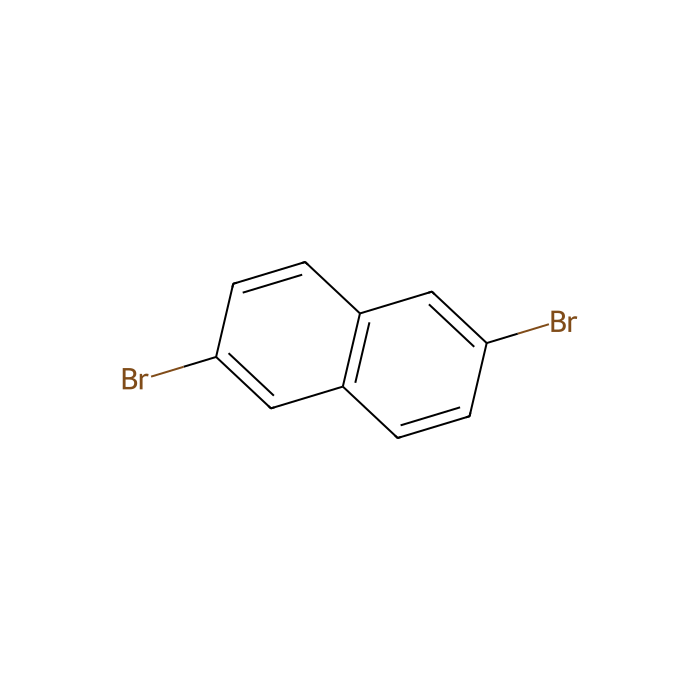
Brief overview: 2,6-Dibromonaphthalene is a dihalogenated polycyclic aromatic hydrocarbon featuring a naphthalene core substituted with bromine atoms at the 2- and 6-positions; it serves as a robust aryl bromide building block for cross-coupling chemistry.
Item-specific (from Product Data)
SKU: D130106
Product name: 2,6-Dibromonaphthalene
CAS: 13720-06-4
PubChem CID: 640591
InChIKey: 279461 (as provided)
Storage conditions: Room temperature
Shipped in: Normal
Literature/Computed identity (for reference; not Aladdin specifications)
Core: Naphthalene bicyclic aromatic system (two fused benzene rings).
Substitution pattern: Bromine atoms at positions 2 and 6 (peri-disposed across the ring junction), enabling differential reactivity and potential for sequential functionalization.
Functional groups: Two aryl–bromide bonds (good leaving groups in Pd- and Ni-catalyzed cross-couplings; amenable to halogen–lithium exchange with strong organolithiums).
2D description in words: Two fused six-membered rings (naphthalene); count carbons from one ring junction—bromine substituents appear ortho to each junction on opposite ring carbons (C2 and C6), giving a symmetrical, para-like relationship across the naphthalene long axis.
Stereochemistry: None (achiral, planar aromatic).
Synthetic Utility
Reactivity and strategic value
Dual aryl bromides: Two C(sp2)–Br bonds make it an excellent platform for iterative or tandem C–C/C–N bond formation. The 2,6-pattern imparts rigidity and linear extension across the naphthalene long axis—advantageous for conjugated materials and ligand backbones.
Cross-coupling manifold: Compatible with Suzuki–Miyaura (boron partners), Sonogashira (terminal alkynes), Buchwald–Hartwig (amines), Negishi (organozincs), and Kumada (Grignards). Symmetry simplifies product distributions in bis-couplings.
Metal–halogen exchange: tBuLi or nBuLi at −78 to −40 °C effects Br–Li exchange; subsequent quench with electrophiles (CO2 → diacids; DMF → dialdehydes; B(OMe)3 → diboronates; Me3SiCl → disilylation). Sequential exchange enables unsymmetrical substitution with appropriate protecting/directing strategies.
Electrophilic substitutions: Further halogenation or nitration at remaining ring positions is attenuated but possible under forcing conditions; radical bromination on benzylic positions is inapplicable (no benzylic C–H present).
Applications
Materials chemistry: Precursor to 2,6-diaryl/diethynyl naphthalenes used in OLED/OPV emitters/transport layers and in porous organic frameworks.
Ligand synthesis: Platform for chelating diamines/diimines and pincer-type architectures after functionalization.
Polycondensation: Step-growth routes to ladder or linear polymers via bis-coupling with diboronic esters/diynes.
Practical notes
Catalyst/ligand selection tunes mono- vs bis-functionalization; monitor by LC/MS to avoid over- or under-coupling.
Heat and solubility: Use higher-boiling aromatics or polar ethers to maintain homogeneity during bis-coupling.
Target Specificity
Not applicable. This product is a small-molecule aromatic building block and is not an antibody, probe, or biological targeting reagent. No antigen/epitope, species reactivity, clone, or isotype information applies.
We use cookies to ensure the website functions properly and, where permitted, to improve your experience. You can manage your preferences at any time in Settings. Learn more in our Cookie Policy.
Shall we send you a message when we have discounts available?
Remind me later
Thank you! Please check your email inbox to confirm.
Products are supplied to verified businesses, institutions, and qualified professionals for research and development use only. Not for use in humans, animals, diagnosis, or therapy.

 D1409024