This compound belongs to the class of organic compounds known as n-acetylarylamines. These are acetamides where one or more amide hydrogens is substituted by an aryl group.
External Descriptors
Not available
1. Djoumbou Feunang Y, Eisner R, Knox C, Chepelev L, Hastings J, Owen G, Fahy E, Steinbeck C, Subramanian S, Bolton E, Greiner R, and Wishart DS. ClassyFire: Automated Chemical Classification With A Comprehensive, Computable Taxonomy. Journal of Cheminformatics, 2016, 8:61.
Determine the necessary mass, volume, or concentration for preparing a solution.
Dilution Calculator
Determine the dilution needed to prepare a stock solution.
Reconstitution Calculator
Avis
Avis des clients
Application Protocols
No vendor-validated biological assay protocols are associated with this small-molecule building block in the Product Data.
General laboratory protocols (guidance only)
Weighing/dissolution: Weigh in a fume hood to avoid dust; dissolve first in a minimal volume of a polar aprotic solvent (e.g., DMSO or DMF), then dilute with the desired medium.
Recrystallization: Common systems include EtOH, IPA, or EtOAc/hexanes; seed if necessary to control crystallite size.
Reaction setup: For air/moisture-sensitive steps (e.g., lithiation), employ oven-dried glassware, inert gas (N2/Ar), and anhydrous solvents.
For application-specific, detailed procedures, consult primary literature pertaining to the intended transformation of the thiazole scaffold.
Biological Roles
Item-specific biological roles: Not specified for this item; refer to primary literature if needed. This product is supplied strictly for research use only.
General context (literature)
The thiazole ring is a common motif in bioactive molecules, including being part of the thiamine (vitamin B1) scaffold and numerous small-molecule ligands. Substituted thiazoles interact in biological systems through heteroatom coordination and π–π/π–cation interactions.
Acylation of an anilinic/azolic amine (as in 2-acetamidothiazole) reduces basicity and hydrogen-bonding donor strength, which can attenuate nonspecific binding and modulate permeability and metabolic stability in medicinal chemistry campaigns.
2-Acetamidothiazole itself is often used as a protected intermediate rather than a final bioactive entity, enabling selective transformations on the thiazole core prior to unveiling the more reactive 2-aminothiazole.
ADME-relevant properties (general trends; not item-specific)
Neutral amide functionality may decrease passive diffusion relative to the free amine but can enhance chemical stability.
The thiazole nitrogen and sulfur provide polar surface area and potential metabolic soft spots (oxidation on sulfur, N-oxidation, or ring hydroxylation) depending on substitution.
No therapeutic or diagnostic claims are implied; use is limited to research applications.
Buffer Applications
2-Acetamidothiazole is not a conventional buffering agent. It lacks a well-defined, practical pKa pair separated by ~2 units that would make it suitable for preparing laboratory buffers.
Applicability
Not typically used to prepare pH buffers for biochemical assays or electrophoresis.
If present in aqueous systems, it should be considered a solute or reagent under investigation rather than a buffering component.
For solution preparation guidance (solubility, cosolvents), see the Solvent Selection and Storage & Reconstitution sections.
Green Alternatives
While 2-acetamidothiazole itself is a substrate/building block rather than a solvent, greener choices can be made for its synthesis, transformations, and handling.
Solvent substitutions (general guidance)
Replace DMF/NMP with alternatives such as Cyrene, propylene carbonate, or ethanol/water mixtures when reaction compatibility permits.
For organolithium/lithiation steps traditionally in THF, consider 2-MeTHF or CPME for lower peroxide risk and improved sustainability.
Reagent and process choices
Use greener acylation protocols (e.g., acetic anhydride with catalytic DMAP in ethyl acetate) rather than acid chlorides in chlorinated solvents.
Favor aqueous workups minimizing halogenated waste; apply crystallization-induced purification instead of silica-intensive chromatography when feasible.
Small comparison (general; illustrative)
| Use case | Conventional | Greener option | Trade-offs |
|---|---|---|---|
| Polar aprotic dissolution | DMF/NMP | Cyrene, PC, EtOAc/EtOH cosolvents | Solubility may be lower; temperature may need to be raised |
| Lithiation medium | THF | 2-MeTHF/CPME | Reaction rates/temperatures may need tuning |
| Recrystallization | Acetone/CH2Cl2 | EtOAc, EtOH, IPA | Evaporation energy use vs yield/purity |
Apply process mass intensity (PMI) tracking and solvent recovery to improve overall sustainability.
Pharmaceutical Uses
Item-specific pharmacopeial status: Not specified for this item; refer to CoA/Spec Sheet.
General formulation/manufacturing context (no therapeutic claims)
2-Acetamidothiazole is commonly employed as a protected intermediate in the synthesis of thiazole-containing active pharmaceutical ingredients (APIs) and advanced intermediates. The acetyl group moderates reactivity during multi-step sequences and can be removed under controlled hydrolysis.
Utility in impurity/isotope standards: The defined structure and stability make it suitable as a reference or process intermediate standard in development and quality investigations for thiazole-based APIs.
Solid-form considerations: As a crystalline organic amide, it is amenable to purification by recrystallization; polymorphism is possible in principle for aromatic amides and should be assessed during process development if relevant.
Manufacturing best practices (general)
Implement ICH-compliant impurity profiling (residual solvents, related substances) for routes employing this intermediate.
Ensure tight control of hydrolytic conditions during downstream steps to avoid premature deprotection.
This product is supplied for research and process development use only and is not intended for human or veterinary use.
Physical Properties
Item-specific specifications
Appearance: Not specified for this item; refer to CoA/Spec Sheet.
Grade/Purity: Not specified for this item; refer to CoA/Spec Sheet.
Literature/typical properties (for general reference only; not specifications for this item)
Physical state: Typically an off-white to light tan crystalline solid
Acid–base behavior: The amide is weakly basic/neutral; the thiazole ring has modest basicity at N but is largely neutral under physiological pH. Overall, the compound behaves as a neutral, polar heteroaromatic amide.
Solubility profile: Often sparingly soluble in water; soluble in polar aprotic organics (e.g., DMSO, DMF) and in alcohols upon warming; limited solubility in nonpolar hydrocarbons
Hydrogen-bonding: Capable of H-bond donation (amide NH) and acceptance (amide carbonyl; thiazole N)
UV characteristics: Conjugated heteroaromatic ring gives UV absorption in the near-UV; exact λmax depends on solvent and concentration (literature)
Practical notes
Pulverization improves dissolution in high-boiling polar solvents
Avoid strong bases if hydrolysis of the acetamide is undesired; prolonged heating in aqueous base can liberate 2-aminothiazole (literature)
For analytical work, DMSO-d6 or DMF-d7 typically affords clean NMR spectra for this scaffold.
Quality and Grades
Item-specific quality
Grade/Purity: Not specified for this item; refer to CoA/Spec Sheet.
How to interpret grades (general guidance)
Analytical/AR grade: Typically suitable for quantitative analytical work; tighter limits on metal/ionic/organic impurities.
Reagent grade: Suitable for most synthetic applications; broader impurity profile.
HPLC/Chromatography grade: Emphasis on low UV-absorbing impurities and particulate control.
Impurity considerations for 2-acetamidothiazole (general)
Potential impurities include unreacted 2-aminothiazole, over-acylated or O-acylated species, and residual acylating agents or solvents. Heteroaromatic sulfur compounds can carry trace odor-active impurities; proper drying/finishing minimizes these.
Analytical control: 1H/13C NMR, HPLC purity, LC–MS for mass confirmation, and IR (amide C=O, thiazole signatures). Elemental analysis can corroborate composition if needed.
Stabilizers/additives
None are typically required for this scaffold; if any stabilizer or inhibitor is present for this specific lot, it will be stated on the CoA/SDS. For this item: Not specified for this item; refer to CoA/Spec Sheet.
Always consult the lot-specific CoA for exact assay, impurity limits, and residual solvent data.
Protecting the 2-aminothiazole as an acetamide: The acetyl group tempers nucleophilicity and basicity, enabling selective functionalization of the thiazole ring (e.g., electrophilic substitution or metalation at C5) without competing N-alkylation.
Precursor to 2-aminothiazole: Controlled hydrolysis (acidic or basic, aqueous–organic) regenerates the free amine, allowing a protect–functionalize–deprotect sequence on the thiazole core.
Cross-coupling routes: Halogenation at C5 followed by Suzuki, Stille, Negishi, or Buchwald–Hartwig (for N-arylation after deprotection) to build thiazole-rich libraries.
Acyl transfer chemistry: Though the amide is generally robust, activated variants (e.g., conversion to acid chloride or imidazole carbamate analogs) can be used to pivot to alternate N-protecting groups.
Named/related transformations (general)
Directed lithiation at C5 using strong bases (e.g., LDA, s-BuLi) in THF at low temperature; subsequent trapping with electrophiles.
Vilsmeier-type formylation on activated thiazoles to deliver 5-formyl derivatives, downstream convertible to alcohols, acids, or heteroannulated systems.
Pd-catalyzed C–H functionalization methods on azoles (literature) can sometimes be adapted when directing effects of the amide are leveraged.
Practical tips
Maintain anhydrous conditions for organometallic steps; the amide can chelate metals—adjust base stoichiometry accordingly.
Monitor for amide hydrolysis under strongly basic or acidic, high-temperature conditions if acetyl protection must be retained.
Reaction Conditions
The following are general literature-guided conditions for transformations involving 2-acetamidothiazole; they are not specifications for this item.
Halogenation at C5 (to enable cross-coupling)
Reagents: NBS or NCS in DMF, AcOH, or MeCN; control temperature to limit polyhalogenation.
Workup: Quench with aqueous sodium thiosulfate; purify by recrystallization or chromatography.
Directed lithiation/electrophile trapping
Base/solvent: s-BuLi or LDA in dry THF or 2-MeTHF at low temperature (e.g., −78 to −40 °C). The amide can coordinate and modestly direct lithiation to C5.
Electrophiles: DMF (formylation), CO2 (carboxylation), alkyl/allyl halides (alkylation), chlorophosphines (P–C bond formation).
Hydrolysis (deprotection to 2-aminothiazole)
Acidic: Aqueous HCl or H2SO4, reflux, with water-miscible cosolvent to aid dissolution.
Basic: Aqueous NaOH/KOH with EtOH/H2O, controlled temperature to avoid ring degradation.
Cross-coupling (after 5-halogenation)
Suzuki–Miyaura: Pd(0/II) catalyst, base (e.g., K2CO3, Cs2CO3), dioxane/water or toluene/EtOH/water mixtures; temperatures typically elevated.
Stille/Negishi: Appropriate organostannane or organozinc partners in polar aprotic solvents; inert atmosphere.
Purification and handling
Favor recrystallization when possible; for chromatography, use buffered eluents to prevent tailing of the amide-containing heteroaromatic.
Drying: Vacuum at moderate temperature to remove high-boiling solvents (DMF/DMSO) without risking amide cleavage.
Safety and Handling
Item-specific hazard information
Signal word: Not specified for this item; refer to SDS.
H-statements: Not specified for this item; refer to SDS.
GHS classification/pictograms: Not specified for this item; refer to SDS.
General safety guidance (literature/general; not a substitute for SDS)
Likely low volatility solid; manage as a laboratory chemical of unknown toxicity. Avoid inhalation of dust, skin contact, and eye exposure.
PPE: Laboratory coat, safety glasses, and appropriate gloves (e.g., nitrile). Use a fume hood during weighing and transfers to minimize dust exposure.
Incompatibilities: Strong oxidizers may attack the heteroaromatic ring; strong bases and acids can promote amide hydrolysis under forcing conditions.
First aid (general): In case of skin or eye contact, rinse with water for at least 15 minutes and remove contaminated clothing. If inhaled, move to fresh air. If ingested, rinse mouth; do not induce vomiting; seek medical attention. Always follow institutional protocols.
Fire response: Use CO2, dry chemical, or foam. Combustion may release nitrogen-, sulfur-, and carbon-oxides; firefighters should wear SCBA.
Waste disposal
Collect in halogen-free organic waste unless a specific stream is mandated locally. Dispose according to institutional and regulatory requirements.
Consult the current SDS for authoritative hazard, exposure limits, and response guidance.
Solvent Selection
2-Acetamidothiazole is a polar, heteroatom-rich aromatic amide. Solvent selection is often driven by the need to balance polarity for dissolution with chemical stability of the amide.
Polarity and miscibility (general)
Polar aprotic solvents (DMSO, DMF, NMP): Excellent solubilizers; favored for spectroscopy, coupling reactions, and SNAr on pre-halogenated derivatives.
Alcohols (MeOH, EtOH, i-PrOH): Moderate solubility; useful for recrystallization and some condensations; avoid strong base if amide cleavage is a concern.
Water: Typically low solubility; cosolvent systems (water/DMF, water/MeOH) can help in bioconjugation-mimetic or enzymatic studies.
Nonpolar solvents (toluene, heptane): Poor solubility; occasionally employed for azeotropic drying or crystallizations from mixed solvents.
Practical selection tips
For N-acyl stability: Choose neutral to mildly acidic media; avoid prolonged exposure to concentrated base at elevated temperature.
For metalation at C5 (via directed lithiation of the thiazole): Use anhydrous ethers (THF, 2-MeTHF) at low temperature with strong bases; the amide can coordinate metals and influence reactivity.
Purification: Recrystallization from alcohols or alcohol/ether mixtures is commonly effective; reverse-phase preparative HPLC can resolve closely related impurities when needed.
Small comparison (general)
DMSO vs DMF: DMSO offers higher solvating power; DMF can be easier to remove. 2-MeTHF may be considered for greener organometallic steps where solubility allows.
Storage and Reconstitution
Item-specific storage and shipping
Storage Conditions: Room temperature (per Product Data)
Shipped In: Normal (per Product Data)
General storage guidance
Keep container tightly closed in a dry, well-ventilated area. Protect from prolonged exposure to strong light and elevated humidity to minimize hydrolysis risk over long periods.
If transferring to working vials, use clean, dry containers; flush headspace with inert gas for long-term storage if frequent openings are expected.
Reconstitution and solution handling (general)
Stock solutions: Prepare in dry DMSO or DMF for highest concentration; alternatively in ethanol or methanol if compatible. Filter through 0.2 µm PTFE syringe filter for analytical use.
Aqueous use: Employ cosolvent (e.g., 5–20% DMSO or ethanol) to aid dissolution; adjust pH only if the chemistry tolerates it—avoid strong base to prevent amide cleavage under heat.
Storage of solutions: Store organic stock solutions at 2–8 °C when possible and use within a few weeks; minimize freeze–thaw by aliquoting. Avoid long-term storage of aqueous solutions unless stability has been verified.
Stability notes
The acetamide is generally stable to neutral conditions; hydrolysis can occur under strong acid/base at elevated temperatures. Always verify solution stability by LC–MS/HPLC for critical applications.
Structure and Identity
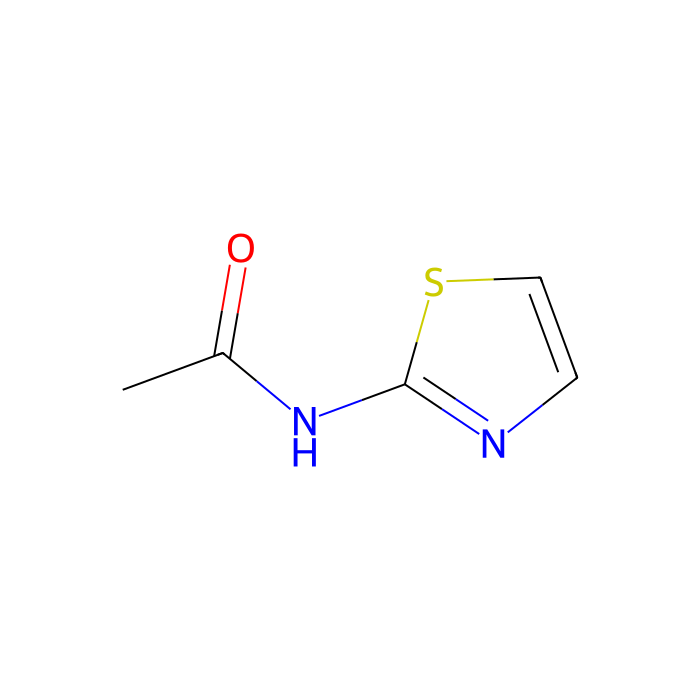
2-Acetamidothiazole is an acylated 2-aminothiazole, featuring a thiazole ring bearing an acetamide substituent at C2.
Item-specific identifiers (from Product Data)
CAS: 2719-23-5
InChIKey: Not specified for this item; refer to CoA/Spec Sheet. (Product Data field provided is non-standard)
SMILES: Not specified for this item; refer to CoA/Spec Sheet.
Literature identity (general reference information, not item-specific specifications)
Heteroaromatic 1,3-azole ring containing one nitrogen (N1) and one sulfur (S1)
Amide functional group (acetamide) bonded to the ring at the 2-position via the amide nitrogen
Planar, conjugated system; the amide is conjugated with the thiazole ring, reducing basicity of the amide nitrogen
No stereocenters; single tautomeric/aromatic form predominates under neutral conditions
2D description in words
A five-membered thiazole ring (S and N incorporated) bearing an acetamide substituent at C2: CH3–CO–NH–(thiazol-2-yl).
Synthetic Utility
Functional groups and reactivity (general)
Amide (acetamide): Robust under many conditions; attenuates nucleophilicity of the ring-bound nitrogen; can be hydrolyzed to reveal 2-aminothiazole.
Thiazole ring: Electron-deficient heteroaromatic system; C5 is typically the most reactive site for electrophilic substitution and metalation.
Strategic roles in synthesis
Protect–functionalize–deprotect: Use the acetyl group to mask the amine while performing C5 functionalization, annulations, or cross-couplings, then deprotect.
Handle for diversification: Convert to 5-halo derivatives (via NBS/Br2 or electrophilic halogenation) followed by Pd-catalyzed cross-couplings to build libraries of 2-acetamidothiazole analogs.
Heteroaryl–heteroaryl linkages: As a thiazole partner in Suzuki (with thiazolyl boronates) or Stille/Negishi variants to assemble biheteroaryl scaffolds.
Downstream transformations (examples, literature)
Vilsmeier–Haack formylation at C5; subsequent reduction or Wittig/HWE olefination.
Directed lithiation at C5 with LDA/s-BuLi, then trapping with electrophiles (CO2, DMF, alkyl halides) to access acids, aldehydes, or alkylated products.
Amide exchange: Transacylation or conversion to alternate protecting groups (e.g., Boc, Cbz via deprotection/reprotection sequences) to align with route needs.
Analytical handles
IR: Amide C=O ~1650–1690 cm−1; ring C=N/C–S stretches characteristic of thiazoles.
NMR: Downfield amide NH; thiazole protons typically appear in the aromatic region with distinctive coupling patterns.
Target Specificity
This product is a small-molecule heteroaromatic building block and does not possess biological “target specificity” in the sense used for biomolecules (e.g., antibodies, enzymes).
Item-specific targeting data: Not applicable; none provided in Product Data.
Use context: Employed as a chemical intermediate or research reagent; any biological targeting arises only after further derivatization into designed ligands.
For bioassay development or ligand design, consult literature on thiazole-containing scaffolds specific to your target of interest.
Foire aux questions
What is the purity of this product?
This product is supplied at ≥98% purity (chemical assay). Lot-specific values are stated on the Certificate of Analysis.
How should this product be stored?
Store at room temperature.
How is this product shipped?
This product ships under standard ambient conditions. No temperature-controlled packaging is required.
What are the CAS number, molecular formula and molecular weight?
The CAS Number is 2719-23-5, the molecular formula is C5H6N2OS, and the molecular weight is 142.18 g/mol. InChIKey WXPLRSVMGRAIGW-UHFFFAOYSA-N.
What documentation is provided?
Available product documentation, including Certificates of Analysis (COA), Safety Data Sheets (SDS), and specification sheets, is shown in the product document area. Document availability and access follow the current site policy.
Nous utilisons des cookies pour garantir le bon fonctionnement du site et, lorsque cela est autorisé, pour améliorer votre expérience. Vous pouvez gérer vos préférences à tout moment dans les Paramètres. Pour en savoir plus, consultez notre Politique relative aux cookies.
Souhaitez-vous que nous vous envoyions un message lorsque des réductions seront disponibles?
Me rappeler plus tard
Merci ! Veuillez vérifier votre boîte de réception e-mail pour confirmer.
Products are supplied to verified businesses, institutions, and qualified professionals for research and development use only. Not for use in humans, animals, diagnosis, or therapy.

 L1713128