Determine the necessary mass, volume, or concentration for preparing a solution.
Taxonomy Tree
| Kingdom | Organic compounds |
|---|---|
| Superclass | Organic oxygen compounds |
| Classe | Organooxygen compounds |
| Subclass | Ethers |
| Intermediate Tree Nodes | Not available |
| Direct Parent | Alkyl aryl ethers |
| Alternative Parents | 2-halopyridines Aryl chlorides Heteroaromatic compounds Azacyclic compounds Organopnictogen compounds Organonitrogen compounds Organochlorides Hydrocarbon derivatives |
| Molecular Framework | Aromatic heteromonocyclic compounds |
| Substituents | 2-halopyridine - Alkyl aryl ether - Pyridine - Aryl halide - Aryl chloride - Heteroaromatic compound - Azacycle - Organoheterocyclic compound - Organic nitrogen compound - Organopnictogen compound - Hydrocarbon derivative - Organonitrogen compound - Organochloride - Organohalogen compound - Aromatic heteromonocyclic compound |
| Description | This compound belongs to the class of organic compounds known as alkyl aryl ethers. These are organic compounds containing the alkyl aryl ether functional group with the generic formula R-O-R' , where R is an alkyl group and R' is an aryl group. |
| External Descriptors | Not available |
Find and download the COA for your product by matching the lot number on the packaging.
| Lot Number | Certificate Type | Date | Article |
|---|---|---|---|
| Certificate of Analysis | Oct 30, 2025 | C115751 | |
| Certificate of Analysis | Jul 16, 2024 | C115751 | |
| Certificate of Analysis | Jun 12, 2024 | C115751 | |
| Certificate of Analysis | Jun 12, 2024 | C115751 | |
| Certificate of Analysis | Jun 12, 2024 | C115751 | |
| Certificate of Analysis | Jun 12, 2024 | C115751 | |
| Certificate of Analysis | Apr 08, 2023 | C115751 | |
| Certificate of Analysis | Apr 08, 2023 | C115751 | |
| Certificate of Analysis | Apr 08, 2023 | C115751 | |
| Certificate of Analysis | Apr 08, 2023 | C115751 | |
| Certificate of Analysis | Apr 08, 2023 | C115751 | |
| Certificate of Analysis | Apr 08, 2023 | C115751 | |
| Certificate of Analysis | Apr 08, 2023 | C115751 | |
| Certificate of Analysis | Apr 08, 2023 | C115751 | |
| Certificate of Analysis | Apr 08, 2023 | C115751 | |
| Certificate of Analysis | Feb 16, 2022 | C115751 |
| Indice de réfraction | 1.528 |
|---|---|
| Point d'éclair (°F) | 168.8 °F |
| Point d'éclair (°C) | 76 °C |
| Point d'ébullition (°C) | 185-186°C |
| Poids moléculaire | 143.57 |
| XLogP3 | 3.000 |
| Hydrogen Bond Donor Count | 0 |
| Hydrogen Bond Acceptor Count | 2 |
| Rotatable Bond Count | 1 |
| Exact Mass | 143.014 Da |
| Monoisotopic Mass | 143.014 Da |
| Topological Polar Surface Area | 22.100 Ų |
| Heavy Atom Count | 9 |
| Formal Charge | 0 |
| Complexity | 89.100 |
| Isotope Atom Count | 0 |
| Defined Atom Stereocenter Count | 0 |
| Undefined Atom Stereocenter Count | 0 |
| Defined Bond Stereocenter Count | 0 |
| Undefined Bond Stereocenter Count | 0 |
| The total count of all stereochemical bonds | 0 |
| Covalently-Bonded Unit Count | 1 |
H315:Causes skin irritation
H319:Causes serious eye irritation
H335:May cause respiratory irritation
P261:Avoid breathing dust/fume/gas/mist/vapors/spray.
P264:Wash hands [and …] thoroughly after handling.
P271:Use only outdoors or in a well-ventilated area.
P280:Wear protective gloves/protective clothing/eye protection/face protection.
P321:Specific treatment (see ... on this label).
P302+P352:IF ON SKIN: wash with plenty of water.
P304+P340:IF INHALED: Remove person to fresh air and keep comfortable for breathing.
P305+P351+P338:IF IN EYES: Rinse cautiously with water for several minutes. Remove contact lenses if present and easy to do - continue rinsing.
P362+P364:Take off contaminated clothing and wash it before reuse.
P405:Store locked up.
P403+P233:Store in a well-ventilated place. Keep container tightly closed.
P501:Dispose of contents/container to an approved waste disposal plant.
P264+P265:Wash hands [and …] thoroughly after handling. Do not touch eyes.
P337+P317:If eye irritation persists: Get medical help.
P332+P317:If skin irritation occurs: Get medical help.
P319:Get medical help if you feel unwell.
Not applicable. No validated bioassay protocols (e.g., WB, IHC, IF, FC) are associated with a small-molecule building block. For synthetic usage, see Reaction Conditions and Synthetic Utility for general procedural guidance.
This compound is a synthetic heteroaromatic building block and is not known as a natural metabolite or cofactor.
General context (non-clinical, literature-based):
No biological activity or roles are claimed for this specific item. Any assessments of ADME, target engagement, or toxicity must be generated within the user’s own research framework and are outside the scope of this catalog entry.
Not typically applicable. 2-Chloro-6-methoxypyridine is a neutral/weakly basic organic building block and is not used as a buffer component. For aqueous work, select established buffering systems (e.g., phosphate, acetate, Tris) appropriate to your application. See Reaction & Applications and Synthetic Utility for relevant usage.
This product is a building block rather than a process solvent; green considerations focus on reaction media and coupling strategies rather than replacing the reagent itself.
Greener media choices (general guidance):
Comparison (illustrative):
Process-intensification tips:
No excipient or pharmacopeial status is specified for this item; refer to CoA/Spec Sheet if formulation-related attributes are needed.
General context (non-clinical):
Use strictly for research and development. No therapeutic claims are made or implied.
Item-specific specifications: Not specified for this item; refer to CoA/Spec Sheet.
Literature/general properties (for context only, not product specifications):
Practical notes (general):
Always verify exact values (bp, mp, density, nD, logP, pKa) from primary literature or the item’s CoA before method development.
Item-specific grade/purity: Not specified for this item; refer to CoA/Spec Sheet for actual assay, impurity profile, and limits.
Guidance on typical grades (general, for context):
Stabilizers/inhibitors:
Release/trace analytics (what to look for on the CoA):
As a 2-chloropyridine bearing a 6-methoxy substituent, this reagent is a versatile building block for heteroaryl elaboration.
Typical applications (literature/general):
Use cases:
General literature guidance (illustrative conditions; optimize per substrate and not product specifications):
Suzuki–Miyaura at C2–Cl:
Buchwald–Hartwig amination:
SNAr (amines/alkoxides):
Demethylation to phenol:
Tips:
Item-specific hazard statements/classification: Not specified for this item; refer to SDS for authoritative information.
General GHS considerations for chlorinated pyridines (informational, not product-specific):
Recommended PPE/controls (good lab practice):
First aid (general guidance; defer to SDS):
Spills and waste:
Special risks/notes:
Not a solvent; this product is a heteroaromatic building block. However, choosing appropriate solvents is critical for its handling, purification, and reactions.
General solvent compatibility and selection (literature/practice):
When to choose alternatives:
Item-specific storage/shipping (from Product Data):
General handling and stability (literature/practice):
Reconstitution: Not applicable; supplied neat. If preparing stock solutions for screening, use dry, oxygen-free solvents when required (e.g., anhydrous DMSO, MeCN, or toluene), filter through PTFE syringe filter (0.2 µm) if particulates are present, and record exact concentration gravimetrically.
Research Use Only: As stated by the manufacturer, for research use only. Consult the product’s CoA/SDS for any additional storage or stability constraints specific to your lot.
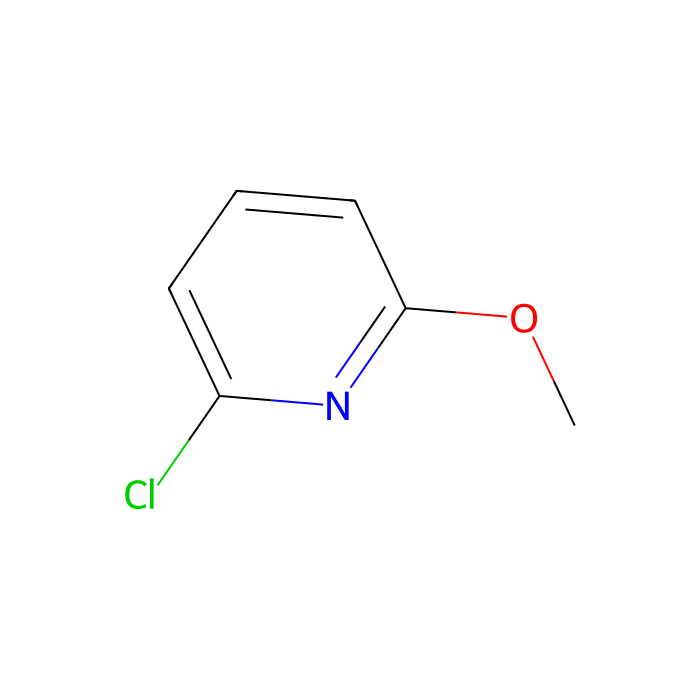
Brief description: 2-Chloro-6-methoxypyridine is a heteroaromatic pyridine derivative bearing a chloro substituent at C2 (ortho to the ring nitrogen) and a methoxy substituent at C6 (the other ortho position). The ring nitrogen and the electron-withdrawing/–donating substituents create a distinct electronic profile useful in cross-coupling and SNAr chemistry.
Item-specific facts (from Product Data):
Literature/general identifiers and composition (not item-specific):
Notes:
Key functional elements and reactivity (literature/general):
Representative transformations:
Retrosynthetic value:
Not applicable. This product is a small-molecule chemical building block, not a biological targeting reagent. No antigen/epitope or species reactivity is relevant.