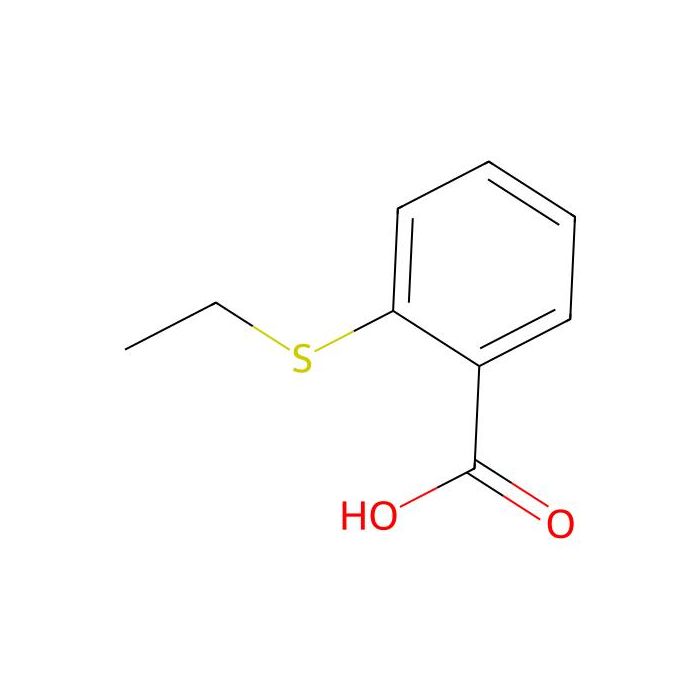
This compound belongs to the class of organic compounds known as o-sulfanylbenzoic acids. These are benzoic acids which bear a sulfanyl group (R-SH) attached to the benzene ring at positions 1 and 2, respectively.
External Descriptors
Not available
1. Djoumbou Feunang Y, Eisner R, Knox C, Chepelev L, Hastings J, Owen G, Fahy E, Steinbeck C, Subramanian S, Bolton E, Greiner R, and Wishart DS. ClassyFire: Automated Chemical Classification With A Comprehensive, Computable Taxonomy. Journal of Cheminformatics, 2016, 8:61.
Certificats (CoA, COO, BSE/TSE et tableau d'analyse)
C of A & Other Certificates(BSE/TSE, COO):
Analytical Chart:
Propriétés chimiques et physiques
Poids moléculaire
182.240 g/mol
XLogP3
2.300
Hydrogen Bond Donor Count
1
Hydrogen Bond Acceptor Count
3
Rotatable Bond Count
3
Exact Mass
182.04 Da
Monoisotopic Mass
182.04 Da
Topological Polar Surface Area
62.600 Ų
Heavy Atom Count
12
Formal Charge
0
Complexity
159.000
Isotope Atom Count
0
Defined Atom Stereocenter Count
0
Undefined Atom Stereocenter Count
0
Defined Bond Stereocenter Count
0
Undefined Bond Stereocenter Count
0
The total count of all stereochemical bonds
0
Covalently-Bonded Unit Count
1
Calculateurs de solution
Molarity Calculator
Determine the necessary mass, volume, or concentration for preparing a solution.
Dilution Calculator
Determine the dilution needed to prepare a stock solution.
Reconstitution Calculator
Avis
Avis des clients
Application Protocols
No validated bioassay or immunoassay protocols are associated with this small-molecule reagent in the product data. Typical usage follows standard organic synthesis protocols, as outlined in Reaction Conditions and Synthetic Utility.
For analytical characterization, standard methods include 1H/13C NMR, HRMS/LC-MS, IR (carboxyl C=O ~1680–1720 cm−1, literature), and HPLC for purity determination.
Biological Roles
This compound is a synthetic aryl carboxylic acid containing a thioether; it is not known as a natural metabolite.
General context (literature):
Benzoic acid derivatives can interact with metabolic enzymes (e.g., via conjugation to glycine or glucuronidation) when studied in biochemical systems; however, specific biological roles for 2-(ethylsulfanyl)benzoic acid have not been established.
Thioethers can undergo metabolic oxidation to sulfoxides/sulfones in biological settings; such transformations are often modeled in medicinal chemistry to modulate ADME properties.
Research relevance:
Useful as a chemical probe precursor: adjusting sulfur oxidation state (thioether → sulfoxide → sulfone) systematically alters polarity and hydrogen-bond acceptor capacity for SAR studies.
No clinical or therapeutic claims are made. For research use only (per product data).
Buffer Applications
Not typically used as a buffer component. As an aryl carboxylic acid, it has limited aqueous solubility at neutral pH and lacks the pKa/solubility profile desirable for standard biological buffer systems.
Practical note: If dissolution in aqueous systems is required for assays, transient solubilization can be achieved by preparing a dilute basic stock (e.g., NaOH) to form the carboxylate, followed by appropriate dilution and pH adjustment. Ensure compatibility with the biological system and avoid precipitation upon neutralization.
Green Alternatives
While this is a solid reagent rather than a volatile solvent, greener practice focuses on solvent and reagent choices during its use.
Comparison of common choices (literature/general):
Coupling solvents and reagents:
Conventional: DMF, DCM; reagents like DCC/HOBt or SOCl2 for acid chlorides.
Greener alternatives: 2-MeTHF or CPME in place of DCM/THF; EtOAc or MeCN as lower-toxicity options. For coupling, prefer EDC·HCl with catalytic DMAP in EtOAc or MeCN; avoid explosive HOBt—use OxymaPure instead.
Oxidations at sulfur:
Conventional: mCPBA in DCM.
Greener: Oxone (KHSO5) in MeOH/H2O or MeCN/H2O; H2O2 with acetic acid or tungstate catalysts can minimize chlorinated waste.
Workup and purification:
Replace brine-heavy wash schemes with minimal aqueous washes when possible; consider crystallization over chromatography to reduce solvent consumption.
Trade-offs:
2-MeTHF/CPME improve safety and often allow easier phase separations but may change reaction rates/solubility compared with DCM/THF.
Oxone/H2O2 systems are greener but may offer different selectivity (over-oxidation to sulfone); careful control of equivalents and temperature is needed.
Pharmaceutical Uses
No pharmacopeial excipient status or formulation role is specified for this item. It is best considered a synthetic intermediate/building block in medicinal chemistry and process development.
Potential roles (general, non-clinical):
Intermediate for preparing amide/ester derivatives during lead optimization campaigns.
Scaffold enabling sulfur oxidation state variation (thioether/sulfoxide/sulfone) to tune physicochemical properties.
No medical or clinical claims are made. For research and laboratory use only (per product data).
Physical Properties
Item-specific specifications are not provided in the product data and should be confirmed on the CoA/Spec Sheet.
Appearance: Not specified for this item; refer to CoA/Spec Sheet.
Melting point: Not specified for this item; consult literature sources or CoA.
Boiling point/decomposition: Not specified for this item; consult literature sources or CoA.
Density: Not specified for this item; refer to CoA/Spec Sheet.
Water: low solubility at neutral pH typical of aryl carboxylic acids; increased solubility in basic aqueous media as the carboxylate salt.
Organic solvents: expected to be soluble in polar aprotic (DMF, DMSO, DMAc), moderately soluble in chlorinated (DCM, CHCl3) and esters (EtOAc); variably soluble in alcohols (MeOH/EtOH) depending on temperature.
pKa (carboxylic acid, literature trend): aryl carboxylic acids typically pKa 4.0–4.6; ortho thioether substituent may slightly modulate acidity. Exact value not verified for this compound.
LogP (qualitative, literature trend): expected moderate lipophilicity due to thioether; exact value not verified.
Refractive index: Not applicable/typically not reported for solids; not specified.
Notes:
Thioethers are air-stable but can oxidize on prolonged exposure to strong oxidants or peroxides.
For quantitative properties (mp, purity, elemental analysis), use the lot-specific CoA.
Quality and Grades
Grade/Purity: Not specified for this item; refer to CoA/Spec Sheet for assay, residual solvents, and impurity profile.
Stabilizers/Inhibitors: Not specified for this item; thioethers generally do not require stabilizers but can slowly oxidize—see storage guidance.
Interpreting typical grades (general, for context):
Analytical grade/AR: suitable for most analytical and synthetic work; impurities typically controlled to low levels.
≥98–99% purity: commonly used for precision synthesis; lower UV background for analytical applications.
HPLC grade (solvents) or LC-MS grade (where applicable): indicates low nonvolatile residue and low background; not directly relevant to this solid reagent unless dissolved for analysis.
What to check on the CoA for this item:
Identity confirmation (1H/13C NMR, MS) and assay.
Residual solvents, water (KF), and inorganic residue (if reported).
Any specified limits on oxidized sulfur impurities (sulfoxide/sulfone), which can arise from storage or handling.
Lot-specific recommendations for storage and retest/expiry dating.
Reaction and Applications
As an ortho-thioether-substituted benzoic acid, this building block offers dual reactivity at the acid and sulfur sites.
Carboxylic acid transformations:
Esterification (Fischer, acid-catalyzed) to access aryl esters; good handles for further cross-coupling or reductions.
Amide bond formation via carbodiimides (EDC/DIC), uronium reagents (HATU/HBTU), or acid chloride intermediates (SOCl2, Oxalyl chloride) for fragment coupling in medicinal chemistry.
Decarboxylative strategies (literature): aryl carboxylates can undergo decarboxylative cross-couplings or radical additions; ortho thioether may influence selectivity.
Sulfur-site chemistry:
Selective oxidation to sulfoxide or sulfone (e.g., mCPBA, Oxone, H2O2 with catalysts). These oxidations tune polarity/electronics for SAR exploration.
C–S bond activation (literature): aryl thioethers can serve as electrophiles in nickel- or palladium-catalyzed cross-couplings, enabling C–C or C–N bond formation after C–S cleavage.
Alkyl transfer under strong electrophiles (e.g., demethylation-like chemistry is not applicable to ethyl, but S-alkylation to sulfonium salts is possible and can be leveraged for further transformations).
Orthogonal reactivity advantages:
The carboxyl group allows convergent assembly (amide/ester), while the aryl–S–ethyl can be diversified later (oxidation/cross-coupling), facilitating two-stage library synthesis.
Applications (general):
Intermediate for sulfur-containing benzoate derivatives, benzothiophene precursors (via oxidative cyclizations in specific literature protocols), and as a scaffold for probing sulfur oxidation state effects in bioactive analogs.
Reaction Conditions
General literature guidance; optimize per substrate and scale. Item-specific specs are not provided in the product data.
Amide coupling (EDC/Oxyma):
Typical: acid (1.0 eq), amine (1.1 eq), EDC·HCl (1.1–1.5 eq), Oxyma (1.1–1.5 eq), DIPEA (2–3 eq) in DMF or MeCN, 0–25°C, 2–16 h. Monitor by TLC/LC-MS.
Acid chloride route:
SOCl2 (3–5 eq), catalytic DMF, 0→reflux (60–80°C) 1–3 h; concentrate to give acid chloride, then couple with amine (2–3 eq) and base (Et3N) in DCM/THF at 0–25°C.
Esterification (Fischer):
Alcohol solvent (MeOH/EtOH, 5–20 eq), catalytic H2SO4 or p-TsOH, reflux 3–16 h. Water removal (Dean–Stark in toluene/alcohol mixtures) can drive equilibrium.
S-oxidation to sulfoxide:
mCPBA (≈1.05 eq) in DCM at 0–5°C, then 0–25°C to completion (0.5–3 h). Control equivalents and temperature to minimize over-oxidation.
S-oxidation to sulfone:
Oxone (2.0–2.5 eq active oxidant) in MeCN/H2O (4:1), 0–25°C, 1–6 h; or mCPBA (≈2.1 eq) in DCM at 0–25°C.
Ni(cod)2 (5–10 mol%), dtbpy or dcype ligands, base (NaOtBu or K3PO4), aryl boronic ester or amine coupling partner, in toluene/THF/dioxane, 60–110°C, 4–24 h. Conditions are highly ligand- and substrate-dependent.
Workup/purification tips:
Thioether-containing compounds may tail on silica; adding 0.1–1% AcOH or Et3N to eluents can sharpen bands depending on functionality.
For oxidations, thoroughly remove residual peracids/peroxides (sulfite wash) before chromatography.
Safety and Handling
Safety data in the product record are not specified; consult the SDS for authoritative guidance.
GHS classification, pictograms, H-statements: Not specified for this item; refer to SDS.
Likely hazards (general for aryl carboxylic acids and thioethers; not item-specific):
May cause skin/eye irritation; dust may irritate respiratory tract.
Thioethers can oxidize to sulfoxides/sulfones with strong oxidants; avoid oxidizers.
Recommended PPE and practices:
Wear lab coat, safety glasses or splash goggles, and appropriate chemical-resistant gloves (e.g., nitrile).
Handle solids in a ventilated hood to minimize dust inhalation; avoid contact with strong oxidizing agents.
Wash hands thoroughly after handling; avoid ingestion and inhalation.
First-aid overview (general):
Inhalation: move to fresh air; seek medical attention if symptoms persist.
Skin contact: wash with soap and water; remove contaminated clothing.
Eye contact: rinse cautiously with water for several minutes; remove contact lenses if easy to do; seek medical attention if irritation continues.
Ingestion: rinse mouth; seek medical advice.
Fire-fighting considerations:
Combustible organic solid; use CO2, dry chemical, or foam. Avoid water streams that may spread material.
Storage incompatibilities:
Strong oxidizers (risk of exothermic oxidation of thioether), strong bases/acids when not intended for reaction.
Always defer to the current SDS and institutional EHS protocols.
Solvent Selection
This compound is an aromatic carboxylic acid bearing a thioether; it behaves as a moderately polar, weak acid and an organosulfur substrate.
Polarity/miscibility profile (general):
Poorly soluble in water at neutral pH; readily soluble as the carboxylate in basic aqueous media.
Good solubility expected in polar aprotic solvents (DMF, DMSO, NMP, DMAc).
Moderate solubility in chlorinated solvents (DCM, CHCl3) and esters (EtOAc); solubility can improve upon gentle heating.
Alcohols (MeOH, EtOH) can be used for Fischer esterifications; baseline solubility varies.
Choosing solvents by task:
Couplings (amide/ester): DMF, DCM, DCE, THF, or MeCN are common; for greener choices see 2-MeTHF or CPME when compatible with coupling reagents.
Oxidations at sulfur (to sulfoxide/sulfone): DCM, MeCN, or AcOEt commonly used with mCPBA or Oxone systems.
Purification: Normal-phase silica gel with hexanes/EtOAc or toluene/EtOAc; thioethers can tail—add 0.1–1% AcOH if needed.
Practical tips:
If solubility is limited, form the triethylammonium or sodium salt in situ for solution-phase transformations.
Avoid strongly basic alcoholic media for prolonged times if ester formation is undesirable.
Shipping: Not specified for this item; refer to CoA/Spec Sheet.
Appearance: Not specified for this item; refer to CoA/Spec Sheet.
Best practices (general for aryl thioethers and carboxylic acids):
Store tightly capped in a dry, well-ventilated area; use a desiccator if ambient humidity is high.
Protect from prolonged exposure to strong light and heat; avoid contact with oxidizing agents to minimize sulfur oxidation during storage.
If long-term storage is planned, consider inert atmosphere (argon/nitrogen) after purging headspace, especially in partially filled bottles.
Reconstitution/solution prep:
No reconstitution required for solid use. For stock solutions, dissolve in dry DMSO, DMF, MeCN, DCM, or EtOAc as appropriate to the application.
For aqueous work, dissolve in minimal organic co-solvent or convert to the carboxylate in basic aqueous media; filter sterilize if sterility is required for assays.
Avoid repeated freeze–thaw of solutions; aliquot stocks and store according to solvent stability (e.g., DMSO stocks at −20°C in inert atmosphere).
Structure and Identity
A sulfur-substituted benzoic acid building block featuring an ortho thioether. The molecule comprises a benzoic acid core (carboxyl at C1) and an ethylsulfanyl (ethylthio, –S–CH2CH3) substituent at the 2-position.
2D description: a benzoic acid ring with the –CO2H para vector as reference; adjacent (ortho) position carries –S–CH2CH3 projecting out of plane; no additional ring fusion or heteroaromatic features.
Research use: For research use only (per product data).
Synthetic Utility
Key functional handles and strategies for 2-(ethylsulfanyl)benzoic acid (general/literature):
Carboxyl group:
Convert to acid chloride (SOCl2, oxalyl chloride) for rapid acylations of amines/alcohols; useful in parallel synthesis.
Direct amide couplings via EDC/HOBt (or Oxyma)/DIC/HATU to access a diverse set of amides; ortho thioether typically survives mild coupling conditions.
Ester formation (Fischer or Steglich) affords aryl esters amenable to further manipulations (reductions, cross-couplings at aryl positions if functionalized).
Thioether handle:
Oxidize to sulfoxide/sulfone to adjust electronics; sulfones can serve as leaving groups or undergo Julia–Kocienski-type chemistry when installed appropriately (after further elaboration).
C–S activation: aryl thioethers are competent electrophiles in Ni/Pd-catalyzed cross-couplings (C–C, C–N, C–O formation) under conditions tailored to C–S bond cleavage.
Formation of sulfonium salts (S-alkylation) as intermediates for subsequent rearrangements or eliminations (substrate-specific feasibility).
Orthogonal chemistry:
Acid functionality permits convergent assembly of targets while preserving the aryl–S–Et moiety for late-stage diversification, enabling tractable SAR matrices.
These features make the compound a versatile bifunctional synthon for library synthesis and method development.
Target Specificity
Not applicable. This product is a small-molecule chemical building block, not a biological targeting reagent. No antigen/epitope, clone, isotype, or species reactivity information applies.
Foire aux questions
What is the purity of this product?
This product is supplied at ≥95% purity (chemical assay). Lot-specific values are stated on the Certificate of Analysis.
How should this product be stored?
Store at room temperature.
What are the CAS number, molecular formula and molecular weight?
The CAS Number is 21101-79-1, the molecular formula is C9H10O2S, and the molecular weight is 182.24 g/mol. InChIKey GLGKZKZNXSHACI-UHFFFAOYSA-N.
What documentation is provided?
Available product documentation, including Certificates of Analysis (COA), Safety Data Sheets (SDS), and specification sheets, is shown in the product document area. Document availability and access follow the current site policy.
We use cookies to ensure the website functions properly and, where permitted, to improve your experience. You can manage your preferences at any time in Settings. Learn more in our Cookie Policy.
Shall we send you a message when we have discounts available?
Remind me later
Thank you! Please check your email inbox to confirm.
Products are supplied to verified businesses, institutions, and qualified professionals for research and development use only. Not for use in humans, animals, diagnosis, or therapy.