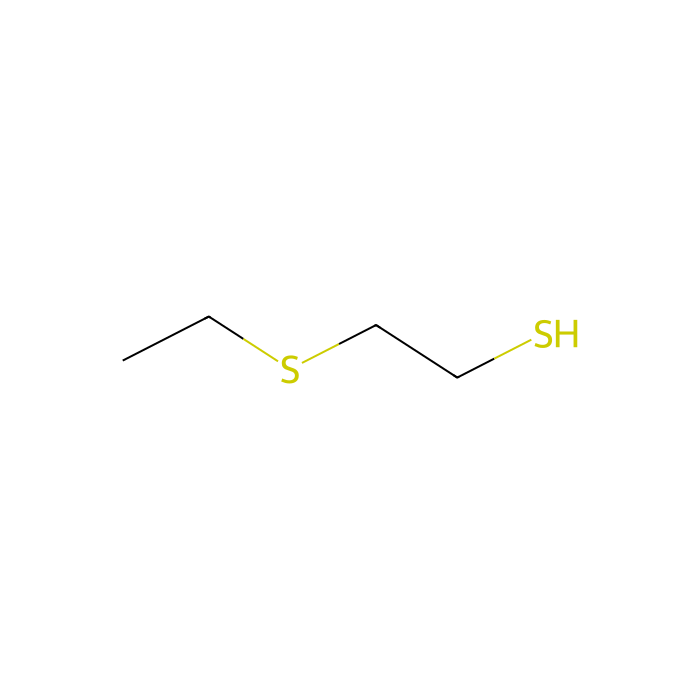
This compound belongs to the class of organic compounds known as alkylthiols. These are organic compounds containing the thiol functional group linked to an alkyl chain.
External Descriptors
aliphatic sulfide - alkanethiol
1. Djoumbou Feunang Y, Eisner R, Knox C, Chepelev L, Hastings J, Owen G, Fahy E, Steinbeck C, Subramanian S, Bolton E, Greiner R, and Wishart DS. ClassyFire: Automated Chemical Classification With A Comprehensive, Computable Taxonomy. Journal of Cheminformatics, 2016, 8:61.
Determine the necessary mass, volume, or concentration for preparing a solution.
Dilution Calculator
Determine the dilution needed to prepare a stock solution.
Reconstitution Calculator
Avis
Avis des clients
Application Protocols
Not applicable. No validated bioassay formats (e.g., WB, IHC, IF, FC) are associated with this small-molecule reagent. For synthetic or materials applications, follow the Reaction Conditions and Synthetic Utility sections for general guidance and adapt protocols from primary literature.
Biological Roles
Item-specific biological data are not provided for this reagent. The notes below are general thiol/organosulfur context from the literature; they do not imply any biological activity of this product.
Thiols in biology (general):
Thiol groups (–SH) are central to protein function (cysteine residues), redox buffering (glutathione), and metal coordination.
Thiol–disulfide exchange underpins redox signaling and protein folding.
Small-molecule organosulfurs:
Low-molecular-weight thiols can engage in redox and metal-binding chemistry but typically lack defined metabolic roles unless biosynthesized.
Volatile thiols are odorants in nature; their detection is highly sensitive in mammals.
Relevance to this reagent (conceptual):
As a monothiol with an internal thioether, it exemplifies soft-donor chemistry and redox lability (thiol ↔ disulfide) that are broadly important in biochemistry.
Research-use limitation: This product is for research use only and is not intended for diagnostics, therapeutic, or in vivo applications.
Buffer Applications
Not typically applicable. 2-(Ethylsulfanyl)ethane-1-thiol is a hydrophobic, odorous organosulfur reagent and not used as a buffering agent. For aqueous/biochemical work, it may be included at low levels as a reductant or thiol source in organic-phase reactions, but standard buffering capacity and recipes do not apply. Consider using appropriate biochemical buffers (e.g., phosphate, HEPES) separately.
Green Alternatives
Goals: reduce odor emissions, improve safety, and minimize environmental impact while achieving similar chemical outcomes.
Strategy alternatives (literature/general):
Use masked thiol equivalents (thioacetates, thioformates) that are less odorous and can be unveiled in situ with base or nucleophiles.
Swap solvent to greener media (EtOAc, 2-MeTHF, CPME, propylene carbonate) for thiol–ene or S-alkylation reactions when compatible.
Consider catalytic thiol surrogates (e.g., thio-Michael using thioacetic acid followed by hydrolysis) to moderate odor and volatility.
Comparison snapshot (general):
2-(Ethylsulfanyl)ethane-1-thiol vs thioacetate surrogate:
Odor: very strong vs substantially reduced.
Reactivity: immediate nucleophilicity vs requires deprotection.
Waste: potential oxidant scrubs vs acetate byproducts (benign).
Solvent switch (THF/DCM → 2-MeTHF/EtOAc):
Safety: reduced peroxide risk (vs ether) or halogenated waste.
Performance: often comparable for thiol–ene; verify for SN2.
Operational greening:
Closed handling (syringe/septum) to cut fugitive emissions.
Adsorptive odor capture (activated carbon) on vents.
Aqueous oxidant polishing of off-gas (e.g., dilute NaOCl) where permitted, ensuring segregation from flammable organics.
Tradeoffs: masking/protection steps add reagents and steps; greener solvents may change rates/selectivity. Pilot small-scale trials to validate equivalence.
Pharmaceutical Uses
No item-specific pharmacopeial status or excipient role is provided. This product is supplied for research use only.
General notes (not specific to this item):
Organosulfur thiols are occasionally used as processing reagents or functionalization handles in medicinal chemistry discovery. They are not typical formulation excipients due to odor, volatility, and reactivity.
If used during API/intermediate synthesis, ensure removal to ICH-compliant residual levels; monitor by validated GC/HPLC methods.
Do not use in human or veterinary applications. Consult your QA/QC team and applicable regulations for any cGMP or clinical manufacturing contexts.
Physical Properties
Item-specific specs not provided in the Product Data. Values below are literature/computed and for general guidance only; they are NOT item specifications.
Molecular weight: ~122.25 g/mol (computed from C4H10S2; literature).
Formula: C4H10S2 (literature/computed).
Density, refractive index, UV cutoff: Not specified for this item; refer to CoA/Spec Sheet.
Melting point: not commonly reported; expected below ambient (literature). Not specified for this item; refer to CoA/Spec Sheet.
Boiling range: small aliphatic thiols/sulfides typically boil in the 110–160 °C range; specific BP for this compound not firmly established in primary data. Not specified for this item; refer to CoA/Spec Sheet.
Solubility (qualitative, literature):
Miscible with many organic solvents (e.g., hydrocarbons, ethers, chlorinated solvents, polar aprotics) due to polarizable sulfur and nonpolar backbone.
Limited solubility in water; thiols may show slight water solubility via H-bonding, but overall hydrophobic behavior predominates.
Partitioning: logP predicted positive (hydrophobic), exact value not established. Not specified for this item; refer to CoA/Spec Sheet.
Vapor pressure/odor: low-MW thiols exhibit strong, penetrating odors and appreciable vapor pressures; handle in well-ventilated hoods (literature caution).
Quality and Grades
Item-specific grade/purity: Not specified for this item; refer to CoA/Spec Sheet.
Interpreting grade (general guidance):
For low-odor handling and reproducible reactivity, thiol content (assay) and peroxide/oxidation byproduct limits (e.g., disulfide content) are often controlled in specifications. Absent item-specific numbers, consult the CoA.
Stabilization: Some thiols are supplied under inert gas or with trace acid/base inhibitors to suppress oxidation or polymerization of contaminants. This item is Argon charged (Product Data), indicating attention to oxidative stability and odor containment.
Typical QC for this class (literature expectations):
Identity by 1H/13C NMR and GC–MS; purity by GC or HPLC; residual solvents by GC; water by Karl Fischer where applicable.
Oxidation profile (thiol vs. disulfide) by GC or HPLC.
Practical implications:
If using in nucleophilic substitutions or thiol–ene additions, trace disulfide can reduce effective –SH concentration; consider titrating the thiol (iodometric or Ellman’s reagent) for exact –SH molarity when critical.
For odor-sensitive environments, verify container integrity and headspace management; plan for rapid transfer under inert atmosphere.
Reaction and Applications
Applications below are literature/general for thiol–sulfide reagents; tailor to your system and consult primary literature.
Thiol–ene and thio-Michael chemistry:
Photoinitiated anti-Markovnikov addition of –SH across alkenes under UV/visible with radical initiators (AIBN, DMPA). Useful for polymer modification and surface grafting.
Conjugate additions to activated alkenes (acrylates, maleimides) under base or nucleophilic catalysis (e.g., DBU, tertiary amines).
Nucleophilic S-alkylation/acylation:
Deprotonation to the thiolate (e.g., with NaH, K2CO3, or DBU) affords a soft nucleophile for SN2 on primary halides/mesylates to build sulfides or for acyl transfer to thioesters.
Redox transformations:
Controlled oxidation of the thiol to the disulfide (I2, air/O2 with catalyst); selective oxidation of the thioether to sulfoxide (1 eq m-CPBA) or sulfone (excess peracid), mindful of competing thiol oxidation—protection recommended.
Protection strategies:
Mask the thiol as thioacetate or disulfide to permit independent manipulation of the thioether moiety (e.g., sulfonium formation, oxidation state edits) without SH side reactions.
Ligand/soft-donor utility:
The –SH binds coinage-metal surfaces (Au, Ag) enabling self-assembled monolayer studies; the internal thioether modulates binding geometry and surface mobility (short-chain, monodentate binding).
Radical chain transfer (literature):
Low-MW thiols act as chain-transfer agents in radical polymerizations (RAFT adjunct or conventional FRP), controlling molecular weight via hydrogen atom transfer.
Practical tips: minimize air exposure; titrate –SH content when stoichiometry matters; consider odor-masking protocols (charcoal traps, oxidant scrubs) downstream.
Reaction Conditions
Guidance below is literature-general for thiol chemistry; optimize per substrate.
Thiol–ene additions:
Initiation: photoinitiators (e.g., DMPA 0.5–2 mol%) under 365–405 nm LED/UV; or thermal AIBN (1–5 mol%) at 60–80 °C.
Solvents: EtOAc, toluene, 2-MeTHF, or neat. Typical times 0.5–4 h; often high conversions (>80%) with radical inhibitors excluded.
Thio-Michael to acrylates/maleimides:
Base catalysis (0.1–10 mol% DBU/TEA) or nucleophilic catalysts (thiolates). Solvents: MeCN, MeOH, DMSO. 0–25 °C; minutes to hours; often near-quantitative under optimized conditions.
S-Alkylation (forming sulfides):
Base: K2CO3 or NaH (0–1.1 equiv) to generate thiolate; electrophiles: primary halides/mesylates.
Solvent: DMF, MeCN, acetone. 0–25 °C, 1–12 h; yields commonly 60–95% for primary substrates (literature ranges).
Oxidations:
Thiol → disulfide: I2 (0.5 equiv), MeOH or CH2Cl2, 0–25 °C, minutes to 1 h.
Thioether → sulfoxide/sulfone: m-CPBA (1.0 or 2.0–2.5 equiv), CH2Cl2, 0 °C to rt; monitor to prevent overoxidation; protect –SH first if selectivity is critical.
Sulfonium formation:
Thioether quaternization with MeI or MeOTf (1.1–1.5 equiv) in MeCN or DCM at 0–25 °C; minutes to hours.
Notes:
Use inert atmosphere (argon, as per Product Data) to minimize air oxidation.
Dry solvents and glassware; trace water suppresses thiolate formation.
For volatile/odorous thiols, employ sealed tubes or Schlenk techniques to contain emissions.
Safety and Handling
Item-specific hazard classifications: Not specified for this item; refer to SDS for definitive GHS signal word, pictograms, and H-statements.
Strong, persistent odor; vapors noticeable at very low concentrations.
Irritation risk to skin, eyes, and respiratory tract; thiols can cause headaches/nausea from odor exposure.
Flammability: many low-MW organosulfurs are combustible; avoid ignition sources.
Reactivity: thiols oxidize in air to disulfides; thioethers oxidize to sulfoxides/sulfones with strong oxidants.
Storage (Product Data): Store at 2–8 °C, argon charged. Shipped on wet ice.
Rationale: limits air oxidation and volatilization; inert blanket suppresses disulfide formation and odor emissions.
Incompatibilities (general): strong oxidizers (e.g., peroxides, permanganate, peracids), strong bases/acids (can accelerate side reactions/odor release), and metals that catalyze oxidation.
Engineering controls: certified chemical fume hood; closed transfer where possible; use septum techniques to minimize headspace exposure.
PPE: safety glasses or splash goggles, lab coat, nitrile gloves (consider double-gloving for odor control), and, if splash risk, face shield. Replace gloves frequently; thiol odors can permeate.
Spill/first aid (overview; defer to SDS):
Spills: contain with inert absorbent; ventilate thoroughly; neutralize odors with oxidizing bleach only if compatible with waste segregation policies.
Skin/eye contact: rinse with water for ≥15 min; remove contaminated clothing.
Inhalation: move to fresh air; seek medical attention if symptoms persist.
Waste: segregate sulfur-containing organics; label for halogen-free organic waste per institutional policy.
Solvent Selection
This compound is a small, polarizable organosulfur with one thiol and one thioether. It behaves as a weak H-bond donor (via –SH) and a soft nucleophile after deprotonation.
Polarity/miscibility (literature-based):
Good solubility in nonpolar and moderately polar organic solvents (hexanes, toluene, Et2O, THF, DCM, EtOAc, MeCN, DMF, DMSO).
Limited water solubility; aqueous workups often partition it into the organic phase unless ionized as a thiolate under basic conditions.
Selection guidance:
Nucleophilic substitutions (S-alkylation): polar aprotic solvents (MeCN, DMF, DMSO) enhance rates with soft electrophiles; maintain inert atmosphere to limit oxidation.
Thiol–ene/thio-Michael reactions: bulk solvents like EtOAc, MeOH, or neat conditions can be used; photochemical thiol–ene often run in nonchlorinated, low-odor media (e.g., 2-MeTHF).
Metal–surface binding studies (Au, Ag): use hydrocarbon or alcohol solvents to minimize competing coordination if exploring thiol adsorption.
Comparison (literature-general):
Versus longer-chain alkanethiols: higher volatility and stronger odor; easier to remove under vacuum.
Versus dithiols: only one –SH; reduced crosslinking potential but lower tendency to form insoluble metal-chelate networks.
Drying: Predry solvents (molecular sieves) when thiolate formation or moisture-sensitive couplings are planned; trace water suppresses deprotonation and slows S-alkylation.
Storage and Reconstitution
Storage (Product Data): Store at 2–8 °C, argon charged. Ship on wet ice.
Container handling:
Keep tightly sealed with minimal headspace; maintain inert gas blanket after each use to limit oxidation and odor escape.
Use PTFE-lined caps; avoid permeable septa for long-term storage.
Stability considerations (general):
Susceptible to air oxidation (thiol → disulfide) and odor emission; cooler temperatures slow both.
Avoid light/heat that can accelerate radical-mediated side reactions.
Reconstitution: Not applicable; supplied neat. If a solution is desired, prepare under inert atmosphere in dry, oxygen-free solvent and store cold in sealed vials.
In-use tips:
Pre-chill receiving vials; perform transfers by syringe/cannula to minimize headspace contact.
If precise –SH stoichiometry is required, freshly standardize by thiol titration (e.g., Ellman’s reagent) after opening.
Shelf-life/specs: Not specified for this item; refer to CoA/Spec Sheet.
Research Use Note: For research use only.
Structure and Identity
Brief description: 2-(Ethylsulfanyl)ethane-1-thiol is a bifunctional organosulfur compound combining a terminal thiol and an internal thioether (sulfide) in a short, flexible, aliphatic chain.
Product Data (item-specific):
CAS: 26750-44-7
PubChem CID: 33596
InChIKey: 153908 (as provided)
SKU: E588498
Category: Chemical and Biochemical Reagents
Literature/computed identifiers (general reference; verify against CoA if critical):
Functional groups: one primary thiol (–SH) at C1; one thioether (–S–) linking C2 of the ethane chain to an ethyl group.
Skeleton: a four-carbon backbone interrupted by two sulfur atoms; overall structure can be written as HS–CH2–CH2–S–CH2–CH3.
Stereochemistry: none (achiral, no stereocenters; conformationally flexible aliphatic chain).
Polarizability: elevated due to two sulfur atoms; weak hydrogen-bond donor via –SH.
2D structure in words:
From the thiol end, a methylene (CH2) bearing an –SH connects to another methylene (CH2), then to a sulfur atom (thioether), which in turn binds an ethyl fragment (–CH2–CH3).
Synthetic Utility
As a bifunctional organosulfur (thiol + thioether), 2-(ethylsulfanyl)ethane-1-thiol offers orthogonal reactivity and strategic flexibility.
Functional group leverage:
Thiol (–SH): soft nucleophile upon deprotonation; engages SN2 S-alkylation, thioester formation, thiol–ene, and disulfide coupling.
Thioether (–S–): oxidatively upgradable (sulfoxide/sulfone); convertible to sulfonium salts for leaving-group activation or Pummerer-related chemistry after oxidation.
Selectivity tactics:
Protect the –SH as thioacetate/disulfide to manipulate the thioether (e.g., selective oxidation to sulfoxide) without competing –SH oxidation.
Conversely, oxidize thioether selectively (1 eq peracid) while maintaining low O2 and adding radical inhibitors to restrain –SH to disulfide formation.
Retrosynthetic value:
Serves as a linchpin to introduce a 2-(ethylthio)ethyl fragment via S-alkylation or thiol–ene onto alkenes, followed by further oxidation to tune polarity and leaving-group ability.
Surface chemistry:
The terminal –SH anchors to Au/Ag surfaces enabling monolayer formation with a built-in internal thioether that modulates packing and electronic properties.
Polymer chemistry:
Functions as a chain-transfer agent in free-radical polymerizations, controlling molecular weight and end-groups through thiol H-transfer (literature precedent for low-MW alkanethiols).
Overall: a compact, versatile soft-nucleophile building block with tunable oxidation states enabling diverse downstream transformations.
Target Specificity
Not applicable. This product is a small-molecule organosulfur reagent, not a biological affinity reagent or antibody. No antigen/epitope or species reactivity applies.
Foire aux questions
What is the purity of this product?
This product is supplied at ≥98% purity (chemical assay). Lot-specific values are stated on the Certificate of Analysis.
How should this product be stored?
Store at 2–8 °C under argon. It is supplied under an argon blanket; reseal under inert gas after each use.
How is this product shipped?
This product ships chilled on wet ice. Unpack on arrival and transfer it to the storage condition stated above.
What are the CAS number, molecular formula and molecular weight?
The CAS Number is 26750-44-7, the molecular formula is C4H10S2, and the molecular weight is 122.3 g/mol. InChIKey IYQVQZXLTJHEKZ-UHFFFAOYSA-N.
What documentation is provided?
Available product documentation, including Certificates of Analysis (COA), Safety Data Sheets (SDS), and specification sheets, is shown in the product document area. Document availability and access follow the current site policy.
Nous utilisons des cookies pour garantir le bon fonctionnement du site et, lorsque cela est autorisé, pour améliorer votre expérience. Vous pouvez gérer vos préférences à tout moment dans les Paramètres. Pour en savoir plus, consultez notre Politique relative aux cookies.
Souhaitez-vous que nous vous envoyions un message lorsque des réductions seront disponibles?
Me rappeler plus tard
Merci ! Veuillez vérifier votre boîte de réception e-mail pour confirmer.
Products are supplied to verified businesses, institutions, and qualified professionals for research and development use only. Not for use in humans, animals, diagnosis, or therapy.