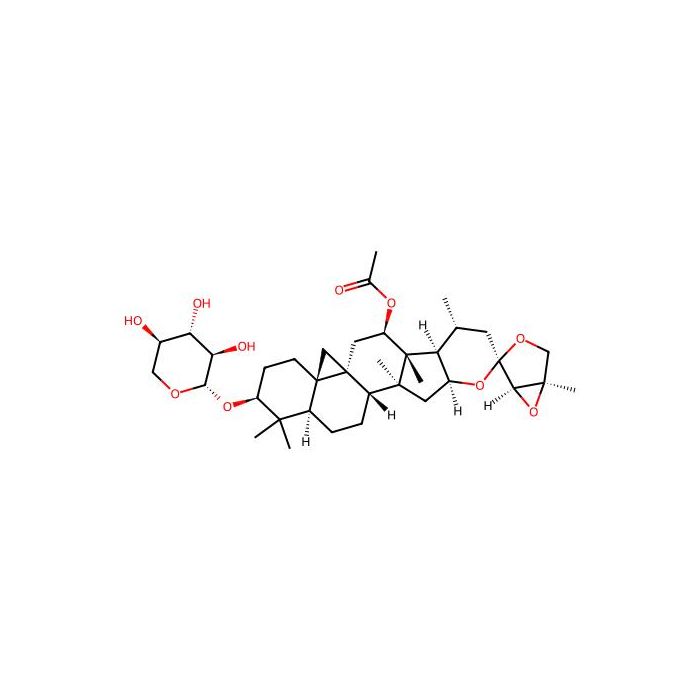
Determine the necessary mass, volume, or concentration for preparing a solution.
23-epi-26-Deoxyactein is a natural and orally active anti-obesity and anti-cancer compound .
In Vitro
23-epi-26-Deoxyactein (DA :10 μM and 20 μM) inhibits 3T3-L1 adipogenesis through down-regulating the expression of C/ebpα , C/ebpβ , and Pparγ , which are the critical adipogenic transcription factors. 23-epi-26-Deoxyactein (DA) promotes mitochondrial biogenesis in pancreatic β-cells preventing methylglyoxal-induced oxidative cell damage and protects osteoblasts against Antimycin A-induced cell damage. 23-epi-26-Deoxyactein (DA) inhibits growth of the MCF7 human breast cancer cells and induces cell cycle arrest at G1 (IC 50 of 21μM). 23-epi-26-Deoxyactein (0.1-1 μM) protects osteoblasts against Antimycin A-induced cell damage . MCE has not independently confirmed the accuracy of these methods. They are for reference only. Cell Differentiation AssayCell Line: 3T3-L1 preadipocytes. Concentration: 0-50 μM. Incubation Time: 8 days. Result: 10 μM DA inhibited the adipogenesis of 3T3-L1 preadipocytes mainly at the early stage of differentiation.
In Vivo
23-epi-26-Deoxyactein (DA: 5 and 10 mg/kg/d) significantly lowers body weight gain, fat mass, and liver weight in HFD-fed mice. 23-epi-26-Deoxyactein (DA) also reduces insulin resistance and serum lipoprotein levels in HFD-fed mice . 23-epi-26-Deoxyactein (DA) promotes adipocyte lipolysis in mice through activating the AMPK signaling and SIRT1-FOXO1 pathway . MCE has not independently confirmed the accuracy of these methods. They are for reference only. Animal Model: Diet induced obesity in C57BL/6 mice . Dosage: 1-10 mg/kg. Administration: Orally, daily for 12 weeks. Result: Lowered body weight gain, fat mass, and liver weight. 5 mg/kg/d DA significantly improved HFD-induced glucose intolerance.
Form:Solid
Taxonomy Tree
| Kingdom | Organic compounds |
|---|---|
| Superclass | Lipids and lipid-like molecules |
| Classe | Steroids and steroid derivatives |
| Subclass | Cycloartanols and derivatives |
| Intermediate Tree Nodes | Not available |
| Direct Parent | Cycloartanols and derivatives |
| Alternative Parents | Triterpenoids Steroid esters O-glycosyl compounds Ketals 1,4-dioxanes Oxanes Monosaccharides Tetrahydrofurans Secondary alcohols Carboxylic acid esters Polyols Oxacyclic compounds Dialkyl ethers Monocarboxylic acids and derivatives Epoxides Hydrocarbon derivatives Organic oxides Carbonyl compounds |
| Molecular Framework | Aliphatic heteropolycyclic compounds |
| Substituents | Cycloartanol-skeleton - 9b,19-cyclo-lanostane-skeleton - Cycloartane-skeleton - Triterpenoid - Steroid ester - Glycosyl compound - O-glycosyl compound - Ketal - Para-dioxane - Monosaccharide - Oxane - Tetrahydrofuran - Secondary alcohol - Carboxylic acid ester - Organoheterocyclic compound - Acetal - Monocarboxylic acid or derivatives - Oxacycle - Ether - Oxirane - Dialkyl ether - Polyol - Carboxylic acid derivative - Alcohol - Organic oxygen compound - Organic oxide - Carbonyl group - Hydrocarbon derivative - Organooxygen compound - Aliphatic heteropolycyclic compound |
| Description | This compound belongs to the class of organic compounds known as cycloartanols and derivatives. These are steroids containing a cycloartanol moiety. |
| External Descriptors | triterpenoid |
| Poids moléculaire | 660.8 |
|---|---|
| XLogP3 | 3.900 |
| Hydrogen Bond Donor Count | 3 |
| Hydrogen Bond Acceptor Count | 10 |
| Rotatable Bond Count | 4 |
| Exact Mass | 660.387 Da |
| Monoisotopic Mass | 660.387 Da |
| Topological Polar Surface Area | 136.000 Ų |
| Heavy Atom Count | 47 |
| Formal Charge | 0 |
| Complexity | 1360.000 |
| Isotope Atom Count | 0 |
| Defined Atom Stereocenter Count | 18 |
| Undefined Atom Stereocenter Count | 0 |
| Defined Bond Stereocenter Count | 0 |
| Undefined Bond Stereocenter Count | 0 |
| The total count of all stereochemical bonds | 0 |
| Covalently-Bonded Unit Count | 1 |