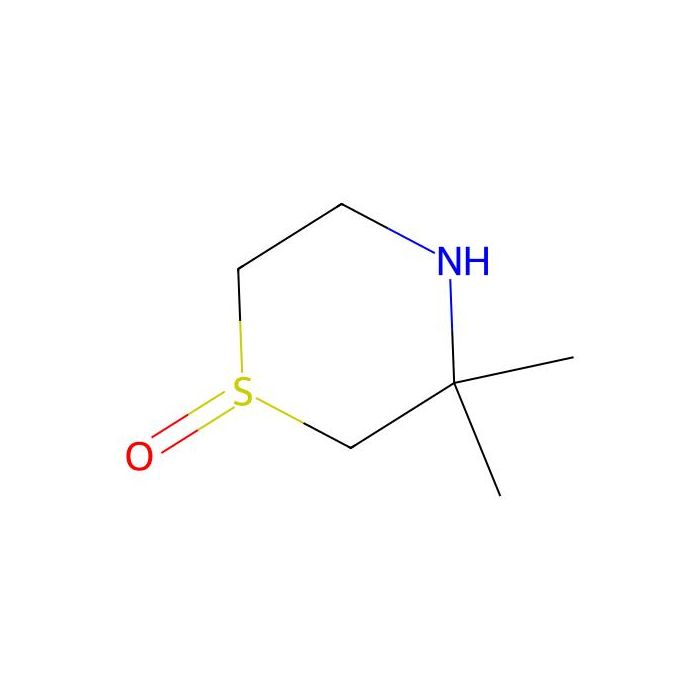
This compound belongs to the class of organic compounds known as thiomorpholines. These are heterocyclic compounds containing a thiomorpholine ring, which is a six-membered aliphatic ring containing one nitrogen atom and one sulfur atom at positions 1 and 4 respectively, and four carbon atoms.
External Descriptors
Not available
1. Djoumbou Feunang Y, Eisner R, Knox C, Chepelev L, Hastings J, Owen G, Fahy E, Steinbeck C, Subramanian S, Bolton E, Greiner R, and Wishart DS. ClassyFire: Automated Chemical Classification With A Comprehensive, Computable Taxonomy. Journal of Cheminformatics, 2016, 8:61.
Certificats (CoA, COO, BSE/TSE et tableau d'analyse)
C of A & Other Certificates(BSE/TSE, COO):
Analytical Chart:
Propriétés chimiques et physiques
Poids moléculaire
147.240 g/mol
XLogP3
-0.800
Hydrogen Bond Donor Count
1
Hydrogen Bond Acceptor Count
3
Rotatable Bond Count
0
Exact Mass
147.072 Da
Monoisotopic Mass
147.072 Da
Topological Polar Surface Area
48.300 Ų
Heavy Atom Count
9
Formal Charge
0
Complexity
133.000
Isotope Atom Count
0
Defined Atom Stereocenter Count
0
Undefined Atom Stereocenter Count
1
Defined Bond Stereocenter Count
0
Undefined Bond Stereocenter Count
0
The total count of all stereochemical bonds
0
Covalently-Bonded Unit Count
1
Calculateurs de solution
Molarity Calculator
Determine the necessary mass, volume, or concentration for preparing a solution.
Dilution Calculator
Determine the dilution needed to prepare a stock solution.
Reconstitution Calculator
Avis
Avis des clients
Application Protocols
No application protocols are specified for this item. As a small-molecule reagent/intermediate, typical protocols will be those of the intended synthetic or analytical procedure (e.g., Pummerer activation, oxidation/reduction steps, LC–MS analysis). For method development, consult standard organic synthesis references and optimize conditions for your substrate and scale.
Biological Roles
This product is listed under life science reagents but is a small-molecule heterocycle. No biological role is claimed for this specific item.
General chemistry/biochemistry context (literature; not product-specific and not a medical claim):
Sulfoxides occur in nature (e.g., methionine sulfoxide) and can participate in redox cycling via methionine sulfoxide reductases. In synthetic chemical biology, sulfoxide-containing scaffolds are used as polarity-tunable motifs and hydrogen-bond acceptors.
Thiomorpholine-derived frameworks appear in probe development due to their balanced polarity and capacity for salt formation via the ring nitrogen. The S=O group can influence binding through dipolar interactions and acceptor capability.
The stereogenic sulfur in sulfoxides can impart enantioselective recognition; however, unless an enantiomer is specified, assume racemic mixtures with no defined biological stereopreference.
If using in biochemical assays, confirm:
Solubility and vehicle compatibility (e.g., DMSO stock solutions),
Absence of intrinsic assay interference (e.g., in redox-sensitive readouts),
Purity and identity by LC–MS/NMR appropriate to your assay sensitivity.
Buffer Applications
This compound is not a buffering agent and is not typically used to prepare biological buffers. If incorporated into biochemical assays, select a buffer system appropriate to your biology (e.g., phosphate, HEPES, MOPS) and verify compound stability across the intended pH range.
Practical notes (general):
The ring nitrogen may be protonated under acidic conditions; strong acids can also trigger sulfoxide activation (Pummerer-type), so avoid highly acidic buffers if structural integrity is critical.
Assess solubility in your buffer with co-solvent (e.g., ≤1–2% DMSO) as needed and confirm no precipitation or time-dependent degradation.
Green Alternatives
While this product is a substrate/reagent rather than a solvent, greener choices can be made in its preparation and subsequent transformations (literature guidance):
Greener options for common steps:
Oxidation S(IV) → S(VI) (sulfone): Prefer Oxone (KHSO5) or 30% H2O2 in MeOH, EtOH, acetone, or water over chlorinated solvents and peracids where feasible. Catalytic systems (e.g., tungstate/H2O2) can reduce waste.
Activation (Pummerer-type): Replace TFAA/Tf2O in DCM with milder, solvent-optimized protocols where possible (e.g., acetic anhydride in 2-MeTHF or EtOAc) while balancing selectivity.
Reduction S(IV) → S(II): Use transfer hydrogenation or zinc–acid alternatives in aqueous ethanol rather than stoichiometric low-valent metals in chlorinated media, if compatible.
Solvent selection hierarchy: Favor ethyl acetate, 2-MeTHF, MeCN, alcohols over DCM/DMF when reaction performance allows. Implement solvent recycling.
Trade-offs:
Greener oxidants (H2O2, Oxone) may require buffering and careful temperature control to avoid N-oxidation or over-oxidation of sensitive sites.
Non-chlorinated solvents can alter selectivity in Pummerer chemistry; pilot screens are advised.
Waste minimization:
Telescoping redox steps and employing catalytic oxidations/reductions decrease E-factor. In-process controls (IPC) cut rework and solvent usage.
Pharmaceutical Uses
No pharmacopeial grade or formulation role is specified for this item; it is sold for research use only.
General formulation context for related scaffolds (literature; not a use claim for this product):
Thiomorpholine-containing motifs are common in medicinal chemistry due to basic nitrogen (salt formation) and tunable polarity from S-oxidation state. Sulfoxides can alter solubility and permeability relative to thioethers/sulfones.
If evaluating as a research intermediate or impurity standard, typical considerations include salt screening (e.g., HCl, mesylate), polymorph assessment, and stress testing (acid/base, oxidative, thermal).
For any cGMP or clinical use, obtain appropriate grades and regulatory documentation; this catalog item is not intended for such applications.
Physical Properties
Appearance: Not specified for this item; refer to CoA/Spec Sheet.
Melting point / Boiling point: Not specified for this item; refer to CoA/Spec Sheet.
Density, refractive index: Not specified for this item; refer to CoA/Spec Sheet.
Solubility: Not specified for this item; refer to CoA/Spec Sheet.
General/literature expectations for related structures (for planning only; verify experimentally):
Polarity: Sulfoxides are polar aprotic; thiomorpholine S-oxides typically show appreciable solubility in polar organic solvents (e.g., DMSO, DMF, MeCN, alcohols) and varying solubility in water depending on substitution.
Acid–base behavior: The ring nitrogen is basic (pK_aH of thiomorpholine derivatives commonly in the range ~7–9, literature), while the sulfoxide oxygen is a strong H-bond acceptor; no acidic protons expected from the sulfoxide itself.
LogP: Sulfoxides increase polarity vs thioethers; 3,3-dimethyl substitution increases hydrophobicity relative to unsubstituted thiomorpholine S-oxide (qualitative, literature).
Important: Do not treat any of the above qualitative expectations as specifications for this catalog item. Obtain exact values from the CoA/Spec Sheet or measure under your lab conditions.
Quality and Grades
Grade/Purity: Not specified for this item; refer to CoA/Spec Sheet.
Stabilizers/Inhibitors: Not specified for this item; refer to CoA/Spec Sheet.
Interpretation and best practices:
In the absence of a declared grade (e.g., AR, technical, ≥98%, HPLC), treat the material as research-grade. For trace analysis or catalysis-sensitive work, consider in-house verification (NMR, LC/HPLC purity, water content by KF if relevant).
Sulfoxide integrity: If enantiospecific work at sulfur is planned, verify enantiomeric composition by chiral HPLC or NMR with chiral shift reagents. Many sulfoxides are sold as racemates unless explicitly stated.
UV profile: If using in photochemical or analytical applications, determine UV cutoff empirically; no item-specific UV data are provided.
Residual metals/ions: Not specified for this item; refer to CoA/Spec Sheet. If metal-sensitive transformations are planned, consider ICP-MS screening.
Documentation: For regulated workflows or reproducibility requirements, request the current lot-specific CoA and SDS. These will list exact purity assay method, residual solvents, water, and any stabilizers if present.
Reaction and Applications
As a 3,3-disubstituted thiomorpholine S-oxide, this compound serves as a versatile, polar, sulfur-centered functional handle in synthesis.
Key application families (literature):
Pummerer and interrupted Pummerer chemistry: Activation of the sulfoxide (e.g., TFAA, Ac2O, Tf2O) generates sulfonium intermediates enabling α-functionalization, C–C/C–X bond formation, and rearrangements. The 3,3-dimethyl substitution can influence regiochemistry and suppress undesired elimination.
Redox transformations:
Oxidation to the corresponding sulfone (S(VI)) using mCPBA, Oxone, or H2O2/Ti catalysts.
Reduction to the thioether (S(II)) with TiCl3/Zn, Raney Ni, or hydride systems (e.g., NaBH4/NiCl2). This toggles polarity and can be used as a protecting/unmasking strategy for sulfur.
Chiral-at-sulfur chemistry: Sulfoxides are inherently stereogenic; if enantioenriched, they can act as chiral auxiliaries or ligands. Without stated configuration, assume racemate and racemization-resistant under neutral conditions.
N-derivatization: The ring nitrogen allows acylation, sulfonylation, or alkylation, enabling access to diversified libraries of S-oxide-containing scaffolds for SAR studies in chemical biology (non-clinical).
Coordination/organocatalysis context: The S=O oxygen is a strong H-bond acceptor and Lewis base, which can modulate interactions in supramolecular assemblies or serve as a directing group.
Practical tips:
Dry, neutral to mildly basic conditions preserve the S-oxide. For electrophilic activation, exclude nucleophiles and moisture. Monitor by LC/MS or 1H/13C NMR; 17O/33S NMR rarely required but 13C shifts adjacent to S=O are diagnostic.
Reaction Conditions
General conditions for typical transformations of thiomorpholine sulfoxides (literature guidance; optimize per substrate):
Pummerer activation / α-functionalization:
Reagents: TFAA (1.5–2.5 equiv) or Tf2O (1.1–1.5 equiv) in dry DCM or 1,2-DCE.
Temperature: −78 to 0 °C for activation; then 0 to rt with nucleophile.
Atmosphere: Dry, inert (N2/Ar). Strictly anhydrous to avoid hydrolysis.
Notes: Interrupted Pummerer couplings with arenes, halides, or heteronucleophiles proceed under Lewis acidic conditions; monitor by LC–MS.
Oxidation to sulfone:
Reagents: mCPBA (1.1–1.5 equiv) in DCM at 0 °C to rt; or Oxone (2–3 equiv) in MeOH/H2O at rt.
Time: 1–6 h typically; exotherm control advised.
Notes: Buffering (NaHCO3) may suppress N-oxidation.
Reduction to thioether:
Reagents: TiCl3 (3–4 equiv) with Zn in MeOH/THF at 0 °C to rt; or Raney Ni hydrogenolysis in EtOH under H2 (1–3 bar).
Time: 1–8 h depending on system.
Notes: Protect acid- or metal-sensitive groups. Work up with chelators if using transition metals.
N-acylation/sulfonylation:
Reagents: Acyl chlorides or sulfonyl chlorides (1.1–1.5 equiv), base (DIPEA, Et3N) in DCM or THF, 0 °C → rt, 1–3 h.
These are representative conditions from the literature; actual performance depends on substitution and scale. Always confirm identity/purity at each stage.
Safety and Handling
GHS classification: Not specified for this item; refer to SDS.
Signal word / H-statements / Pictograms: Not specified for this item; refer to SDS.
Research use: For research use only (product data).
General laboratory safety guidance for sulfoxide-bearing heterocycles (literature, not product-specific):
PPE: Lab coat, safety glasses, and appropriate chemically resistant gloves (e.g., nitrile). Handle in a fume hood to avoid inhalation of vapors, aerosols, or dust.
Incompatibilities: Strong oxidizers can over-oxidize sulfoxides to sulfones; strong reducing agents (e.g., low-valent metals, hydrides under activating conditions) may reduce to thioethers. Strong acids/anhydrides (TFAA, Ac2O) can induce Pummerer-type rearrangements.
Thermal/chemical stability: Sulfoxides are generally stable at ambient temperature; avoid prolonged heating with dehydrating reagents.
First aid (overview; consult SDS): If on skin/eyes, rinse with water for ≥15 min; remove contaminated clothing. If inhaled, move to fresh air. If ingested, rinse mouth and seek medical attention. Provide SDS to medical personnel.
Spill response: Absorb small spills with inert material, collect for disposal. Prevent release to drains. Dispose of waste according to institutional and regulatory requirements.
Always defer to the product SDS for authoritative hazard classification, exposure limits, and disposal guidance.
Solvent Selection
This product is a heterocyclic sulfoxide substrate/reagent, not a bulk solvent. Solvent selection therefore concerns its use in synthesis or analysis.
General guidance (literature):
Preferred media: Polar aprotic solvents (e.g., DCM, EtOAc, MeCN, THF, 2-MeTHF, DMF, DMSO) typically dissolve sulfoxides well. Alcohols and water may also be suitable depending on basicity/protonation of the ring nitrogen.
Acidic activation (Pummerer conditions): Non-nucleophilic chlorinated solvents (DCM, 1,2-DCE) are common with TFAA/Ac2O; low temperatures help control rearrangements.
Oxidation to sulfone: Use DCM, MeOH, MeCN, or acetone with mCPBA, Oxone, or H2O2 (catalyzed) as oxidants; buffer or base can moderate over-oxidation of other sites.
Reduction to thioether: Alcohols or ethereal solvents under hydride/metal conditions; avoid protic solvents if hydride-sensitive functional groups present.
Analytical: Reverse-phase LC often provides good retention due to mixed polarity; aqueous-organic eluents (water/MeCN or water/MeOH with formic acid or ammonium buffers) are typical.
Selection tips:
Choose DCM or 1,2-DCE for electrophilic activations (minimize side reactions), MeCN/EtOAc for oxidations, and alcohols or THF for reductions. Verify solubility on small scale prior to scale-up.
Shipped in: Not specified for this item; refer to CoA/Spec Sheet.
Formulation/appearance: Not specified for this item; refer to CoA/Spec Sheet.
Reconstitution: Not applicable unless supplied as a solid requiring solution preparation; if making stock solutions, use dry, appropriate solvents (e.g., MeCN, DCM, DMSO) and store in airtight containers. Filter if particulate is present.
Best practices (general):
Keep container tightly closed, under dry, inert atmosphere if long-term storage is planned to avoid moisture uptake and unintended acid-promoted reactions.
Avoid prolonged exposure to strong light/heat and segregate from strong oxidizers or reducers.
If preparing solutions, consider aliquoting and storing at 2–8 °C or −20 °C to minimize degradation; allow to warm to room temperature before opening to prevent condensation.
For exact stability and shelf-life, consult the lot-specific CoA and SDS.
Structure and Identity
A saturated sulfur-containing heterocycle bearing a sulfoxide (S=O) at the ring sulfur and two methyl groups at C-3, giving a sterically encumbered, polar, chiral-at-sulfur scaffold.
SMILES: Not specified for this item; refer to CoA/Spec Sheet.
Molecular formula: Not specified for this item; refer to CoA/Spec Sheet.
Molecular weight: Not specified for this item; refer to CoA/Spec Sheet.
Structural features (general chemistry description):
Ring system: Six-membered thiomorpholine ring (–CH2–CH2–S(=O)–CH2–CH2–N–), bearing a sulfoxide at the ring sulfur (denoted by 1λ4) and two methyl groups geminal at C-3 (3,3-dimethyl).
Functional groups: Tertiary sulfoxide (S(IV)=O), secondary amine within a saturated heterocycle. The sulfoxide renders the sulfur center a stereogenic center (configurationally stable under mild conditions; racemate likely unless specified otherwise).
2D description: A chair-like six-membered heterocycle with adjacent S(=O) and N within the ring; C-3 carbon carries two methyl substituents, increasing steric bulk and potentially biasing conformations around S and N.
Notes:
No item-specific structural identifiers beyond the above are provided in the product data; any additional identifiers should be confirmed against the product CoA/SDS.
Synthetic Utility
Functional group set and opportunities:
Sulfoxide (S=O, S(IV)): Stereogenic sulfur, strong H-bond acceptor, Lewis-basic oxygen; undergoes oxidation to sulfone, reduction to thioether, and electrophilic activation to sulfonium species.
Secondary amine (ring N): Amenable to acylation, sulfonylation, alkylation; salt formation improves handling/solubility.
Gem-dimethyl at C-3: Increases steric hindrance, influences conformational bias and regioselectivity in α-functionalization.
Pummerer rearrangement and interrupted Pummerer couplings (e.g., with nucleophiles, halogenation, or arylation partners) from activated sulfoxides using TFAA, Tf2O, or Ac2O.
Oxidation to sulfones with mCPBA or Oxone; careful control avoids N-oxidation.
Reduction to thioether via TiCl3/Zn or Raney Ni; hydride-mediated routes possible under activating conditions.
Directed functionalization α-to-sulfoxide (via enolizable positions) enabling C–C bond construction.
Retrosynthetic value:
Serves as a masked, polarity-switchable sulfur handle; S-oxidation state toggling provides strategic access to series of matched analogs (thioether ↔ sulfoxide ↔ sulfone) for property tuning.
The thiomorpholine framework is a modular heterocycle; N-protection and subsequent substitution enable late-stage diversification.
Target Specificity
Not applicable. This product is a small-molecule heterocycle, not an antibody, enzyme, or targeted biological reagent. No antigen/epitope or species reactivity information applies.
We use cookies to ensure the website functions properly and, where permitted, to improve your experience. You can manage your preferences at any time in Settings. Learn more in our Cookie Policy.
Shall we send you a message when we have discounts available?
Remind me later
Thank you! Please check your email inbox to confirm.
Products are supplied to verified businesses, institutions, and qualified professionals for research and development use only. Not for use in humans, animals, diagnosis, or therapy.