This compound belongs to the class of organic compounds known as trifluoromethylbenzenes. These are organofluorine compounds that contain a benzene ring substituted with one or more trifluoromethyl groups.
External Descriptors
Not available
1. Djoumbou Feunang Y, Eisner R, Knox C, Chepelev L, Hastings J, Owen G, Fahy E, Steinbeck C, Subramanian S, Bolton E, Greiner R, and Wishart DS. ClassyFire: Automated Chemical Classification With A Comprehensive, Computable Taxonomy. Journal of Cheminformatics, 2016, 8:61.
Determine the necessary mass, volume, or concentration for preparing a solution.
Dilution Calculator
Determine the dilution needed to prepare a stock solution.
Reconstitution Calculator
Avis
Avis des clients
Application Protocols
Not applicable. No immunoassay or bioanalytical application protocols (e.g., WB, IHC, IF, FC) are associated with this small-molecule reagent. For synthetic use, see Reaction Conditions, Synthetic Utility, and Solvent Selection for general laboratory guidance.
Biological Roles
This compound is a synthetic, fluorinated aromatic reagent and is not a known endogenous metabolite.
General biochemical considerations (literature/general)
The –CF3 group is a common medicinal chemistry motif used to modulate lipophilicity, metabolic stability, and pKa of adjacent functionalities. Meta-placement often tunes electronics without strong steric interactions at ortho sites.
Phenolic functionality can engage in hydrogen bonding as a donor (neutral form) or acceptor (as phenoxide), which may influence binding in biochemical screening once converted to derivatives (ethers/esters often employed as pro-moieties in discovery chemistry).
Metabolic perspective
Phenols are generally subject to phase II conjugation (glucuronidation, sulfation) in biological systems; however, the presence of –CF3 can decrease oxidative metabolism on the ring due to deactivation. These statements apply to general phenolic CF3 aromatics and not to in vivo use of this product.
Research utility
Serves as a precursor to fluorinated phenyl ethers/esters used in probe and ligand development for target-binding studies in vitro.
Note: For research use only (per Product Data). No medical, diagnostic, or in vivo use is intended or implied.
Buffer Applications
Not typically applicable. 3-Hydroxybenzotrifluoride is a hydrophobic aromatic building block rather than a buffering agent. It lacks a conjugate acid/base pair suitable for maintaining a defined pH in aqueous solution. For practical work, select an appropriate buffer (e.g., phosphate, Tris, HEPES) for biological assays, and consult the Solvent Selection and Reaction & Applications sections for using this compound in organic synthesis.
Green Alternatives
While 3-hydroxybenzotrifluoride itself is a target building block (not a solvent), greener choices can be made around its use and potential alternatives.
Greener process solvents (literature/general)
Replace DMF/DMSO where possible with 2-MeTHF, CPME, EtOAc, or propylene carbonate for O-alkylations/acylations, provided bases/nucleophiles remain soluble.
Employ aqueous/phase-transfer conditions (e.g., K2CO3, TBAB, toluene or EtOAc) to reduce dipolar aprotic solvent usage.
Energy and protection strategies
Use catalytic Mitsunobu alternatives (e.g., PPh3-free variants) or direct Williamson etherification under solvent-minimized conditions.
Avoid unnecessary protection/deprotection by selecting chemoselective routes that tolerate the phenol or use carbonate protecting groups removable under mild conditions.
Comparative assessment (general)
Functionality replacement: If –CF3 serves only as an electron-withdrawing group, consider –SF5 or –CF2H alternatives for specific environmental footprints; however, these have their own synthesis challenges and may not be greener overall. Retain –CF3 when performance necessitates it and prioritize greener solvents and workups instead.
Small comparison (general guidance):
Traditional choice: DMF + K2CO3 (efficient, but DMF is reproductive toxin; difficult to remove).
Greener swap: 2-MeTHF or EtOAc + aqueous K2CO3/PTC (easier workup, lower toxicity) if substrate solubility allows.
Note: Always confirm solvent and waste policies with your EHS office; fluorinated organics may require special waste handling.
Pharmaceutical Uses
No pharmacopeial/excipient status is provided for this item; see CoA/SDS for any regulatory notes. The following are general, non-clinical remarks relevant to process chemistry and formulation development:
Role in API synthesis (literature/general)
3-Hydroxybenzotrifluoride serves as a versatile intermediate for preparing meta-CF3 phenyl ethers, esters, and other derivatives that modulate lipophilicity and metabolic stability in lead optimization.
O-Acyl derivatives (benzoates, carbonates) can function as protected forms or as intermediates toward more complex scaffolds.
Formulation considerations
As a small-molecule reagent (not an excipient), it is generally not used directly in dosage forms. If derivatives advance to candidates, residual levels of starting materials/impurities would be controlled by ICH Q3A/B guidelines.
Process and analytical notes
Typical in-process controls include assay by GC/LC, 19F NMR for CF3 content, and identification of regioisomeric impurities.
No therapeutic or clinical claims are made. For research and laboratory synthesis only (per Product Data: Research Use Only).
Physical Properties
Item-specific property values
Appearance: Not specified for this item; refer to CoA/Spec Sheet.
Grade/Purity: Not specified for this item; refer to CoA/Spec Sheet.
Literature/computed properties (general guidance; verify against primary references before use)
Acid–base: Phenolic OH expected pKa typically in the 8.5–10.0 range for CF3-substituted phenols; CF3 meta substituent usually lowers pKa relative to phenol (literature trend). Use measured values where critical.
Polarity/solubility (qualitative, literature): Moderately polar aromatic; immiscible with water as the neutral phenol, but the phenoxide salt is water soluble under basic conditions; miscible with many organic solvents (e.g., ethers, chlorinated solvents, aromatics). Quantitative solubilities should be determined experimentally for critical processes.
Volatility: Significantly less volatile than benzotrifluoride due to hydrogen bonding and increased polarity from the OH (literature trend).
Spectral handles: Strong 19F NMR signal for the –CF3 group (~ −63 to −65 ppm vs CFCl3, literature range); phenolic OH appears in 1H NMR as a broad, exchangeable resonance (often 4–12 ppm depending on solvent/H-bonding).
Note: For exact BP, MP, density, refractive index, or UV cutoff for this specific item, see the product CoA/SDS. Do not substitute literature values for method-critical specifications.
Quality and Grades
Item-specific grade/purity: Not specified for this item; refer to CoA/Spec Sheet. Without a declared grade (e.g., >98%, AR, or HPLC), users should verify suitability for sensitive applications by reviewing the CoA and performing incoming QC if required.
What grade implies (general guidance)
Research/technical grade: Suitable for routine synthesis; may contain trace non-volatile or isomeric impurities. Evaluate for catalyst-sensitive steps.
High-purity/GC grade: Lower volatile and non-volatile impurities; appropriate for analytical or mechanism studies.
HPLC grade (if applicable): Controlled UV absorbance and low particulates for chromatographic use; less relevant here as this is a reagent, not a solvent.
Stabilizers/inhibitors
Not specified for this item; refer to CoA/Spec Sheet. Phenolic materials are usually not stabilized, but if any stabilizers are present they should be listed on the CoA/SDS as they may interfere with downstream steps (e.g., quantitative esterification or polymerization initiations).
Recommended incoming QC (practical tips)
Verify identity by 1H/13C/19F NMR (distinct –CF3 resonance; phenolic OH often exchangeable), and GC–MS/LC–MS as appropriate.
Check water content (KF) and acidity/basicity if these parameters are critical to your process; specification limits are not provided here.
If regioisomeric purity matters (3- vs 2-/4- isomers), consider GC or NMR diagnostic patterns to confirm meta substitution.
Reaction and Applications
General, literature-based applications for 3-hydroxybenzotrifluoride (not product-specific):
Building block in fluorinated aromatic synthesis
The –CF3 group acts as a robust, lipophilic, and strongly electron-withdrawing substituent. The phenolic OH allows straightforward derivatization to ethers, esters, carbonates, and sulfonates, enabling diverse libraries of m-CF3 aryl derivatives.
O-Functionalization
O-alkylation: Generate the phenoxide (K2CO3/Cs2CO3, NaH) in polar aprotic solvents (DMF, DMSO, MeCN) to prepare aryl ethers. Mitsunobu conditions (DEAD/DIAD + PPh3) can invert secondary alcohol partners while avoiding strong base.
O-acylation/sulfonylation: Acyl chlorides or anhydrides; sulfonyl chlorides (e.g., TsCl, MsCl) in pyridine or with base to yield esters/sulfonates—useful as leaving groups for subsequent substitution or as protecting groups.
Electrophilic aromatic substitution (EAS)
The –CF3 group deactivates the ring and is meta-directing; EAS (nitration, sulfonation, halogenation) may require stronger conditions than phenol. The phenolic OH can be masked (e.g., as OMe, OBn, OTBDMS) to control regioselectivity and reactivity.
Cross-coupling via indirect strategies
While the substrate lacks a direct cross-coupling handle, conversion to aryl triflates (from the corresponding 3-hydroxybenzotrifluoride after oxidation to a phenolic leaving group) or to diazonium salts (if an aniline were present) can enable Pd-catalyzed couplings. Alternatively, start from halogenated m-CF3 phenol analogs.
Materials/ligand contexts
The –CF3 group enhances thermal/oxidative stability and lowers polarizability; O-functionalized derivatives can serve in liquid crystals, fluorinated polymers, or as ligands/additives with tuned lipophilicity (literature precedents).
Note: Optimize base strength and solvent polarity to balance deprotonation vs side reactions; rigorously exclude moisture for alkylations/acylations as needed.
Reaction Conditions
General literature guidance (non-item-specific; optimize for your substrate and scale):
O-Alkylation (Williamson)
Base: K2CO3 (2–3 eq) or Cs2CO3; for challenging substrates, NaH (1.1–1.5 eq) at 0–25°C.
Solvent: DMF, MeCN, acetone, or DMSO; greener options include 2-MeTHF or EtOAc with phase-transfer catalysts (TBAB).
Temperature/time: 20–80°C, 1–16 h depending on electrophile; monitor by TLC/GC.
Notes: Exclude water to favor phenoxide formation; avoid over-alkylation by controlling base and stoichiometry.
O-Acylation/Sulfonylation
Reagents: Acyl chlorides/anhydrides (1.1–1.5 eq), MsCl/TsCl for sulfonates; base (pyridine, Et3N, or DMAP catalysis).
Solvent: DCM, THF, or toluene under inert atmosphere.
Temperature: 0–25°C initial; allow to warm if sluggish.
Aryl triflate formation (for cross-coupling via phenolic position)
Reagents: Tf2O (1.1–1.5 eq) with 2,6-lutidine or pyridine in DCM at −20 to 0°C; then standard Suzuki/Negishi conditions for coupling.
CF3 meta-directs and lowers reactivity; nitration/sulfonation typically require stronger or longer conditions than phenol. Protect OH if necessary to avoid O-substitution.
Workup/purification
Quench strong bases carefully; neutralize residual reagents. Extract into organic solvents, wash brine, dry (Na2SO4/MgSO4), concentrate. Purify by column chromatography; silica gel pre-treated with base may be needed to prevent phenol tailing.
These conditions are literature-style starting points; verify on small scale and adjust based on kinetics, solubility, and impurity profile.
Safety and Handling
Authoritative safety information must be taken from the product SDS. The following are general precautions for phenolic, fluorinated aromatics and do not replace the SDS.
GHS classification, signal word, H-statements, pictograms: Not specified for this item; refer to SDS.
General hazards (literature/general):
Phenolic compounds can cause skin/eye irritation and may be harmful if swallowed or inhaled. Some phenols can be absorbed through skin. Avoid contact and inhalation.
Organic fluorinated aromatics are typically combustible; keep away from ignition sources.
PPE and engineering controls
Use in a chemical fume hood. Wear safety glasses or splash goggles, lab coat, and appropriate chemical-resistant gloves (e.g., nitrile). For scale-up or splash risk, use face shield and apron.
Have eyewash and safety shower accessible.
Handling and storage
Follow item-specific storage: store at room temperature in a cool location, under argon, and desiccated (from Product Data). Keep container tightly closed.
Incompatibilities (general): Strong bases (may form phenoxide; exotherm), strong oxidizers, and acyl/alkylating agents (can react with phenolic OH). Avoid moisture if purity/hydrolysis sensitivity is critical.
First aid (overview; defer to SDS)
Skin/eye contact: Rinse with water for at least 15 minutes. Remove contaminated clothing. Seek medical attention if irritation persists.
Inhalation: Move to fresh air; monitor breathing; seek medical attention if symptoms occur.
Ingestion: Rinse mouth; do not induce vomiting unless directed by medical personnel; seek medical attention.
Fire-fighting (general): Use dry chemical, CO2, alcohol-resistant foam. Combustion may release HF and other corrosive fluorinated fumes; firefighters should wear SCBA.
Solvent Selection
This product is a functionalized aromatic reagent, not a solvent. Solvent selection pertains to its use in synthesis and purification.
Polarity and miscibility context (literature/general)
Neutral form: Moderately polar aromatic; generally soluble in common organic solvents (EtOAc, THF, DCM, toluene, MeCN). Limited water solubility; solubility increases upon deprotonation to the phenoxide in basic aqueous media.
Acid–base handling: Under basic conditions (e.g., K2CO3, NaOH), forms phenoxide that is more soluble in polar aprotic solvents (DMF, DMSO) and biphasic aqueous systems.
Typical solvent choices by transformation
O-alkylation/O-acylation: Polar aprotic solvents (DMF, DMSO, acetone, MeCN) or phase-transfer in toluene/CH2Cl2; mild bases (K2CO3, Cs2CO3). Dry conditions favored.
Protection (silylation) or Mitsunobu etherification: THF, DCM, or toluene under anhydrous, inert atmosphere.
Electrophilic aromatic substitution (nitration/sulfonation): Mixed acids or chlorosulfonic acid media; CF3 group deactivates ring, conditions may need to be more forcing (safety note: conduct only with appropriate expertise).
Comparison guidance (general)
Versus unsubstituted phenol: Lower nucleophilicity/acidity profile is affected by –CF3; reactions may proceed cleaner in more polar solvents that stabilize phenoxide.
Versus ortho/para isomers: Similar solubility; sterics differ (ortho isomer more hindered). Meta isomer often shows simpler patterns in substitution studies.
Keep tightly closed in chemically compatible glass with PTFE-lined cap. Minimize headspace exchanges to maintain inert atmosphere.
If frequent access is required, consider aliquoting under argon or nitrogen to limit moisture/air exposure.
Stability considerations (general)
Phenolic compounds may slowly oxidize or discolor upon prolonged air/light exposure. Inert, dark storage helps preserve quality. Avoid prolonged contact with strong bases unless intentionally forming phenoxide.
Reconstitution/solution preparation
Solid/liquid state for this item is not specified; prepare solutions directly in your reaction solvent of choice (e.g., DCM, THF, MeCN, DMF) under dry, inert conditions when moisture-sensitive reactions are planned.
For analytical standards, weigh quickly, cap immediately, and prepare solutions in high-purity solvents; record concentration by mass.
Shelf life
Not specified for this item; refer to CoA/Spec Sheet. Reassess by NMR/GC before critical use if stored for extended periods.
Research use note
For research use only (per Product Data). Not for human or veterinary use.
Structure and Identity
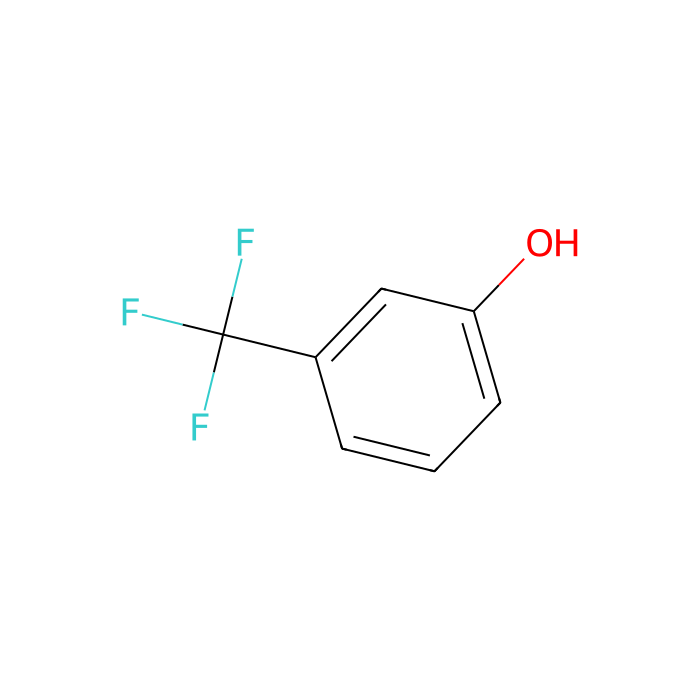
Brief description: 3-Hydroxybenzotrifluoride (meta-hydroxybenzotrifluoride) is a phenolic aromatic bearing a strongly electron-withdrawing trifluoromethyl group in the meta position.
Item-specific identifiers (from Product Data)
SKU: H101737
Product Name: 3-Hydroxybenzotrifluoride
CAS: 98-17-9
PubChem CID: 7376
InChIKey: Not specified for this item; refer to CoA/Spec Sheet.
SMILES: Not specified for this item; refer to CoA/Spec Sheet.
Computed/literature structural data (general reference, not item-specific specs)
Typical SMILES (literature): c1cc(C(F)(F)F)cc(O)c1 (meta relationship between CF3 and OH)
Typical InChIKey (literature): common listings report DMQPPAYWQNGCDG-UHFFFAOYSA-N (check primary databases/SDS to confirm)
Structural features (general description)
Aromatic ring with two substituents: a phenolic hydroxyl (–OH) and a trifluoromethyl (–CF3) group in a meta (3-) arrangement.
Functional groups: phenol (acidic hydrogen capable of H-bond donation/acceptance via conjugate base), and –CF3 (strong –I/–M electron-withdrawing group, lipophilic).
2D structure in words: A benzene ring bearing –OH at C1 and –CF3 at C3 (meta), with three fluorine atoms bound to the benzylic quaternary carbon.
Electronic effects: –CF3 deactivates the ring toward electrophilic aromatic substitution and directs meta; the phenolic oxygen increases acidity relative to phenol due to the additional –CF3 withdrawal.
Note: Structural identifiers above labeled as “literature” are for orientation and should be verified against the item’s CoA/SDS for definitive identity data.
Synthetic Utility
Key reactivity features (literature/general):
Functional groups
Phenolic OH: amenable to O-alkylation, O-arylation (via Mitsunobu or through aryl triflates + cross-coupling after derivatization), acylation, sulfonylation, silyl protection (TBS/TBDPS), and carbonate formation.
–CF3: strongly electron-withdrawing, meta-directing in EAS, stabilizes adjacent negative charge inductively, reduces phenolic nucleophilicity vs phenol, and enhances lipophilicity of derived molecules.
Typical transformations
Williamson ether synthesis: m-CF3 phenoxide + alkyl halides/sulfonates → aryl ethers. Use K2CO3/Cs2CO3 or NaH; polar aprotic solvent.
Mitsunobu etherification: couples with alcohols under PPh3/DIAD (or modern variants) to form aryl ethers without strong base.
O-Acylations/sulfonations: Rapid with acyl/sulfonyl chlorides; products serve as protecting groups or intermediates.
Aryl triflate route: Convert phenol to aryl triflate (Tf2O, pyridine/Et3N) to create a superb leaving group for Pd-catalyzed cross-couplings (Suzuki, Stille, Negishi) on the aryl position originally bearing OH.
Strategic value in retrosynthesis
As a meta-CF3 handle, it allows access to motifs difficult to install late-stage by direct CF3 introduction. Starting from the phenol enables rapid library synthesis of m-CF3 aryl ethers/esters with varied O-substituents.
Purification/analysis tips
19F NMR rapidly confirms CF3 incorporation. Ethers/esters typically show distinct GC retention and simplified NMR patterns vs the parent phenol. Phenolic hydrogen exchange can complicate integration; consider D2O shake or dry conditions.
Target Specificity
Not applicable. This product is a small-molecule chemical reagent and is not an antibody, enzyme, or biological probe with defined target specificity. No antigen/epitope, clone, isotype, or species reactivity information applies.
We use cookies to ensure the website functions properly and, where permitted, to improve your experience. You can manage your preferences at any time in Settings. Learn more in our Cookie Policy.
Shall we send you a message when we have discounts available?
Remind me later
Thank you! Please check your email inbox to confirm.
Products are supplied to verified businesses, institutions, and qualified professionals for research and development use only. Not for use in humans, animals, diagnosis, or therapy.

 C2313270