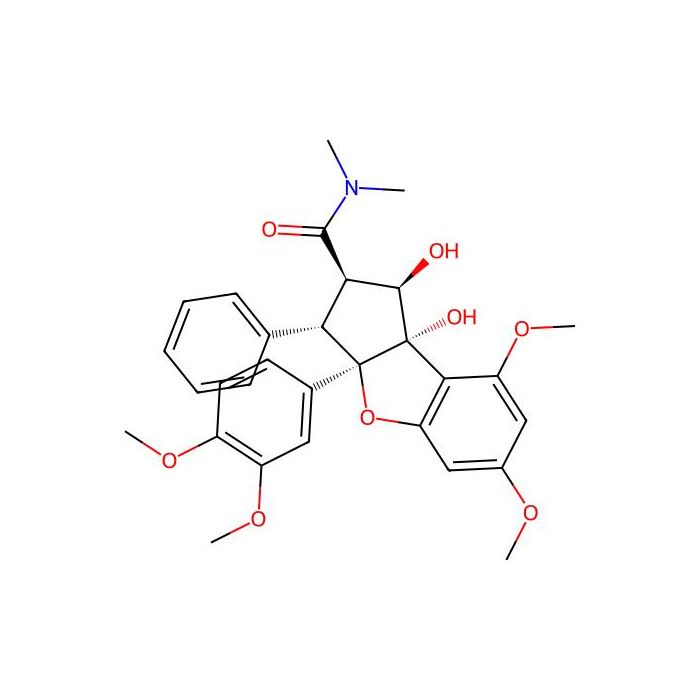
This compound belongs to the class of organic compounds known as flavaglines. These are heterocyclic compounds with a structure characterized by a cyclopenta[b]benzofuran skeleton.
External Descriptors
Not available
1. Djoumbou Feunang Y, Eisner R, Knox C, Chepelev L, Hastings J, Owen G, Fahy E, Steinbeck C, Subramanian S, Bolton E, Greiner R, and Wishart DS. ClassyFire: Automated Chemical Classification With A Comprehensive, Computable Taxonomy. Journal of Cheminformatics, 2016, 8:61.
Certificats (CoA, COO, BSE/TSE et tableau d'analyse)
C of A & Other Certificates(BSE/TSE, COO):
Analytical Chart:
Propriétés chimiques et physiques
Poids moléculaire
535.600 g/mol
XLogP3
2.800
Hydrogen Bond Donor Count
2
Hydrogen Bond Acceptor Count
8
Rotatable Bond Count
7
Exact Mass
535.221 Da
Monoisotopic Mass
535.221 Da
Topological Polar Surface Area
107.000 Ų
Heavy Atom Count
39
Formal Charge
0
Complexity
866.000
Isotope Atom Count
0
Defined Atom Stereocenter Count
5
Undefined Atom Stereocenter Count
0
Defined Bond Stereocenter Count
0
Undefined Bond Stereocenter Count
0
The total count of all stereochemical bonds
0
Covalently-Bonded Unit Count
1
Calculateurs de solution
Molarity Calculator
Determine the necessary mass, volume, or concentration for preparing a solution.
Dilution Calculator
Determine the dilution needed to prepare a stock solution.
Reconstitution Calculator
Avis
Avis des clients
Application Protocols
Item-specific validated applications:
None specified for this item in the Product Data.
General protocols for small-molecule test articles (guidance only):
Stock preparation: Dissolve in anhydrous DMSO to 10–20 mM. Vortex/sonicate until clear. Aliquot into amber vials or plates to minimize freeze–thaw.
Cell-based assays: Dilute stock into pre-warmed culture medium to the desired final concentration, keeping final DMSO typically ≤0.1–0.5% v/v. Include vehicle controls and, if available, a mechanistic positive control from the rocaglate class.
Biochemical assays: Use assay buffer containing a small percentage of solvent (e.g., 0.5–1% DMSO) to maintain solubility. Pre-incubate with target protein where mechanism requires.
Analytical QC: Confirm concentration by UV or quantitative NMR when feasible; verify identity/purity by LC–MS prior to critical experiments.
Documentation:
Record lot number, preparation date, solvent, and concentration for traceability. Refer to the CoA/Spec Sheet for any lot-specific handling notes.
Rocaglamide and related rocaglates (flavaglines) are widely used as research probes in chemical biology. A hallmark reported mechanism in the literature is modulation of eukaryotic translation initiation via interaction with the DEAD-box RNA helicase eIF4A, stabilizing eIF4A–RNA complexes and thereby impacting cap-dependent translation. Substitution patterns (such as aryl methoxy groups) can tune potency and selectivity across isoforms and cellular contexts.
The polycyclic cyclopenta[b]benzofuran scaffold is a privileged structure in chemical biology programs, often investigated for effects on stress response pathways, proteostasis, and apoptosis signaling in model systems. These studies are research-focused and mechanistic; no therapeutic or clinical claims are made here.
As with many lipophilic natural-product-like small molecules, nonspecific binding (to serum proteins or plastic surfaces) and limited aqueous solubility can influence apparent activity; careful assay design and controls are recommended.
Item-specific biological data:
No target, potency, or cellular activity data are specified for this item in the Product Data. Users should consult primary literature for 3'-methoxy substitutions within the rocaglamide series and verify activity in their own systems.
Buffer Applications
Not typically applicable:
3'-Methoxyrocaglamide is a neutral, non-buffering small molecule and is not used to establish or maintain pH.
Practical guidance for assay buffers (general):
Prepare concentrated DMSO stocks and dilute into pre-made biological buffers (e.g., PBS, HEPES, Tris) to the desired final concentration, ensuring the final DMSO content is compatible with the assay (commonly ≤0.1–1% v/v).
To mitigate precipitation on dilution: add the DMSO stock to vigorously mixed buffer last, optionally with a small co-solvent percentage (e.g., 0.01–0.1% Tween 80 or 0.5–1% ethanol) if permissible for the assay.
Filter sterilize assay media after addition of organic co-solvents only if compatible; otherwise, sterile stock solutions may be prepared and added aseptically.
Item-specific buffer specifications: Not specified for this item; refer to CoA/Spec Sheet if any validated buffer formulations are provided.
Green Alternatives
Context:
As a complex, target-focused small molecule supplied for research and screening, 3'-Methoxyrocaglamide is not a process solvent or routine reagent where greener drop-in replacements are typically discussed. However, greener practices apply to its handling and formulation.
Greener handling considerations (general):
Use minimal DMSO stock volumes and prepare the highest feasible concentration to reduce solvent consumption.
For preparative workups or analytical sample prep, prefer less hazardous solvents (e.g., ethanol or ethyl acetate) over chlorinated solvents when compatible with solubility and stability.
Implement microscale assays and high-throughput formats to decrease chemical and solvent footprints.
Illustrative comparison for stock preparation solvents (general):
DMSO: High solubilizing power, fully miscible with water; not volatile and has favorable EHS profile relative to many aprotic solvents; may affect some biological assays at higher percentages.
Ethanol: Renewable feedstock potential and lower toxicity; solubility for lipophilic heteroaromatics may be lower vs DMSO; volatility can aid drying but increases fire risk.
Note: No specific green metrics or alternative chemistries are specified for this item; apply institutional green chemistry guidelines where feasible.
Pharmaceutical Uses
Not a formulated excipient:
3'-Methoxyrocaglamide is supplied for research use only and is not an approved pharmaceutical excipient or active ingredient.
Research/manufacturing context (general):
May serve as a reference standard in analytical development (e.g., LC–MS assay qualification) for programs exploring rocaglate chemotypes.
Utilized in discovery-phase screening cascades and mechanistic studies; any preclinical formulation work (e.g., for in vivo research) should be guided by institutional protocols and is outside the scope of this listing.
No pharmacopeial monographs or compendial specifications are indicated for this item in the Product Data.
Item-specific regulatory/formulation notes:
None provided. All use is restricted to research and laboratory investigation. No medical or clinical uses are stated or implied.
Physical Properties
Item-specific specifications:
Appearance: Not specified for this item; refer to CoA/Spec Sheet.
Molecular weight: Not specified for this item; refer to CoA/Spec Sheet.
Other specifications (mp/bp/density/UV cutoff, etc.): Not specified for this item; refer to CoA/Spec Sheet.
Literature/general properties for rocaglamide-type small molecules (non-specification guidance):
Physical state: typically isolated as off-white to pale solids.
Solubility profile: low aqueous solubility; readily soluble in polar aprotic organic solvents such as DMSO and DMF; moderate solubility in alcohols; limited in hydrocarbons and water.
UV/Vis: polyaromatic/heteroaromatic cores usually show strong UV absorption in the 200–300 nm region; exact maxima depend on substitution.
LogP/cLogP: rocaglates are generally lipophilic to moderately lipophilic owing to their polycyclic aromatic framework and limited ionizable groups; specific values vary by derivative.
Stability: polyoxygenated aryl ethers and amides are generally stable under neutral, anhydrous conditions; prolonged exposure to strong acids/bases may cause hydrolysis or demethylation (for methoxy groups). Light sensitivity can occur with polyaromatic systems; store protected from excessive light as good practice.
Note: Any exact numerical values (mp, bp, logP, pKa, refractive index, water content, peroxide levels, metals, or UV cutoffs) are not specified for this item and should be taken from the item’s CoA/Spec Sheet if required.
Quality and Grades
Item-specific grade and purity:
Grade/Purity: Not specified for this item; refer to CoA/Spec Sheet.
Context and expectations (general guidance):
Small-molecule library members are typically supplied at high chemical purity suitable for discovery screening, hit validation, and mechanistic studies. When provided, HPLC area% and spectral identity (1H NMR, MS) support compound identity and purity.
If labeled as “screening grade,” expect high HPLC purity (often ≥95% area by a single method), with residual solvent and counter-ion content potentially reported on the CoA.
If a stabilizer, salt form, or specific polymorph is applicable, it will be stated on the label/CoA. No stabilizers or salt forms are specified for this item in the provided data.
Researchers conducting quantitative assays (biophysical binding, ITC, or kinetic studies) should verify purity, water content, and counter-ion identity from the CoA and independently confirm by HPLC/LC–MS where critical.
Trace impurity and metals specifications, UV cutoffs, and residual solvent limits are not specified here and should be obtained from the CoA/Spec Sheet if needed for regulated workflows.
Reaction and Applications
Scope for this compound type:
3'-Methoxyrocaglamide is primarily used as a bioactive small molecule standard or screening library member rather than as a general synthetic reagent. Consequently, classic reagent-centered transformations (e.g., Grignard formation, cross-couplings performed on this item as a substrate) are not typical end-user applications.
General laboratory applications (non-specification/literature-based):
Reference compound for cell-free biochemical assays, biophysical binding studies, and cell-based screening where rocaglate scaffolds are investigated.
Analytical standard for LC–MS method development in studies targeting rocaglate-like chemotypes.
Control material for comparative SAR investigations alongside other rocaglamide derivatives.
Practical notes:
Prepare concentrated DMSO stocks under dry, inert atmosphere if long-term stability is a concern; aliquot to avoid multiple freeze–thaw cycles.
For combinatorial testing, pre-screen solubility at desired concentrations (e.g., 1–50 µM final in assay) to mitigate precipitation upon dilution into aqueous buffers.
Protect from strong acids/bases during any derivatization attempts (if performed in a research context) to minimize amide hydrolysis or O-demethylation of the methoxy substituent.
Manufacturer Applications: No additional manufacturer application notes were provided in the Product Data.
Reaction Conditions
Applicability:
End-users typically employ 3'-Methoxyrocaglamide as a test article in assays rather than subjecting it to synthetic reactions. Consequently, there are no canonical reaction conditions for this item as a reagent substrate.
General handling/solution preparation (non-specification guidance):
Stock solution: prepare at 10–20 mM in anhydrous DMSO; sonication or brief warming (≤40 °C) can aid dissolution. Filter if particulate persists (PTFE, 0.2 µm) when compatible.
Working concentrations: common assay ranges are 1–10,000 nM depending on assay sensitivity; verify solubility and avoid exceeding vehicle limits.
Stability checks: perform short-term stability tests (e.g., 24–72 h at room temperature and 4 °C in assay media) by LC–MS or HPLC to confirm no rapid degradation.
If derivatization is attempted (general organic chemistry considerations):
Avoid strongly acidic or basic conditions that may hydrolyze amide or promote O-demethylation.
Conduct any oxidations or reductions at low temperature and monitor closely to preserve the polycyclic core.
Item-specific, validated reaction or assay conditions: Not specified for this item; consult primary literature for rocaglamide analogs if needed.
Safety and Handling
Item-specific hazard information:
Signal Word: Not specified for this item; refer to SDS.
H-Statements: Not specified for this item; refer to SDS.
GHS Classification: Not specified for this item; refer to SDS.
Pictograms: Not specified for this item; refer to SDS.
General laboratory safety guidance (non-specification):
Handle in a chemical fume hood, avoiding inhalation of dusts or aerosols. Use appropriate PPE: lab coat, nitrile gloves, and safety glasses.
Avoid contact with strong acids/bases and strong oxidizing agents that may degrade aromatic ethers or amide functionalities.
Prevent environmental release; collect organic solvent rinses and residues as halogen-free organic waste unless otherwise required by local regulations.
First aid overview: in case of skin/eye contact, rinse with water for several minutes; remove contaminated clothing. If inhaled, move to fresh air. If ingested, rinse mouth; seek medical attention in all cases as per SDS instructions.
Fire safety: Treat as an organic combustible solid; use CO2, dry chemical, or foam. Avoid water jets on solvent-rich fires.
Weighing and solution prep: Minimize dust formation; for screening stocks, dissolve directly into dry, oxygen-poor DMSO if needed to maximize stability.
Always consult the product’s SDS for authoritative hazard classification, exposure limits, and emergency procedures. For research use only.
Solvent Selection
Applicability:
3'-Methoxyrocaglamide is a polycyclic, neutral small molecule. For solution preparation and screening use, solvent choice focuses on achieving a clear, stable stock solution without chemical degradation.
General solubility guidance (literature/general):
Preferred solvents for stock solutions: DMSO (highly recommended), DMF, or mixtures of DMSO with water or buffer for downstream dilution.
Secondary options: ethanol or methanol, sometimes with gentle warming and sonication; solubility may be limited compared with DMSO.
Aqueous media: Direct dissolution in water or buffer is typically poor; prepare concentrated DMSO stocks (e.g., 10–20 mM) and dilute into assay media, maintaining final DMSO ≤0.1–1% v/v as assay-appropriate.
Polarity/miscibility notes (general):
DMSO is polar aprotic (dielectric ~47, miscible with water) and minimizes precipitation on dilution when added last to aqueous buffers.
Alcohols are protic and can aid wetting but may reduce stability in some cases; verify by short stability checks.
Comparison (general):
DMSO vs ethanol: DMSO typically affords higher solubility and better freeze–thaw stability of stocks; ethanol may be preferable for enzyme systems sensitive to DMSO but can have lower solubility limits.
Item-specific solvent specifications: Not specified for this item; refer to CoA/Spec Sheet for any validated solvent data.
Storage and Reconstitution
Item-specific storage:
Storage Conditions: Room temperature (as provided in Product Data). Protect from excessive heat, moisture, and light as good laboratory practice.
Shipped In: Not specified for this item; refer to CoA/Spec Sheet.
Reconstitution (general guidance for small molecules; not a specification):
For assay use, reconstitute in anhydrous DMSO to prepare a concentrated stock (e.g., 10–20 mM). Vortex/sonicate to fully dissolve. If required, warm gently (≤40 °C) and protect from light.
After reconstitution, aliquot into small volumes (amber vials or 96/384-well plates) to avoid repeated freeze–thaw. Although the neat solid is stored at room temperature per Product Data, frozen storage of DMSO stocks at −20 °C or −80 °C is commonly practiced to maximize stability; avoid multiple freeze–thaw cycles by using single-use aliquots.
Allow frozen DMSO stocks to equilibrate to room temperature before opening to prevent moisture uptake. Inspect for precipitation or discoloration before use.
Expiration and stability:
No shelf-life or stability specifications are provided for this item. For definitive guidance, consult the item’s CoA/Spec Sheet and SDS. Use only for research purposes.
3'-Methoxyrocaglamide is a rocaglate (flavagline) derivative of the natural product rocaglamide, typically featuring a fused cyclopenta[b]benzofuran core decorated with multiple oxygenated substituents and an amide function. The “3'-methoxy” designation refers to a methoxy group on the aryl portion of the scaffold.
Functional groups commonly present in rocaglamides include: a benzofuran ring system, a cyclopentane ring fused to the benzo-fused heteroaryl, phenolic/methoxy substituents, and an amide moiety.
Stereochemistry: Rocaglates are classically polycyclic and stereochemically defined; multiple contiguous stereocenters are typical in the natural products and many semisynthetic derivatives (exact configuration for this specific item is not specified here).
2D structure in words (literature/general):
A tricyclic cyclopenta[b]benzofuran skeleton bearing aryl/alkoxy substituents and an external amide side chain; a methoxy substituent is located at the 3'-position of the aryl ring in the rocaglamide framework.
Synthetic Utility
Scope for this molecule class:
3'-Methoxyrocaglamide is a complex, polyfunctional small molecule typically employed as a finished compound for biological investigation rather than as a general-purpose synthetic building block.
General retrosynthetic considerations for rocaglamide analogs (literature/general):
The cyclopenta[b]benzofuran core can arise from oxidative dearomatization/cyclization sequences or stepwise annulations; late-stage functionalization can install methoxy groups via O-alkylation on phenolic precursors.
The amide moiety enables limited derivatization (e.g., amide coupling, N-alkylation under controlled conditions), but such modifications may compromise the delicate stereochemical integrity and SAR-relevant features of the scaffold.
Protection strategies: phenols (if present) often require protection (e.g., benzyl, silyl) during multistep synthesis; methoxy substituents are typically stable under neutral to mildly basic conditions but can be cleaved under strong Lewis/Brønsted acids.
End-user utility:
Most users will not transform this compound chemically; instead, it functions as an authentic reference for SAR comparison, analytical calibration, and biological testing.
Item-specific reactivity specs (e.g., residual catalysts, salt form, polymorph): Not specified for this item; refer to CoA/Spec Sheet.
Target Specificity
Item-specific target data:
Not specified for this item; refer to primary literature or internal assay data.
Literature/general context (non-item-specific):
Rocaglate probes are commonly studied for interaction with the eukaryotic RNA helicase eIF4A within the translation initiation complex, with reported effects on cap-dependent translation in research systems. Specific target engagement, isoform preference, and potency depend on substitution patterns and experimental conditions.
Important note:
This section does not constitute a validated target assignment for the specific item listed. Users should verify target specificity and mechanism of action in their own assays.
We use cookies to ensure the website functions properly and, where permitted, to improve your experience. You can manage your preferences at any time in Settings. Learn more in our Cookie Policy.
Shall we send you a message when we have discounts available?
Remind me later
Thank you! Please check your email inbox to confirm.
Products are supplied to verified businesses, institutions, and qualified professionals for research and development use only. Not for use in humans, animals, diagnosis, or therapy.