5-TAMRA - ≥97% , CAS No.91809-66-4

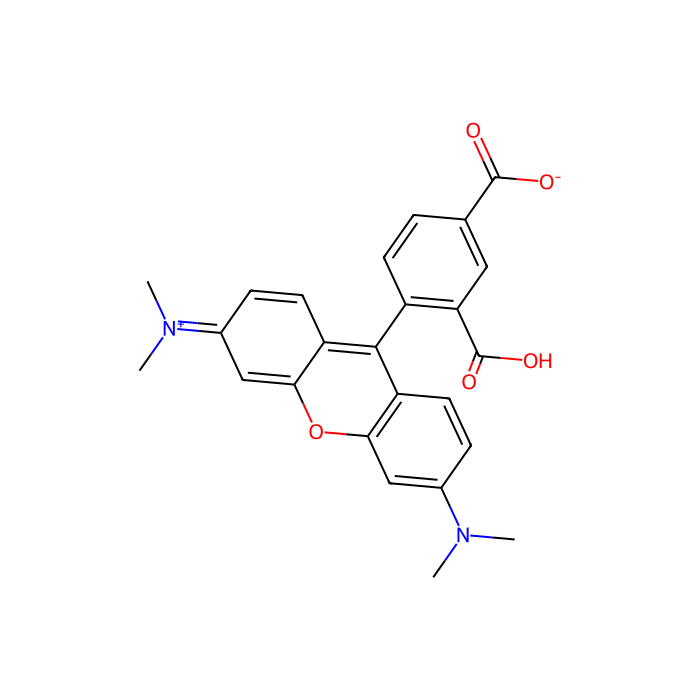
CAS: 91809-66-4 Cat. No.: C272928 Formule: C25H22N2O5 Poids moléculaire: 430.45 Numéro CE: 989-222-5
DISPONIBLE À COMMANDE
GRADE & PURITY ≥97%
Synonyms
2-[3,6-bis(diméthylamino)xanthénium-9-yl]-5-carboxybenzoate | 2-(3,6-Bis(diméthylamino)xanthylium-9-yl)-5-carboxybenzoate | Acide 5(6)-TAMRA | BCP20413 | AKOS032949753 | BP-23469 | 5-Carboxytétraméthyl Rhodamine | AKOS016000326 | DTXSID20376330 | F12248 |
Storage
A l'abri de la lumière,A conserver à -20°C,Desséché
Shipped In
Glacière + blocs de glace
★
Size
Allemagne (EU)
USA*
Price
Qty
50mg
C272928-50mg
—
2 En stock
45,90€
100mg
C272928-100mg
Sur commande · 8–12 semaines
73,67€
250mg
C272928-250mg
—
3 En stock
146,56€
1g
C272928-1g
—
1 En stock
485,85€
5g
C272928-5g
—
1 En stock
1 711,09€
Enter a quantity for the sizes you want to add.
🧪

Why this grade

≥97% for sensitive chromatographic and analytical workflows requiring minimal baseline interference.

🌡

Storage & shipping

A l'abri de la lumière,A conserver à -20°C,Desséché Ships Glacière + blocs de glace Check lot-specific COA for exact specifications.

📋

Quality documents

SDS, COA, datasheet, and spec sheet available for download. Lot-specific COA accessible via lot number lookup.

📚

Literature proof

Cited in 3 peer-reviewed publications across chromatography, organic synthesis, and cross-coupling reactions.

Vue d’ensemble

Acides carboxyliques fluorescents et leurs esters de succinimidyle

Les esters de succinimidyle se sont avérés être les meilleurs réactifs pour les modifications d'amines car les liaisons amides formées sont essentiellement identiques et aussi stables que les liaisons peptidiques naturelles. Ces réactifs sont généralement stables et présentent une bonne réactivité et sélectivité avec les amines aliphatiques. Quelques facteurs doivent être pris en compte lorsque les composés SE sont utilisés pour la réaction de conjugaison :

1). Solvants : la plupart des colorants réactifs sont des molécules hydrophobes et doivent être dissous dans du diméthylformamide (DMF) ou du diméthylsulfoxyde (DMSO) anhydre.

2). PH de réaction : les réactions de marquage des amines avec les esters de succinimidyle dépendent fortement du pH. Les réactifs aminés réagissent avec les groupes amines aliphatiques non tamponnés, y compris les amines terminales des protéines et les groupes e-amino des lysines. Les réactions d'acylation des amines sont donc généralement effectuées à un pH supérieur à 7,5. Les modifications de protéines par des esters de succinimidyle peuvent généralement être effectuées à un pH compris entre 7,5 et 8,5, tandis que les isothiocyanates peuvent nécessiter un pH compris entre 9,0 et 10,0 pour des conjugaisons optimales.

3) Tampons de réaction : les tampons contenant des amines libres telles que le Tris et la glycine et les composés thiols doivent être évités lors de l'utilisation d'un réactif réactif aux amines. Les sels d'ammonium (tels que le sulfate d'ammonium et l'acétate d'ammonium) qui sont largement utilisés pour la précipitation des protéines doivent également être éliminés (comme la viadinlyse) avant d'effectuer les conjugaisons de colorants.

4). Température de réaction : la plupart des conjugaisons sont effectuées à température ambiante. Cependant, une température élevée ou réduite peut être nécessaire pour une réaction de marquage particulière.

Caractéristiques et applications biologiques

le 5-TAMRA est le seul isomère purifié du 5(6)-TAMRA. Il est largement utilisé pour marquer les peptides et les protéines. Il est préféré pour certaines applications biologiques complexes où la reproductibilité est plus importante que le coût du matériau, car la différence de position mineure entre le 5-TAMRA et le 6-TAMRA peut affecter certaines propriétés biologiques des conjugués sous-jacents.

Paramètre du produit

Ex(nm):541

Em(nm):568

Références

1. Evans NA, et al (2001). Visualisation des différences dans les interactions bêta-arrestin-GFP induites par les ligands et le trafic entre trois récepteurs couplés aux protéines G récemment caractérisés. J Neurochem77, 476-85.

2. Hahn, M., et al, Influence of fluorophor dye labels on the migration behavior of polymerase chain reaction-amplified short tandem repeats during denaturing capillary electrophoresis.Electrophoresis2001, 22, 2691-700.

3. Yoo H et Juliano RL (2000). Enhanced delivery of antisense oligonucleotides with fluorophore- conjugated PAMAM dendrimers (livraison améliorée d'oligonucléotides antisens avec des dendrimères PAMAM conjugués à des fluorophores). Nucleic Acids Res28, 4225-31.

Specifications

Synonymes
2-[3,6-bis(diméthylamino)xanthénium-9-yl]-5-carboxybenzoate | 2-(3,6-Bis(diméthylamino)xanthylium-9-yl)-5-carboxybenzoate | Acide 5(6)-TAMRA | BCP20413 | AKOS032949753 | BP-23469 | 5-Carboxytétraméthyl Rhodamine | AKOS016000326 | DTXSID20376330 | F12248 |
Spécifications et pureté
≥97%
Conditions de stockage de stockage
A l'abri de la lumière,A conserver à -20°C,Desséché
Expédié en
Glacière + blocs de glace
Pureté
≥97%
Noms et identifiants
Pubchem Sid504761672
Pubchem Sid Urlhttps://pubchem.ncbi.nlm.nih.gov/substance/504761672
Sourires canoniquesCN(C)C1=CC2=C(C=C1)C(=C3C=CC(=[N+](C)C)C=C3O2)C4=C(C=C(C=C4)C(=O)[O-])C(=O)O
IUPAC Name3-carboxy-4-[3-(dimethylamino)-6-dimethylazaniumylidenexanthen-9-yl]benzoate
InChIKeyYMZMTOFQCVHHFB-UHFFFAOYSA-N
INCHI1S/C25H22N2O5/c1-26(2)15-6-9-18-21(12-15)32-22-13-16(27(3)4)7-10-19(22)23(18)17-8-5-14(24(28)29)11-20(17)25(30)31/h5-13H,1-4H3,(H-,28,29,30,31)
Isomères SMILES CN(C)C1=CC2=C(C=C1)C(=C3C=CC(=[N+](C)C)C=C3O2)C4=C(C=C(C=C4)C(=O)[O-])C(=O)O
WGK Allemagne 3
Poids moléculaire 430.45
Reaxy-Rn 27597948
Reaxys-RN_link_address https://www.reaxys.com/reaxys/secured/hopinto.do?context=S&query=IDE.XRN=27597948&ln=

Documentation

📋 Safety Data Sheet (SDS)

Comprehensive hazard, handling, storage, and regulatory compliance document.

Download SDS →

✅ Certificate of Analysis (COA)

Lot-specific quality data. Enter your lot number to retrieve the exact COA.

Look up COA →

📊 Datasheet

Quick-reference summary of product specifications and applications.

View datasheet →

🔬 Specification Sheet

Full quality attributes and acceptance criteria for this grade.

View spec sheet →

Advanced Data

Taxonomic Classification

Taxonomy Tree

KingdomOrganic compounds
SuperclassOrganoheterocyclic compounds
ClasseBenzopyrans
Subclass1-benzopyrans
Intermediate Tree Nodes Dibenzopyrans
Direct ParentXanthenes
Alternative Parents M-phthalic acid and derivatives  Benzoic acids  Benzoyl derivatives  Dialkylarylamines  Dicarboxylic acids and derivatives  Secondary ketimines  Heteroaromatic compounds  Amino acids  Carboxylic acid salts  Oxacyclic compounds  Carboxylic acids  Hydrocarbon derivatives  Organic oxides  Organic salts  Organic zwitterions  Organooxygen compounds  Organopnictogen compounds  
Molecular FrameworkAromatic heteropolycyclic compounds
Substituents Xanthene - Meta_phthalic_acid - Benzoic acid or derivatives - Benzoic acid - Benzoyl - Dialkylarylamine - Tertiary aliphatic/aromatic amine - Monocyclic benzene moiety - Dicarboxylic acid or derivatives - Benzenoid - Heteroaromatic compound - Secondary ketimine - Amino acid or derivatives - Amino acid - Carboxylic acid salt - Tertiary amine - Carboxylic acid derivative - Oxacycle - Carboxylic acid - Organic salt - Organic nitrogen compound - Amine - Hydrocarbon derivative - Organic oxide - Organopnictogen compound - Organic oxygen compound - Organic zwitterion - Organonitrogen compound - Organooxygen compound - Aromatic heteropolycyclic compound
DescriptionThis compound belongs to the class of organic compounds known as xanthenes. These are polycyclic aromatic compounds containing a xanthene moiety, which consists of two benzene rings joined to each other by a pyran ring.
External Descriptors xanthenes
Structure 3D
Modèle de structure chimique interactif


Certificats (CoA, COO, BSE/TSE et tableau d'analyse)
C of A & Other Certificates(BSE/TSE, COO):
Analytical Chart:

Find and download the COA for your product by matching the lot number on the packaging.

11 results found

Lot NumberCertificate TypeDateArticle
I2602028Certificate of AnalysisSep 14, 2026 C272928
C2208267Certificate of AnalysisSep 07, 2026 C272928
C2208268Certificate of AnalysisSep 07, 2026 C272928
L2403237Certificate of AnalysisJun 11, 2026 C272928
J2114486Certificate of AnalysisMay 18, 2026 C272928
F2518147Certificate of AnalysisApr 02, 2026 C272928
F2505032Certificate of AnalysisMar 18, 2026 C272928
B2306914Certificate of AnalysisFeb 04, 2026 C272928
J2307056Certificate of AnalysisJan 20, 2026 C272928
J2114459Certificate of AnalysisMay 11, 2023 C272928
J2114476Certificate of AnalysisMay 11, 2023 C272928

Show more ⌵

Propriétés chimiques et physiques
SensibilitéLight and moisture sensitive
Point d'éclair (°F)92.5 °C
Point d'éclair (°C)92.5°C
Poids moléculaire430.500 g/mol
XLogP33.200
Hydrogen Bond Donor Count1
Hydrogen Bond Acceptor Count6
Rotatable Bond Count3
Exact Mass430.153 Da
Monoisotopic Mass430.153 Da
Topological Polar Surface Area92.900 Ų
Heavy Atom Count32
Formal Charge0
Complexity875.000
Isotope Atom Count0
Defined Atom Stereocenter Count0
Undefined Atom Stereocenter Count0
Defined Bond Stereocenter Count0
Undefined Bond Stereocenter Count0
The total count of all stereochemical bonds0
Covalently-Bonded Unit Count1
FAQ et articles
Citations of This Product
Références
1. Yijun Luo, Yuxia Luo, Yuxi Liu, Yin Huang, Ping Yu, Hao Ma, Xinping Li, Zhao Zhang, Cuiling Zhang, Chaohao Chen, Philip A. Gale, Guochen Bao.  (2024)  A Hybrid Strategy to Enhance Small-Sized Upconversion Nanocrystals.  BIOSENSORS & BIOELECTRONICS,      [PMID:39657555] [10.1016/j.bios.2024.117003]
2. Yajing Yang, Fenglin Li, Dayin Sun, Yilan Ye, Zhenzhong Yang.  (2024)  Large-Scale Synthesis of Reactive Janus Inorganic/Polymer Colloidal Dimer.  MACROMOLECULES,      [PMID:] [10.1021/acs.macromol.3c02334]
3. Li Shuo, Xu Bing, Lu Ming-jun, Wu Qian-wen, Qin Wen-qing, Dai Zi-qi, Li Xiao-jiao-yang, Bai Jin-zhao, Lei Hai-min, Liu Run-ping.  (2026)  A sinomenine derivative protects life-threatening inflammatory injuries via covalently binding to a novel allosteric inhibition site of IRF3.  ACTA PHARMACOLOGICA SINICA,      [PMID:41545756] [10.1038/s41401-025-01723-3]
Calculateurs de solution
Avis

Avis des clients

Foire aux questions

What is the purity of this product?
This product is supplied at ≥97% purity (chemical assay). Lot-specific values are stated on the Certificate of Analysis.
How should this product be stored?
Store at ?20 °C, protected from light, desiccated. Keep the container tightly closed with desiccant — the material is moisture-sensitive.
How is this product shipped?
This product ships in an insulated container with ice pads. Unpack on arrival and transfer it to the storage condition stated above.
What are the CAS number, molecular formula and molecular weight?
The CAS Number is 91809-66-4, the molecular formula is C25H22N2O5, and the molecular weight is 430.45 g/mol. InChIKey YMZMTOFQCVHHFB-UHFFFAOYSA-N.
What documentation is provided?
Available product documentation, including Certificates of Analysis (COA), Safety Data Sheets (SDS), and specification sheets, is shown in the product document area. Document availability and access follow the current site policy.

Shall we send you a message when we have discounts available?

Remind me later

Thank you! Please check your email inbox to confirm.

Oops! Notifications are disabled.