Determine the necessary mass, volume, or concentration for preparing a solution.
Taxonomy Tree
| Kingdom | Organic compounds |
|---|---|
| Superclass | Organoheterocyclic compounds |
| Classe | Pyridines and derivatives |
| Subclass | Pyridinecarboxylic acids and derivatives |
| Intermediate Tree Nodes | Not available |
| Direct Parent | Pyridinecarboxylic acids |
| Alternative Parents | Polyhalopyridines 2-halopyridines Aryl fluorides Aryl chlorides Vinylogous halides Heteroaromatic compounds Carboxylic acids Azacyclic compounds Organooxygen compounds Organonitrogen compounds Organofluorides Organochlorides Organic oxides Hydrocarbon derivatives |
| Molecular Framework | Aromatic heteromonocyclic compounds |
| Substituents | Pyridine carboxylic acid - Polyhalopyridine - 2-halopyridine - Aryl chloride - Aryl fluoride - Aryl halide - Heteroaromatic compound - Vinylogous halide - Carboxylic acid derivative - Carboxylic acid - Azacycle - Organonitrogen compound - Organofluoride - Organochloride - Organohalogen compound - Organic nitrogen compound - Organic oxide - Organooxygen compound - Hydrocarbon derivative - Organic oxygen compound - Aromatic heteromonocyclic compound |
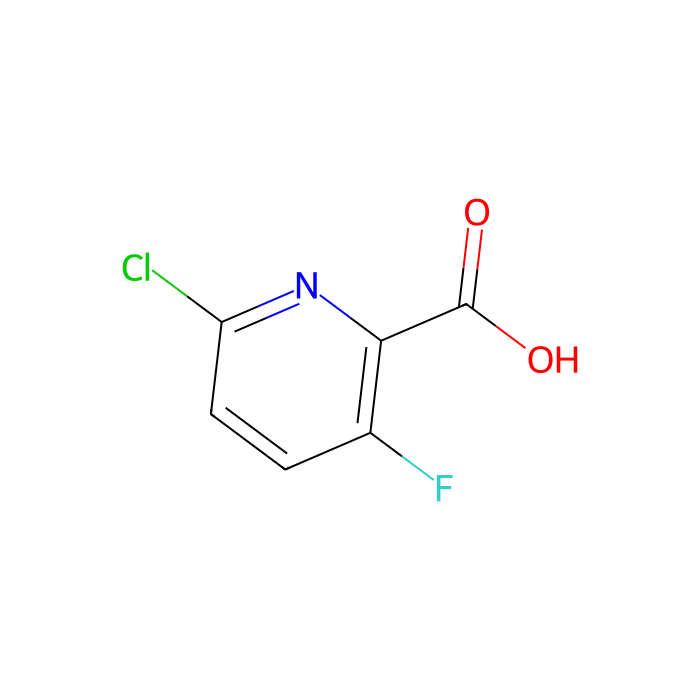
| Description | This compound belongs to the class of organic compounds known as pyridinecarboxylic acids. These are compounds containing a pyridine ring bearing a carboxylic acid group. |
| External Descriptors | Not available |
Find and download the COA for your product by matching the lot number on the packaging.
| Lot Number | Certificate Type | Date | Article |
|---|---|---|---|
| Certificate of Analysis | Nov 26, 2025 | C195530 | |
| Certificate of Analysis | Jul 01, 2023 | C195530 | |
| Certificate of Analysis | Jul 01, 2023 | C195530 | |
| Certificate of Analysis | Jul 01, 2023 | C195530 | |
| Certificate of Analysis | Jul 01, 2023 | C195530 | |
| Certificate of Analysis | Jul 01, 2023 | C195530 | |
| Certificate of Analysis | Jul 01, 2023 | C195530 | |
| Certificate of Analysis | Jul 01, 2023 | C195530 | |
| Certificate of Analysis | Jul 01, 2023 | C195530 | |
| Certificate of Analysis | Jul 01, 2023 | C195530 | |
| Certificate of Analysis | Jul 01, 2023 | C195530 |
| Poids moléculaire | 175.54 |
|---|---|
| XLogP3 | 1.800 |
| Hydrogen Bond Donor Count | 1 |
| Hydrogen Bond Acceptor Count | 4 |
| Rotatable Bond Count | 1 |
| Exact Mass | 174.984 Da |
| Monoisotopic Mass | 174.984 Da |
| Topological Polar Surface Area | 50.200 Ų |
| Heavy Atom Count | 11 |
| Formal Charge | 0 |
| Complexity | 167.000 |
| Isotope Atom Count | 0 |
| Defined Atom Stereocenter Count | 0 |
| Undefined Atom Stereocenter Count | 0 |
| Defined Bond Stereocenter Count | 0 |
| Undefined Bond Stereocenter Count | 0 |
| The total count of all stereochemical bonds | 0 |
| Covalently-Bonded Unit Count | 1 |
H302:Harmful if swallowed
H315:Causes skin irritation
H319:Causes serious eye irritation
H335:May cause respiratory irritation
P261:Avoid breathing dust/fume/gas/mist/vapors/spray.
P264:Wash hands [and …] thoroughly after handling.
P270:Do not eat, drink or smoke when using this product.
P271:Use only outdoors or in a well-ventilated area.
P280:Wear protective gloves/protective clothing/eye protection/face protection.
P321:Specific treatment (see ... on this label).
P330:Rinse mouth.
P302+P352:IF ON SKIN: wash with plenty of water.
P304+P340:IF INHALED: Remove person to fresh air and keep comfortable for breathing.
P305+P351+P338:IF IN EYES: Rinse cautiously with water for several minutes. Remove contact lenses if present and easy to do - continue rinsing.
P362+P364:Take off contaminated clothing and wash it before reuse.
P405:Store locked up.
P403+P233:Store in a well-ventilated place. Keep container tightly closed.
P501:Dispose of contents/container to an approved waste disposal plant.
P264+P265:Wash hands [and …] thoroughly after handling. Do not touch eyes.
P301+P317:IF SWALLOWED: Get medical help.
P337+P317:If eye irritation persists: Get medical help.
P332+P317:If skin irritation occurs: Get medical help.
P319:Get medical help if you feel unwell.
Not applicable. No antibody/assay protocols are associated with this chemical building block. For synthetic use, refer to the Reaction Conditions and Synthetic Utility sections for general literature guidance.
This compound is not a standard laboratory buffer component. As a heteroaromatic monocarboxylic acid, it lacks the defined buffering range and solubility characteristics desired for routine buffer systems.
While the compound itself is a fixed building block, several greener choices can be made around its use.
As a doubly halogenated picolinic acid, this molecule is a versatile heteroaryl building block enabling orthogonal functionalization.
General literature guidance for analogous substrates; optimize per substrate and scale. These are not specifications for this item.
This compound is a polar, heteroaromatic carboxylic acid solid. Solubility and reaction media choice strongly influence performance in couplings and substitutions.
A halogenated, heteroaromatic carboxylic acid derived from picolinic acid (pyridine‑2‑carboxylic acid) bearing chlorine at C‑6 and fluorine at C‑3.
Not applicable. This product is a small-molecule building block, not a biological targeting reagent. No antigen/epitope, clone, isotype, or species reactivity information applies.