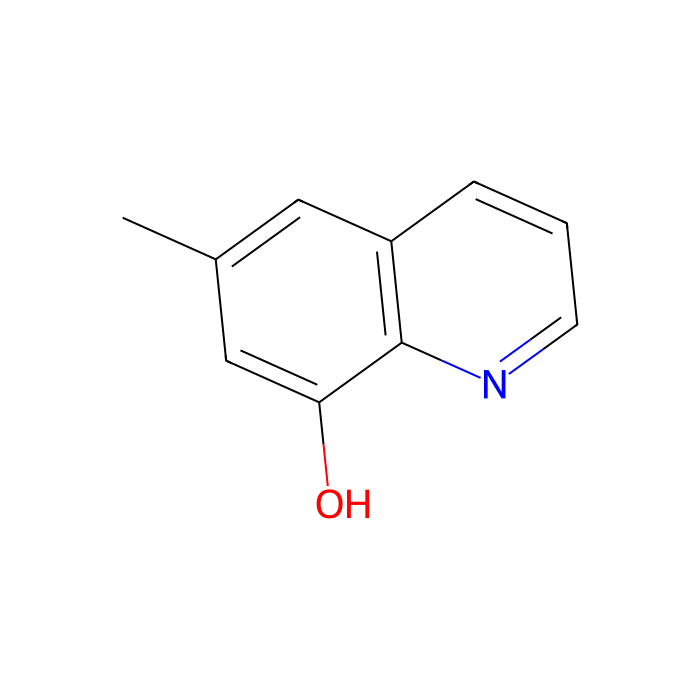
6-Methylquinolin-8-ol - ≥98% , CAS No.20984-33-2

CAS: 20984-33-2 Cat. No.: M192011 Formule: C10H9NO Poids moléculaire: 159.19
DISPONIBLE À COMMANDE
GRADE & PURITY ≥98%
Storage
Room temperature
Shipped In
Normal
★
Size
Allemagne (EU)
USA*
Price
Qty
25mg
M192011-25mg
Sur commande · 8–12 semaines

8,59€

12,93€
Enregistrer 4,34 € (33.56%)
100mg
M192011-100mg
Sur commande · 8–12 semaines

26,81€

40,70€
Enregistrer 13,88 € (34.12%)
Enter a quantity for the sizes you want to add.
🧪
Why this grade

≥98% for sensitive chromatographic and analytical workflows requiring minimal baseline interference.

🌡

Storage & shipping

Room temperature Ships Normal Check lot-specific COA for exact specifications.

📋

Quality documents

SDS, COA, datasheet, and spec sheet available for download. Lot-specific COA accessible via lot number lookup.

📚

Literature proof

Cited in 0 peer-reviewed publications across chromatography, organic synthesis, and cross-coupling reactions.

Specifications

Spécifications et pureté
≥98%
Conditions de stockage de stockage
Room temperature
Expédié en
Normal
Pureté
≥98%
Noms et identifiants
Sourires canoniques
CC1=CC2=C(C(=C1)O)N=CC=C2
IUPAC Name
6-methylquinolin-8-ol
InChIKey
AIBOXZCUYYHFTM-UHFFFAOYSA-N
INCHI
1S/C10H9NO/c1-7-5-8-3-2-4-11-10(8)9(12)6-7/h2-6,12H,1H3
Isomères SMILES
CC1=CC2=C(C(=C1)O)N=CC=C2
Poids moléculaire
159.19
Reaxy-Rn
119123
Reaxys-RN_link_address
https://www.reaxys.com/reaxys/secured/hopinto.do?context=S&query=IDE.XRN=119123&ln=

Documentation

📋 Safety Data Sheet (SDS)

Comprehensive hazard, handling, storage, and regulatory compliance document.

Download SDS →

✅ Certificate of Analysis (COA)

Lot-specific quality data. Enter your lot number to retrieve the exact COA.

Look up COA →

📊 Datasheet

Quick-reference summary of product specifications and applications.

View datasheet →

🔬 Specification Sheet

Full quality attributes and acceptance criteria for this grade.

View spec sheet →

Advanced Data

Taxonomic Classification

Taxonomy Tree

KingdomOrganic compounds
SuperclassOrganoheterocyclic compounds
ClasseQuinolines and derivatives
Subclass8-hydroxyquinolines
Intermediate Tree Nodes Not available
Direct Parent8-hydroxyquinolines
Alternative Parents 1-hydroxy-4-unsubstituted benzenoids  1-hydroxy-2-unsubstituted benzenoids  Pyridines and derivatives  Heteroaromatic compounds  Azacyclic compounds  Organopnictogen compounds  Organooxygen compounds  Organonitrogen compounds  Hydrocarbon derivatives  
Molecular FrameworkAromatic heteropolycyclic compounds
Substituents 8-hydroxyquinoline - 1-hydroxy-4-unsubstituted benzenoid - 1-hydroxy-2-unsubstituted benzenoid - Benzenoid - Pyridine - Heteroaromatic compound - Azacycle - Organic nitrogen compound - Organic oxygen compound - Organopnictogen compound - Hydrocarbon derivative - Organooxygen compound - Organonitrogen compound - Aromatic heteropolycyclic compound
DescriptionThis compound belongs to the class of organic compounds known as 8-hydroxyquinolines. These are compounds containing a quinoline moiety, which carries a hydroxy group at the 8-position. Quinoline consists of a benzene ring fused to a pyrimidine ring to form benzo[b]azabenzene.
External Descriptors Not available
Structure 3D
Modèle de structure chimique interactif


Certificats (CoA, COO, BSE/TSE et tableau d'analyse)
C of A & Other Certificates(BSE/TSE, COO):
Analytical Chart:
Propriétés chimiques et physiques
Poids moléculaire159.180 g/mol
XLogP32.400
Hydrogen Bond Donor Count1
Hydrogen Bond Acceptor Count2
Rotatable Bond Count0
Exact Mass159.068 Da
Monoisotopic Mass159.068 Da
Topological Polar Surface Area33.100 Ų
Heavy Atom Count12
Formal Charge0
Complexity160.000
Isotope Atom Count0
Defined Atom Stereocenter Count0
Undefined Atom Stereocenter Count0
Defined Bond Stereocenter Count0
Undefined Bond Stereocenter Count0
The total count of all stereochemical bonds0
Covalently-Bonded Unit Count1
Calculateurs de solution
Avis

Avis des clients

Application Protocols

No assay-specific, vendor-validated protocols are provided for this item. For general laboratory use:

  • Stock solutions (research use only):
    • Prepare 10–100 mM stocks in DMSO, DMF, or ethanol depending on downstream assay compatibility.
    • Filter (0.2 µm PTFE) if particulate is observed.
  • Metal-binding titrations:
    • Use metal-free buffers/solvents; determine pH accurately.
    • Titrate standardized metal solutions into ligand solution while recording UV–Vis/fluorescence.
  • Thin film/materials preparation:
    • Dissolve in aromatic solvent (e.g., toluene) with co-ligands if needed; spin-cast or drop-cast under inert atmosphere for optoelectronic studies.

These are general literature-style guidelines; adapt and validate for your system. Always consult primary references and your institutional safety protocols.

Biological Roles

No biological role is specified for this catalog item; it is provided strictly for research use only.

General literature context for the 8-hydroxyquinoline scaffold (non-clinical, non-therapeutic):

  • Metal ion chelation: The N,O-bidentate motif binds a variety of bio-relevant metal ions (e.g., Fe, Cu, Zn), altering their speciation in vitro. 6-Methyl substitution modulates lipophilicity and binding constants.
  • Fluorescence modulation: Metal coordination frequently yields chelation-enhanced fluorescence (CHEF) or quenching, enabling in vitro probes for metal sensing in biochemical assays.
  • Acid–base behavior: Protonation at the ring N (acidic media) and deprotonation at the phenolic O (basic media) impact membrane partitioning and binding to proteins or nucleic acids in model systems.
  • Redox interactions: Coordinated metal complexes can participate in redox cycles in cell-free biochemical experiments; handle with care to avoid artifactual oxidative chemistry.

Important: Avoid implying or inferring any diagnostic, therapeutic, or clinical utility. All usage should remain in controlled laboratory experiments, with appropriate approvals for biological testing where required.

Buffer Applications

This compound is not a conventional buffering agent. It lacks a conjugate acid/base pair with a narrow, well-defined pKa window suitable for maintaining constant pH in aqueous systems at typical buffer concentrations.

  • Practical guidance:
    • Use established buffer systems (e.g., phosphate, HEPES, MOPS, Tris) to control pH in experiments that include this compound.
    • To increase aqueous solubility for assays, adjust pH with a separate buffer while converting the compound to its phenolate (basic pH) or quinolinium salt (acidic pH) as appropriate.
    • Monitor potential interactions between the compound and buffer components, especially metal contaminants; use metal-free buffers for chelation studies.
Green Alternatives

As a solid heteroaromatic reagent/ligand, “greenness” considerations focus on solvent and process choices rather than replacing the molecule itself.

Greener process choices (literature guidance):

  • Solvent selection:
    • Prefer ethanol, isopropanol, or water/EtOH mixtures for metal complexation and extractions when feasible.
    • For O-alkylations, consider 2-MeTHF or CPME with K2CO3 under phase-transfer catalysis as alternatives to DMF/DMSO.
  • Bases and catalysts:
    • Use inorganic carbonates (K2CO3, K3PO4) over strong bases; explore organocatalytic or solvent-free conditions for derivatizations.
  • Energy:
    • Employ microwave or flow chemistry to reduce energy/time footprints in functionalization steps.
  • Workup:
    • Replace chlorinated solvents during purification with greener options (EtOAc/hexanes or heptane mixtures) where resolution allows.

Illustrative comparison (process level):

  • DMF O-alkylation vs. 2-MeTHF + PTC
    • DMF: high solubility and rate; difficult removal; higher EHS concerns.
    • 2-MeTHF: renewable, easier separation, often comparable yields with optimized PTC; may require longer time or higher temperature.

Note: If your end-use is photophysics or sensing, greener alcoholic media often suffice and simplify waste handling versus halogenated solvents.

Pharmaceutical Uses

No pharmacopeial or excipient status is specified for this item; it is supplied for research use only.

General formulation-relevant notes (non-clinical, literature-based):

  • 8-Hydroxyquinoline derivatives can act as chelators and UV-absorbing auxiliaries in materials; however, they are not typical excipients.
  • If used in pre-formulation research, consider:
    • Salt formation (quinolinium salts) to enhance aqueous handling.
    • Avoiding reactive excipients that can O-alkylate/acylate the phenolic OH.
    • Protecting from trace metals to prevent unintended complex formation that may alter stability, color, or fluorescence.

Any use in drug product development would require independent suitability assessments, regulatory review, and full quality characterization beyond the scope of this catalog listing.

Physical Properties

Item-specific physico-chemical specifications (bp, mp, density, UV cutoff, metal limits, residual solvents, etc.): Not specified for this item; refer to CoA/Spec Sheet.

General/literature characterization for this scaffold (for guidance only; not item specifications):

  • Physical state: typically a crystalline solid for alkyl-substituted 8-hydroxyquinolines (literature, class behavior)
  • Polarity: moderately polar aromatic heterocycle with one phenolic OH and one ring N; substantially less polar than polyols (literature)
  • Acidity/basicity: phenolic OH weakly acidic (pKa for 8-hydroxyquinoline derivatives commonly near 9–10); ring N weakly basic and readily protonated under acidic conditions (literature, scaffold values)
  • Solubility profile:
    • Water: low solubility expected due to aromaticity and limited H-bond donors (literature trend for 8-HQ derivatives)
    • Organic solvents: soluble in polar organics (DMSO, DMF, alcohols, acetone) and many aromatic/aliphatic solvents upon warming (literature)
  • Spectroscopy/chelation: forms colored and often fluorescent chelates with many metal ions via N,O bidentate coordination; complexation can shift absorbance/emission (literature)

Notes for use: Because phenolic 8-HQ derivatives display tautomerism (oxo/enol-like within the ring system) and metal-binding, observed properties (UV/Vis bands, NMR shifts, solubility) can change with pH, solvent polarity, and trace metal content (literature). Always confirm item-specific values from the CoA prior to quantitative work.

Quality and Grades
  • Grade/Purity: Not specified for this item; refer to CoA/Spec Sheet.
  • Appearance: Not specified for this item; refer to CoA/Spec Sheet.

Context and guidance (general):

  • Analytical/Reagent grade expectations: Low inorganic residue and well-characterized purity by NMR/IR/HRMS/HPLC. For spectroscopy or chelation assays, trace metal content may be critical; request metal analysis if needed.
  • Chromatographic purity vs. assay: HPLC/UPLC area % may differ from qNMR/assay on anhydrous basis. For chelation and photophysical studies, non-aromatic impurities and trace metals can bias results.
  • Stabilizers: None indicated for this item. Many phenolic heteroaromatics are stable at ambient conditions; avoid prolonged exposure to strong light/heat.
  • Documentation: For tightly controlled applications (e.g., materials research, metrology), request a detailed specification including residual solvents, water (KF), ash, and trace metal profile.

Practical tip: If your application is metal-sensitive (fluorescence sensing, catalysis), pre-treat solvent and glassware to remove adventitious metals and consider re-crystallization or column purification to minimize background chelation.

Reaction and Applications

6-Methylquinolin-8-ol is a substituted 8-hydroxyquinoline, widely used as a bidentate N,O donor ligand and functional aromatic scaffold.

Representative application spaces (literature; expand per project needs):

  • Metal coordination/chelation:
    • Forms stable chelates with Al(III), Zn(II), Cu(II), Ni(II), Fe(III), etc., via the quinoline N and phenolate O. Substitution at C6 modulates electronics, sterics, and photophysics.
    • Uses: analytical metal extraction, fluorescent sensing, and precursor ligands for materials (e.g., AlQ-type complexes in optoelectronics).
  • Derivatization chemistry:
    • O-alkylation/acylation to access ethers and esters (modulate solubility and photophysics).
    • N-oxidation to N-oxide (tunes coordination and directing effects).
    • Electrophilic aromatic substitution on remaining activated positions (halogenation, sulfonylation).
    • Cross-coupling after halogenation (Suzuki, Sonogashira) to build extended π-systems.
  • Directing-group roles:
    • The 8-hydroxyquinoline motif can act as a strong bidentate directing group for C–H activation/functionalization (Pd, Ru, Rh catalysis), with 6-methyl substituent influencing site selectivity.
  • Materials and sensing:
    • Fluorescence responsive to metal binding; 6-methyl substitution often increases rigidity/hydrophobicity, shifting emission and enhancing quantum yields relative to the parent.

Practical tips:

  • Drying: Phenolic moisture is not typically critical, but water competes in chelation equilibria—use dry solvents for binding constants.
  • Degassing: Remove O2 in photophysical or oxidative metal systems.
  • Titrations: Control pH precisely; speciation (HL, L–, H2L+) strongly impacts signals and stoichiometry.
Reaction Conditions

General literature conditions for typical transformations of 8-hydroxyquinoline derivatives (for planning; not item specifications):

  • O-alkylation (ethers):

    • Base: K2CO3 or Cs2CO3 (1.5–2.0 eq)
    • Solvent: DMF, acetonitrile, or acetone
    • Electrophile: primary alkyl halide or tosylate (1.2–1.5 eq)
    • Temp/time: 40–80 °C, 2–16 h; often complete overnight
    • Notes: Avoid over-alkylation at N by controlling base strength and temperature.
  • O-acylation (esters/carbamates):

    • Base: pyridine or triethylamine
    • Reagent: acyl chloride, anhydride, or CDI-activated acids
    • Solvent: DCM or THF; 0–25 °C
  • N-oxidation (N→O oxide):

    • Reagent: mCPBA or H2O2/acetic acid
    • Solvent: DCM or MeOH
    • Temp: 0–25 °C; monitor to avoid over-oxidation
  • Electrophilic halogenation:

    • NBS/NCS (1.0–1.2 eq) in DMF/AcOH, 0–25 °C; regioselectivity influenced by 6-CH3 and 8-OH.
  • Metal complexation (chelate formation):

    • Metal salts: AlCl3, Zn(OAc)2, Cu(OAc)2, Ni(OAc)2, etc.
    • Solvent: EtOH/MeOH or mixed alcohol/water; pH adjusted mildly basic to deprotonate phenol
    • Stoichiometry: often 3:1 ligand:Al(III) for tris-chelates; 2:1 for many divalent metals
    • Temp/time: RT to reflux, 0.5–4 h; isolate by filtration/precipitation

Expected yields are highly substrate- and condition-dependent; consult primary literature for the specific substitution pattern (6-methyl) to optimize regioselectivity.

Safety and Handling

Item-specific hazard classification (GHS, H-statements, pictograms, signal word): Not specified for this item; refer to the product SDS for authoritative safety information.

General safety considerations for 8-hydroxyquinoline derivatives (literature/good practice; not item-specific):

  • Likely hazards: may cause skin/eye irritation; harmful if swallowed or inhaled; dust may cause respiratory irritation. Avoid dust formation and inhalation.
  • PPE: laboratory coat, safety glasses or goggles, appropriate gloves (e.g., nitrile). Use in a fume hood to limit inhalation exposure, especially during weighing or heating.
  • Handling:
    • Avoid contact with strong oxidizers.
    • Prevent exposure to strong bases/acids unless intended; protonation/deprotonation can alter reactivity and solubility.
    • Minimize exposure to light and air when studying photophysical properties, as photoactivity is possible for chelates.
  • First aid (overview; consult SDS):
    • Skin/eyes: rinse with water for several minutes; remove contaminated clothing; seek medical attention if irritation persists.
    • Inhalation: move to fresh air; seek medical attention if symptoms develop.
    • Ingestion: rinse mouth; do not induce vomiting; seek medical advice.
  • Fire safety: Combustible organic solid; use CO2, dry chemical, or foam. Thermal decomposition may produce NOx/CO/CO2.
  • Waste: Collect as hazardous organic waste; metal-chelate solutions should be disposed per local regulations for metal-containing waste.

Always defer to the SDS for definitive hazards, exposure limits, and emergency procedures.

Solvent Selection

This compound is a neutral aromatic heterocycle bearing a phenolic OH and a pyridine-like N. It is generally sparingly soluble in water but dissolves in many organic solvents.

  • Solubility/miscibility (literature trends):
    • Good: DMSO, DMF, NMP, ethanol, methanol, acetone, acetonitrile, chloroform, dichloromethane, toluene (often with mild heating)
    • Limited: Water (solubility can increase at high pH via phenolate formation or in acidic media via N-protonation)
  • Selection by application:
    • Metal complexation studies: alcoholic solvents (EtOH/MeOH) or mixed MeOH/H2O buffers facilitate salt dissolution; adjust pH to modulate speciation.
    • Nucleophilic substitutions (O-alkylation/acylation): polar aprotic solvents (DMF, acetonitrile) with inorganic base (K2CO3, Cs2CO3).
    • Electrophilic substitutions on the ring: use chlorinated or aromatic solvents (DCM, DCE, nitrobenzene) under Lewis/Brønsted acid catalysis.
    • Photophysics: use dry, spectroscopic grade solvents; avoid metal contamination.
  • Comparison (general):
    • DMSO vs. DMF: DMSO offers higher solubility and thermal stability; DMF may be easier to remove and is less viscous.
    • Alcohols vs. aprotics: Alcohols are greener and facilitate proton transfers; aprotics favour SN2 O-alkylations with inorganic bases.

Note: If water participation is required, form the phenolate (mild base) or quinolinium (mild acid) to enhance aqueous compatibility, then back-extract or neutralize as needed.

Storage and Reconstitution
  • Storage conditions (item-specific): Store at room temperature. Protect from excessive heat and direct light for best stability.
  • Shipped in (item-specific): Normal conditions.
  • Research use note (item-specific): For research use only.

Reconstitution and solution handling (general guidance):

  • Solvents: Dissolve in DMSO, DMF, ethanol, methanol, acetone, acetonitrile, or chlorinated solvents as needed. For aqueous use, form salts (acidic media) or phenolate (basic media) to aid dissolution.
  • Concentration: Prepare concentrated stocks (e.g., 10–100 mM) and dilute into assay media just before use to minimize adsorption and degradation.
  • Filtration: If necessary, filter through PTFE or PES membranes; avoid cellulose filters in strongly basic solutions to prevent adsorption.
  • Stability: Phenolic heteroaromatics are generally stable at ambient conditions. Avoid prolonged exposure to strong light, strong oxidants, or high pH during storage to prevent discoloration or side reactions.
  • Freeze–thaw: Not typically required for solids. If preparing long-term stock solutions, aliquot and store at 2–8 °C or −20 °C (solvent permitting) to minimize repeated freeze–thaw cycles.

Always refer to the CoA/SDS for item-specific stability data and compatibility before long-term storage of solutions.

Structure and Identity

Brief overview: 6-Methylquinolin-8-ol is a methylated 8-hydroxyquinoline derivative featuring a fused benzene–pyridine ring (quinoline) bearing a phenolic OH at C8 and a methyl substituent at C6.

  • SKU: M192011 (item-specific)
  • Product name: 6-Methylquinolin-8-ol (item-specific)
  • CAS: 20984-33-2 (item-specific)
  • PubChem CID: 71700 (item-specific)
  • InChIKey (catalog field): 6104 (item-specific; as provided)
  • Molecular formula: C10H9NO (literature)
  • Molecular weight: ~159.19 g/mol (literature, calculated from C10H9NO)
  • Structural features (general description):
    • Quinoline core (fused benzene + pyridine) with ring nitrogen at position 1
    • Phenolic hydroxyl at the 8-position (quinolin-8-ol scaffold)
    • Methyl substituent at the 6-position on the benzenoid ring
    • Aromatic, planar polycyclic heteroaromatic system capable of π–π interactions and metal chelation via N,O donor set
  • 2D structure in words (literature): A quinoline ring where the OH group is ortho to the ring fusion (position 8) and a methyl group resides two carbons away on the benzenoid portion (position 6), providing an N (pyridine-like) and phenolic O as potential bidentate donors.
  • SMILES: Not specified for this item; refer to CoA/Spec Sheet.
  • InChI: Not specified for this item; refer to CoA/Spec Sheet.
Synthetic Utility

Functional elements and reactivity (literature):

  • Phenolic OH (acidic; nucleophilic upon deprotonation):
    • O-alkylation (Williamson ether synthesis) and O-acylation to tune lipophilicity and electronics.
    • Formation of metal–phenolate chelates with the quinoline N as a bidentate donor.
  • Quinolyl N (basic, Lewis-basic site):
    • Protonation to form quinolinium salts; N-oxide formation under peracids.
    • Coordinates to transition metals to template C–H functionalization.
  • Aromatic ring system:
    • Electrophilic aromatic substitution (EAS) at positions governed by the directing effects of OH and ring N; halogenation enables cross-coupling.
    • Directed ortho metalation adjacent to the phenol or within the quinoline ring under strong base (e.g., s-BuLi/TMEDA) with appropriate protection.

Retrosynthetic value:

  • A versatile intermediate toward functionalized ligands, fluorescent probes, and metal-organic precursors.
  • 6-Methyl substitution provides steric/electronic tuning; retained during many downstream transformations.

Common protections and tactics:

  • Protect the phenol as benzyl or silyl ether (TBS) to guide regioselectivity in metalation/coupling.
  • Halogenate selectively (e.g., NBS/NCS) to install handles for Suzuki/Sonogashira/Negishi couplings.
Target Specificity

Not applicable — this product is a small-molecule heteroaromatic reagent, not an antibody or biological targeting reagent. No antigen, clone, isotype, or species reactivity information applies.

Shall we send you a message when we have discounts available?

Remind me later

Thank you! Please check your email inbox to confirm.

Oops! Notifications are disabled.