This compound belongs to the class of organic compounds known as chromones. These are compounds containing a benzopyran-4-one moiety.
External Descriptors
Not available
1. Djoumbou Feunang Y, Eisner R, Knox C, Chepelev L, Hastings J, Owen G, Fahy E, Steinbeck C, Subramanian S, Bolton E, Greiner R, and Wishart DS. ClassyFire: Automated Chemical Classification With A Comprehensive, Computable Taxonomy. Journal of Cheminformatics, 2016, 8:61.
Determine the necessary mass, volume, or concentration for preparing a solution.
Dilution Calculator
Determine the dilution needed to prepare a stock solution.
Reconstitution Calculator
Avis
Avis des clients
Application Protocols
Not specifically applicable as standardized bioassay protocols. However, for common laboratory uses:
Stock preparation (screening): Dissolve in DMSO to 10–50 mM; vortex and sonicate if needed. Filter through 0.22 μm PTFE prior to sensitive assays. Store aliquots to minimize freeze–thaw.
TLC/HPLC monitoring: Use UV detection in the near-UV (e.g., 254–300 nm) for tracking; develop TLC in hexanes/EtOAc or DCM/MeOH systems depending on polarity. For HPLC, start with 40–70% acetonitrile in water and adjust.
Purification: Flash chromatography on silica using hexanes/EtOAc or toluene/EtOAc gradients. Avoid prolonged exposure to strong acids on silica which may induce side reactions.
For biological protocols (if any), users should develop assay-specific conditions; no validated application parameters are provided in the Product Data for this item.
Biological Roles
Scope: This section provides general, non-clinical context about the chromanone scaffold; no medical or therapeutic claims are made.
General biochemical relevance (literature/general)
Chroman-4-one frameworks underpin many natural products (flavanones, benzopyran derivatives). Substituted chromanones interact with proteins via π–π stacking and H-bond acceptance at the carbonyl; demethylated phenolic analogs can also serve as H-bond donors and metal chelators.
The 7-methoxy substitution masks phenolic acidity, modulating lipophilicity and membrane permeability compared with the 7-hydroxy counterpart. This often alters microsomal stability and metabolic soft spots in discovery campaigns.
Metabolic considerations: In biological systems, O-demethylation (CYP-mediated) to the corresponding phenol is a common biotransformation route for anisole-like motifs; subsequent phase II conjugation (glucuronidation/sulfation) can occur for phenolics.
Redox behavior: While 7-methoxychroman-4-one lacks a free phenolic OH, related chromanones/phenolics participate in radical scavenging; masking the phenol typically diminishes direct antioxidant reactivity until demethylation.
Use in research
Serves as a neutral, UV-active probe scaffold in biochemical assay development and as a starting point for SAR in enzyme or receptor-binding studies.
Note
Specific biological activity for this exact item is not established in the Product Data; users should generate empirical data under their assay conditions.
Buffer Applications
Not typically applicable. 7-Methoxychroman-4-one is a neutral, sparingly water-soluble organic solid and is not used as a buffering agent.
Practical guidance
For aqueous assays, prepare concentrated stock solutions in DMSO or ethanol and dilute into the desired biological buffer (e.g., PBS, HEPES) maintaining final co-solvent ≤1–2% v/v to avoid precipitation and matrix effects.
If aqueous formulation is required, consider inclusion complexes (e.g., cyclodextrins) or surfactants; validate stability and absence of assay interference.
For recipes and pH control, refer instead to dedicated buffers (phosphate, HEPES, Tris) appropriate to your application.
Green Alternatives
Greener choices pertain to solvents and reagents used with 7-methoxychroman-4-one; the compound itself is a fixed structure.
Solvent alternatives (general guidance)
Replace dichloromethane with ethyl acetate or 2-MeTHF for extractions and flash chromatography where polarity permits.
Substitute DMF/NMP with safer polar aprotics like dimethyl carbonate (DMC), propylene carbonate, or Cyrene (for some base-mediated couplings), noting solubility and base strength compatibility.
Favor ethanol or isopropanol over methanol when feasible for reductions/hydrogenations; they have better EHS profiles.
Reagent alternatives (example trade-offs)
O-Demethylation: BBr3 (efficient; hazardous, corrosive) vs AlCl3 with thiols or Lewis acid–iodide systems; milder catalytic demethylations (e.g., nickel-catalyzed) are emerging but may require specialized conditions and show narrower scope.
Reductions: Use catalytic hydrogenation (H2/Pd, EtOH, ambient–3 bar) in place of stoichiometric hydrides to minimize waste, provided chemoselectivity is acceptable.
Halogenation: NBS/NCS in greener solvents (EtOAc, MeCN) rather than molecular halogens in chlorinated media, balancing selectivity.
Comparison snapshot (general)
DCM vs EtOAc: EtOAc reduces chlorinated solvent use but may require larger volumes or longer runs during chromatography.
DMF vs Cyrene: Cyrene is bio-derived and less problematic in waste streams; however, it is more viscous and can complicate workup and drying.
Implementation tips
Evaluate solubility upfront; a co-solvent approach (2-MeTHF/EtOH or EtOAc/MeCN) often preserves performance while reducing environmental burden.
Pharmaceutical Uses
No clinical or therapeutic claims. This information concerns only formulation and manufacturing contexts in research/development.
General roles (literature/general)
Discovery intermediate: 7-Methoxychroman-4-one functions as a scaffold in medicinal chemistry, enabling rapid derivatization at the aromatic ring, the methoxy (via demethylation), and the carbonyl/α-position for SAR exploration.
Analytical reference: UV-active standard for method development in chromatographic assays (e.g., retention modeling, stability-indicating methods) due to its aromatic chromophore.
Not an approved excipient: There is no pharmacopeial monograph known for this substituted chromanone; it is not used as a standard excipient.
Formulation guidance (preclinical)
Solubilization: DMSO, PEG400, or ethanol/cremophor/saline co-solvent systems can be used for in vivo enabling studies of related scaffolds; ensure toxicology of vehicles is appropriate and keep solvent loads minimal.
Stability: Protect from strong light/UV during long-term storage to limit potential photochemical reactions of the aryl–carbonyl system; evaluate in relevant vehicles for hydrolytic and oxidative stability.
Item-specific note
No pharmacopeial grade, GMP status, or excipient listing is provided in the Product Data for this item.
Physical Properties
Item-specific (from Product Data)
Appearance: Not specified for this item; refer to CoA/Spec Sheet.
Grade/Purity: Not specified for this item; refer to CoA/Spec Sheet.
Molecular weight: Not specified for this item; refer to CoA/Spec Sheet.
Literature/computed (non-spec) information
Physical state: typically a crystalline solid for chromanone derivatives.
Melting point: specific MP for 7-methoxychroman-4-one is not firmly established in public sources; consult primary literature or CoA for lot-specific values.
Boiling point: not commonly reported for this solid; thermal decomposition may precede boiling under ambient pressure.
Density: not readily found in standard compilations for this specific substitution pattern.
Solubility (qualitative): sparingly soluble in water; generally soluble in common organic solvents (e.g., dichloromethane, ethyl acetate, acetone, acetonitrile, methanol, ethanol, DMSO) owing to the aromatic core and limited H-bond donors.
LogP/cLogP: expected to be moderate (aromatic ketone with an ether), indicating preference for organic phases; exact value varies by algorithm and is not specified here.
UV-Vis: aromatic chromophore and enone-like system typically show absorption in the near-UV; exact λmax depends on solvent and is not specified here.
pKa: no ionizable strongly acidic/basic centers; phenolic acidity is masked by methylation at the 7-position; enolization at C-3 is possible under strong base but no discrete pKa is typically tabulated.
Always treat literature values as guidance only; for method development, determine empirical properties under your conditions.
Quality and Grades
Item-specific (from Product Data)
Grade/Purity: Not specified for this item; refer to CoA/Spec Sheet.
Interpretation and guidance
If provided as research-grade, the material is suitable for synthetic chemistry, screening assays, and method development. For trace analyses or photophysical studies, users may require additional purification depending on UV background and impurity profile.
Chromatographic suitability: For applications requiring low baseline drift (HPLC/UV), evaluate the UV cutoff and residual solvent/impurity content from the CoA; re-crystallization or flash chromatography may further improve performance if necessary.
Stabilizers/inhibitors: None are indicated in the Product Data. If a stabilizer is listed on the CoA, consider its impact on downstream reactions (e.g., acid-catalyzed transformations) and remove as needed.
Lot-to-lot consistency: Verify identity by orthogonal methods (e.g., 1H/13C NMR, HRMS). For kinetic/biophysical assays, confirm purity by quantitative chromatography to ensure reproducible activity readouts.
Trace metals/ionic contaminants: Not specified for this item; refer to CoA/Spec Sheet. If using in catalytic studies sensitive to metals, consider a metal-scavenging cleanup or additional purification.
Water/peroxides/UV cutoff: Not specified for this item; refer to CoA/Spec Sheet.
Documentation
CoA/SDS access: Obtain the lot-specific Certificate of Analysis and Safety Data Sheet for definitive quality attributes and regulatory information before initiating critical work.
Reaction and Applications
Compound type and use-case
7-Methoxychroman-4-one is a substituted chromanone (flavanone-like) scaffold. It serves as a versatile intermediate in heterocycle, flavonoid-analog, and medicinal chemistry SAR programs.
O-Demethylation: Conversion to 7-hydroxychroman-4-one using BBr3, BCl3, or AlCl3/thiophenol systems in dichloromethane or toluene at −78 to 0 °C to unmask the phenol for further diversification (ether/ester formation, metalation as phenoxide).
Carbonyl chemistry: The C-4 ketone participates in reductions (NaBH4, catalytic hydrogenation) to give chroman-4-ols; enone formation at C-2/C-3 through oxidation/dehydrogenation enables conjugate additions.
Enolate functionalization: Deprotonation at C-3 (LDA, LiHMDS in THF, −78 to 0 °C) permits α-alkylation or aldol-type couplings, accessing 3-substituted chromanones.
Electrophilic aromatic substitution: The 7-methoxy group activates ortho/para positions (e.g., 6- and 8-positions) toward halogenation or nitration under controlled conditions.
Cross-coupling on derivatized analogs: Installation of halogens (e.g., 6- or 8-bromo derivatives) allows Suzuki, Buchwald–Hartwig, or Sonogashira couplings, expanding substitution patterns around the chroman core.
Applications
Scaffold for libraries: Common in phenolic/benzopyran libraries for probing redox properties, metal chelation (after demethylation), and protein–ligand interactions in discovery chemistry.
Photophysics/materials: The aryl-enone chromophore affords UV absorption useful for analytical tracking and photochemical studies (quantum yield tuning via substitution).
Practical tips
Protect the carbonyl when needed (ketalization) to withstand strongly nucleophilic conditions. Avoid prolonged strong base with protic solvents to limit retro-aldol or ether cleavage.
Reaction Conditions
The following conditions are literature/general guidance for chromanone scaffolds and should be optimized for your substrate and scale.
O-Demethylation (to 7-hydroxychroman-4-one): BBr3 (1.5–3.0 equiv) in dry CH2Cl2, −78 to 0 °C, 1–4 h; quench with MeOH/H2O at low temperature. Alternative: AlCl3 (3–5 equiv) with ethanethiol in toluene, reflux.
Reduction of C-4 carbonyl: NaBH4 (1–2 equiv) in MeOH or EtOH, 0–25 °C, 0.5–2 h, furnishing the corresponding chroman-4-ol (monitor for over-reduction). Catalytic hydrogenation: H2 (1–3 bar), Pd/C (5–10 wt%), EtOH, 25–50 °C, 2–8 h.
α-Alkylation at C-3: LDA (1.1–1.5 equiv) generated in situ from n-BuLi/diisopropylamine in THF at −78 °C; add substrate then electrophile (alkyl halide). Warm to 0–25 °C. Typical times 1–3 h; quench with NH4Cl.
Electrophilic aromatic halogenation: NBS or NCS (1.05–1.2 equiv) in AcOH or MeCN, 0–25 °C, 0.5–2 h; regioselectivity favors positions activated by the methoxy (e.g., C-6/C-8). Confirm by NMR.
Oxidation to enone (dehydrogenation): DDQ (1.2–2.0 equiv) in toluene or chlorobenzene, reflux, 1–4 h to form chromone-like unsaturation; or IBX/DMSO at 25–60 °C.
Practical considerations
Maintain anhydrous conditions for Lewis-acid or enolate chemistry. Use inert atmosphere (N2/Ar). Control exotherms when quenching BBr3 or strong bases. Validate chemoselectivity to retain the methoxy group where desired.
Yields
Reported literature yields for these operations vary widely (50–90%) depending on substitution and scale; determine your own mass balance under chosen conditions.
Safety and Handling
Item-specific (from Product Data)
GHS classification: Not specified for this item; refer to SDS.
Signal word: Not specified for this item; refer to SDS.
Hazard (H-) statements: Not specified for this item; refer to SDS.
Pictograms: Not specified for this item; refer to SDS.
General guidance (consult SDS for authoritative information)
Likely hazards: Aromatic ketone/ether solids often present as irritants to skin, eyes, and respiratory tract. Avoid dust formation and inhalation of particulates.
PPE: Wear lab coat, safety glasses or goggles, and suitable chemical-resistant gloves (e.g., nitrile). Handle in a fume hood to avoid dust and vapor exposure.
Handling: Avoid contact with strong oxidizers and strong bases (which can drive enolization or ether cleavage). Use antistatic measures when weighing fine powders.
First aid overview: Inhalation—remove to fresh air; seek medical attention if symptoms persist. Skin/eye contact—rinse with plenty of water for at least 15 minutes; remove contaminated clothing. Ingestion—rinse mouth; do not induce vomiting; seek medical attention.
Fire safety: Organic solid; combustible. Use CO2, dry chemical, or foam extinguishers. Thermal decomposition may generate CO/CO2 and phenolic/anisole-like vapors.
Spill response: Avoid dust; collect mechanically or with dampened absorbent. Dispose of waste according to local regulations.
Storage incompatibilities: Keep away from strong acids for prolonged periods (possible acetalization/hydrolysis), strong bases (O-demethylation risk under harsh conditions), and oxidants.
Always refer to the Aladdin SDS for this catalog item before use.
Solvent Selection
Applicability: This is an aromatic ketone/ether solid used as a building block and screening compound; solvent selection focuses on dissolution for reactions, purification, and analytical work.
Expected miscibility/solubility: good solubility in DMSO, DMF, acetone, acetonitrile, dichloromethane, ethyl acetate, methanol/ethanol; low solubility in water and alkanes.
For stock solutions (screening): DMSO (10–50 mM) is typical; filter-sterilize if needed through 0.22 μm PTFE or PES.
For synthesis: THF, toluene, MeCN, DCM, or EtOAc are common media depending on transformation (e.g., reductions in MeOH/EtOH; base-mediated alkylations in THF/DMF).
Small comparison (general guidance)
DMSO vs DMF: DMSO offers higher solvency and lower volatility; DMF may be preferable for some base-mediated reactions but is harder to remove and more regulated.
DCM vs EtOAc: DCM provides strong elution in normal-phase chromatography; EtOAc is greener and often sufficient for flash purification.
MeOH/EtOH: useful for catalytic hydrogenation or NaBH4 reductions; may cause transetherification under strong acid/base—monitor.
Analytical solvents
HPLC: Acetonitrile/water or methanol/water with 0.1% formic acid or neutral buffers depending on detection mode; detect at near-UV wavelengths typical of aryl enones.
NMR: CDCl3 typically dissolves well; DMSO-d6 or acetone-d6 for poorly soluble samples or to observe exchangeable signals.
Storage and Reconstitution
Item-specific (from Product Data)
Storage conditions: Room temperature, desiccated.
Shipped in: Normal.
General guidance
Container: Store in a tightly closed, light-resistant container with desiccant to limit moisture uptake and potential hydrolysis/oxidation over long periods.
Stability: Aromatic ketone/ether solids are typically stable under ambient, dry conditions. Avoid prolonged exposure to strong light/UV; consider amber vials for long-term storage.
Reconstitution/stock solutions: For screening or synthetic use, prepare stock solutions in dry solvents (DMSO, DMF, acetonitrile, dichloromethane, methanol/ethanol as appropriate). Filter if particulate persists. Record concentration gravimetrically for quantitative work.
Freeze–thaw: Solid form tolerates ambient storage as specified; for solutions, aliquot and store at 2–8 °C or −20 °C depending on solvent to minimize degradation. Allow solutions to warm to room temperature before opening to avoid moisture condensation.
Shelf-life: Not specified for this item; refer to CoA/Spec Sheet. Periodically verify integrity by NMR/LC–MS if stored for extended periods.
Note
Always consult the Aladdin SDS and CoA for lot-specific recommendations and to confirm compatibility of planned storage and handling conditions with your application.
Molecular formula: Not specified for this item; refer to CoA/Spec Sheet.
Molecular weight: Not specified for this item; refer to CoA/Spec Sheet.
SMILES: Not specified for this item; refer to CoA/Spec Sheet.
Literature/General structural information
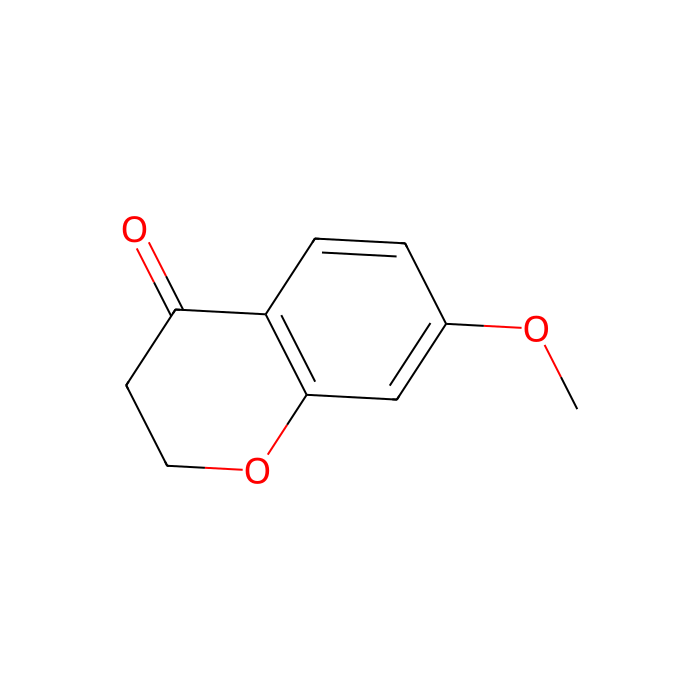
Core scaffold: chroman-4-one (3,4-dihydro-1-benzopyran-4-one) bearing a methoxy substituent at the 7-position of the aromatic ring.
Functional groups: one aryl methoxy ether (–O–CH3), one cyclic aryl ether (the chroman O), and one conjugated cyclic ketone (lactam-like enone within the chromanone ring).
Typical formula/MW (literature): commonly reported as C10H10O3, MW ≈ 178.18 g/mol for the 7-methoxy derivative of chroman-4-one.
2D description: a benzene ring fused to a saturated O-containing ring; the carbonyl is at the benzylic C-4 position of the heterocycle; the methoxy group is para to the heterocyclic oxygen and meta to the carbonyl (7-position).
Notes
Stereochemistry: none (achiral) in the parent; substituted derivatives may introduce chirality at C-2 if further functionalized.
For definitive identifiers (InChI, SMILES) used to release lots, consult the CoA/Spec Sheet for this catalog item.
Synthetic Utility
Strategic value (literature/general)
Privileged scaffold: The chroman-4-one core is a gateway to flavanones, isoflavanones, and benzopyran derivatives, enabling access to diverse chemical space.
Key functional elements and reactivity
Carbonyl at C-4: amenable to reductions (NaBH4, catalytic H2) to secondary alcohols; serves as an electrophile for nucleophilic additions (e.g., Grignard at C-4 after activating to enone).
α-Position (C-3): enolizable; LDA or LiHMDS in THF enables α-alkylation/arylation (via subsequent cross-coupling) after halogenation of the α-position.
7-Methoxy substituent: a latent phenol. BBr3-mediated demethylation unlocks phenoxide chemistry (etherification, esterification, carbonate formation) and allows directed ortho-metalation for further ring elaboration.
Aromatic ring: activated by the methoxy for electrophilic aromatic substitution (EAS) at the 6- and 8-positions; regioselectivity can be tuned via temporary directing groups or protection strategies.
Retrosynthetic perspectives
Assemble via cyclization of o-hydroxyacetophenone equivalents with acetals/ketenes (Baker–Venkataraman-type or acid-catalyzed intramolecular acylation), followed by selective O-methylation at the 7-position.
Alternatively, start from 7-hydroxychroman-4-one and methylate under mild conditions (Me2SO4/Na2CO3 or MeI/K2CO3) to furnish the target.
Practical notes
Protecting groups: Ketalize the carbonyl to tolerate strong bases/nucleophiles; deprotect under mild acid. Control moisture during enolate chemistry to avoid proton quench and self-condensation.
Target Specificity
Not applicable. This product is a small-molecule building block, not an antibody, enzyme, or biologic reagent. No antigen/epitope or isotype information applies.
We use cookies to ensure the website functions properly and, where permitted, to improve your experience. You can manage your preferences at any time in Settings. Learn more in our Cookie Policy.
Shall we send you a message when we have discounts available?
Remind me later
Thank you! Please check your email inbox to confirm.
Products are supplied to verified businesses, institutions, and qualified professionals for research and development use only. Not for use in humans, animals, diagnosis, or therapy.

 E2212044