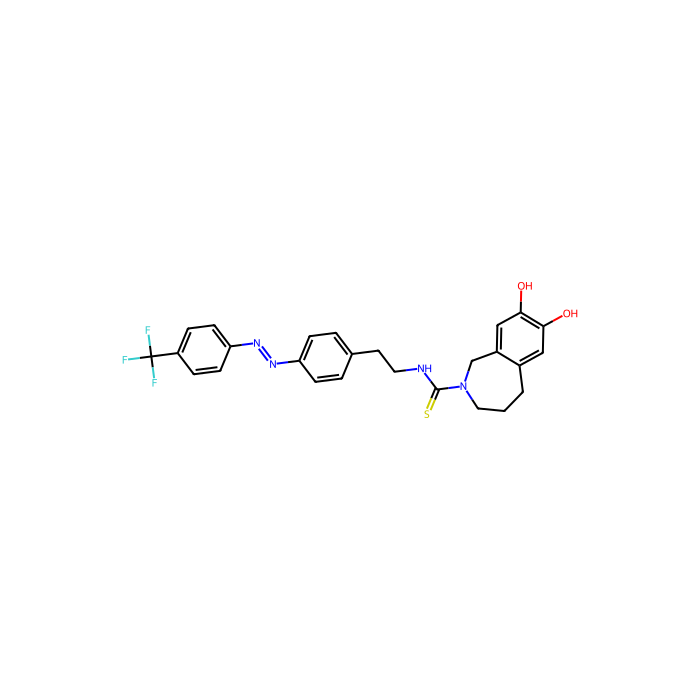
Photoswitchable TRPV1 channel blocker (IC50= 3.1μM). Acts as an antagonist intransconformation during voltage gated activation. Also acts as an antagonist in thecisformation during capsaicin-induced TRPV1 currents. Switches conformation fromcistotransat 4
Conditions de stockage de stockage
Store at -20°C
Expédié en
Ice chest + Ice pads
Ce produit nécessite l'expédition en chaîne froide. Les services terrestres et autres services économiques ne sont pas disponibles.
Determine the necessary mass, volume, or concentration for preparing a solution.
Dilution Calculator
Determine the dilution needed to prepare a stock solution.
Reconstitution Calculator
Avis
Avis des clients
Application Protocols
No tested application protocols are provided for AC 4. Because structure, solubility, and stability are not specified, standardized protocols cannot be recommended here.
General lab startup protocol (suggested framework)
Identity/purity check: Acquire 1H NMR and LC–MS.
Solubility screen: Evaluate in water, MeOH, MeCN, DMSO, and one nonpolar solvent; record concentrations at 25 °C.
Stability screen: Assess at room temperature and 37 °C in chosen solvent(s) over 24–72 h by HPLC.
Document safe handling steps per SDS; define PPE and waste codes with your EHS office.
For application-specific protocols, consult the primary literature once the compound’s structure and intended use are confirmed.
Biological Roles
No biological function, pathway association, or biochemical role is provided for AC 4 in the Product Data. Without structural information, assigning biological roles is not appropriate.
Item-specific
Research Use Note: For research use only (not for human or veterinary applications).
General guidance
If the compound is intended for biochemical assays, verify purity, confirm absence of interfering stabilizers, and establish DMSO stock stability and freeze–thaw robustness.
Determine assay interference risks (e.g., PAINS, fluorescence/absorbance overlap) once the structure is known.
Please consult primary literature associated with CAS 1459809-09-6 for any reported biochemical context.
Buffer Applications
Buffer-specific information for AC 4 is not available. Without knowledge of acid/base functionality or ionizable groups, buffer preparation guidance specific to this compound is not applicable.
Recommendation
If AC 4 must be formulated into aqueous systems, first establish its solubility and stability across pH 2–10 using small-scale screens (UV–Vis or HPLC to monitor degradation), then select a standard buffer (e.g., phosphate, citrate, Tris, HEPES) compatible with its chemistry.
Avoid assumptions about pKa; determine experimentally by potentiometric titration or spectrophotometric methods if relevant.
Green Alternatives
Because the chemical class and function of AC 4 are not disclosed here, specific greener substitutions cannot be prescribed. However, the following framework can guide selection of greener options once the role of AC 4 in your process is known.
If AC 4 is used as a reaction solvent
Consider bio-based or lower-toxicity solvents such as 2-MeTHF, CPME, EtOAc, propylene carbonate, or water/ethanol systems when compatible with reactivity and separation.
If AC 4 is a coupling reagent/activator
Where feasible, switch to greener peptide-coupling systems (e.g., CDI, DMTMM) or enzyme-catalyzed ligations, balancing efficiency with waste and hazard reduction.
If AC 4 is a protecting-group reagent or halogenating agent
Evaluate milder, catalytic, or electrochemical variants that reduce stoichiometric waste and hazards.
Decision criteria (general)
Assess solvent/reagent CHEM21 or GSK solvent guide rankings, energy intensity (temperature/pressure), atom economy, and ease of workup/recycle.
Tradeoffs
Greener choices may impact rate, selectivity, or purity; run head-to-head experiments and include life-cycle and EHS assessments.
Pharmaceutical Uses
No pharmacopeial status, excipient role, or processing function is provided for AC 4. Without structure and grade information, pharmaceutical formulation guidance is not applicable.
Compliance note
This product is supplied for research use only. It is not intended for human use, clinical diagnostics, or as an API/excipient in commercial drug products.
If exploring pre-formulation (general)
Determine polymorphism/solid form, hygroscopicity, and thermal behavior (DSC/TGA) if the compound is considered for non-clinical formulation research.
Establish solubility in pharmaceutically relevant cosolvents (PEG 400, PG, ethanol, polysorbates) and pH-adjusted media, subject to appropriate safety review.
Physical Properties
Only limited physical data are available in the Product Data for AC 4. Do not infer missing values as specifications.
Item-specific (from Product Data)
Appearance: Not specified for this item; refer to CoA/Spec Sheet.
Typical physical constants (literature/computed)
Boiling point, melting point, density, refractive index, pKa, logP, solubility: Not available from the provided data and not derived here; consult literature linked to CAS 1459809-09-6 or the SDS/CoA.
Practical guidance (general)
If the substance is solid, determine approximate melting behavior with a micro-melting point apparatus before handling in heat-dependent steps.
Establish solubility empirically on milligram scale in a solvent panel (e.g., water, MeOH, EtOH, MeCN, DMSO, DMF, THF, toluene, EtOAc, hexanes) to inform purification and assay preparation.
If hygroscopicity or volatility is unknown, handle quickly on the bench, recap promptly, and consider working in a dry box when weighing.
Quality and Grades
Item-specific (from Product Data)
Grade/Purity: Not specified for this item; refer to CoA/Spec Sheet.
Interpretation and best practices (general guidance)
If the item is supplied at research grade without stated assay purity, confirm suitability for your application via chromatographic purity (HPLC/GC) and spectroscopic identity (NMR/MS).
For analytical or trace applications, request metal/ionic impurity profiles, water content (Karl Fischer), residual solvent data, and any stabilizers. Absent explicit specifications in this listing, these parameters are Not specified for this item; refer to CoA/Spec Sheet.
If UV transparency matters (e.g., HPLC mobile phase additives or photophysical studies), verify UV cutoff/absorbance on the CoA or run a baseline scan of your batch.
If the lot contains stabilizers or inhibitors, their identity and concentration should be disclosed on the CoA; adjust workflows (e.g., additional purification or inhibitor removal) accordingly.
Reaction and Applications
Manufacturer Applications: Not provided in the Product Data.
Given the absence of structural information for AC 4, specific reaction roles cannot be assigned. The following are general considerations for integrating a new organic reagent/intermediate into synthetic workflows:
Establish identity and purity first (1H/13C NMR, HRMS, HPLC/GC). Impurities can mask reactivity trends.
Conduct stability screens (air, moisture, light, heat) on milligram scale. If instability is observed, consider inert-atmosphere handling, dry solvents, and light protection.
If the compound is a potential electrophile (e.g., acid chloride, anhydride, activated ester), maintain anhydrous conditions and use stoichiometric base or nucleophile traps.
If it is a potential nucleophile (e.g., amine, thiol), account for acid/base neutralization and select solvents accordingly.
For scale-up, perform calorimetry or at least adiabatic quench tests to identify exotherms; define safe addition and quench protocols.
Without the specific functional group information, please consult literature associated with CAS 1459809-09-6 for tailored reaction guidance.
Reaction Conditions
No reaction condition data are provided for AC 4. In the absence of functional group information, provide conditions only after identity is confirmed.
General guidance for initial scouting
Screen a matrix of solvents (aprotic polar, protic, nonpolar) and bases/acids as relevant to the hypothesized transformation.
Use small scale (0.05–0.2 mmol) with in situ monitoring (TLC/UPLC). Establish temperature limits by DSC/TGA if available, or begin at ambient and escalate cautiously.
For air/moisture-sensitive chemistry, apply Schlenk or glovebox techniques and rigorously dried solvents.
Expected yields
Not specified for this item; consult literature after verifying the structure linked to CAS 1459809-09-6.
Safety and Handling
Safety details were not provided in the Product Data and should be confirmed in the SDS prior to use.
GHS information (from Product Data)
Signal word: Not specified for this item; refer to SDS.
H-statements: Not specified for this item; refer to SDS.
GHS classification: Not specified for this item; refer to SDS.
Pictograms: Not specified for this item; refer to SDS.
General laboratory precautions (general guidance)
Use a chemical fume hood; avoid inhalation of dusts, vapors, or aerosols.
Recommended PPE: lab coat, safety glasses or splash goggles, and appropriate chemical-resistant gloves (e.g., nitrile). Upgrade PPE based on SDS.
Avoid contact with strong oxidizers, strong acids/bases, and reducing agents until compatibility is known.
If peroxide-forming tendencies or instability are unknown, store under recommended conditions and minimize exposure to air/light until SDS guidance is reviewed.
First-aid overview (general)
Inhalation: Move to fresh air; seek medical attention if symptoms persist.
Skin/eye contact: Rinse with water for at least 15 minutes; remove contaminated clothing.
Ingestion: Rinse mouth; do not induce vomiting unless directed by medical personnel.
Always defer to the product-specific SDS for authoritative hazard, spill, and disposal instructions.
Solvent Selection
Solvent selection depends on the compound’s polarity, ionizability, and functional groups, which are not provided here.
Item-specific
Solubility profile: Not specified for this item; confirm experimentally.
Practical strategy (general guidance)
Small-scale solubility screen (1–2 mg in 0.5–1 mL): water, phosphate buffer (pH 7.4), MeOH, EtOH, i-PrOH, MeCN, acetone, DMSO, DMF, THF, EtOAc, toluene, hexanes. Sonicate and gently heat if appropriate.
For analytical prep, prefer HPLC-compatible solvents (MeCN/H2O or MeOH/H2O with 0.1% FA/NH4OAc) if UV/ESI-MS detection is used.
For poorly soluble organics, a DMSO stock (10–100 mM) diluted into assay media can be effective; keep final DMSO below 0.5–1% v/v for most biological assays.
If acid/base functionality is suspected, exploit pH to modulate solubility (salt formation or deprotonation), then back-extract or crystallize.
Comparison notes (general)
Protic polar (water/alcohols) vs aprotic polar (MeCN, DMF, DMSO) vs nonpolar (toluene, hexanes) classes cover most needs; select based on stability and downstream compatibility.
Storage and Reconstitution
Item-specific (from Product Data)
Storage Conditions: Store at -20°C.
Shipped In: Ice chest + Ice pads.
Appearance: Not specified for this item; refer to CoA/Spec Sheet.
Reconstitution: Not specified for this item; refer to CoA/Spec Sheet.
Best practices (general guidance)
Upon receipt: Inspect packaging integrity and allow to equilibrate to room temperature in sealed condition before opening to minimize condensation.
Aliquoting: If repeated access is expected, prepare small aliquots under dry conditions to minimize freeze–thaw cycles and moisture uptake.
Atmosphere/light: If sensitivity is unknown, store in amber vials under inert gas (N2/Ar) with desiccant.
Thawing: Warm to ambient temperature before opening; reseal promptly after use. Avoid prolonged bench exposure.
Solution stability: If preparing stock solutions (e.g., in DMSO, MeOH, or buffer), record concentration, solvent, date, and storage temperature; assess stability with periodic HPLC checks.
Always consult the lot-specific CoA and SDS for definitive storage and handling instructions.
Structure and Identity
Overview for AC 4 (SKU A288643). Structural identifiers are limited for this listing; consult the CoA/SDS for definitive identity data.
Item-specific (from Product Data)
Product name: AC 4
CAS: 1459809-09-6
PubChem CID: 121513863
InChIKey: 49633 (truncated/short form provided; full InChIKey not specified)
SMILES: Not specified for this item; refer to CoA/Spec Sheet.
Molecular formula: Not specified for this item; refer to CoA/Spec Sheet.
Molecular weight: Not specified for this item; refer to CoA/Spec Sheet.
Structural features (descriptive)
2D/3D structure: Not available in the provided Product Data.
Functional groups, ring systems, stereochemistry: Not specified; no structural annotations provided.
Identity best practices
Verify identity upon receipt by orthogonal methods (e.g., NMR, LC–MS, HRMS) using the CAS and catalog metadata as starting points.
If you maintain internal reference libraries (NMR/MS), record spectra under your lab’s standard conditions for future cross-checks.
Synthetic Utility
Specific synthetic roles for AC 4 cannot be detailed without structural information. The following general considerations may help position an unknown intermediate/reagent:
If AC 4 is an intermediate
Map plausible transformations based on functional group analysis (once known): oxidations/reductions, cross-couplings, condensations, cyclizations, or protecting-group manipulations.
Confirm chemo-/regioselectivity with competition experiments and monitor by LC–MS.
If AC 4 is a reagent
Establish stoichiometry, byproducts, and quench strategies; run small-scale scouting experiments to define kinetics and selectivity.
Purification planning
Develop a decision tree for purification: crystallization vs normal-phase flash vs reverse-phase prep HPLC, guided by polarity/logP and ionizability once measured.
Retrosynthetic value
After identity confirmation, place AC 4 within known synthetic routes (via CAS literature) to identify convergent entries or greener disconnections.
Target Specificity
This section is typically applicable to biologics (e.g., antibodies, enzymes). AC 4 is listed as a chemical reagent with no biological target information in the Product Data.
Item-specific
Target/epitope: Not applicable; not specified for this item.
Species reactivity/clone/isotype: Not applicable.
Refer to biochemical assay documentation if AC 4 is later associated with a specific target.
We use cookies to ensure the website functions properly and, where permitted, to improve your experience. You can manage your preferences at any time in Settings. Learn more in our Cookie Policy.
Shall we send you a message when we have discounts available?
Remind me later
Thank you! Please check your email inbox to confirm.
Products are supplied to verified businesses, institutions, and qualified professionals for research and development use only. Not for use in humans, animals, diagnosis, or therapy.