Determine the necessary mass, volume, or concentration for preparing a solution.
| Activity Type | Relation | Activity value | Units | Action Type | Journal | PubMed Id | doi | Assay Aladdin ID |
|---|

étalon analytique, ≥99,5% (GC) Étalon d'analyse for sensitive chromatographic and analytical workflows requiring minimal baseline interference.
Room temperature Ships FedEx DG Service Check lot-specific COA for exact specifications.
SDS, COA, datasheet, and spec sheet available for download. Lot-specific COA accessible via lot number lookup.
Cited in 17 peer-reviewed publications across chromatography, organic synthesis, and cross-coupling reactions.
L'acétate d'hexyle a été utilisé pour étudier l'activité de la phéromone sexuelle de la fausse-teigne des crucifères et des volatiles des déjections larvaires, ainsi que des volatiles de feuilles vertes de choux, sur les ennemis naturels du ravageur.
| Pubchem Sid | 528769475 |
|---|---|
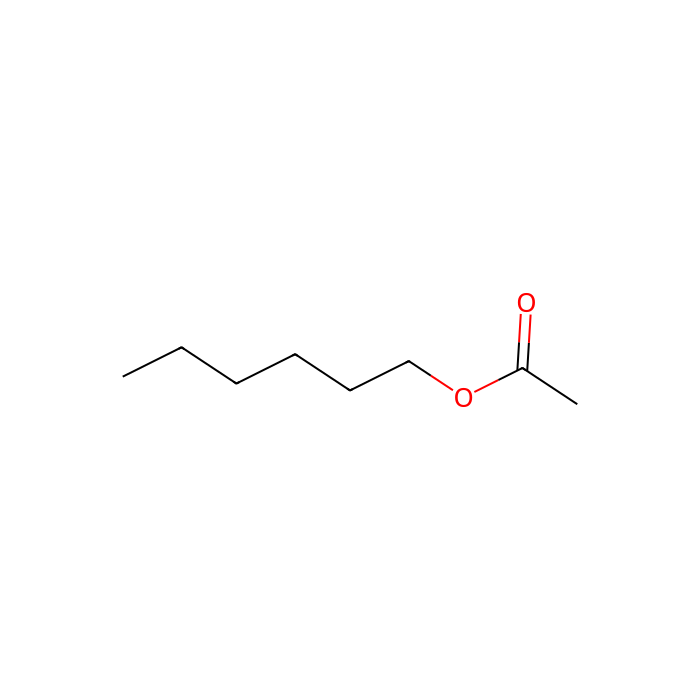
| Sourires canoniques | CCCCCCOC(=O)C |
| IUPAC Name | hexyl acetate |
| InChIKey | AOGQPLXWSUTHQB-UHFFFAOYSA-N |
| INCHI | 1S/C8H16O2/c1-3-4-5-6-7-10-8(2)9/h3-7H2,1-2H3 |
| Isomères SMILES | CCCCCCOC(=O)C |
| WGK Allemagne | 1 |
| RTECS | AI0875000 |
| Numéro ONU | 1993 |
| Groupe d'emballage | I |
| Poids moléculaire | 144.21 |
| Beilstein | 1747138 |
| Reaxy-Rn | 1747138 |
| Reaxys-RN_link_address | https://www.reaxys.com/reaxys/secured/hopinto.do?context=S&query=IDE.XRN=1747138&ln= |
Comprehensive hazard, handling, storage, and regulatory compliance document.
Download SDS →Lot-specific quality data. Enter your lot number to retrieve the exact COA.
Look up COA →Full quality attributes and acceptance criteria for this grade.
View spec sheet →Taxonomy Tree
| Kingdom | Organic compounds |
|---|---|
| Superclass | Organic acids and derivatives |
| Classe | Carboxylic acids and derivatives |
| Subclass | Carboxylic acid derivatives |
| Intermediate Tree Nodes | Not available |
| Direct Parent | Carboxylic acid esters |
| Alternative Parents | Monocarboxylic acids and derivatives Organic oxides Hydrocarbon derivatives Carbonyl compounds |
| Molecular Framework | Aliphatic acyclic compounds |
| Substituents | Carboxylic acid ester - Monocarboxylic acid or derivatives - Organic oxygen compound - Organic oxide - Hydrocarbon derivative - Organooxygen compound - Carbonyl group - Aliphatic acyclic compound |
| Description | This compound belongs to the class of organic compounds known as carboxylic acid esters. These are carboxylic acid derivatives in which the carbon atom from the carbonyl group is attached to an alkyl or an aryl moiety through an oxygen atom (forming an ester group). |
| External Descriptors | Wax monoesters |
| Activity Type | Relation | Activity value | Units | Action Type | Journal | PubMed Id | doi | Assay Aladdin ID |
|---|
| Activity Type | Relation | Activity value | Units | Action Type | Journal | PubMed Id | doi | Assay Aladdin ID |
|---|
Find and download the COA for your product by matching the lot number on the packaging.
| Lot Number | Certificate Type | Date | Article |
|---|---|---|---|
 I2314065 I2314065 | Certificate of Analysis | Mar 28, 2025 | H111063 |
| I2314066 | Certificate of Analysis | Mar 28, 2025 | H111063 |
| K2013026 | Certificate of Analysis | Jun 14, 2024 | H111063 |
| G2225031 | Certificate of Analysis | Apr 07, 2024 | H111063 |
| K2019042 | Certificate of Analysis | Sep 15, 2022 | H111063 |
| Indice de réfraction | 1.409 |
|---|---|
| Point d'éclair (°F) | 131 °F |
| Point d'éclair (°C) | 43℃ |
| Point d'ébullition (°C) | 169.2°C |
| Point de fusion (°C) | -80°C |
| Poids moléculaire | 144.210 g/mol |
| XLogP3 | 2.400 |
| Hydrogen Bond Donor Count | 0 |
| Hydrogen Bond Acceptor Count | 2 |
| Rotatable Bond Count | 6 |
| Exact Mass | 144.115 Da |
| Monoisotopic Mass | 144.115 Da |
| Topological Polar Surface Area | 26.300 Ų |
| Heavy Atom Count | 10 |
| Formal Charge | 0 |
| Complexity | 89.300 |
| Isotope Atom Count | 0 |
| Defined Atom Stereocenter Count | 0 |
| Undefined Atom Stereocenter Count | 0 |
| Defined Bond Stereocenter Count | 0 |
| Undefined Bond Stereocenter Count | 0 |
| The total count of all stereochemical bonds | 0 |
| Covalently-Bonded Unit Count | 1 |
| 1. Yu Mu, Jun Huang, Rongqing Zhou, Suyi Zhang, Hui Qin, Hanlan Tang, Qianglin Pan, Huifang Tang. (2023) Characterization of the differences in aroma-active compounds in strong-flavor Baijiu induced by bioaugmented Daqu using metabolomics and sensomics approaches. FOOD CHEMISTRY, [PMID:37247603] [10.1016/j.foodchem.2023.136429] |
| 2. Die Hu, Wei Chen, Aiqing Miao, Xiaoyan Qiao, Hongling Xia, Chengying Ma. (2023) Analysis of volatile emission of tea (Camellia sinensis) shoots in response to temperature-dependent postharvest treatments. EUROPEAN JOURNAL OF AGRONOMY, [PMID:] [10.1016/j.eja.2023.126821] |
| 3. Jing Li, Youyou Yang, Chaohua Tang, Shengnan Yue, Qingyu Zhao, Fadi Li, Junmin Zhang. (2022) Changes in lipids and aroma compounds in intramuscular fat from Hu sheep. FOOD CHEMISTRY, [PMID:35413762] [10.1016/j.foodchem.2022.132611] |
| 4. Wei Fu, Linxin Xu, Qiwen Yu, Jiajia Fang, Guohua Zhao, Yi Li, Chenying Pan, Hao Dong, Di Wang, Haiyan Ren, Yi Guo, Qingjun Liu, Jun Liu, Xing Chen. (2022) Artificial Intelligent Olfactory System for the Diagnosis of Parkinson’s Disease. ACS Omega, [PMID:35155895] [10.1021/acsomega.1c05060] |
| 5. Zi Ye, Zhixun Shang, Meiqi Li, Yonghan Qu, Hongjin Long, Junjie Yi. (2020) Evaluation of the physiochemical and aromatic qualities of pickled Chinese pepper (Paojiao) and their influence on consumer acceptability by using targeted and untargeted multivariate approaches. FOOD RESEARCH INTERNATIONAL, [PMID:33233164] [10.1016/j.foodres.2020.109535] |
| 6. Xuyang Xiong, Liyong Ding, Qingqian Wang, Yongxiu Li, Qingqing Jiang, Juncheng Hu. (2016) Synthesis and photocatalytic activity of BiOBr nanosheets with tunable exposed {0 1 0} facets. APPLIED CATALYSIS B-ENVIRONMENTAL, [PMID:] [10.1016/j.apcatb.2016.02.018] |
| 7. Hao Chen, Yingwu Luo. (2011) Facile Synthesis of Nanocapsules and Hollow Nanoparticles Consisting of Fluorinated Polymer Shells by Interfacial RAFT Miniemulsion Polymerization. MACROMOLECULAR CHEMISTRY AND PHYSICS, 212 (7): (737-743). [PMID:] [10.1002/macp.201000664] |
| 8. Sanyan Lai, Ning Yi, Shixin Yin, Yipeng Huang, Tianlin Shen, Qianying Dai, Liping Gao, Xiaolan Jiang, Tao Xia. (2024) Biochemical characterization of CsCXEs: Carboxylesterase enhances the biosynthesis of green odor volatiles during tea processing. Horticultural Plant Journal, [PMID:] [10.1016/j.hpj.2024.08.001] |
| 9. Wenyi Duan, Zhenyu Yao, Chengkui Qiao, Junren Meng, Shihang Sun, Lei Pan, Liang Niu, Guochao Cui, Zhiqiang Wang, Wenfang Zeng. (2025) Combined volatile metabolome and transcriptome analysis of 60 peach cultivars provide new insights into the formation of aroma and the identification of associated genes. Horticultural Plant Journal, [PMID:] [10.1016/j.hpj.2024.12.005] |
| 10. Xiaoying Li, Chunsheng Liu, Junkai Wu, Kai Su, Xiao Xiao, Libin Zhang, B. Loye Eberhart, Caixia Chen, Fuhang Song. (2025) Comprehensive investigation on the dynamic changes of volatile organic compounds in three peach cultivars during fruit development. FOOD RESEARCH INTERNATIONAL, [PMID:40022387] [10.1016/j.foodres.2025.115866] |
| 11. Xiaoying Li, Chunsheng Liu, Junkai Wu, Xiao Xiao, Libin Zhang, Caixia Chen, Annette S. Wilson, Fuhang Song. (2024) Ester-related volatile compounds reveal the diversity and commonalities of different types of late-ripening peaches. JOURNAL OF FOOD SCIENCE, 89 (3): (1485-1497). [PMID:38317483] [10.1111/1750-3841.16943] |
| 12. Mingming Zhao, Zhiheng You, Huayun Chen, Xiao Wang, Yibin Ying, Yixian Wang. (2024) Integrated Fruit Ripeness Assessment System Based on an Artificial Olfactory Sensor and Deep Learning. Foods, 13 (5): (793). [PMID:38472906] [10.3390/foods13050793] |
| 13. Mingming Zhao, Huizi Lu, Zhiheng You, Huayun Chen, Xiao Wang, Yaqing Zhang, Yixian Wang. (2024) Olfactory Visualization Sensing Array Made with CelluMOFs to Predict Fruit Ripeness Using Deep Learning. ACS Applied Materials & Interfaces, [PMID:39403818] [10.1021/acsami.4c09402] |
| 14. Yue Wang, Jianing Li, Tingting Zhu, Yiran Li, Jinyu Yang, Tingting Ma, Yulin Fang, Xiangyu Sun. (2025) Unveiling sub-regional aroma differences in China's Ningxia region: Characterization of key aroma profiles and chemical foundations via sensomics and RATA. FOOD CHEMISTRY, [PMID:41045857] [10.1016/j.foodchem.2025.146557] |
| 15. Xiaoying Li, Gang Li, Haijing Wang, Chunsheng Liu, Chunrui Rong, Fuhang Song, Caixia Chen, Junkai Wu. (2025) Characterization of volatile flavor profiles in three peach cultivars during postharvest storage at various temperatures using HS-SPME-GC–MS. Food Chemistry-X, [PMID:40497035] [10.1016/j.fochx.2025.102554] |
| 16. Mei Chen, Fengyun Tian, Youshudi Xie, Jie Ma, Yanfen Yang, Changli Yang, Xinrong Zhou, Tian Deng, Houhong Xiao, Xue Dong, Dingli Chen, Xinlong Dai, Zhi zhou, Shimao Fang. (2025) A comprehensive study of carboxylesterases involved in the degradation of volatile esters in horticultural crops. INDUSTRIAL CROPS AND PRODUCTS, [PMID:] [10.1016/j.indcrop.2025.122039] |
| 17. Fan Feng, Na Li, Hongcong Song, Aihua Li, Yongsheng Tao. (2026) Matrix effects of tartaric acid on the volatile release and aroma perception of fruity esters in wine. FOOD RESEARCH INTERNATIONAL, [PMID:] [10.1016/j.foodres.2026.120304] |
Our grade selection guide covers purity, stabilizer status, and application suitability for all variants in our catalog.
View Analytical standard grade guide →