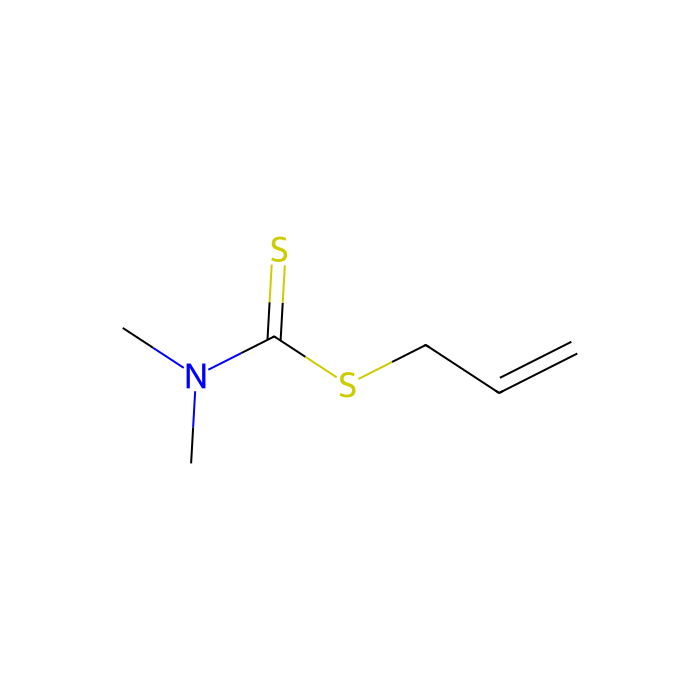
This compound belongs to the class of organic compounds known as dithiocarbamic acid esters. These are organosulfur compounds with the general formula R3SC(=S)N(R1)R2; R1-R2 = H or organyl group, R3 = organyl.
External Descriptors
Not available
1. Djoumbou Feunang Y, Eisner R, Knox C, Chepelev L, Hastings J, Owen G, Fahy E, Steinbeck C, Subramanian S, Bolton E, Greiner R, and Wishart DS. ClassyFire: Automated Chemical Classification With A Comprehensive, Computable Taxonomy. Journal of Cheminformatics, 2016, 8:61.
Certificats (CoA, COO, BSE/TSE et tableau d'analyse)
C of A & Other Certificates(BSE/TSE, COO):
Analytical Chart:
Propriétés chimiques et physiques
Indice de réfraction
1.6
Point d'éclair (°C)
71 °C
Point d'ébullition (°C)
108°C/5mmHg(lit.)
Poids moléculaire
161.300 g/mol
XLogP3
1.900
Hydrogen Bond Donor Count
0
Hydrogen Bond Acceptor Count
2
Rotatable Bond Count
3
Exact Mass
161.033 Da
Monoisotopic Mass
161.033 Da
Topological Polar Surface Area
60.600 Ų
Heavy Atom Count
9
Formal Charge
0
Complexity
110.000
Isotope Atom Count
0
Defined Atom Stereocenter Count
0
Undefined Atom Stereocenter Count
0
Defined Bond Stereocenter Count
0
Undefined Bond Stereocenter Count
0
The total count of all stereochemical bonds
0
Covalently-Bonded Unit Count
1
Calculateurs de solution
Molarity Calculator
Determine the necessary mass, volume, or concentration for preparing a solution.
Dilution Calculator
Determine the dilution needed to prepare a stock solution.
Reconstitution Calculator
Avis
Avis des clients
Application Protocols
No item-specific, validated application protocols are provided for this listing.
General lab-use outlines (informational only; adjust to your scale and safety requirements):
Metal scavenging test:
Dissolve the reagent (e.g., 5–20 mM) in DCM; contact with metal-containing aqueous phase (neutral pH). Shake, separate, and assay metal content by ICP.
Radical addition trial:
Combine substrate and reagent in toluene with 1–2 mol% AIBN under N2; heat to 70 °C; monitor by TLC/GC-MS. Optimize initiator loading and time.
Allyl manipulation screen:
Under inert gas, expose to a soft nucleophile (e.g., thiolate) in MeCN at 40–60 °C to probe S–allyl transfer; analyze by LC-MS.
These are starting points only; develop full SOPs and conduct appropriate hazard/risk assessments.
Biological Roles
Item-specific biological/biochemical data: Not specified for this item; for research use only.
General biochemical context for dithiocarbamates (informational; no medical claims):
Metal chelation: Dithiocarbamates bind transition metals (Cu(II), Ni(II), Zn(II)) via soft sulfur donors, forming stable chelates. This underpins their use as analytical derivatization ligands and metal staining/extraction aids.
Redox/thiol chemistry: The thiocarbonylthio functionality can engage in radical and thiol-exchange processes under appropriate conditions, allowing labeling or crosslinking strategies in biomolecule model systems.
Membrane affinity: The hydrophobic allyl–thioether moiety and overall lipophilicity suggest partitioning into organic phases or lipid environments, relevant for biphasic extraction protocols rather than in vivo use.
Potential as a derivatization agent for amines or alcohols (via interconversion routes) to improve chromatographic detection (e.g., UV/visible through thiocarbonyl absorbance) in method development.
Metal-sensing model systems: Formation of colored/UV-active metal–dithiocarbamate complexes can serve as simple proxies for monitoring metal availability in buffered organic/aqueous mixtures.
Note: This product is designated for research use only. No claims are made regarding biological activity, safety, or suitability for diagnostic/therapeutic applications.
Buffer Applications
This reagent is not a buffer component and is not typically used to control pH in aqueous systems.
If used alongside buffers (general guidance):
Maintain aprotic organic phases or low-water content to minimize hydrolysis/oxidation.
If biphasic extractions with buffers are necessary (e.g., for metal capture), select buffers that avoid strong acidity/oxidants and verify partitioning behavior experimentally.
For pH-stable buffering needs, consider standard biological buffers (phosphate, Tris, HEPES); this reagent does not substitute for such systems.
Green Alternatives
Selection of greener strategies depends on the role of Allyl Dimethyldithiocarbamate in your process.
If used as a sulfur-transfer/thiocarbonylthio reagent:
Consider xanthates or thiocarbonates derived from bio-based alcohols (e.g., 2-MeTHF-derived) when feasible; these can offer similar radical reactivity with potentially lower odor and improved handling.
If used for metal capture/chelation:
Evaluate biobased chelants (e.g., polysaccharide-supported thiols, immobilized thioethers) for easier separation and reduced solvent use.
If used in polymerization control (RAFT-like):
Alternative mediators such as trithiocarbonates may provide comparable control for certain monomers with different toxicity/odor profiles.
Greener solvent swaps (general guidance):
Comparison (informational; not item-specific)
Conventional: DCM, toluene
Greener alternative: Ethyl acetate, 2-MeTHF, CPME
Trade-offs:
Ethyl acetate offers lower toxicity and good dissolving power but may promote hydrolysis in moist conditions.
2-MeTHF/CPME are hydrophobic, support water-separations, and tolerate Grignard-like dryness; note peroxide formation risk for ethers—monitor and manage.
Process intensification:
Use flow chemistry for radical additions to improve heat/mass transfer and reduce inventory of odorous intermediates.
Apply solvent recycling and in-line metal scavenging to reduce waste.
Always validate reactivity/selectivity when substituting reagents; thiocarbonyl electronics differ among dithiocarbamates, xanthates, and trithiocarbonates.
Pharmaceutical Uses
No item-specific pharmacopeial status, excipient role, or GMP grade is provided for this listing.
General note (non-clinical, research-only):
Dithiocarbamates are used in the lab as chelating ligands and derivatization agents; they are not standard pharmaceutical excipients.
If considering use in process development studies (e.g., metal scavenging in API synthesis), ensure comprehensive extractables/leachables and residual reagent controls, and confirm effective removal in downstream operations.
Documentation to request for regulated environments:
Detailed CoA with assay/impurity profile.
Residual solvent data and potential nitrosamine risk assessment if secondary amines are present in process streams.
SDS and any available stability studies (temperature/light/moisture).
This product is supplied for research use only and is not intended for human or veterinary applications.
Physical Properties
Item-specific properties: Not specified for this item; refer to CoA/Spec Sheet.
Literature/general properties for S-allyl N,N-dimethyldithiocarbamate (informational; not product specifications):
Physical state: typically a pale yellow to amber liquid or low-melting solid, with a characteristic sulfurous odor, consistent with many dithiocarbamate esters.
Approximate formula and mass: C6H11NS2; ~161.29 g/mol (literature).
Polarity/solubility: expected to be sparingly soluble in water and miscible with many organic solvents (e.g., dichloromethane, toluene, ethers, esters); the dialkylamino/thiocarbonyl motif provides moderate polarity and strong affinity for soft metals.
Volatility: moderate; handle under well-ventilated conditions to manage odor and potential vapor exposure.
Stability: dithiocarbamates can hydrolyze under strongly acidic conditions and oxidize in air/light; prefer storage away from acids, oxidants, and moisture.
Properties commonly requested but not provided for this item:
Boiling point, melting point, density, refractive index, pKa, logP, UV cutoff, residuals/trace metals: Not specified for this item; refer to CoA/Spec Sheet.
Practical note (general): For exact chromatographic method development (e.g., GC/HPLC), determine sample-specific BP/RI or UV characteristics experimentally or consult the lot-specific CoA to avoid method transfer issues.
Quality and Grades
Item-specific grade/purity: Not specified for this item; refer to CoA/Spec Sheet.
How to interpret grades for this class of reagent (general guidance):
Reagent/AR grade emphasizes low inorganic contaminants and suitability for general synthesis.
High-purity or ≥98–99% assay grades are preferred for kinetic studies, polymerization mediators, or when trace impurities (e.g., amines, sulfur byproducts) could affect catalysis or analytical baselines.
GC/HPLC grade solvents/solutions of dithiocarbamates are uncommon; when chromatography is critical, verify UV-Vis and baseline behavior of the specific lot.
Stabilizers/inhibitors:
Dithiocarbamates are sometimes shipped without stabilizers but benefit from controlled atmosphere (low O2, low light). Any stabilizers present would be disclosed on the CoA; otherwise assume none and store accordingly.
What to look for on the CoA/Spec Sheet (practical checklist):
Assay method (e.g., 1H NMR qNMR, titration).
Identity confirmation (NMR, IR with characteristic C=S stretch ~1050–1200 cm−1; literature reference only), and MS consistent with ~161 Da (literature).
Residual solvents, acid/amine content, and peroxide/oxidation markers (where applicable).
Appearance limits (color, clarity) and water content if relevant to your application.
For regulated or trace-metal-sensitive work, request a detailed impurity profile and ensure batch-to-batch consistency.
Reaction and Applications
Allyl Dimethyldithiocarbamate is a versatile organosulfur building block combining an allylic thioether with a dithiocarbamate (thiocarbonyl) functionality.
Key reaction families and uses (literature/general):
Ligand & scavenger for soft metals: Dithiocarbamates chelate Cu, Ni, Pd, and other soft/ borderline metals. Useful for metal capture from reaction mixtures or forming defined complexes for catalysis studies.
Radical chemistry / RAFT paradigms: The dithiocarbamoyl group is a classical thiocarbonylthio motif used in reversible addition–fragmentation chain-transfer. Allyl groups can serve as R or transfer groups in radical additions; ensure oxygen-free conditions and appropriate initiator control.
Thiofunctionalization & leaving-group strategies: The –S–allyl bond can engage in substitution or be leveraged in transition-metal-catalyzed allylic substitution (e.g., Pd-catalyzed Tsuji–Trost-type allylations from activated partners). The dithiocarbamate fragment can serve as a masked amine/sulfur donor or as a leaving group in transformations analogous to xanthate chemistry.
Pericyclic/ionic rearrangements (analogy): Allyl sulfides and related thiocarbonyl systems are competent in [2,3]-sigmatropic rearrangements under appropriate activation, enabling C–S to C–C bond reorganization (substrate-dependent; literature precedent with allyl thioesters and xanthates).
Protecting/derivatizing chemistry: Dithiocarbamate formation is a classical method to derivatize amines or alcohols (via interconversion to O-alkyl thiocarbamates/xanthates) for further manipulation (Barton–McCombie-type radical deoxygenation strategies employ related thiocarbonyls).
Practical tips:
Work anhydrous and avoid acids/oxidants.
Exclude O2 rigorously for radical applications.
For metal-binding uses, adjust solvent polarity and pH (if biphasic) to optimize extraction and complexation.
Reaction Conditions
The following conditions are general literature-informed guidelines for dithiocarbamate/allyl-thioether chemistry and should be optimized empirically for your substrate set. They are not specifications for this item.
Water: expected low solubility; emulsions possible due to surface activity of the dithiocarbamate motif.
Choosing a solvent by task (practical guidance):
Nucleophilic substitutions or Pd-allylation studies: THF, MeCN, or DCM under anhydrous conditions.
Radical or RAFT-type transformations: toluene, dioxane, or bulk monomer media; ensure oxygen exclusion.
Metal complexation or extraction: DCM/CHCl3 or toluene for phase-transfer capture of soft metals (Cu, Ni, Pd) followed by back-extraction.
Chromatography: silica can interact via soft acid–base contacts; start with hexanes/EtOAc or toluene/EtOAc gradients; add 0.1–1% Et3N if tailing is observed (general tip for thiocarbonyl compounds).
Small comparison (literature-informed):
vs. Alcohols (MeOH/EtOH): better stability in aprotic media; avoid protic solvents during storage to minimize hydrolysis.
vs. Polar amide solvents (DMF/DMAc): dissolve well but may complicate workup and promote side reactions at elevated temperature.
Note: Exact solubility and UV-cutoff for this item are not specified; verify with your lot’s CoA or a quick solubility/UV scan.
Storage Conditions: Room temperature, Cool. Store in a cool, dry place.
Shipped In: Normal.
General storage guidance for dithiocarbamates:
Keep container tightly closed, under inert gas (nitrogen/argon) if possible, to limit oxidation.
Protect from light and moisture; use amber glass and desiccant.
Avoid contact with acids, strong oxidizers, and reactive metals.
Minimize headspace and repeated opening; consider aliquoting for long-term projects.
Stability monitoring:
Check periodically by 1H NMR/IR for new signals or loss of C=S intensity; inspect for color changes or precipitates.
Reconstitution/handling:
If solidified or viscous, warm gently to ambient temperature and vortex/sonicate.
Prepare solutions in dry, oxygen-free organic solvents (e.g., DCM, toluene, MeCN, THF). Use freshly prepared solutions for sensitive transformations.
For exact shelf-life and any stabilizers present, consult the lot-specific CoA and SDS. Product is for research use only.
Structure and Identity
Allyl Dimethyldithiocarbamate is an S-allyl ester of a dimethyl dithiocarbamic acid, featuring a thiocarbonyl (C=S) flanked by a dimethylamino group and a thioether-bound allyl substituent.
Item-specific identifiers (from Product Data):
CAS: 20821-66-3
SKU: A151292
InChIKey: 455576 (as provided)
SMILES: Not specified for this item; refer to CoA/Spec Sheet.
Molecular formula: Not specified for this item; refer to CoA/Spec Sheet.
Molecular weight: Not specified for this item; refer to CoA/Spec Sheet.
Literature/computed identifiers and descriptors (general reference; not item specifications):
Common structural depiction: S-allyl N,N-dimethyldithiocarbamate with connectivity N(CH3)2–C(=S)–S–CH2–CH=CH2.
Typical SMILES (literature): CN(C)C(=S)SCC=C or C=CCSC(=S)N(C)C (synonymous representations).
Typical molecular formula (literature): C6H11NS2; formula mass ~161.29 g/mol (literature).
Structural features (general):
Functional groups: dithiocarbamate (thiocarbonyl C=S adjacent to a dialkylamino), thioether linkage to an allyl group (terminal alkene).
Hybridization and conjugation: The C=S is polarized and conjugated with the nitrogen lone pair (thiourea-like resonance), imparting soft nucleophilicity at sulfur and ligand character toward soft metals.
2D description: Dimethylamino carbonyl-thio center with a second sulfur bearing an allyl chain (–CH2–CH=CH2); no stereocenters; one terminal C=C.
Synthetic Utility
Allyl Dimethyldithiocarbamate is a compact platform combining an allylic sulfide with a dithiocarbamate, offering multiple orthogonal reaction handles.
Functional group leverage (literature/general):
Thiocarbonyl (C=S): Enables radical chemistry, serves as a soft Lewis base for metal coordination, and provides a UV-visible chromophore for monitoring.
Dithiocarbamate moiety: Acts as a leaving group or transferable fragment in substitutions and rearrangements; amenable to conversion into isothiocyanate/thiourea derivatives under appropriate conditions.
Allylic C=C: Participates in thiol–ene additions, allylic substitutions (Pd-catalyzed), epoxidation/hydroxylation (if desired downstream), or radical additions.
Named/related transformations (contextual):
Tsuji–Trost allylation (using suitable electrophiles; the allyl thioether fragment may be utilized or transformed under Pd catalysis).
Barton–McCombie-type strategies by analogy with xanthates for deoxygenation when interconverted to the appropriate thiocarbonyl derivative.
[2,3]-Sigmatropic rearrangements of allyl sulfur systems (substrate/condition-dependent), enabling C–C bond formation from C–S precursors.
Retrosynthetic value:
Serves as a masked allyl thiolate or dithiocarbamate synthon. Cleavage of the S–allyl bond (e.g., nucleophilic or radical) can reveal different sulfur oxidation states or exchange partners.
Practical considerations:
Maintain anhydrous, oxygen-limited conditions.
If silica gel chromatography causes tailing, use basic modifiers (0.2–1% Et3N) or alumina as stationary phase.
Target Specificity
This product is a small-molecule reagent, not a biological targeting agent or antibody.
Item-specific targeting data (antigen/epitope/clone/isotype/species): Not applicable.
For target-selective applications, consider pairing this reagent with appropriate catalysts, ligands, or derivatization strategies tailored to your system.
Foire aux questions
What is the purity of this product?
This product is supplied at ≥98% purity (chemical assay). Lot-specific values are stated on the Certificate of Analysis.
How should this product be stored?
Store in a cool place.
How is this product shipped?
This product ships under standard ambient conditions. No temperature-controlled packaging is required.
What are the CAS number, molecular formula and molecular weight?
The CAS Number is 20821-66-3, the molecular formula is C6H11NS2, and the molecular weight is 161.28 g/mol. InChIKey ZFMLVJCASVPGIT-UHFFFAOYSA-N.
What documentation is provided?
Available product documentation, including Certificates of Analysis (COA), Safety Data Sheets (SDS), and specification sheets, is shown in the product document area. Document availability and access follow the current site policy.
Nous utilisons des cookies pour garantir le bon fonctionnement du site et, lorsque cela est autorisé, pour améliorer votre expérience. Vous pouvez gérer vos préférences à tout moment dans les Paramètres. Pour en savoir plus, consultez notre Politique relative aux cookies.
Souhaitez-vous que nous vous envoyions un message lorsque des réductions seront disponibles?
Me rappeler plus tard
Merci ! Veuillez vérifier votre boîte de réception e-mail pour confirmer.
Products are supplied to verified businesses, institutions, and qualified professionals for research and development use only. Not for use in humans, animals, diagnosis, or therapy.