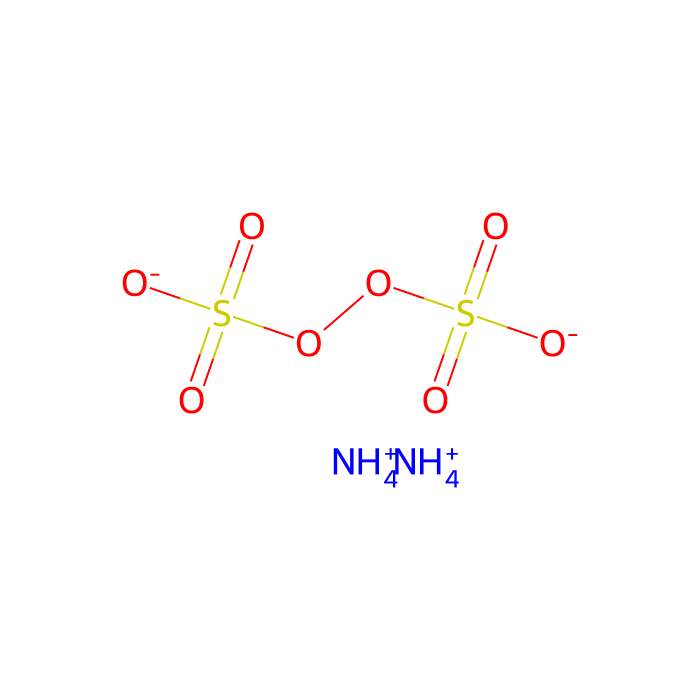
Ammonium persulfate(APS) - ACS, used for Ammonium persulfate can be used as an oxidizing reagent for the solvent-free oxidation of:Primary and secondary alcohols to corresponding carbonyl compounds in an aqueous medium.Thiols to disulfides.It can also be

CAS: 7727-54-0 Cat. No.: A112449 Formule: H8N2O8S2 Poids moléculaire: 228.20 Numéro CE: 231-786-5
DISPONIBLE À COMMANDE
QUALITÉ & PURETÉ ACS ? ACS grade — meets American Chemical Society specifications, the analytical benchmark in the US. Use for analytical and QC work needing ACS-defined purity.
Synonyms
Ammonium peroxodisulfate|PER|AP|APS
Storage
Protected from light,Room temperature
Shipped In
FedEx DG Service
★
Taille
Allemagne (EU)
USA*
Prix
Qté
500g
A112449-500g
—
En stock ≥10
24,21€
12×500g
A112449-12×500g
Sur commande · 8–12 semaines
226,39€
Enter a quantity for the sizes you want to add.

Vue d’ensemble

Ammonium persulfateis a readily available oxidizing agent for various chemicaltransformations, and it is also usedas a bleaching agent in the chemical industry.

Spécifications

Synonymes
Ammonium peroxodisulfate | PER | AP | APS
Spécifications et pureté
ACS
Application
Ammonium persulfate can be used as an oxidizing reagent for the solvent-free oxidation of:Primary and secondary alcohols to corresponding carbonyl compounds in an aqueous medium.Thiols to disulfides.It can also be used as an initiator to initiate copolyme
Conditions de stockage de stockage
Protected from light,Room temperature
Expédié en
FedEx DG Service
Grade
ACS
Product Line
A112449-500g
Noms et identifiants
Pubchem Sid
SMILES
[NH4+].[NH4+].[O-]S(=O)(=O)OOS(=O)(=O)[O-]
IUPAC Name
diazanium;sulfonatooxy sulfate
InChIKey
ROOXNKNUYICQNP-UHFFFAOYSA-N
InChI
1S/2H3N.H2O8S2/c;;1-9(2,3)7-8-10(4,5)6/h2*1H3;(H,1,2,3)(H,4,5,6)
Isomères SMILES
[NH4+].[NH4+].[O-]S(=O)(=O)OOS(=O)(=O)[O-]
WGK Allemagne
1
RTECS
SE0350000
Numéro ONU
1444
Groupe d'emballage
III
Poids moléculaire
228.20
Reaxys
11343687
Reaxys-RN_link_address
https://www.reaxys.com/reaxys/secured/hopinto.do?context=S&query=IDE.XRN=11343687&ln=

Données avancées

Taxonomic Classification

Taxonomy Tree

KingdomInorganic compounds
SuperclassHomogeneous non-metal compounds
ClasseNon-metal oxoanionic compounds
SubclassNon-metal peroxodisulfates
Intermediate Tree Nodes Not available
Direct ParentNon-metal peroxodisulfates
Alternative Parents Inorganic salts  Inorganic oxides  
Molecular FrameworkNot available
Substituents Non-metal peroxodisulfate - Inorganic oxide - Inorganic salt
DescriptionThis compound belongs to the class of inorganic compounds known as non-metal peroxodisulfates. These are inorganic non-metallic compounds containing a peroxodisulfate as its largest oxoanion.
External Descriptors Not available
Structure 3D
Modèle de structure chimique interactif


Certificats (CoA, COO, BSE/TSE et tableau d'analyse)
C of A & Other Certificates(BSE/TSE, COO):
Analytical Chart:

Find and download the COA for your product by matching the lot number on the packaging.

14 results found

Lot NumberCertificate TypeDateArticle
G2609225G2609225Certificate of AnalysisJun 22, 2026 A112449
C2613515C2613515Certificate of AnalysisFeb 04, 2026 A112449
K2518337K2518337Certificate of AnalysisOct 16, 2025 A112449
D2515292D2515292Certificate of AnalysisMar 31, 2025 A112449
K2419176K2419176Certificate of AnalysisNov 04, 2024 A112449
H2421068H2421068Certificate of AnalysisAug 30, 2024 A112449
D2425142D2425142Certificate of AnalysisApr 03, 2024 A112449
E2410270E2410270Certificate of AnalysisApr 03, 2024 A112449
E2410271E2410271Certificate of AnalysisApr 03, 2024 A112449
B2427430B2427430Certificate of AnalysisFeb 02, 2024 A112449
K2314128K2314128Certificate of AnalysisOct 24, 2023 A112449
G2327100G2327100Certificate of AnalysisJul 12, 2023 A112449
C23101203C23101203Certificate of AnalysisFeb 02, 2023 A112449
J2226146J2226146Certificate of AnalysisOct 10, 2022 A112449
Propriétés chimiques et physiques
SensibilitéLight sensitive.Hygroscopic
Indice de réfraction1.5
Point de fusion (°C)120°C
Poids moléculaire228.21
XLogP3
Hydrogen Bond Donor Count2
Hydrogen Bond Acceptor Count8
Rotatable Bond Count1
Exact Mass227.972 Da
Monoisotopic Mass227.972 Da
Topological Polar Surface Area152.000 Ų
Heavy Atom Count12
Formal Charge0
Complexity206.000
Isotope Atom Count0
Defined Atom Stereocenter Count0
Undefined Atom Stereocenter Count0
Defined Bond Stereocenter Count0
Undefined Bond Stereocenter Count0
The total count of all stereochemical bonds0
Covalently-Bonded Unit Count3
Sécurité et dangers (GHS)
Pictogramme(s)
GHS03,   GHS07,   GHS08
Signal
Danger
Mentions de danger

H272:May intensify fire; oxidizer

H302:Harmful if swallowed

H315:Causes skin irritation

H317:May cause an allergic skin reaction

H319:Causes serious eye irritation

H334:May cause allergy or asthma symptoms or breathing difficulties if inhaled

H335:May cause respiratory irritation

Conseils de prudence

P210:Keep away from heat, hot surface, sparks, open flames and other ignition sources. - No smoking.

P220:Keep away from clothing and other combustible materials.

P261:Avoid breathing dust/fume/gas/mist/vapors/spray.

P264:Wash hands [and …] thoroughly after handling.

P270:Do not eat, drink or smoke when using this product.

P271:Use only outdoors or in a well-ventilated area.

P272:Contaminated work clothing should not be allowed out of the workplace.

P280:Wear protective gloves/protective clothing/eye protection/face protection.

P284:[In case of inadequate ventilation] Wear respiratory protection.

P321:Specific treatment (see ... on this label).

P330:Rinse mouth.

P302+P352:IF ON SKIN: wash with plenty of water.

P304+P340:IF INHALED: Remove person to fresh air and keep comfortable for breathing.

P305+P351+P338:IF IN EYES: Rinse cautiously with water for several minutes. Remove contact lenses if present and easy to do - continue rinsing.

P333+P313:IF SKIN irritation or rash occurs: Get medical advice/attention.

P362+P364:Take off contaminated clothing and wash it before reuse.

P370+P378:In case of fire: Use ... to extinguish.

P405:Store locked up.

P403+P233:Store in a well-ventilated place. Keep container tightly closed.

P501:Dispose of contents/container to an approved waste disposal plant.

P264+P265:Wash hands [and …] thoroughly after handling. Do not touch eyes.

P301+P317:IF SWALLOWED: Get medical help.

P337+P317:If eye irritation persists: Get medical help.

P332+P317:If skin irritation occurs: Get medical help.

P319:Get medical help if you feel unwell.

P342+P316:If experiencing respiratory symptoms: Get emergence medical help immediately.

WGK Allemagne
1
RTECS
SE0350000
Reaxys
11343687
Reaxys-RN_link_address
https://www.reaxys.com/reaxys/secured/hopinto.do?context=S&query=IDE.XRN=11343687&ln=
Classe
5.1
Index Merck
541
FAQ et articles
Nucleic Acid Electrophoresis Workflow—5 Main Steps
Radical Initiator Selection Guide
Standard Operating Procedure (SOP) for Bis-Tris Polyacrylamide Gel Electrophoresis (SDS-PAGE)
Protein Tris-Acetate Electrophoresis System Standard Operating Procedure
Standard Operating Procedure (SOP) for the Protein Tris–Glycine Electrophoresis System
Protein Tris-Tricine Electrophoresis System Standard Operating Procedure
Fundamentals and Applications of Etching Solutions: Using Metallic Copper / PCB Etching as an Example
Electrophoretic Mobility Shift Assay (EMSA) Standard Operating Procedure (SOP)
Materials Can “Switch”: How Smart Polymers Respond to Temperature, pH, and Light (with Experimental Selection Tips & Product Navigation)
A Review of Ten Commonly Used Techniques for Detection, Quantification, and Interaction Analysis in Nucleic Acid Research
EMSA PAGE Precast Gels: Principle Alignment, Performance Advantages, and Application Scenarios
Chymosin: A Review of Molecular Features, Coagulation Kinetics, and Activity Evaluation
Experimental Judgment and Condition Selection for Visible-Light Catalysis in Organic Synthesis
Structural and Performance Design of Acrylic Resins for Coatings: Monomer Composition, Key Parameters, and Film Formation/Curing Mechanisms
From Natural Cellulose to Nanocrystals: Structural Characteristics, Application Directions, and Industrialization Challenges of CNC
Vinyl Acetate-Acrylic Emulsion (Vinyl Acrylic Emulsion): A Cost-Performance Balance Solution for Architectural Coatings
PVAc, VAE, and Vinyl Acetate-Based Emulsions: Film-Forming Logic and Performance Boundaries in Architectural Coatings
How to Select Vinyl-Related Resins: Building Formulation Judgment Based on Substrate, Performance Targets, and Failure Risks
Waterborne Resin Technology Explained: Waterborne Forms, Performance Balance, and a Technology Map
What Is an Etchant? Etching Mechanisms for Revealing Metallographic Microstructures, Selection Methods, and Applications of Related Wet-Etching Reagents
Citations of This Product
Calculateurs de solution
Avis

Avis des clients

Besoin d'aide pour choisir la qualité ?

Notre guide de sélection des qualités couvre la pureté, le statut du stabilisant et l'adéquation à l'application pour toutes les variantes de notre catalogue.

Voir le guide des qualités ACS →

Souhaitez-vous que nous vous envoyions un message lorsque des réductions seront disponibles?

Me rappeler plus tard

Merci ! Veuillez vérifier votre boîte de réception e-mail pour confirmer.

Oups ! Les notifications sont désactivées.