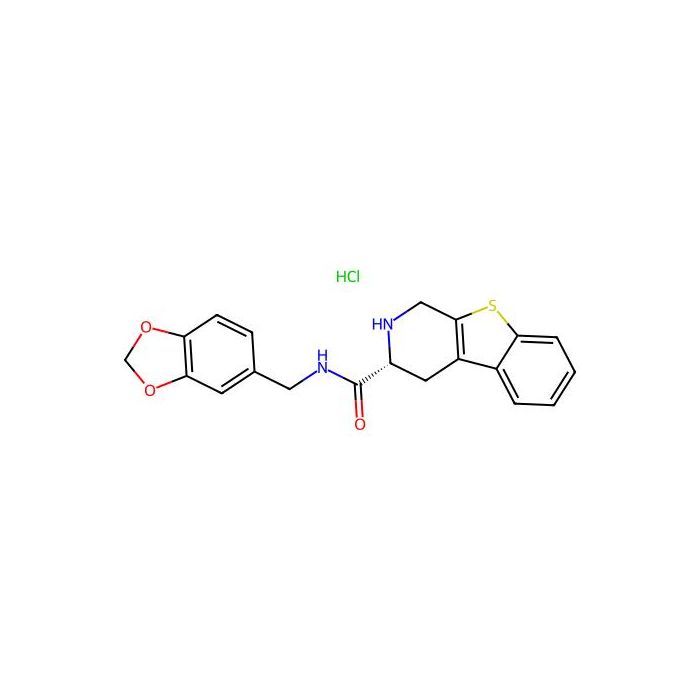
This compound belongs to the class of organic compounds known as alpha amino acid amides. These are amide derivatives of alpha amino acids.
External Descriptors
Not available
1. Djoumbou Feunang Y, Eisner R, Knox C, Chepelev L, Hastings J, Owen G, Fahy E, Steinbeck C, Subramanian S, Bolton E, Greiner R, and Wishart DS. ClassyFire: Automated Chemical Classification With A Comprehensive, Computable Taxonomy. Journal of Cheminformatics, 2016, 8:61.
Certificats (CoA, COO, BSE/TSE et tableau d'analyse)
C of A & Other Certificates(BSE/TSE, COO):
Analytical Chart:
Propriétés chimiques et physiques
Poids moléculaire
402.900 g/mol
XLogP3
Hydrogen Bond Donor Count
3
Hydrogen Bond Acceptor Count
5
Rotatable Bond Count
3
Exact Mass
402.08 Da
Monoisotopic Mass
402.08 Da
Topological Polar Surface Area
87.800 Ų
Heavy Atom Count
27
Formal Charge
0
Complexity
533.000
Isotope Atom Count
0
Defined Atom Stereocenter Count
1
Undefined Atom Stereocenter Count
0
Defined Bond Stereocenter Count
0
Undefined Bond Stereocenter Count
0
The total count of all stereochemical bonds
0
Covalently-Bonded Unit Count
2
Calculateurs de solution
Molarity Calculator
Determine the necessary mass, volume, or concentration for preparing a solution.
Dilution Calculator
Determine the dilution needed to prepare a stock solution.
Reconstitution Calculator
Avis
Avis des clients
Application Protocols
No tested application protocols are provided for AP-521 in this listing.
General starting points:
Stock solutions: If soluble, prepare 10–50 mM in dry DMSO (light-protected), verify concentration, and store aliquots at 2–8°C or frozen as appropriate for stability.
Bioassays: Dilute stocks into assay buffer/cell media to the desired final concentration with ≤0.5–1% DMSO; include vehicle controls.
Analytical QC: Verify identity and purity of the working lot by LC–MS/HPLC prior to critical experiments.
For method-specific protocols (e.g., HPLC conditions, assay set-ups), request the lot CoA or contact technical support citing SKU A997340 and CAS 151227-08-6.
Biological Roles
No biological function or pathway information is provided for AP-521 in this listing.
Because the structure and bioactivity data are not specified, no assertions can be made regarding endogenous roles, targets, or metabolism.
If AP-521 is to be used in biochemical or cellular research, first establish solubility and stability in the assay medium and perform control experiments with vehicle alone.
For any putative biological mechanism identified from external literature via CAS 151227-08-6 or CID 9887401, confirm identity, lot comparability, and material provenance prior to experimental interpretation.
Research Use Note: For research use only. Not for human or veterinary use.
Buffer Applications
Buffer-specific applications are not provided and may not be relevant without knowing the compound’s acid/base properties.
Practical guidance (general):
If AP-521 is used in aqueous assays but is poorly soluble, prepare a concentrated stock in DMSO or ethanol, then dilute into buffer while vortexing; keep final co-solvent ≤1% where possible.
If ionizable groups are suspected, solubility may improve in adjusted pH buffers:
Weak acids: try pH 8–9 (e.g., Tris, borate).
Weak bases: try pH 3–5 (e.g., citrate, acetate).
Always confirm that the compound is chemically stable at the chosen pH and under light-protected conditions.
Since no pKa or buffering capacity is specified, AP-521 should not be used as a buffer component without further data.
Green Alternatives
Without a defined structure or intended use, “green” substitutions must be framed around general solvent and process choices rather than the reagent itself.
General greener solvent considerations:
Prefer bio-based ethers/esters like 2-methyltetrahydrofuran (2-MeTHF) or ethyl acetate over petroleum-derived, chlorinated, or high-toxicity solvents when compatible.
Use water, ethanol, or isopropanol where feasible for workups and crystallizations.
Replace DMF/NMP with propylene carbonate, Cyrene, or dimethyl isosorbide when reactivity and solubility allow.
Tradeoffs: viscosity (Cyrene, PC), peroxide risk (ethers), different polarity/solvency windows.
Process-intensity and waste minimization:
Right-size reaction scale and concentration to minimize solvent volume.
Apply in-line analysis (FTIR/UPLC) to reduce iterative workups.
Choose energy-efficient heating/cooling (microwave where appropriate; avoid prolonged reflux).
Note: These are general recommendations. Validate that AP-521 is stable and compatible with any proposed green solvent under dry, light-protected conditions, consistent with the storage guidance.
Pharmaceutical Uses
No pharmacopeial status, excipient function, or formulation role is specified for this item.
This product is labeled: For research use only; it is not intended for human or veterinary use, clinical diagnosis, or therapeutic applications.
If used in pre-formulation research, establish:
Solubility across pH 1–8 and common cosolvents.
Chemical stability versus hydrolysis/oxidation and photolysis (light protection is indicated by storage guidance).
Compatibility with common excipients (if screened in vitro), while recognizing non-GMP status.
For any development activities, obtain a detailed CoA and stability profile; this catalog entry does not provide pharmaceutical-use information.
Physical Properties
Item-specific physicochemical constants are not listed in the current catalog record.
Appearance: Not specified for this item; refer to CoA/Spec Sheet.
Melting/Boiling Point (literature/computed): Not available due to unspecified structure; consult CoA or authoritative databases using CAS 151227-08-6.
Density, Refractive Index, pKa, logP/logD: Not specified for this item; refer to CoA/Spec Sheet.
Solubility: Not specified for this item; refer to CoA/Spec Sheet.
Practical guidance (general/literature-informed):
When properties are unknown, perform a tiered solubility screen at small scale (0.5–2 mg):
Polar aprotic: DMSO, DMF, acetonitrile.
Protic: methanol, ethanol, isopropanol, water (and buffered water at pH 2–3 and 9–10 if acid/base functionality suspected).
Less polar: ethyl acetate, dichloromethane, toluene, MTBE.
Establish a working stock in the most compatible solvent and record actual concentration by UV (if chromophore present) or quantitative NMR.
Note the catalog storage guidance (2–8°C, protected from light, desiccated) suggests potential sensitivity to moisture and light; avoid prolonged exposure to ambient humidity and illumination during handling.
For authoritative, lot-specific physical data, always defer to the CoA/Spec Sheet.
Quality and Grades
Grade/Purity: Not specified for this item; refer to CoA/Spec Sheet.
How to interpret and verify quality (general guidance):
If designated as “research grade,” expect suitability for exploratory R&D and synthetic use, not for clinical or GMP applications.
If “≥98%” or similar purity is indicated on a future CoA, verify by HPLC/GC trace, LC–MS single-peak profile, and NMR integral balance; check for residual solvents and water content where relevant.
For chromophore-containing analytes intended for analytical use, query UV cutoffs and background absorbance if you plan HPLC/UPLC detection at low wavelengths.
If a stabilizer or salt form is present (not specified here), understand implications for assay performance, reactivity, and mass balance.
Lot-specific QC that you may request:
Identity: 1H/13C NMR, HRMS/LC–MS, and (if chiral) chiral HPLC.
Purity: HPLC/UPLC with multiple detection wavelengths; report area % and method conditions.
Residuals: Karl Fischer water, residual solvents (GC-headspace), and inorganic content (ICP) if relevant to your application.
Note: The storage guidance (2–8°C, protected from light, desiccated) suggests stability considerations. Confirm retest/expiry dating and any recommended in-use period after opening with the lot CoA.
Reaction and Applications
Manufacturer Applications: Not specified in the current catalog entry.
Given the absence of structural information, specific reaction classes cannot be assigned. The following are general best practices when deploying an unfamiliar small molecule in research workflows:
Analytical pre-checks:
Run LC–MS stability snapshots in the intended solvent at 0, 4, and 24 h protected from light to verify solution stability.
Record 1H NMR in a dry deuterated solvent to identify labile functionalities (aldehydes, anhydrides, acid chlorides) that might demand inert handling.
Handling and setup:
Follow the storage cues: keep desiccated and protected from light; consider amber vials and an inert blanket (N2/Ar) during weighing and solution prep.
If hygroscopic, pre-dry on a vacuum manifold or in a desiccator before gravimetric dosing.
Assay deployment:
For biochemical or materials screening, qualify a vehicle (e.g., DMSO) and run a mini solubility/precipitation test in the target matrix.
Synthetic contexts:
If using as a building block, conduct small-scale test reactions to assess compatibility with bases, acids, nucleophiles, and oxidants before scale-up.
Please contact technical support with your application and the CAS 151227-08-6 to obtain any available, structure-specific guidance.
Reaction Conditions
No reaction conditions can be recommended for AP-521 without knowledge of its functional groups.
General guidance for method development with an unfamiliar substrate:
Start with 0.05–0.2 mmol scale screens to evaluate base/acid tolerance, solvent effects, and temperature windows.
Select dry, oxygen-free conditions if storage notes imply sensitivity: flame-dried glassware, inert atmosphere (N2/Ar), and anhydrous solvents.
Temperature: scout from 0–25°C for sensitive substrates; escalate cautiously to 50–80°C if stability is demonstrated.
Time: monitor by TLC/UPLC at early intervals (5–30 min) and stage-gate to longer holds only if clean.
Workup: use minimal aqueous exposure if hydrolytic lability is suspected; quench under cooled, controlled conditions.
Until AP-521’s structure is confirmed (via CoA or database match to CAS 151227-08-6), avoid scale-up beyond pilot trials.
Safety and Handling
Regulatory safety details are not provided in this listing; always consult the product SDS for authoritative information.
GHS Classification / Pictograms / H-Statements / Signal Word: Not specified for this item; refer to SDS.
Primary hazards: Undetermined. Until specified, handle as a potentially harmful laboratory chemical. Avoid inhalation, ingestion, skin/eye contact.
PPE: Laboratory coat, safety glasses or goggles, appropriate chemically resistant gloves (e.g., nitrile); use in a fume hood.
Engineering controls: Work in a certified chemical fume hood. Use light shielding (amber glass/foil) given the “protect from light” instruction. Maintain desiccation to limit moisture uptake.
Incompatibilities (general): Unknown for this item. As a precaution, segregate from strong oxidizers/reductants, strong acids/bases, and reactive metals until compatibility is known.
First aid (general overview):
Skin: Remove contaminated clothing; wash with soap and water. Seek medical attention if irritation persists.
Eyes: Rinse cautiously with water for several minutes; remove contact lenses if present and easy; seek medical attention.
Inhalation: Move to fresh air; keep at rest; seek medical attention if symptoms occur.
Ingestion: Rinse mouth; do NOT induce vomiting; seek medical attention.
Spill response: Absorb small spills with inert material (e.g., vermiculite), collect for disposal. Ventilate area; avoid dust/aerosol formation.
Waste disposal: Dispose of in accordance with institutional, local, and national regulations; treat as hazardous chemical waste absent specific guidance.
Always defer to the SDS accompanying your lot for definitive hazard and response information.
Solvent Selection
Because the structure and solubility profile of AP-521 are not specified, solvent choice should be established empirically.
Recommended workflow:
Start with a small-scale solubility screen (0.5–2 mg in 0.5–1 mL):
Polar aprotic: DMSO, DMF, acetonitrile.
Protic: methanol, ethanol, isopropanol, water (plus buffers at pH ~3 and ~9 if ionizable groups are suspected).
For bioassays, prepare a concentrated DMSO stock (e.g., 10–50 mM) if soluble, then dilute into aqueous media with ≤1% final DMSO to minimize vehicle effects.
For synthetic use, match solvent to reactivity once functional groups are known; if moisture-sensitive, use rigorously dried solvents under inert atmosphere.
Small comparison (general considerations):
DMSO: broad solvency; high boiling; possible assay interference at >1–2%.
Acetonitrile: volatile, HPLC compatible; limited for very lipophilic solids.
Methanol/Ethanol: protic, good for salts; may participate in transesterification.
EtOAc/DCM: workup/extraction friendly; limited for polar salts.
Always confirm stability of AP-521 in the chosen solvent under light-excluded, dry conditions as indicated by the storage notes.
Storage and Reconstitution
Item-specific storage is provided; reconstitution details are not.
Storage Conditions (from Product Data): Store at 2–8°C, protected from light, desiccated.
Shipped In: Wet ice.
Reconstitution Solvent: Not specified for this item; refer to CoA/Spec Sheet.
Best practices (general):
Upon receipt, keep container closed, in a desiccator, and shielded from light (amber vial or foil wrap). Minimize headspace and humidity exposure during weighing by allowing the vial to reach room temperature before opening to prevent condensation.
If the material is a solid, prepare small aliquots (e.g., 2–20 mg) in tightly sealed amber vials; for solutions, partition into single-use amber microvials to avoid repeated opening.
For initial dissolution, screen dry solvents (e.g., anhydrous DMSO, DMF, MeOH, ACN) on a milligram scale; sonication and gentle warming (≤30–40°C) may assist, provided stability is confirmed.
Filter sterilize (0.22 µm PTFE/NYLON) if particulate-free solutions are required for sensitive assays.
Record preparation details (solvent, concentration, date, lot) on the vial and laboratory notebook. Reassess solution stability periodically by LC–MS or HPLC.
Always defer to the lot-specific CoA/SDS for any additional storage constraints, retest intervals, and safe handling instructions.
Structure and Identity
Brief overview: AP-521 (SKU A997340) is listed as a research-use chemical. Limited structural data are provided in the current catalog record.
Product Name / Code: AP-521 (SKU: A997340)
CAS: 151227-08-6
PubChem CID: 9887401
InChIKey (as provided): 147238 (note: format appears non-standard; verify on CoA/SDS)
SMILES: Not specified for this item; refer to CoA/Spec Sheet.
Molecular Formula: Not specified for this item; refer to CoA/Spec Sheet.
Molecular Weight: Not specified for this item; refer to CoA/Spec Sheet.
IUPAC/Chemical Name: Not specified for this item; refer to CoA/Spec Sheet.
Structural features and 2D description:
Item-specific functional groups, ring systems, and stereochemistry are not available in the current listing. Consult the CoA/SDS or contact technical support with CAS and CID for a definitive structure depiction and functional group inventory.
Identity confirmation guidance (general):
Cross-check CAS 151227-08-6 and CID 9887401 in primary databases (PubChem, CAS Registry) and match InChIKey/SMILES.
Request NMR, LC–MS, and HPLC chromatograms from the CoA to verify identity and purity prior to critical use.
If you receive a structure-enabled CoA, verify the material’s lot-specific stereochemistry (if applicable) and any counterions/solvates.
Synthetic Utility
Specific synthetic roles cannot be assigned without structural information.
General considerations when evaluating an unfamiliar reagent as a building block or intermediate:
Characterize functional groups by NMR/IR/MS to predict reactivity (e.g., electrophiles such as acyl halides/anhydrides, nucleophiles such as amines/alcohols, or π-systems amenable to cross-coupling).
If moisture/light sensitive (suggested by storage directions), consider protecting-group strategies and inert handling to prevent decomposition during transformations.
Run micro-scale scouting reactions to map compatibility with bases, acids, reductants/oxidants, and transition-metal catalysts.
Track conversions and impurity growth by UPLC at multiple wavelengths; retain samples in amber vials to prevent photoproduct artifacts.
Please request structural details (CoA/SDS) for AP-521 to plan targeted synthetic routes and retrosynthetic disconnections.
Target Specificity
This section applies to biologics such as antibodies or targeted probes. AP-521 is listed as a chemical reagent with no target information provided.
Target, epitope, species reactivity, clone/isotype: Not applicable for this item.
If AP-521 is explored as a probe in your research, independently establish target engagement using orthogonal assays (biochemical and biophysical) and confirm identity/purity of the material used.
We use cookies to ensure the website functions properly and, where permitted, to improve your experience. You can manage your preferences at any time in Settings. Learn more in our Cookie Policy.
Shall we send you a message when we have discounts available?
Remind me later
Thank you! Please check your email inbox to confirm.
Products are supplied to verified businesses, institutions, and qualified professionals for research and development use only. Not for use in humans, animals, diagnosis, or therapy.