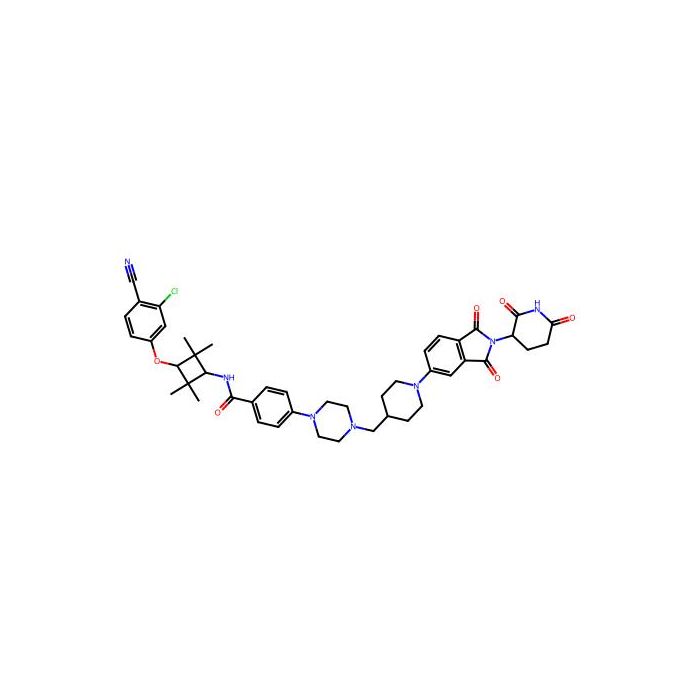
ARD-2128 - ≥99% , CAS No.2222111-87-5

CAS: 2222111-87-5 Cat. No.: A651640 Formule: C45H50ClN7O6 Poids moléculaire: 820.37
DISPONIBLE À COMMANDE
QUALITÉ & PURETÉ ≥99%
Storage
Protected from light,Store at -20°C,Desiccated
Shipped In
Ice chest + Ice pads
Application
PROTAC
★
Taille
Allemagne (EU)
USA*
Prix
Qté
10mg
A651640-10mg
Sur commande · 8–12 semaines
1 996,58€
1mg
A651640-1mg
Sur commande · 8–12 semaines
486,71€
5mg
A651640-5mg
Sur commande · 8–12 semaines
1 215,62€
Enter a quantity for the sizes you want to add.

Vue d’ensemble

ARD-2128 is a highly potent, orally bioavailable PROTAC androgen receptor (AR) degrader. ARD-2128 effectively reduces AR protein, suppresses AR-regulated genes in tumor tissues, and inhibits growth of tumor without signs of toxicity. ARD-2128 has the potential for the research of the prostate cancer

In Vitro

ARD-2128 is highly potent and effective in the inhibition of cell growth in the VCaP cell line and LNCaP cell line with the IC 50 values of 4 nM and 5 nM, respectively. ARD-2128 (1, 10, 100, and 1000 nM; 24 hours) effectively reduces the AR protein level by >50% at 1 nM and achieves the AR degradation of >90% at 10, 100, and 1000 nM, respectively, in VCaP cell. MCE has not independently confirmed the accuracy of these methods. They are for reference only. Cell Viability AssayCell Line: VCaP cell Concentration: 1, 10, 100, and 1000 nM Incubation Time: 24 hours Result: Reduces the AR protein level and achieves the AR degradation.

In Vivo

ARD-2128 (20 mg/kg; p.o.; once) is effective in reducing the level of AR protein in mice after 24 hours . ARD-2128 (10-40 mg/kg; p.o.; daily for 21 days) shows antitumor activity in the VCaP xenograft model in mice . ARD-2128 (5mg/kg; p.o.) treatment shows the C max , AUC 0-t and t 1/2 values of 1304 ng/mL, 22361 ng h/mL and 18.8 hours, respectively . MCE has not independently confirmed the accuracy of these methods. They are for reference only. Animal Model: SCID mice Dosage: 20 mg/kg Administration: Oral Result: Reducing the level of AR protein in mice after 24 hours. Animal Model: SCID mice Dosage: 10, 20, and 40 mg/kg Administration: P.o.; daily for 21 days Result: Inhibits tumor growth by 46, 69, and 63%, respectively. Animal Model: Male ICR Mice Dosage: 5 mg/kg Administration: P.o. (Pharmacokinetic Analysis) Result: The C max , AUC 0-t and t 1/2 were 1304 ng/mL, 22361 ng h/mL and 18.8 hours, respectively.

Form:Solid

IC50& Target:IC50: 4 nM (VCaP), 5 μM (LNCaP)

Spécifications

Spécifications et pureté
≥99%
Mécanismes biochimiques et physiologiques
ARD-2128 is a highly potent, orally bioavailable PROTAC androgen receptor (AR) degrader. ARD-2128 effectively reduces AR protein, suppresses AR-regulated genes in tumor tissues, and inhibits growth of tumor without signs of toxicity. ARD-2128 has the pote
Conditions de stockage de stockage
Protected from light,Store at -20°C,Desiccated
Expédié en
Ice chest + Ice pads
Ce produit nécessite l'expédition en chaîne froide. Les services terrestres et autres services économiques ne sont pas disponibles.
Type d'action
INHIBITOR
Pureté
≥99%
Noms et identifiants
Poids moléculaire
820.37

Données avancées

Certificats (CoA, COO, BSE/TSE et tableau d'analyse)
C of A & Other Certificates(BSE/TSE, COO):
Analytical Chart:
Propriétés chimiques et physiques
SolubilitéDMSO : 100 mg/mL (121.90 mM; Need ultrasonic)
Calculateurs de solution
Avis

Avis des clients

Application Protocols

No tested applications are specified in the Product Data for ARD-2128. The following are general, non-clinical procedures for handling small-molecule research compounds; adjust to your system and consult the SDS.

  • Stock preparation (general):

    • Dissolve in anhydrous DMSO to 10–50 mM. Vortex and, if needed, gently warm (<40°C) in the dark to assist dissolution. Filter through 0.22 µm PTFE for sterility/clarity if used in cell culture.
    • Aliquot into amber vials/tubes to minimize light exposure; store at −20°C, desiccated, as indicated.
  • Cell-based assays (general):

    • Prepare serial dilutions in DMSO, then add to pre-warmed medium to a final DMSO ≤0.1–0.5% v/v.
    • Typical exploratory ranges: 0.01–30 µM, subject to solubility and cytotoxicity limits. Include vehicle controls.
    • Protect plates/tubes from light during incubation if the compound is light-sensitive.
  • Biochemical assays (general):

    • Assess stability in assay buffer over the experimental time course (e.g., by LC-MS). Include detergent at low levels to minimize aggregation if compatible with your assay.
  • Analytical QC (general):

    • Verify identity/purity by LC-MS/HPLC upon receipt if data reproducibility is mission-critical.

These are generalized protocols. Optimize parameters empirically for your specific biology and consult the item’s CoA/SDS before use.

Biological Roles

Item-specific biological function or target information for ARD-2128 is not provided in the Product Data.

  • Biological role (item-specific): Not specified for this item; refer to CoA/Spec Sheet or primary literature associated with the CAS number for any mechanistic insights.

General context for small-molecule research tools (literature/general):

  • Small molecules are frequently used to modulate protein function (inhibition/activation) or, in the case of specialized chemotypes, alter protein stability or localization. Without structural or target data, no particular pathway or enzyme can be ascribed to this item.
  • In cellular systems, such compounds may exhibit context-dependent effects influenced by permeability, efflux, metabolic stability, and binding kinetics. These properties vary widely and are not specified here.

Practical guidance (general):

  • Prior to biological evaluation, confirm compound identity and purity of your lot; cross-check analytical data in the CoA.
  • Start with a broad concentration range (e.g., 0.01–30 µM) for exploratory assays, respecting solubility and cytotoxicity ceilings. Optimize DMSO content to ≤0.1–0.5% v/v.
  • Given the storage note “Protected from light,” minimize light exposure during cell-based work to avoid photodegradation artifacts.

For definitive biological roles or targets, consult peer-reviewed literature linked by the CAS number or contact Aladdin Scientific for any available application notes.

Buffer Applications

ARD-2128 is a discrete research small molecule; it is not a buffering reagent.

  • Buffering capacity/use: Not applicable. No acid–base pair, pKa range, or buffering system is specified for this item in the Product Data.

Practical note (general):

  • When using this compound in biochemical assays, select a buffer based on the biology of your system (e.g., HEPES pH 7.4 for cell-based assays, Tris pH 7.5–8.0 for enzyme assays, phosphate buffers for general use). Verify compound stability in your chosen buffer and co-solvent composition.
  • Maintain consistent final organic solvent content (commonly ≤0.1–0.5% DMSO) across all samples and controls to avoid solvent-derived effects.
Green Alternatives

While ARD-2128 is a research small molecule (not a process solvent), greener choices can be considered for its dissolution, formulation, and handling. The following are general recommendations (not item-specific specifications):

  • Prefer lower-toxicity solvents and excipients when feasible:

    • Use ethanol or aqueous ethanol as a co-solvent instead of DMF where solubility allows.
    • Replace NMP/DMF with DMSO for stock solutions; although DMSO is not “green,” it is generally safer and more acceptable in bioassays.
    • Employ PEG400, cyclodextrins (e.g., HP-β-CD), or polysorbates at low levels to improve apparent solubility in aqueous media, reducing reliance on harsher organic solvents.
  • Minimize solvent volumes:

    • Prepare higher-concentration stocks to reduce total solvent usage, provided the compound remains stable and fully dissolved.
  • Waste management:

    • Segregate halogenated from non-halogenated waste streams. Where possible, prefer non-halogenated solvent systems for cleanup and sample prep.

Illustrative comparison (general, literature-based; not specific to this item):

  • DMF/NMP: High solvency, reproductive toxicity concerns; difficult disposal.
  • DMSO: Broad solvency, lower volatility/toxicity than DMF/NMP; hygroscopic; acceptable in many biological systems at ≤0.1–0.5% v/v.
  • Ethanol: Renewable feedstock potential; good biocompatibility; limited solvency for very lipophilic compounds.

Always confirm compound stability and assay compatibility when substituting solvents or excipients.

Pharmaceutical Uses

No pharmaceutical, clinical, or therapeutic uses are specified or implied for ARD-2128 in the Product Data.

  • Regulatory/compendial status: Not specified for this item; refer to CoA/Spec Sheet. This product is supplied strictly for research use only.

General formulation context for research compounds (not item-specific; non-clinical):

  • For in vitro and exploratory in vivo research (where permitted by institutional approvals), investigators often prepare concentrated DMSO stocks and dilute into acceptable vehicles (e.g., aqueous ethanol/saline, PEG400/saline, or cyclodextrin-based vehicles) to achieve desired exposure while limiting irritancy. Stability and compatibility must be verified case by case.
  • No excipient roles or pharmacopeial monographs are claimed for this item. Do not use in human or veterinary applications.

Important: Aladdin Scientific supplies this material for laboratory research only. It is not intended for drug, household, or other uses. For any application requiring GLP/GMP or clinical-grade materials, contact us regarding feasibility; separate sourcing and documentation would be necessary.

Physical Properties

Only validated item-specific physical data are listed. No speculative specifications are provided.

  • Appearance: Not specified for this item; refer to CoA/Spec Sheet.
  • Molecular weight: Not specified for this item; refer to CoA/Spec Sheet.
  • Molecular formula: Not specified for this item; refer to CoA/Spec Sheet.
  • Melting point (MP): Not specified for this item; refer to CoA/Spec Sheet.
  • Boiling point (BP): Not specified for this item; refer to CoA/Spec Sheet.
  • Density: Not specified for this item; refer to CoA/Spec Sheet.
  • Refractive index: Not specified for this item; refer to CoA/Spec Sheet.
  • Solubility (item-specific): Not specified for this item; refer to CoA/Spec Sheet.
  • LogP/logD, pKa: Not specified for this item; refer to CoA/Spec Sheet.
  • UV-Vis characteristics: Not specified for this item; refer to CoA/Spec Sheet.

General laboratory guidance (literature/general, not item-specific):

  • Many modern research small molecules are prepared and stored as concentrated DMSO stocks (e.g., 10–50 mM), then diluted into aqueous assay media using ≤0.1–0.5% v/v DMSO.
  • If the compound is polyfunctional or contains multiple heteroatoms, aqueous solubility may be limited and can often be improved by co-solvents (DMSO, DMF), cosolubilizers (PEG400, cremophor-type excipients), or pH adjustment where chemically permissible. These are general strategies and may not apply to this specific item.

Always consult the item’s CoA/Spec Sheet and SDS for authoritative specifications before designing experiments.

Quality and Grades

Item-specific quality attributes provided:

  • Grade/Purity: Not specified for this item; refer to CoA/Spec Sheet.

Interpretation and guidance (general; not item-specific):

  • Research chemical quality is typically documented on a Certificate of Analysis (CoA) with tests such as HPLC/UPLC purity, NMR identity, water content (Karl Fischer), residual solvent levels, and sometimes metal content. In the absence of stated specifications above, rely on the lot CoA for exact acceptance criteria.
  • If designated as “analytical standard,” “bioactive,” or “screening compound,” additional controls like UPLC purity and LC-MS identity are often emphasized to ensure reproducible biological assays.
  • UV cutoffs, specific stabilizers, or inhibitor content limits are not provided here and should be verified on the CoA. If your application is UV-sensitive (e.g., HPLC detection at low wavelengths), request low-UV-absorbing solvent residues or a chromatogram.
  • If you require enhanced documentation (pharmacopoeial alignment, residual solvent class reporting, or impurity profiling), contact Aladdin Scientific for a technical package. Custom purification or lot reservation may be available upon request.

Note: Never substitute generalized quality narratives for the item’s CoA/Spec Sheet. Where a particular threshold is essential for your method, stipulate it at order placement.

Reaction and Applications

Context for use is research-only. No specific synthetic/reactive use is claimed for this item in the Product Data.

  • Item-specific application notes from catalog: Not provided.

General laboratory applications for small-molecule research compounds (not item-specific):

  • Chemical biology: Employed as tool compounds in target validation, pathway interrogation, and phenotypic screening. Researchers commonly prepare DMSO stocks and perform concentration–response studies to derive EC50/IC50 or degradation metrics where applicable.
  • Assay development: Utilized as positive/negative controls in high-throughput screening, target engagement assays (e.g., CETSA, NanoBRET), or cellular readouts (e.g., reporter gene, viability, imaging-based phenotypes). Selection of assay format depends on compound mechanism and permeability, which are not specified here.
  • Physicochemical profiling: Determination of solubility, lipophilicity, metabolic stability (microsomes/hepatocytes), and permeability (PAMPA, Caco-2) to inform handling conditions. These are general practices and not specific to ARD-2128 without supporting data.

Practical tips (general):

  • Validate identity and purity in-house (LC-MS, HPLC, NMR) if results are publication-critical.
  • Run solubility trials to set maximum working concentrations that avoid precipitation in media/buffer.
  • Protect from light during assays if the compound is light-sensitive as indicated by storage instructions.

For any specific mechanism-of-action or target-related application, consult primary literature associated with the CAS or contact us for available technical notes.

Reaction Conditions

This section is typically relevant for reagents or building blocks used as substrates in chemical reactions. ARD-2128 is supplied as a discrete research compound; no synthetic transformations or reaction conditions are specified for its use in the Product Data.

  • Reaction conditions (item-specific): Not applicable/Not specified for this item; refer to CoA/Spec Sheet if you intend to use it as a reagent.

General notes (literature/general):

  • If repurposed as a substrate or ligand in exploratory chemistry, establish stability profiles first (thermal, photochemical, hydrolytic). Use small-scale trials to map compatibility with acids/bases, oxidants/reductants, and common catalysts.
  • Monitor by LC-MS or UPLC to detect degradation versus desired transformation.

Given the storage requirement “Protected from light, Store at -20°C, Desiccated,” maintain low temperatures and exclude moisture during any handling steps where stability is critical.

Safety and Handling

Safety details specific to this item are limited in the Product Data. Exercise prudent laboratory precautions.

  • GHS/CLP classification (item-specific): Not specified for this item; refer to SDS.
  • Signal word, hazard statements (H-phrases), pictograms: Not specified for this item; refer to SDS.
  • Research use: For research use only.

General laboratory safety guidance (not item-specific; defer to SDS):

  • PPE: Wear lab coat, safety glasses, and appropriate chemically resistant gloves. Work in a fume hood to avoid inhalation exposure to dusts/aerosols or solvent vapors.
  • Handling: Avoid breathing dust or vapors. Avoid contact with skin and eyes. Do not ingest. Prevent environmental release.
  • Incompatibilities: Until specific data are known, segregate from strong oxidizers/reducers and reactive acids/bases. Avoid moisture if the item is moisture-sensitive; the storage note “Desiccated” indicates low-humidity storage is preferred for this item.
  • Light sensitivity: The Product Data specify “Protected from light” — minimize light exposure during handling and storage (use amber vials/wraps as appropriate).
  • First aid (overview): In case of contact, rinse affected area with water; remove contaminated clothing. If inhaled, move to fresh air. If ingested or on persistent exposure, seek medical attention and provide the SDS.
  • Spill/cleanup: Avoid dust generation. Absorb solutions with inert material and dispose of according to institutional and local regulations.

Always consult the official SDS provided with the shipment for authoritative hazard, toxicity, and response information.

Solvent Selection

Item-specific solubility data are not provided. The following are general, practical strategies for handling small-molecule research compounds like ARD-2128.

  • Stock solutions (general practice):

    • Prepare a concentrated DMSO stock (e.g., 10–50 mM) whenever chemically compatible. Filter-sterilize if required for cell work (0.22 µm PTFE is preferred for DMSO compatibility).
    • For aqueous assays, pre-dilute the DMSO stock into medium or buffer to a final DMSO content typically ≤0.1–0.5% v/v, balancing solubility against biological tolerance.
  • Co-solvent systems (general):

    • DMSO/aqueous, DMSO/ethanol/aqueous, or DMSO/PEG400/saline mixtures can improve apparent solubility and reduce precipitation on dilution.
    • For in vitro enzymology, consider adding a nonionic surfactant at low levels (e.g., 0.01–0.05% Tween-20 or Pluronic F-127) to mitigate compound aggregation, where compatible with the assay.
  • Solvent compatibility considerations:

    • Avoid strong acids/bases unless the compound is known to be stable under those conditions.
    • For light-sensitive materials (as indicated), use amber vials and minimize exposure during preparation and storage.
  • Choosing among common solvents (general comparison):

    • DMSO: Highest solvating power for diverse chemotypes; widely used in screening; hygroscopic.
    • DMF: Strong solvent; less favored in bioassays; handle with care due to toxicity.
    • Ethanol: Biologically friendlier but lower solvating power; useful for co-solvent blends.
    • Acetonitrile: Good for analytical work; limited use in biological systems.

Always verify item-specific solubility/stability on the CoA/Spec Sheet or via a small pilot test.

Storage and Reconstitution

Item-specific storage conditions (from Product Data):

  • Store at −20°C, desiccated.
  • Protect from light.
  • Shipped in ice chest with ice pads to maintain cold chain.

Reconstitution guidance (general best practices; not item-specific specifications):

  • Solvent: Use anhydrous DMSO to prepare a concentrated stock solution (e.g., 10–50 mM), unless contraindicated by your internal data. If alternative solvents are required (DMF, ethanol), confirm compatibility and stability first.
  • Technique: Allow the vial to equilibrate to room temperature in the dark before opening to prevent moisture condensation. Add solvent, vortex, and sonicate briefly if needed to achieve complete dissolution. Avoid prolonged exposure to light.
  • Aliquoting: Dispense into small, single-use amber vials/tubes to minimize freeze–thaw cycles and headspace moisture. Flush with inert gas if the compound is air/moisture sensitive (not specified here).
  • Storage of solutions: Store aliquots at −20°C (or per your stability data). Avoid repeated freeze–thaw; thaw on ice/in the dark immediately before use.
  • Stability: Item-specific stability, hygroscopicity, and solution shelf-life are not specified; consult the CoA/Spec Sheet and perform pilot stability checks (e.g., LC-MS after 1–2 weeks at working conditions).

Always follow the SDS for safe handling and disposal. For detailed, lot-specific reconstitution advice, contact Aladdin Scientific technical support.

Structure and Identity

Overview of identity and structural information for ARD-2128 (SKU A651640).

  • Item-specific identifiers (from Product Data):

    • Product name: ARD-2128
    • CAS: 2222111-87-5
    • SKU: A651640
    • Molecular formula: Not specified for this item; refer to CoA/Spec Sheet.
    • Molecular weight: Not specified for this item; refer to CoA/Spec Sheet.
    • SMILES: Not specified for this item; refer to CoA/Spec Sheet.
    • InChIKey: Not specified for this item; refer to CoA/Spec Sheet.
  • Structural features (general context, literature/assumption-free):

    • The trivial name “ARD-2128” denotes a discrete small-molecule research compound. The exact functional groups, ring systems, and stereochemistry are not provided in the current Product Data.
    • Without a supplied structure, no definitive statement can be made about aromaticity, heteroatoms, linker motifs, or stereocenters for this specific lot/item.
  • Practical notes:

    • If you require definitive structural descriptors (2D/3D structure, stereochemical configuration, or canonical identifiers), please consult the product CoA/Spec Sheet or contact Aladdin Scientific technical support. Cross-referencing by CAS in major chemical databases may also be useful for literature verification.
  • 2D structure description:

    • Not specified for this item; refer to CoA/Spec Sheet.
Synthetic Utility

ARD-2128 is offered as a finished small-molecule research product rather than a synthetic building block. No reactive handle or derivatization strategy is specified in the Product Data.

  • Synthetic building block use: Not typically applicable without structural information. Lacking a defined SMILES or functional group list, no reliable guidance can be given on coupling, protection/deprotection, or late-stage diversification for this particular item.

General guidance if structural data become available (literature/general):

  • If the compound contains amide, urea, or ether linkages typical of many modern bioactives, such motifs are generally robust but may be sensitive to strong acids/bases or oxidative conditions during any attempted derivatization.
  • Compounds with multiple heteroatoms or chiral centers often require careful chemoselective strategies and may not be amenable to routine cross-couplings without prior functional group interconversions.

Recommendation:

  • If your program requires analog generation or tagging (e.g., biotinylation, fluorophore conjugation), request the structure or consider ordering precursor building blocks. Our team can help identify synthetically tractable surrogates with defined functional handles.
Target Specificity

Target-related details are not provided for this product.

  • Intended molecular target(s): Not specified for this item; refer to CoA/Spec Sheet or primary literature associated with CAS 2222111-87-5.
  • Species selectivity, off-target profile, binding constants, and cellular potency: Not specified for this item; refer to CoA/Spec Sheet.

Note: In the absence of validated, item-specific data, no claims are made regarding target engagement, selectivity, or mechanism. Researchers should determine target specificity experimentally using appropriate assays (e.g., binding, enzymatic activity, genetic rescue, or proteomics) as relevant to their program.

Souhaitez-vous que nous vous envoyions un message lorsque des réductions seront disponibles?

Me rappeler plus tard

Merci ! Veuillez vérifier votre boîte de réception e-mail pour confirmer.

Oups ! Les notifications sont désactivées.