GRADE & PURITYCarrier Free?Carrier-free — supplied without added carrier protein/stabilizer. Use when carriers (e.g. BSA) would interfere with conjugation or sensitive assays.ExactAb™?ExactAb™ — Aladdin's antibody line emphasizing precision and validated quality. Use for reliable, specificity-validated antibody applications.Validated?Validated grade — performance confirmed in defined applications before release. Use when you want documented assurance the reagent works as stated.1.0 mg/mL
ExactAb™, Validated, Carrier Free, 1.0 mg/mL Carrier Free,ExactAb™,Validated for sensitive chromatographic and analytical workflows requiring minimal baseline interference.
🌡
Storage & shipping
Store at -20°C,Avoid repeated freezing and thawing Ships Ice chest + Ice pads Check lot-specific COA for exact specifications.
📋
Quality documents
SDS, COA, datasheet, and spec sheet available for download. Lot-specific COA accessible via lot number lookup.
📚
Literature proof
Cited in 0 peer-reviewed publications across chromatography, organic synthesis, and cross-coupling reactions.
Vue d’ensemble
Rabbit anti Human ARHGAP27 Antibody, Polyclonal, could be used for WB and so on.
Specifications
Product Name
ARHGAP27 Antibody - Anticorps primaire, specific to ARHGAP27
Synonymes
ARHGAP27 | CAMGAP1 | CIN85-associated multi-domain-containing Rho GTPase-activating protein 1 | PP905 | RHG27_HUMAN | Rho GTPase-activating protein 27 | Rho-type GTPase-activating protein 27 | SH3 domain containing 20 | SH3 domain containing protein 20 |
Spécifications et pureté
ExactAb™, Validated, Carrier Free, 1.0 mg/mL
Mécanismes biochimiques et physiologiques
Rho GTPase-activating protein which may be involved in clathrin-mediated endocytosis. GTPase activators for the Rho-type GTPases act by converting them to an inactive GDP-bound state. Has activity toward CDC42 and RAC1.
Espèce hôte
Lapin
Spécificité
ARHGAP27
Immunogène
KLH-conjugated synthetic peptide encompassing a sequence within the Central region of human ARHGAP27.
Contrôle positif
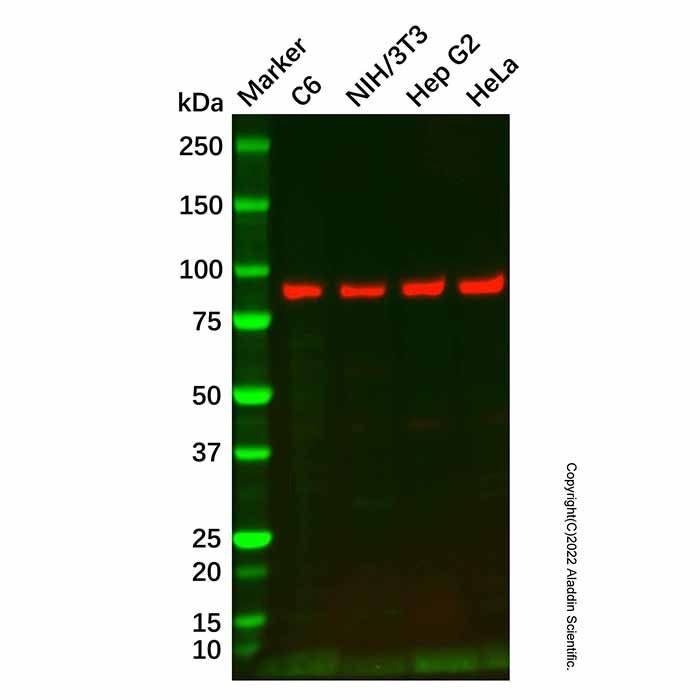
WB: HeLa, Hep G2, NIH/3T3 and C6 cell lysates.
Conjugation
Unconjugated
Grade
Carrier Free, ExactAb™, Validated
SDS-PAGE
150 kDa
Méthode de purification
Immunogen affinity purified
Concentration
1.0 mg/mL
Product Line
Produits biologiques
Stockage et expédition
Forme
Liquid
Conditions de stockage de stockage
Store at -20°C,Avoid repeated freezing and thawing
Expédié en
Ice chest + Ice pads
Stabilité et stockage
Store at 4℃ short term (1-2 weeks). Store at -20℃ long term (12 months). Upon receipt, it is recommended to aliquot. Avoid freeze/thaw cycle.
Images
ARHGAP27 Antibody (Ab089547) - Western Blot All lanes: ARHGAP27 Antibody (Ab089547) at 1/1000 dilution Samples: Lysates at 20 µg per lane Secondary: Goat Anti-Rabbit IgG H&L (HRP) (Ab170144) at 1/20000 dilution
Predicted band size: 98 kDa Observed band size: 90 kDa Exposure time: 153.0 s
Application
Application
Dilution info
WB
1/500-1/1000
Documentation
📋 Safety Data Sheet (SDS)
Comprehensive hazard, handling, storage, and regulatory compliance document.
Determine the necessary mass, volume, or concentration for preparing a solution.
Dilution Calculator
Determine the dilution needed to prepare a stock solution.
Reconstitution Calculator
Avis
Avis des clients
Application Protocols
Item-specific tested applications, recommended dilutions, positive controls, and incubation conditions are Not specified for this item; refer to CoA/Spec Sheet.
General guidance (not specific to this SKU)
Western blot: Start at 0.2–0.5 µg/mL primary in TBST + 5% milk or BSA; optimize as needed.
Immunofluorescence/IHC: Begin at 1–5 µg/mL; include appropriate fixation/permeabilization controls (e.g., 4% PFA, 0.1–0.3% Triton X-100 as required).
Immunoprecipitation: 1–5 µg antibody per 200–500 µg lysate protein; validate lysis buffer stringency.
These are generic starting points only and do not constitute specifications for this item.
Biological Roles
About the target (literature/general information)
ARHGAP27 (Rho GTPase-activating protein 27) is a member of the RhoGAP family that accelerates GTP hydrolysis on Rho-family GTPases, generally acting as a negative regulator of Rho GTPase signaling.
Reported domains include BAR, PH, and SH3-interaction motifs in related family members, enabling membrane association and protein–protein interactions. ARHGAP27 has been linked to regulation of actin cytoskeleton remodeling, endocytosis, and vesicular trafficking pathways.
Cellular localization: Predominantly cytoplasmic with membrane-associated pools reported depending on cell state and isoform (literature). Expression is cell-type dependent.
Relevance for antibody-based studies (general guidance)
Use in immunoblotting to assess expression levels, in immunofluorescence to map subcellular distribution during cytoskeletal rearrangements, and in immunoprecipitation to probe ARHGAP27-associated complexes.
Cross-validation with orthogonal methods (siRNA/CRISPR perturbation or overexpression of tagged ARHGAP27) is recommended to confirm target specificity.
Note: The biological details provided are general literature context for ARHGAP27. Item-specific validation data, species reactivity, and epitope information are Not specified for this item; refer to CoA/Spec Sheet.
Buffer Applications
Item-specific details
Formulation and exact buffer for this SKU are Not specified for this item; refer to CoA/Spec Sheet. Product is Carrier Free per Product Data (no carrier proteins added).
General buffer practices for antibodies (literature/best practice)
Stock/working buffers: PBS or TBS at pH 7.2–7.6. Avoid extreme pH or low ionic strength that can promote aggregation.
Preservatives: If long-term refrigerated storage is needed and live-cell compatibility is not required, 0.02–0.05% sodium azide can be added by the user (not included by default).
Stabilizers: 10–50% glycerol facilitates storage at −20°C without freezing; confirm assay compatibility.
Blocking agents for assays: Use 1–5% BSA, casein, or species-matched normal serum in assay buffers to reduce nonspecific binding. Since this item is Carrier Free, add blockers only to the assay buffer, not the stock, if future conjugation is planned.
Detergents: 0.05–0.1% Tween-20 in wash buffers improves stringency for ELISA/WB; reduce or omit for IF when membrane integrity is critical.
Typical use concentrations (guidance, not item-specific):
WB: 0.1–1 µg/mL; IF/IHC: 0.5–10 µg/mL; IP: 1–5 µg per reaction. Optimize per system.
Always validate buffer composition for downstream applications and consult the CoA for any product-specific recommendations.
Green Alternatives
Conventional “green chemistry solvent” comparisons are not applicable to antibody reagents. Sustainability considerations for antibodies focus on:
Using concentrated stocks and minimizing shipping volume/packaging.
Selecting glycerol-free or azide-free formats only when required (reduces hazardous waste), and preparing working aliquots to minimize discard.
Implementing cold-chain efficiency and reusable ice packs. For this SKU, shipping is on ice pads in an ice chest (per Product Data).
Pharmaceutical Uses
This reagent is for research use only and is not intended for human or veterinary use.
Process development/QC: Antibodies to intracellular signaling proteins such as ARHGAP27 can be used as analytical reagents in cell-line characterization, mechanism-of-action studies for Rho-pathway modulators, or biomarker method development in preclinical research.
Assay development: Serves as a capture or detection reagent in ELISA or as a probe in Western blot and immunocytochemistry for target qualification in discovery pipelines.
Conjugation: Carrier-free format facilitates preparation of labeled conjugates (fluorophores, biotin, enzymes) for high-sensitivity analytical assays.
Compliance notes
No pharmacopeial status or monograph is indicated. Lot-specific impurity limits (e.g., endotoxin, residual DNA/protein A) and bioburden are Not specified for this item; refer to CoA/Spec Sheet.
Any use in GMP environments requires internal qualification and suitability testing per site procedures.
Physical Properties
Item-specific physical properties
Appearance: Not specified for this item; refer to CoA/Spec Sheet.
Concentration/formulation: Not specified for this item; refer to CoA/Spec Sheet.
Refractive index, pH, osmolality: Not specified for this item; refer to CoA/Spec Sheet.
General/typical properties for IgG-class antibodies (literature)
Approximate molecular mass: ~150 kDa for full-length IgG; Fab ~50 kDa; scFv ~25–30 kDa (actual for this item not specified).
Isoelectric point (pI): commonly 6–9 depending on sequence and glycosylation.
Solubility: Highly soluble in aqueous buffers (PBS, TBS). Stability influenced by pH (optimal near neutral), ionic strength, and presence/absence of stabilizers.
Thermal behavior: Onset of unfolding transitions often 60–70°C for IgG1 in neutral buffers but strongly buffer- and sequence-dependent.
Storage buffer additives (general): Stabilizers such as 0.02–0.05% sodium azide (biocide) or 10–50% glycerol (freeze–thaw protection) are sometimes used; this item is designated Carrier Free—no carrier proteins are included per Product Data (other excipients not specified).
What these designations typically imply (general/industry usage; not a specification for this lot)
Carrier Free: No protein carriers (e.g., BSA, gelatin) are added to the formulation. Advantages include:
Lower background in cell-based assays and immunoassays sensitive to carrier proteins.
Direct compatibility with chemical conjugation (e.g., NHS-esters for fluorophores/biotin) without prior removal of carriers.
Reduced risk of carrier-derived protease or immunogenic impurities. Note: Absence of carrier may reduce long-term stability; handle and store carefully.
ExactAb™: Proprietary designation indicating a defined, highly consistent antibody preparation. In common practice this often denotes lot-to-lot reproducibility and suitability for critical applications; consult the CoA for exact meaning and performance metrics for this SKU.
Validated: The antibody has undergone internal QC/validation by the manufacturer. Specific validated applications, species reactivity, and recommended dilutions are Not specified for this item; refer to CoA/Spec Sheet and SDS for authoritative details.
Quality control considerations (general)
Identity/Integrity: SDS-PAGE under reducing/non-reducing conditions; size-exclusion chromatography for aggregates; endotoxin testing for cell-based uses (thresholds not specified for this item).
Functional: Antigen-specific binding assessed by ELISA, WB, IHC/IF, or flow cytometry depending on intended use (details not provided here).
Reaction and Applications
This product is a biological affinity reagent (antibody) and is not typically used as a stoichiometric/reactive substrate or catalyst in synthetic organic or inorganic reactions. For practical laboratory use, see Buffer Applications, Biological Roles, Target Specificity, and Application Protocols sections.
Reaction Conditions
Not applicable to chemical synthesis. For conjugation workflows (general guidance, not item-specific): NHS-ester labeling is typically performed in amine-free buffers (e.g., 50–100 mM sodium bicarbonate, pH 8.3–8.5) at room temperature for 30–60 minutes, followed by desalting. However, specific conjugation protocols should be optimized per application and are not provided for this SKU.
Safety and Handling
Item-specific hazard information
GHS classification, pictograms, H-statements, signal word: Not specified for this item; refer to SDS.
Research use: For research use only (per Product Data). Not for diagnostic, therapeutic, or clinical use.
General safety guidance for handling antibodies (literature/best practice)
PPE: Wear lab coat, disposable nitrile gloves, and safety glasses. Handle solutions using sterile technique to avoid microbial contamination.
Incompatibilities: Avoid strong oxidizers and proteases. Prevent microbial growth; if user adds sodium azide as preservative, note its acute toxicity and incompatibility with metals/plumbing.
First aid (overview; defer to SDS):
Skin/eye contact: Rinse with water. Remove contaminated clothing.
Inhalation of aerosols: Move to fresh air; seek medical advice if symptoms persist.
Ingestion: Rinse mouth; do not induce vomiting; seek medical advice.
Spill response: Absorb with inert material, clean with aqueous detergent or 70% ethanol. Decontaminate surfaces.
Special risks: Repeated freeze–thaw can denature antibodies and generate particulates; aliquot to minimize cycles. Use low-retention plastics to limit adsorption.
Waste: Dispose of biological protein solutions per institutional biosafety and chemical waste procedures; azide-containing solutions require hazardous waste handling.
Solvent Selection
For antibodies, “solvent” considerations center on aqueous buffer formulation rather than organic solvent choice.
Item-specific note
This SKU is Carrier Free. No carrier proteins are present by design; buffer composition and excipients are Not specified for this item; refer to CoA/Spec Sheet.
General buffer selection guidance (literature/best practice)
Working buffers: PBS (10 mM phosphate, 137 mM NaCl, 2.7 mM KCl, pH 7.2–7.4) or TBS (50 mM Tris, 150 mM NaCl, pH 7.4–7.6) are common. Maintain near-neutral pH to preserve IgG stability.
Additives (user-optional):
0.02–0.05% sodium azide as a preservative (avoid for live-cell work and HRP-based assays).
10–50% glycerol for freeze–thaw protection at −20°C (may affect some assays; validate).
0.01–0.1% nonionic surfactant (e.g., Tween-20) to reduce nonspecific adsorption for ELISA/IF; avoid during conjugation steps.
Organic solvents: Avoid >10% organic co-solvents; even low levels of DMSO/ethanol can destabilize antibodies unless specifically optimized.
Low-binding plastics and pre-blocked surfaces reduce loss at low concentrations.
When to choose alternatives
If conjugation is planned, carrier-free formulations are preferred (as in this item). For cell stimulation/neutralization studies, endotoxin-controlled reagents are recommended; endotoxin level for this item is Not specified for this item; refer to CoA/Spec Sheet.
Storage and Reconstitution
Item-specific instructions (from Product Data)
Storage: Store at −20°C. Avoid repeated freezing and thawing.
Shipping: Ice chest with ice pads (cold chain).
General handling recommendations (literature/best practice)
Upon receipt: Inspect for container integrity. If lyophilized, briefly centrifuge before opening. If liquid, keep cold; do not warm above 4°C until ready to aliquot.
Aliquoting: Prepare single-use aliquots under aseptic conditions to minimize freeze–thaw cycles and contamination. Use low-binding tubes and pipette tips.
Reconstitution (if lyophilized; not specified for this item): Reconstitute with sterile, neutral pH buffer (e.g., PBS or 1× TBS). For carrier-free stocks intended for conjugation, avoid primary amines (e.g., Tris) during NHS-ester labeling steps.
Optional stabilizers (user-added, if compatible with application): 10–50% glycerol to permit storage at −20°C without freezing; 0.02–0.05% sodium azide as preservative (do not use for live cells or HRP-based detection).
Short-term storage: 2–8°C for days to weeks depending on formulation; long-term per Product Data at −20°C. For very long-term storage, −80°C may be advantageous if formulation permits.
Freeze–thaw: Thaw on ice, mix gently; never vortex vigorously. Discard aliquots showing visible precipitate or loss of activity.
Documentation: Consult the CoA/Spec Sheet for any lot-specific buffer composition, concentration, and reconstitution volume.
Structure and Identity
Item-specific identifiers (from Product Data)
Molecular formula: Not specified for this item; refer to CoA/Spec Sheet.
Molecular weight: Not specified for this item; refer to CoA/Spec Sheet.
SMILES / InChIKey / CAS / CID: Not specified for this item; refer to CoA/Spec Sheet.
General structural description (literature/general information)
This product is an antibody specific for the human protein ARHGAP27 (also known as SH3-domain binding protein 1-like; a Rho GTPase-activating protein). Antibodies are Y-shaped immunoglobulins typically composed of two heavy and two light chains, forming two antigen-binding fragments (Fab) and one crystallizable fragment (Fc).
The antigen-binding site is formed by the complementarity-determining regions (CDRs) on each Fab. Exact clone/isotype/host species and CDR sequences are not specified for this item; refer to CoA/Spec Sheet.
Expected molecular architecture for IgG-class antibodies (literature): disulfide-linked heterotetramer with multiple N-glycosylation sites on Fc (glycoform heterogeneity varies by production system).
Synthetic Utility
Not applicable. As an antibody affinity reagent, this product is not used as a building block or reagent in synthetic organic chemistry. See Biological Roles, Buffer Applications, and Target Specificity for relevant information.
Target Specificity
Item-specific information only
Antigen/epitope, species reactivity, clone, host/isotype, and cross-reactivity: Not specified for this item; refer to CoA/Spec Sheet.
Note: While this product name indicates ARHGAP27 specificity, definitive target validation parameters and epitope details must be obtained from the lot-specific certificate or technical datasheet.
Need help choosing the grade?
Our grade selection guide covers purity, stabilizer status, and application suitability for all variants in our catalog.
We use cookies to ensure the website functions properly and, where permitted, to improve your experience. You can manage your preferences at any time in Settings. Learn more in our Cookie Policy.
Shall we send you a message when we have discounts available?
Remind me later
Thank you! Please check your email inbox to confirm.
Products are supplied to verified businesses, institutions, and qualified professionals for research and development use only. Not for use in humans, animals, diagnosis, or therapy.

 ZJ25F0116734