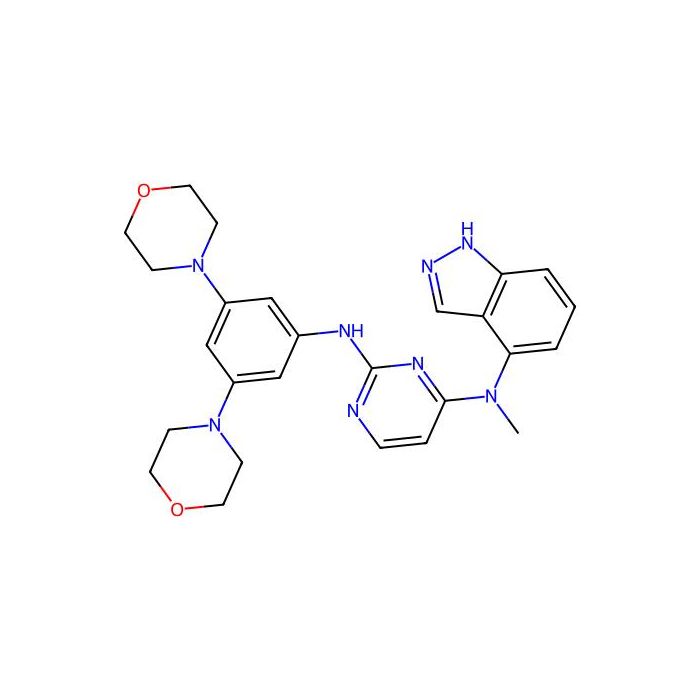
≥98% for sensitive chromatographic and analytical workflows requiring minimal baseline interference.
🌡
Storage & shipping
Store at -20°C Ships Ice chest + Ice pads Check lot-specific COA for exact specifications.
📋
Quality documents
SDS, COA, datasheet, and spec sheet available for download. Lot-specific COA accessible via lot number lookup.
📚
Literature proof
Cited in 0 peer-reviewed publications across chromatography, organic synthesis, and cross-coupling reactions.
Vue d’ensemble
AZ12672857 is an orally active inhibitor of EphB4 ( IC 50 =1.3 nM) and Src kinases . AZ12672857 shows good inhibition of proliferation of c-Src transfected 3T3 cells (IC 50 =2 nM) as well as autophosphorylation of EphB4 in transfected CHO-K1 cells (IC 50 =9 nM)
In Vitro
AZ12672857 shows only modest inhibition of CYP P450 (IC 50 =5 μM against 2C9 and 3A4, >10 μM against 1A4, 2D6 and 2C19). AZ12672857 inhibits p-KDR in HUVEC with an IC 50 of 240 nM and inhibits p-PDGFR-βin MG63 cell line with an IC 50 of 58 nM. MCE has not independently confirmed the accuracy of these methods. They are for reference only.
Form:Solid
IC50& Target:Src
Specifications
Spécifications et pureté
≥98%
Mécanismes biochimiques et physiologiques
AZ12672857 is an orally active inhibitor of EphB4 ( IC 50 =1.3 nM) and Src kinases . AZ12672857 shows good inhibition of proliferation of c-Src transfected 3T3 cells (IC 50 =2 nM) as well as autophosphorylation of EphB4 in transfected CHO-K1 cells (IC 50
Conditions de stockage de stockage
Store at -20°C
Expédié en
Ice chest + Ice pads
Ce produit nécessite l'expédition en chaîne froide. Les services terrestres et autres services économiques ne sont pas disponibles.
This compound belongs to the class of organic compounds known as phenylmorpholines. These are aromatic compounds containing a morpholine ring and a benzene ring linked to each other through a CC or a CN bond.
External Descriptors
Not available
1. Djoumbou Feunang Y, Eisner R, Knox C, Chepelev L, Hastings J, Owen G, Fahy E, Steinbeck C, Subramanian S, Bolton E, Greiner R, and Wishart DS. ClassyFire: Automated Chemical Classification With A Comprehensive, Computable Taxonomy. Journal of Cheminformatics, 2016, 8:61.
Certificats (CoA, COO, BSE/TSE et tableau d'analyse)
C of A & Other Certificates(BSE/TSE, COO):
Analytical Chart:
Propriétés chimiques et physiques
Solubilité
DMSO : 25 mg/mL (51.38 mM; Need ultrasonic)
Poids moléculaire
486.600 g/mol
XLogP3
3.200
Hydrogen Bond Donor Count
2
Hydrogen Bond Acceptor Count
9
Rotatable Bond Count
6
Exact Mass
486.249 Da
Monoisotopic Mass
486.249 Da
Topological Polar Surface Area
94.700 Ų
Heavy Atom Count
36
Formal Charge
0
Complexity
665.000
Isotope Atom Count
0
Defined Atom Stereocenter Count
0
Undefined Atom Stereocenter Count
0
Defined Bond Stereocenter Count
0
Undefined Bond Stereocenter Count
0
The total count of all stereochemical bonds
0
Covalently-Bonded Unit Count
1
Calculateurs de solution
Molarity Calculator
Determine the necessary mass, volume, or concentration for preparing a solution.
Dilution Calculator
Determine the dilution needed to prepare a stock solution.
Reconstitution Calculator
Avis
Avis des clients
Application Protocols
Item-specific
No tested applications or recommended protocols are provided for this item in the product data.
General RUO handling notes (not a specification)
Preparing stocks: Dissolve the compound in anhydrous DMSO to a convenient concentration (e.g., 10–50 mM). Vortex and, if needed, sonicate briefly. Filter through 0.22 µm PTFE only if particulates persist and the compound is stable.
Dosing: Add DMSO stock to assay media to achieve the desired final concentration, keeping DMSO constant across conditions. Include vehicle controls.
Storage of working solutions: Use freshly prepared dilutions. Avoid extended storage in aqueous media unless stability has been verified.
Biological Roles
Item-specific
No target assignment, pathway annotation, or biological role is provided in this catalog entry for AZ12672857.
General guidance for small-molecule tool compounds
Putative roles are typically established by target binding/functional assays, phenotypic screening, and orthogonal validation. Absent item-specific data, users should consult primary literature or public databases using the provided CAS (945396-55-4) and CID (49831162) and then verify activity with authentic standards and controls.
When exploring mechanism, consider: concentration–effect relationships, temporal response, and chemical genetics approaches (e.g., overexpression/knockdown of suspected targets) to support causal links.
Off-target assessment: Early counterscreens against common liabilities (e.g., aggregation, redox cycling, PAINS motifs) and orthogonal assay formats can prevent misannotation.
ADME-relevant properties (permeability, microsomal stability, plasma protein binding) are often informative for biological interpretation but are not specified here and should be determined experimentally as needed.
Reminder: For research use only. Not for human or veterinary use.
Buffer Applications
Applicability
AZ12672857 is not a buffering agent. No buffer system parameters (pKa, effective pH range) are provided or expected for this molecule.
Practical notes for assay buffers (general guidance)
If dosing from DMSO stocks, maintain consistent final DMSO content across conditions (commonly 0.1–1% v/v) and include vehicle controls.
To improve apparent solubility upon dilution, add compound stock to vigorously stirred buffer or pre-mix with a small volume of water-miscible solvent before addition.
Common assay buffers (e.g., PBS, HEPES, Tris) may be used according to the biological system; confirm compound stability in the chosen buffer and at the working temperature and time frame.
Monitor for precipitation or adsorption to plastics; low-binding tubes/plates can mitigate losses for hydrophobic compounds.
Green Alternatives
Context
This product is a discrete screening compound, not a process solvent or commodity reagent; therefore, classic “green alternative” substitution frameworks are less applicable to the molecule itself.
Greener handling strategies (general guidance)
Solvent minimization: Prepare higher-concentration DMSO stocks to reduce overall solvent use; dilute immediately before assays to limit waste.
Alternative cosolvents: Where compatible, consider water-rich buffers with minimal DMSO (≤0.1–0.5% v/v) to decrease organic solvent burden.
Micro-scale assays: Use miniaturized assay formats (e.g., 384/1536-well plates) to reduce per-experiment solvent and compound consumption.
Waste management: Segregate halogenated vs non-halogenated organic waste streams; implement solvent recovery where institutional infrastructure exists.
Tradeoffs
Lower DMSO fractions can decrease compound solubility and increase adsorption losses; validate recovery and actual delivered dose at reduced organic content.
Using ethanol or acetonitrile in place of DMSO may aid volatility and downstream removal but often reduces achievable stock concentrations.
Pharmaceutical Uses
Item-specific
No pharmacopeial status, excipient role, or formulation designation is provided. This material is labeled: For research use only.
Context and guidance
AZ12672857 is offered as a discovery research compound and is not intended for use in drug products or clinical applications.
Preformulation-style investigations (solubility, stability, solid form) may still be valuable in research settings to support in vitro/in vivo experiments, but any such work remains RUO and non-GMP.
If translational studies are contemplated, separate sourcing under appropriate quality systems (GMP) and comprehensive CMC characterization would be required; this is outside the scope of this product listing.
Physical Properties
Item-specific specifications
Appearance: Not specified for this item; refer to CoA/Spec Sheet.
Purity/Grade: Not specified for this item; refer to CoA/Spec Sheet.
Literature/computed (general guidance only)
Exact physicochemical properties (mp, bp, logP, pKa, density, refractive index, aqueous solubility) are not provided in this listing. For screening compounds like AZ12672857, supplier documents or public databases (via the provided CID) are the most reliable source.
Practical implications for handling and use
Solubility screening: For novel/screening molecules, begin with small-scale solubility tests in DMSO (typical stock 10–50 mM), then evaluate miscibility with aqueous assay buffers at intended final DMSO levels (often 0.1–1% v/v).
Polymorphism: If the solid form is polymorphic or amorphous (unknown here), apparent solubility and dissolution rate may vary. Empirically confirm before critical experiments.
Hygroscopicity/oxidation: Not specified. Until known, minimize moisture/air exposure and store tightly sealed under inert atmosphere if feasible.
Stability: Without a structural motif, projected stability windows are uncertain. Protect from light and heat as a precaution and use amber vials when possible.
Always treat the values from literature/computation as preliminary and confirm experimentally for your system.
Quality and Grades
Item-specific
Grade/Purity: Not specified for this item; refer to CoA/Spec Sheet.
How to interpret typical grades (general guidance)
Research/Screening grade: Common for discovery tool compounds; emphasizes identity and purity suitable for in vitro/in vivo research (RUO), but not certified for GMP or clinical use.
HPLC/LCMS characterization: For small molecules, CoA often includes chromatographic purity (area%), identity confirmation (1H NMR/HRMS), and water/solvent residuals when relevant. Review batch documentation before critical studies.
Stabilizers and additives
No stabilizer information is provided for this item. If stability is a concern, users may aliquot and store under inert gas, protected from light.
Batch-to-batch considerations
Potency-sensitive studies (e.g., target modulation, phenotypic assays) can be impacted by minor impurities or polymorphic form. Verify purity/identity for each lot and record storage/handling history to ensure reproducibility.
Reaction and Applications
Item-specific
Manufacturer Applications: Not specified in the catalog entry beyond placement in a small-molecule/compound library category.
Applicability to chemical synthesis
AZ12672857 is offered as a research compound for screening and biological studies rather than as a synthetic reagent or building block. As such, it is not typically selected to promote or catalyze reactions (e.g., Grignard, cross-coupling) or to serve as a general-purpose synthetic intermediate.
Research applications (general guidance for screening compounds)
Tool compound usage: Evaluate dose–response in biochemical or cell-based assays to probe pathway hypotheses. Use orthogonal readouts to mitigate assay interference.
Profiling: Consider solubility/permeability assessment, microsomal stability, and basic selectivity panels as appropriate to your research context.
Analytical confirmation: Verify identity and purity by LC–MS/HPLC upon receipt, especially prior to SAR or mechanistic studies.
If your intended use requires derivatization or immobilization, consult structural data (via CoA or CID) to assess functional handles and compatibility.
Reaction Conditions
Not typically applicable
AZ12672857 is not supplied for use as a reagent or catalyst, and no reaction condition data (solvent, temperature, catalysts, yields) are provided for this item.
If chemical modification is undertaken by the user (general guidance)
Use anhydrous conditions and inert atmosphere as default for moisture/air-sensitive transformations until stability is established.
Choose solvents based on the functional groups present in the verified structure; start with small-scale feasibility experiments and analytical monitoring (LC–MS/HPLC).
Purification: Preparative HPLC or flash chromatography with gradient optimization is commonly required for complex screening compounds; validate purity by orthogonal techniques.
Safety and Handling
Item-specific hazard information (from Product Data)
GHS Classification: Not specified for this item; refer to SDS.
Signal Word / Pictograms / H-Statements: Not specified for this item; refer to SDS.
General laboratory precautions for bioactive small molecules (guidance; defer to SDS)
Assume harmful if swallowed, inhaled, or in contact with skin. Work in a certified chemical fume hood or biosafety cabinet appropriate to your assay.
PPE: Lab coat, safety glasses, and suitable chemically resistant gloves (e.g., nitrile). Change gloves regularly and avoid skin contact.
Handling solutions: Dimethyl sulfoxide (DMSO) stocks can enhance dermal absorption of solutes; avoid skin contact with any DMSO solutions.
Incompatibilities: Unknown for this specific item. As a precaution, avoid strong oxidizers, strong acids/bases, and reducing agents until compatibility is known.
First aid overview: In case of skin contact, wash with plenty of water. If inhaled, move to fresh air. If in eyes, rinse cautiously with water for several minutes. If ingested, rinse mouth. Seek medical attention and provide the SDS.
Spill/Accident: Absorb small spills with inert material, collect in suitable waste. Prevent release to drains. Decontaminate surfaces with appropriate solvent/detergent.
Waste: Dispose of in accordance with institutional and local regulations for organic laboratory waste.
Authoritative source: Always consult the product-specific SDS for definitive hazard, exposure limits, and response procedures.
Solvent Selection
Item-specific
No solvent specifications are provided for AZ12672857.
Practical solvent strategy for bioactive screening compounds (general guidance)
Primary solvent: DMSO is typically the first choice for preparing concentrated stocks (10–50 mM) due to broad solvating power and assay compatibility at low final %.
Secondary/co-solvents: DMF, acetonitrile, or ethanol can be evaluated if DMSO solubility is limited. For aqueous work, consider co-solvent systems (e.g., 0.1–1% DMSO in buffer), or surfactant-assisted solubilization (0.01–0.1% Tween-20) if compatible with the assay.
Aqueous buffers: Direct water solubility is unknown. Titrate compound into buffer with vigorous mixing and allow time for equilibration; monitor for precipitation and adsorption losses.
pH effects: If ionizable groups are present (not specified here), solubility may improve at pH values where the compound is charged. Conduct small pH–solubility screens when feasible.
Comparison notes
DMSO vs ethanol: DMSO generally affords higher solubility and lower volatility; ethanol may be preferred for biological systems sensitive to DMSO but often at lower achievable stock concentrations.
Avoid high final organic content (>1–2% v/v) in biochemical/cell assays unless previously validated.
Storage and Reconstitution
Item-specific (from Product Data)
Storage Conditions: Store at -20°C.
Shipping: Ice chest + ice pads.
Item-specific fields not provided
Appearance, stabilizers, and exact reconstitution solvent: Not specified for this item; refer to CoA/Spec Sheet.
General guidance (not a specification; for small-molecule solids/powders)
Upon receipt: Allow the sealed container to equilibrate to room temperature before opening to minimize moisture uptake. Open in a dry environment.
Reconstitution: If no solvent is specified, prepare a concentrated stock in anhydrous DMSO (typical 10–50 mM). Confirm complete dissolution visually and analytically if critical.
Aliquoting: Divide stock into single-use portions in inert, amber vials or low-binding tubes. Flush headspace with dry nitrogen/argon if feasible.
Storage of stocks: Store aliquots at -20°C or below. Avoid repeated freeze–thaw cycles; thaw at room temperature, mix gently, and use promptly.
Stability: Protect from light and moisture. Record preparation date, concentration, and lot number. Discard if precipitation, discoloration, or significant degradation is observed by LC–MS/HPLC.
Research Use Note: For research use only.
Structure and Identity
Item-specific (from Product Data)
Product Name: AZ12672857 (SKU: A648653)
CAS: 945396-55-4
PubChem CID: 49831162
InChIKey: 299899 (as provided)
SMILES: Not specified for this item; refer to CoA/Spec Sheet.
Molecular Formula: Not specified for this item; refer to CoA/Spec Sheet.
Molecular Weight: Not specified for this item; refer to CoA/Spec Sheet.
Structural description
2D/functional features: Not available from the provided data. No functional group, ring system, or stereochemical information is specified for this catalog entry.
Notes for users
If structural identifiers are required for registration or informatics work (e.g., SMILES/InChI, exact mass), please consult the CoA/Spec Sheet or retrieve from the PubChem CID listed. Verify that the registry record matches CAS 945396-55-4 and the supplier’s batch documentation before use in computational or analytical workflows.
Synthetic Utility
Applicability
This product is supplied as a final small molecule for biological screening and is not positioned as a general synthetic building block. No functional group information is supplied to suggest specific derivatization pathways.
Guidance if derivatization is desired (general)
Consult structural data (via CoA/CID) to identify potential handles for modification (e.g., aryl halides for cross-coupling, amines for acylation, phenols/alcohols for etherification/esterification). Confirm reactivity through small-scale trials.
Protecting-group strategy, chemoselectivity, and stability under reaction conditions should be considered, particularly if multiple heteroatoms or sensitive motifs are present.
For bioconjugation or immobilization, evaluate introduction of linkers/spacers at positions that preserve activity, guided by SAR if available.
Without item-specific structural information, no further synthetic guidance is provided to avoid unfounded assumptions.
Target Specificity
Item-specific
No target, selectivity panel, or binding data are provided for AZ12672857 in this catalog entry.
Guidance
If a specific target is hypothesized based on external literature, confirm identity and batch purity, then reproduce key binding/functional assays with appropriate positive/negative controls and orthogonal methods (e.g., biochemical vs cellular readouts) to establish specificity.
We use cookies to ensure the website functions properly and, where permitted, to improve your experience. You can manage your preferences at any time in Settings. Learn more in our Cookie Policy.
Shall we send you a message when we have discounts available?
Remind me later
Thank you! Please check your email inbox to confirm.
Products are supplied to verified businesses, institutions, and qualified professionals for research and development use only. Not for use in humans, animals, diagnosis, or therapy.