Determine the necessary mass, volume, or concentration for preparing a solution.
| Activity Type | Activity Value -log(M) | Mechanism of Action | Activity Reference | Publications (PubMed IDs) |
|---|

Moligand™, 10mM in DMSO Moligand™ pour les flux de travail chromatographiques et analytiques sensibles nécessitant une interférence de ligne de base minimale.
Store at -80°C Expédition Dry ice packs + Cold packs. Consultez le COA spécifique au lot pour les spécifications exactes.
SDS, COA, fiche technique et fiche de spécifications disponibles au téléchargement. COA spécifique au lot accessible via la recherche par numéro de lot.
Cité dans 0 publications à comité de lecture couvrant la chromatographie, la synthèse organique et les réactions de couplage croisé.
Information
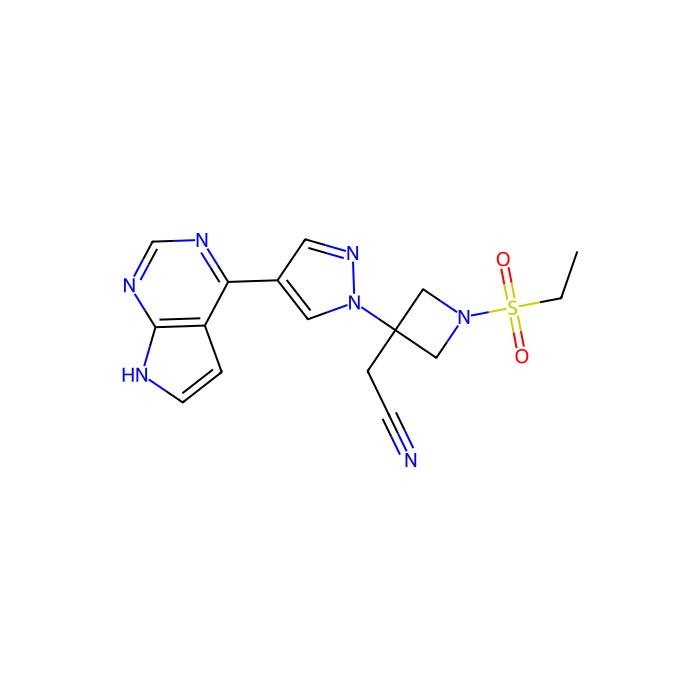
Baricitinib (LY3009104, INCB028050) is a selectiveJAK1andJAK2inhibitor withIC50of 5.9 nM and 5.7 nM in cell-free assays, ~70 and ~10-fold selective versus JAK3 and Tyk2, no inhibition to c-Met and Chk2. Baricitinib is found to reduce or interrupt the pass
In vitro
Baricitinib inhibits IL-6–stimulated phosphorylation of the canonical substrate STAT3 (pSTAT3) and subsequent production of the chemokine MCP-1 with IC50 values of 44 nM and 40 nM, respectively, in PBMCs. Baricitinib also inhibits pSTAT3 stimulated by IL-23 with IC50 od 20 nM in isolated naive T-cells.
In vivo
Baricitinib inhibits IL-6–stimulated phosphorylation of STAT3 in whole blood with an IC50 of 128 nM. Baricitinib (10 mg/kg p.o.) is expected to inhibit JAK1/2 signaling (by ≥50%) in rats for about 8 hours. Baricitinib (10 mg/mL, p.o.) inhibits disease scores in dose-dependent manner in rats with established disease in the adjuvant arthritis model. Baricitinib treatment, compared with vehicle, inhibits the increase in hind paw volumes during the 2 weeks of treatment by 50% at a dose of 1 mg/kg and >95% at doses of 3 mg/kg or 10 mg/kg. Baricitinib treatment, compared with vehicle, also inhibits composite score of immune infiltrate, edema, and periarticular tissue appearance by 27% at a dose of 1 mg/kg, 64% at doses of 3 mg/kg and 82% at doses of 10 mg/kg in rats with established disease in the adjuvant arthritis model. Baricitinib reduces bone resorption by 15%, 61%, and 67% with increasing dose level (1, 3, and 10 mg/kg) in rats with established disease in the adjuvant arthritis model. Baricitinib (10 mg/kg, daily for 2 wk, p.o.) results in radiographic improvements with restoration of the normal architecture and appearance to the ankle and tarsals in rats with established disease in the adjuvant arthritis model. Baricitinib reduces levels of pSTAT3 in a dose- and time-dependent manner in the peripheral blood of rAIA animals. Baricitinib (10 mg/mL, p.o.) improves a composite score of joint damage by 47% in the murine CIA model. Baricitinib (10 mg/kg) reduces pannus (74%) and bone damage (78%) and improves cartilage damage (43%) and signs of inflammation (33%), resulting in a 53% improvement in an aggregate score of disease in the collagen Ab-induced arthritis (CAIA) murine model. Baricitinib (10 mg/kg) inhibits the delayed-type hypersensitivity response by 48% in both the CIA and CAIA models. Baricitinib is efficacious in active rheumatoid arthritis patients refractory to disease modifying drugs and biologics. Baricitinib preferentially inhibits JAK1 and JAK2, with 10-fold selectivity over Tyk2 and 100-fold over JAK3. The observed effects of GLPG-0634 on the ACR20, albeit in a smaller study, appear to be at least as good as that seen with tofacitinib and superior to that of baricitinib, since baricitinib only moderately affect the ACR20 values in Phase IIa clinical studies. Baricitinib has the dose-limiting side-effect of inducing anaemia which has been attributed to its effects on JAK2 but has clearly shown efficacy.
Cell Data
cell lines:
Concentrations:
Incubation Time:
Powder Purity:≥99%
Document complet couvrant les dangers, la manipulation, le stockage et la conformité réglementaire.
<<<<<<< HEAD Télécharger la SDS → ======= Télécharger la SDS → >>>>>>> release248-p3Données qualité spécifiques au lot. Saisissez votre numéro de lot pour récupérer le COA exact.
Rechercher le COA →Résumé de référence rapide des spécifications et applications du produit.
Voir la fiche technique →Attributs de qualité complets et critères d'acceptation pour cette qualité.
Voir la fiche de spécifications →| Activity Type | Activity Value -log(M) | Mechanism of Action | Activity Reference | Publications (PubMed IDs) |
|---|
| Activity Type | Activity Value -log(M) | Mechanism of Action | Activity Reference | Publications (PubMed IDs) |
|---|
| Activity Type | Activity Value -log(M) | Mechanism of Action | Activity Reference | Publications (PubMed IDs) |
|---|
| Activity Type | Activity Value -log(M) | Mechanism of Action | Activity Reference | Publications (PubMed IDs) |
|---|
| Activity Type | Activity Value -log(M) | Mechanism of Action | Activity Reference | Publications (PubMed IDs) |
|---|
| Activity Type | Activity Value -log(M) | Mechanism of Action | Activity Reference | Publications (PubMed IDs) |
|---|
| Activity Type | Activity Value -log(M) | Mechanism of Action | Activity Reference | Publications (PubMed IDs) |
|---|
| Activity Type | Activity Value -log(M) | Mechanism of Action | Activity Reference | Publications (PubMed IDs) |
|---|
| Solubilité | Solubility (25°C) In vitro DMSO: 6 mg/mL (26.64 mM); Water: Insoluble; Ethanol: Insoluble; |
|---|
Notre guide de sélection des qualités couvre la pureté, le statut du stabilisant et l'adéquation à l'application pour toutes les variantes de notre catalogue.
Voir le guide des qualités Moligand™ →