Determine the necessary mass, volume, or concentration for preparing a solution.
≥98% pour les flux de travail chromatographiques et analytiques sensibles nécessitant une interférence de ligne de base minimale.
Store at -20°C Expédition Ice chest + Ice pads. Consultez le COA spécifique au lot pour les spécifications exactes.
SDS, COA, fiche technique et fiche de spécifications disponibles au téléchargement. COA spécifique au lot accessible via la recherche par numéro de lot.
Cité dans 0 publications à comité de lecture couvrant la chromatographie, la synthèse organique et les réactions de couplage croisé.
Information
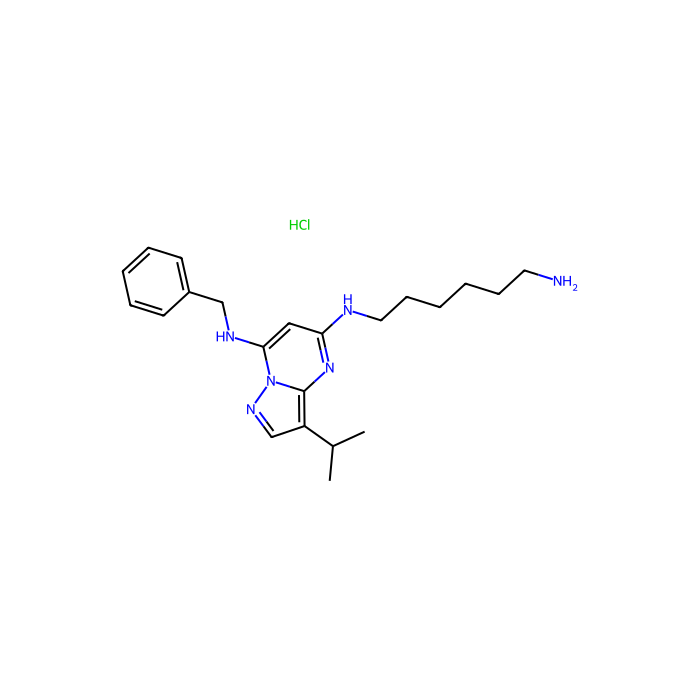
BS-181 HCl is a highly selectiveCDK7inhibitor withIC50of 21 nM. It is more than 40-fold selective for CDK7 than CDK1, 2, 4, 5, 6, or 9.
Targets
CDK7 (Cell-free assay) 21 nM
In vitro
BS-181 is a small molecule inhibitor of CDK7 in a cell-free environment, which displays more potential activity than roscovitine with IC 50 of 510 nM. Among the CDKs and other 69 kinases from many different classes, BS-181 shows high inhibitory selectivity for CDK7, inhibits CDK2 at concentrations lower than 1 μM which being inhibited 35-fold less potently (IC50 with 880 nM) than CDK7, shows slight inhibition for CDK1, CDK4, CDK5, CDK6 and CDK9 with IC50 values higher than 3.0 μM, and only shows inhibition for several kinases from other classes at high concentrations (>10 μM). BS-181 promotes cell cycle arrest and inhibits the cancer cell growth of a range of tumor types, including breast, lung, prostate and colorectal cancer with IC50 in the range of 11.5-37 μM. In MCF-7 cells, BS-181 inhibits the phosphorylation of the CDK7 substrate RNA polymerase II COOH-terminal domain (CTD), and promotes cell cycle arrest and apoptosis to inhibit the growth of cancer cell lines.
In vivo
BS-181 is stable in vivo with a plasma elimination half-life in mice of 405 minutes after i.p. administration of 10 mg/kg. BS-181 inhibits the growth of MCF-7 xenografts in the nude mice model in a dose-dependent manner, with 25% and 50% reduction in tumor growth after 2 weeks of treatment at 10 mg/kg/day and 20 mg/kg/day, respectively without apparent toxicity.
Cell Research(from reference)
Cell lines:MCF-7 cells
Concentrations:Dissolved in DMSO, final concentration ~50 μM
Incubation Time:24 hours
Document complet couvrant les dangers, la manipulation, le stockage et la conformité réglementaire.
<<<<<<< HEAD Télécharger la SDS → ======= Télécharger la SDS → >>>>>>> release248-p3Données qualité spécifiques au lot. Saisissez votre numéro de lot pour récupérer le COA exact.
Rechercher le COA →Résumé de référence rapide des spécifications et applications du produit.
Voir la fiche technique →Attributs de qualité complets et critères d'acceptation pour cette qualité.
Voir la fiche de spécifications →Taxonomy Tree
| Kingdom | Organic compounds |
|---|---|
| Superclass | Organoheterocyclic compounds |
| Classe | Pyrazolopyrimidines |
| Subclass | Pyrazolo[1,5-a]pyrimidines |
| Intermediate Tree Nodes | Not available |
| Direct Parent | Pyrazolo[1,5-a]pyrimidines |
| Alternative Parents | Benzylamines Secondary alkylarylamines Aminopyrimidines and derivatives Imidolactams Pyrazoles Heteroaromatic compounds Azacyclic compounds Monoalkylamines Hydrochlorides Hydrocarbon derivatives |
| Molecular Framework | Aromatic heteropolycyclic compounds |
| Substituents | Pyrazolo[1,5-a]pyrimidine - Benzylamine - Aminopyrimidine - Secondary aliphatic/aromatic amine - Monocyclic benzene moiety - Pyrimidine - Benzenoid - Imidolactam - Heteroaromatic compound - Pyrazole - Azole - Secondary amine - Azacycle - Organic nitrogen compound - Primary amine - Organonitrogen compound - Primary aliphatic amine - Hydrocarbon derivative - Amine - Hydrochloride - Aromatic heteropolycyclic compound |
| Description | This compound belongs to the class of organic compounds known as pyrazolo[1,5-a]pyrimidines. These are aromatic heterocyclic compounds containing a pyrazolo[3,4-d]pyrimidine ring system, which consists of a pyrazole ring fused to and sharing exactly one nitrogen atom with a pyrimidine ring. |
| External Descriptors | Not available |
Find and download the COA for your product by matching the lot number on the packaging.
| Lot Number | Certificate Type | Date | Article |
|---|---|---|---|
| Certificate of Analysis | Apr 09, 2026 | B412709 | |
| Certificate of Analysis | Jan 21, 2026 | B412709 | |
| Certificate of Analysis | Jan 21, 2026 | B412709 | |
| Certificate of Analysis | Jan 21, 2026 | B412709 | |
| Certificate of Analysis | Jan 21, 2026 | B412709 | |
| Certificate of Analysis | Jan 21, 2026 | B412709 | |
| Certificate of Analysis | Jan 21, 2026 | B412709 |
| Solubilité | Solubility (25°C) In vitro DMSO: 83 mg/mL (199.04 mM); Water: 83 mg/mL (199.04 mM); Ethanol: 22 mg/mL warmed with 50ºC Water: bath (52.75 mM); |
|---|---|
| DMSO (mg/mL) Solubilité maximale | 83 |
| DMSO (mM) Solubilité maximale | 199.0455407 |
| Eau (mg/mL) Solubilité maximale | 3 |
| Eau (mM) Solubilité maximale | 7.194417132 |
| Poids moléculaire | 417.000 g/mol |
| XLogP3 | |
| Hydrogen Bond Donor Count | 4 |
| Hydrogen Bond Acceptor Count | 5 |
| Rotatable Bond Count | 11 |
| Exact Mass | 416.246 Da |
| Monoisotopic Mass | 416.246 Da |
| Topological Polar Surface Area | 80.300 Ų |
| Heavy Atom Count | 29 |
| Formal Charge | 0 |
| Complexity | 425.000 |
| Isotope Atom Count | 0 |
| Defined Atom Stereocenter Count | 0 |
| Undefined Atom Stereocenter Count | 0 |
| Defined Bond Stereocenter Count | 0 |
| Undefined Bond Stereocenter Count | 0 |
| The total count of all stereochemical bonds | 0 |
| Covalently-Bonded Unit Count | 2 |