pour les flux de travail chromatographiques et analytiques sensibles nécessitant une interférence de ligne de base minimale.
🌡
Stockage & expédition
Store at -20°C Expédition Ice chest + Ice pads. Consultez le COA spécifique au lot pour les spécifications exactes.
📋
Documents qualité
SDS, COA, fiche technique et fiche de spécifications disponibles au téléchargement. COA spécifique au lot accessible via la recherche par numéro de lot.
📚
Preuve documentaire
Cité dans 0 publications à comité de lecture couvrant la chromatographie, la synthèse organique et les réactions de couplage croisé.
Vue d’ensemble
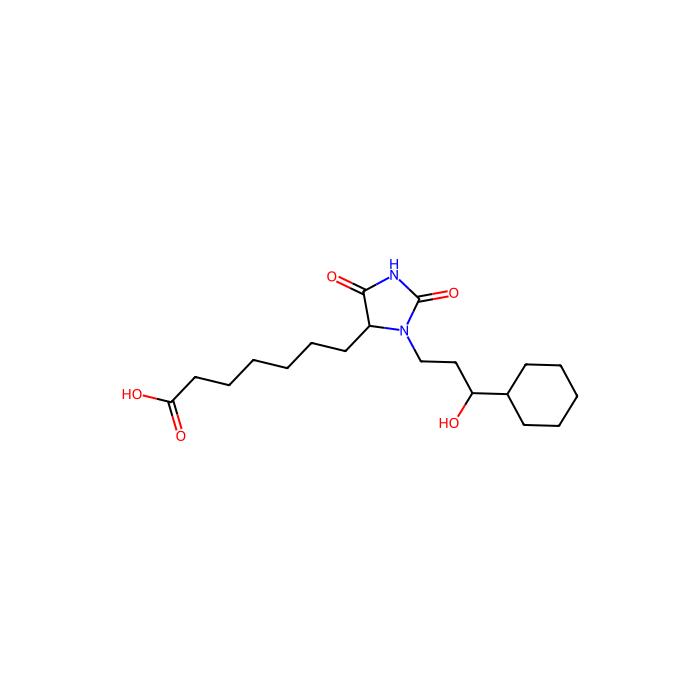
BW 245C is a selective agonist for the DP (DP|1|receptor) where the K|i|for the inhibition of [3H]-PGD2 binding to isolated human platelet membranes is 0.9 nM. This compound has a reported IC50 of 2.5 nM for the inhibition of ADP-induced human platelet aggregation.
This compound belongs to the class of organic compounds known as hydantoins. These are heterocyclic compounds containing an imidazolidine substituted by ketone group at positions 2 and 4.
External Descriptors
Not available
1. Djoumbou Feunang Y, Eisner R, Knox C, Chepelev L, Hastings J, Owen G, Fahy E, Steinbeck C, Subramanian S, Bolton E, Greiner R, and Wishart DS. ClassyFire: Automated Chemical Classification With A Comprehensive, Computable Taxonomy. Journal of Cheminformatics, 2016, 8:61.
Certificats (CoA, COO, BSE/TSE et tableau d'analyse)
C of A & Other Certificates(BSE/TSE, COO):
Analytical Chart:
Propriétés chimiques et physiques
Solubilité
Soluble in ethanol (~50 mg/ml), DMSO (~50 mg/ml), DMF (~50 mg/ml), PBS(pH7.2) (~2.2 mg/ml), and water (sparingly).
Indice de réfraction
n20D1.52 (Predicted)
Poids moléculaire
368.500 g/mol
XLogP3
2.900
Hydrogen Bond Donor Count
3
Hydrogen Bond Acceptor Count
5
Rotatable Bond Count
11
Exact Mass
368.231 Da
Monoisotopic Mass
368.231 Da
Topological Polar Surface Area
107.000 Ų
Heavy Atom Count
26
Formal Charge
0
Complexity
490.000
Isotope Atom Count
0
Defined Atom Stereocenter Count
2
Undefined Atom Stereocenter Count
0
Defined Bond Stereocenter Count
0
Undefined Bond Stereocenter Count
0
The total count of all stereochemical bonds
0
Covalently-Bonded Unit Count
1
Calculateurs de solution
Molarity Calculator
Determine the necessary mass, volume, or concentration for preparing a solution.
Dilution Calculator
Determine the dilution needed to prepare a stock solution.
Reconstitution Calculator
Avis
Avis des clients
Application Protocols
Not specified for this item; no tested applications or recommended protocols are provided in the product data for SKU B345265.
General guidance (non-validated, literature-informed; for planning only)
Prepare a concentrated DMSO stock (e.g., 10 mM), vortex and, if necessary, sonicate briefly. Filter through 0.22 µm PTFE if particulates are observed.
Conduct a small-scale solubility test upon dilution into your assay buffer/media to check for precipitation at intended working concentrations.
For receptor signaling assays, run serial dilutions (e.g., 1:3 or 1:10) spanning sub-micromolar to tens of micromolar with matched vehicle controls. Determine EC50/efficacy by non-linear regression.
These steps are not product-specific validations; establish your own SOPs and consult the CoA/SDS for constraints.
Biological Roles
Item-specific target data are not provided. The following information summarizes commonly reported literature context for BW 245C and should be treated as general background only.
Literature context: BW 245C is widely cited as a selective agonist of the prostanoid DP1 (PGD2) receptor, a Gs-coupled GPCR that elevates intracellular cAMP upon activation. It is frequently used as a tool compound to distinguish DP1-mediated responses from other prostanoid receptors in cell and tissue studies (research use only).
Typical readouts: increases in cAMP, PKA substrate phosphorylation, vasorelaxation or smooth muscle responses in ex vivo systems, and modulation of mediator release in certain immune cell models (all literature observations; not product-specific and not clinical claims).
Selectivity considerations: Literature reports often compare BW 245C activity to endogenous prostaglandin D2 and to other prostanoid receptor ligands to confirm pathway assignment. Users should independently verify potency/selectivity in their system and for their species, as receptor expression and coupling can vary.
Assay implementation: Conduct concentration–response experiments spanning at least 0.1–30 µM (range illustrative, literature) with appropriate vehicle controls. Confirm identity/purity via CoA for quantitative pharmacology.
Caution: The above roles are literature-derived and not a guarantee of performance for this specific lot. Always consult the item’s CoA and perform system-specific validation.
Buffer Applications
This product is a bioactive small molecule, not a buffering agent. It is not typically used to prepare buffer systems or maintain pH. For experimental use, it may be dosed into existing buffers as a solute from an organic stock (e.g., DMSO), keeping final co-solvent low to avoid assay interference. Refer to Solvent Selection and Storage & Reconstitution for practical handling guidance.
Green Alternatives
Green chemistry considerations apply mainly to the choice of solvents and work-up for handling this bioactive compound; the molecule itself is not readily substituted without changing biological activity.
Prefer greener solvents for solution prep and cleaning where feasible:
Replace chlorinated solvents with ethyl acetate, 2-MeTHF, or acetone when cleaning glassware or preparing intermediate solutions, provided solubility is adequate (general guidance).
For assay dilutions, use buffered aqueous media with minimal DMSO (≤0.2–0.5% v/v) to reduce solvent burden.
Comparative notes (general)
DMSO vs 2-MeTHF (for processing, not assays): DMSO offers superior solvency and biocompatibility in assays; 2-MeTHF is a greener organic solvent for preparative steps but is rarely suitable as an assay cosolvent.
Ethanol vs methanol: Ethanol is preferred on green metrics and lower toxicity; use if compound solubility permits.
Waste minimization
Prepare concentrated master stocks to reduce solvent volumes and aliquot to avoid repeat thaw/dilute cycles. Combine compatible organic waste streams and follow institutional solvent recycling where available.
Note: No structural or reactivity alternatives can preserve the unique biological profile of BW 245C; substitution would alter target engagement.
Pharmaceutical Uses
No pharmacopeial or excipient role is specified for this item. BW 245C is supplied strictly for research use only and is not intended for human or veterinary use, diagnostic procedures, or clinical applications.
Formulation context (research-only, general)
For in vitro assays, prepare concentrated DMSO stocks and dilute into assay media with final DMSO ≤0.2–0.5% v/v (literature practice). For ex vivo tissue studies, ensure solvent controls and equilibration periods to mitigate vehicle effects.
For any in vivo research, ensure institutional approvals and develop vehicle systems that maintain solubility and stability (e.g., DMSO/PEG400/saline mixtures or cyclodextrin complexes), recognizing this product is not supplied for clinical administration.
Regulatory note
No USP/EP/JP monograph or GMP status is claimed. Lot-specific purity, identity, and residual solvent data should be confirmed via the CoA to determine fitness for analytical or preclinical research workflows.
Physical Properties
Item-specific values are not supplied in the product data; defer to the CoA/SDS for authoritative figures.
Appearance: Not specified for this item; refer to CoA/Spec Sheet.
Melting point: Not specified for this item; refer to CoA/Spec Sheet.
Boiling point: Not applicable/unknown for this type of bioactive small molecule under ambient pressure; refer to CoA/Spec Sheet for any DSC/TGA data.
Density: Not specified for this item; refer to CoA/Spec Sheet.
Solubility: Not specified for this item; refer to CoA/Spec Sheet. (General note: many bioactive small molecules are soluble in DMSO at 10–50 mM stock concentrations, literature.)
LogP/logD: Not specified for this item; refer to CoA/Spec Sheet.
pKa: Not specified for this item; refer to CoA/Spec Sheet.
Refractive index: Not applicable for solids; not specified for this item.
Practical guidance (general, literature-informed)
If the compound is supplied as a solid, pre-screen solubility in dry DMSO, ethanol, or methanol, then dilute into aqueous buffers with co-solvent ≤1–2% v/v to minimize precipitation. Filter (0.22 µm PTFE) if compatible.
For UV/Vis characterization of stock solutions, record spectra from 200–400 nm to verify absence of unexpected UV-active impurities; do not use as a specification without CoA correlation.
Hygroscopicity, polymorphism, and hydrate/solvate state are unknown for this item; handle under dry conditions until verified.
Quality and Grades
Grade/Purity: Not specified for this item; refer to CoA/Spec Sheet for assay, related substances, residual solvents, water content, and identification tests.
Stabilizers/additives: Not specified for this item; refer to CoA/Spec Sheet. If a stabilizer is present, consider its impact on bioassays or spectral baselines.
How to interpret grade (general guidance)
Research-grade small molecules are typically qualified by identity (NMR/HRMS/IR), purity by HPLC/UPLC (area %), and may include water (KF) and residual solvent analysis. Where UV-cutoff or trace-metal limits are critical (e.g., for photophysics or catalysis), verify on the CoA; do not assume.
Fit-for-purpose recommendations
For receptor pharmacology or signaling assays, request/confirm: purity by HPLC (≥95% area, literature standard), lot-specific identity spectra, and salt form. Trace impurities can confound EC50/IC50 determinations.
For analytical reference use (LC–MS), ensure lot documents include exact molecular formula/accurate mass and report of counterions to support MRM transition development.
Batch control
Retain aliquots under −20°C with minimized freeze–thaw cycles. If you require a specific polymorph or amorphous form, contact support prior to ordering; this is not specified for the present item.
Reaction and Applications
This listing is for a bioactive small molecule used primarily as a research tool rather than as a general-purpose reagent for synthetic transformations.
Manufacturer applications: Not specified in the product data.
Typical research uses (general, literature-informed): ligand-based modulation of prostanoid receptor signaling in biochemical and cellular assays; determination of cAMP responses, receptor selectivity profiling, and pharmacological benchmarking versus endogenous prostanoids. No medical or clinical use is implied or permitted.
Analytical uses: reference standard for chromatographic method development (retention and MS response profiling), stability-indicating assays, and matrix-spike recovery studies in complex biological matrices (research-only).
Not typically applicable to: organometallic catalysis, coupling chemistry, or classical functional group interconversions. If you require a synthetic intermediate, consult a building-block catalog entry with defined reactive handles.
Reaction Conditions
Not typically applicable. BW 245C is provided as a bioactive small molecule for use in assays and analytical workflows rather than for performing chemical reactions.
General handling conditions (assay preparation, literature-informed)
Stock solutions: Commonly prepared at 10–50 mM in dry DMSO; verify solubility for your lot and adjust accordingly.
Working concentrations: Determine empirically via concentration–response curves; include vehicle controls matched to the highest DMSO percentage.
Stability checks: Monitor freshly prepared working solutions by LC–MS or HPLC over the course of the assay to confirm no significant degradation or adsorption.
If you require reaction conditions for chemical modification, first establish the presence of modifiable functional groups from the CoA/structure and then consult reaction-specific literature; no item-specific reaction data are provided here.
Safety and Handling
Authoritative safety data must be taken from the SDS. The following are general best practices.
GHS classification, signal word, pictograms, and H-statements: Not specified for this item; refer to SDS.
Primary risks: Unknown without SDS. As a precaution for bioactive small molecules, avoid inhalation, ingestion, and skin/eye contact. Assume potential for irritation or organ effects upon prolonged/repeated exposure until proven otherwise.
PPE: Lab coat, safety glasses, and suitable chemical-resistant gloves (e.g., nitrile). Handle in a fume hood to avoid inhalation of dust/aerosols.
Storage: Store at −20°C (per product data). Keep tightly closed in original container. Protect from moisture and light until usage is defined by SDS/CoA.
Incompatibilities: Not specified for this item; check SDS. As a general precaution, keep away from strong oxidizers and strong acids/bases unless compatibility is confirmed.
First aid (overview):
Skin/eye contact: Rinse with water for ≥15 min. Remove contaminated clothing. Seek medical attention if irritation persists.
Inhalation: Move to fresh air; seek medical attention if symptoms occur.
Ingestion: Rinse mouth; do not induce vomiting; seek medical attention.
Spill/accidental release: Avoid dust generation; collect with inert absorbent; dispose according to institutional and local regulations.
Waste: Treat as organic hazardous waste unless your SDS indicates otherwise.
Solvent Selection
This product is a bioactive small molecule; item-specific solubility is not provided. Use a stepwise approach to determine solvent and working stocks.
Primary stock solvent (general practice): Dry DMSO due to broad solvency and assay compatibility up to 0.1–1% v/v in many biological systems (literature). Start with 10 mM trial stocks and adjust.
Alternative organic solvents: Ethanol or methanol may be used for initial dissolution; confirm compatibility with downstream assays or cells. For hydrophobic compounds, consider co-solvents (PEG400, propylene glycol) for in vivo models (research use only), or cyclodextrin complexation for aqueous delivery (literature techniques).
Aqueous buffers: Direct dissolution is frequently poor for neutral/hydrophobic ligands. If ionizable groups are known (from CoA), adjust pH to favor solubility. Otherwise, prepare DMSO stocks and dilute into buffer, keeping final DMSO ≤0.2–0.5% to minimize biological effects (literature).
Filtration: Use PTFE or PVDF membranes for organic-rich solutions. Avoid nylon if compound is strongly acidic (adsorption risk).
Selection rationale (comparison, general)
DMSO: highest likelihood of success and chemical stability; may interfere with certain enzymes/receptors above 1%.
Ethanol: volatile, lower cytotoxicity at ≤0.5%, but narrower solvency.
Aqueous + cosolvent: best for immediate dosing but risk of precipitation upon dilution.
Always verify concentration by UV/Vis or LC–MS if an extinction coefficient or response factor is available.
Storage and Reconstitution
Storage temperature: Store at −20°C (per product data). Maintain in a desiccated, light-protected environment if compatible with packaging; minimize temperature cycling.
Shipping: Ice chest + ice pads (per product data). Inspect upon receipt; if warmed, allow to equilibrate in a desiccator before opening to prevent condensation.
Reconstitution solvent: Not specified for this item; refer to CoA/Spec Sheet. General practice is to use anhydrous DMSO for initial stocks, then dilute into assay media immediately before use.
Aliquoting: Prepare small, single-use aliquots (e.g., 10–100 µL) to avoid repeated freeze–thaw. Label with lot number, concentration, and date.
Freeze–thaw: Avoid repeated cycles; stability after multiple freeze–thaws is not specified for this item.
Stability/expiry: Not specified for this item; refer to CoA. If required, perform periodic QC (HPLC purity, LC–MS) on retained samples.
Aqueous solutions: Unless stability is documented, prepare fresh before use and keep on ice during experiments. Discard at end of day.
Research use note: For research use only. Not for human or veterinary use, diagnostic procedures, or clinical applications.
Structure and Identity
Item name: BW 245C (SKU: B345265)
CAS: 72814-32-5
PubChem CID: 3080928
InChIKey (as provided): 457669 (Not specified in full for this item; refer to CoA/Spec Sheet.)
SMILES: Not specified for this item; refer to CoA/Spec Sheet.
Molecular formula: Not specified for this item; refer to CoA/Spec Sheet.
Molecular weight: Not specified for this item; refer to CoA/Spec Sheet.
Structural features
Item-specific structural details have not been provided. Based on common usage in research (literature), BW 245C is a small-molecule prostanoid receptor ligand. Precise functional groups, ring systems, and stereochemistry for this lot are not specified; consult the CoA/Spec Sheet for definitive structure information.
2D structure description (general)
Without a provided structure, a reliable 2D description cannot be given for this exact item. If structural elucidation is needed, verify using the CAS/CID against an authoritative database and cross-check with the item’s CoA to confirm identity, stereochemistry, and salt/solvate state (if any).
Synthetic Utility
BW 245C is sold as a finished bioactive small molecule and is not primarily intended as a synthetic intermediate. As such, it has limited utility in routine bond-forming reactions without prior functional group analysis.
Reactive functional groups: Not specified for this item; refer to CoA/Spec Sheet. Without confirmed handles (e.g., halides, carboxyls, amines), derivatization strategies cannot be recommended.
Use as a reference standard: Suitable for calibrating bioassays or analytical methods targeting prostanoid receptor ligands (research-only), including LC–MS retention time locking and response factor estimation.
Stability considerations: Unknown for this lot. If chemical transformation is attempted, first determine stability versus acids/bases, oxidants/reductants, and heat by small-scale screening and LC–MS monitoring.
If your goal is to build analogs or conjugates, request a building-block version with a defined coupling handle (e.g., carboxylate, amine, azide) rather than modifying BW 245C directly.
Target Specificity
Not specified for this item; refer to CoA/Spec Sheet. No target, antigen, clone, epitope, species reactivity, or isotype information is provided in the product data for SKU B345265.
Note: While BW 245C is discussed in literature as a prostanoid receptor ligand, target details for this specific product/lot are not provided and should not be inferred without documentation.
Nous utilisons des cookies pour garantir le bon fonctionnement du site et, lorsque cela est autorisé, pour améliorer votre expérience. Vous pouvez gérer vos préférences à tout moment dans les Paramètres. Pour en savoir plus, consultez notre Politique relative aux cookies.
Souhaitez-vous que nous vous envoyions un message lorsque des réductions seront disponibles?
Me rappeler plus tard
Merci ! Veuillez vérifier votre boîte de réception e-mail pour confirmer.
Products are supplied to verified businesses, institutions, and qualified professionals for research and development use only. Not for use in humans, animals, diagnosis, or therapy.