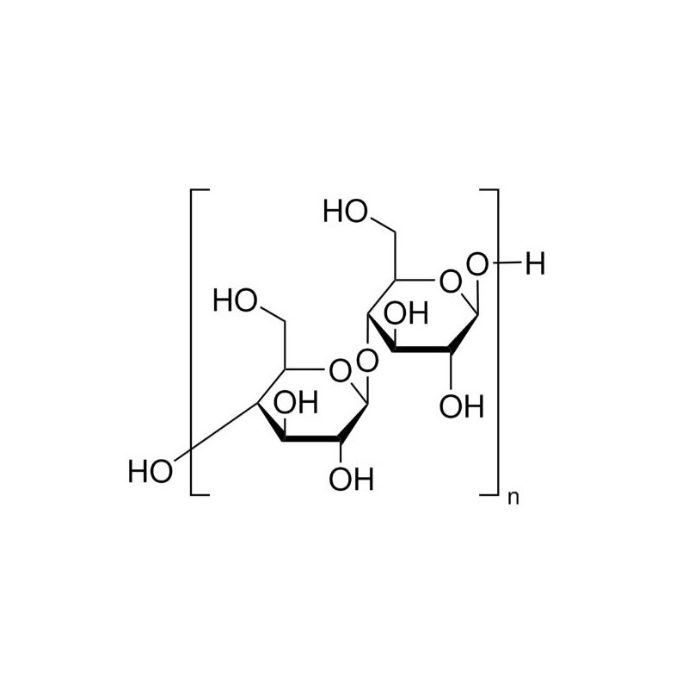
Cellulose - Colloid, microcrystalline, containing 10.0-20.0% sodium carboxymethyl cellulose as a stabilizer , CAS No.9004-34-6

CAS: 9004-34-6 Cat. No.: C434460 Formule: (C6H10O5)n Numéro CE: 232-674-9 PubChem CID: 16211032
DISPONIBLE À COMMANDE
GRADE & PURITY Colloid, microcrystalline, containing 10.0-20.0% sodium carboxymethyl cellulose as a stabilizer
Synonyms
(5S)-6-(hydroxymethyl)-5-{[(2S)-3,4,5-trihydroxy-6-(hydroxymethyl)oxan-2-yl]oxy}oxane-2,3,4-triol | Diethylaminoethyl cellulose | Cellulosepulver | Express-Ion(TM) exchanger?? D free base, 60-130 mum | DEAE-CELLULOSE | EN300-381040 | (6S)-2-(HYDROXYMETHYL
Storage
Room temperature
Shipped In
Normal
★
Size
Allemagne (EU)
USA*
Price
Qty
250g
C434460-250g
2 En stock
3 En stock

119,66€

140,49€
Enregistrer 20,83 € (14.82%)
500g
C434460-500g
1 En stock
1 En stock

178,67€

252,43€
Enregistrer 73,76 € (29.22%)
Enter a quantity for the sizes you want to add.
🧪
Why this grade

Colloid, microcrystalline, containing 10.0-20.0% sodium carboxymethyl cellulose as a stabilizer for sensitive chromatographic and analytical workflows requiring minimal baseline interference.

🌡

Storage & shipping

Room temperature Ships Normal Check lot-specific COA for exact specifications.

📋

Quality documents

SDS, COA, datasheet, and spec sheet available for download. Lot-specific COA accessible via lot number lookup.

📚

Literature proof

Cited in 882 peer-reviewed publications across chromatography, organic synthesis, and cross-coupling reactions.

Vue d’ensemble

Application

Bulking agent, opacifier, anti-caking agent, extrusion aid and stabilizer for foams and emulsions. High purity cellulose powders for partition chromatography.

Specifications

Synonymes
(5S)-6-(hydroxymethyl)-5-{[(2S)-3,4,5-trihydroxy-6-(hydroxymethyl)oxan-2-yl]oxy}oxane-2,3,4-triol | Diethylaminoethyl cellulose | Cellulosepulver | Express-Ion(TM) exchanger?? D free base, 60-130 mum | DEAE-CELLULOSE | EN300-381040 | (6S)-2-(HYDROXYMETHYL
Spécifications et pureté
Colloid, microcrystalline, containing 10.0-20.0% sodium carboxymethyl cellulose as a stabilizer
Conditions de stockage de stockage
Room temperature
Expédié en
Normal
Noms et identifiants
Pubchem Sid
IUPAC Name
(6S)-2-(hydroxymethyl)-6-[(3S)-4,5,6-trihydroxy-2-(hydroxymethyl)oxan-3-yl]oxyoxane-3,4,5-triol
InChIKey
GUBGYTABKSRVRQ-WFVLMXAXSA-N
INCHI
1S/C12H22O11/c13-1-3-5(15)6(16)9(19)12(22-3)23-10-4(2-14)21-11(20)8(18)7(10)17/h3-20H,1-2H2/t3?,4?,5?,6?,7?,8?,9?,10-,11?,12+/m1/s1
Isomères SMILES
C(C1[C@H](C(C(C(O1)O)O)O)O[C@H]2C(C(C(C(O2)CO)O)O)O)O
WGK Allemagne
3
RTECS
FJ5691460
PubChem CID
16211032

Documentation

📋 Safety Data Sheet (SDS)

Comprehensive hazard, handling, storage, and regulatory compliance document.

Download SDS →

✅ Certificate of Analysis (COA)

Lot-specific quality data. Enter your lot number to retrieve the exact COA.

Look up COA →

📊 Datasheet

Quick-reference summary of product specifications and applications.

View datasheet →

🔬 Specification Sheet

Full quality attributes and acceptance criteria for this grade.

View spec sheet →

Advanced Data

Taxonomic Classification

Taxonomy Tree

KingdomOrganic compounds
SuperclassOrganic oxygen compounds
ClasseOrganooxygen compounds
SubclassCarbohydrates and carbohydrate conjugates
Intermediate Tree Nodes Glycosyl compounds
Direct ParentO-glycosyl compounds
Alternative Parents Disaccharides  Oxanes  Secondary alcohols  Hemiacetals  Polyols  Oxacyclic compounds  Acetals  Primary alcohols  Hydrocarbon derivatives  
Molecular FrameworkAliphatic heteromonocyclic compounds
Substituents O-glycosyl compound - Disaccharide - Oxane - Secondary alcohol - Hemiacetal - Oxacycle - Organoheterocyclic compound - Polyol - Acetal - Hydrocarbon derivative - Primary alcohol - Alcohol - Aliphatic heteromonocyclic compound
DescriptionThis compound belongs to the class of organic compounds known as o-glycosyl compounds. These are glycoside in which a sugar group is bonded through one carbon to another group via a O-glycosidic bond.
External Descriptors Not available
Certificats (CoA, COO, BSE/TSE et tableau d'analyse)
C of A & Other Certificates(BSE/TSE, COO):
Analytical Chart:

Find and download the COA for your product by matching the lot number on the packaging.

6 results found

Lot NumberCertificate TypeDateArticle
E2330343Certificate of AnalysisApr 07, 2023 C434460
E2330349Certificate of AnalysisApr 07, 2023 C434460
E2330350Certificate of AnalysisApr 07, 2023 C434460
E2330351Certificate of AnalysisApr 07, 2023 C434460
I2418100Certificate of AnalysisApr 07, 2023 C434460
J2524037Certificate of AnalysisApr 07, 2023 C434460
Propriétés chimiques et physiques
Poids moléculaire342.300 g/mol
XLogP3-4.700
Hydrogen Bond Donor Count8
Hydrogen Bond Acceptor Count11
Rotatable Bond Count4
Exact Mass342.116 Da
Monoisotopic Mass342.116 Da
Topological Polar Surface Area190.000 Ų
Heavy Atom Count23
Formal Charge0
Complexity382.000
Isotope Atom Count0
Defined Atom Stereocenter Count2
Undefined Atom Stereocenter Count8
Defined Bond Stereocenter Count0
Undefined Bond Stereocenter Count0
The total count of all stereochemical bonds0
Covalently-Bonded Unit Count1
FAQ et articles
Immobilized Enzyme Technology and Its Applications in Biocatalysis
Poly(vinyl alcohol) (PVA): From Basics to Selection Key Parameters, Freeze–Thaw vs. Chemical Crosslinking Hydrogel Routes, and an Aladdin Product List
Microcrystalline Cellulose (MCC): A Comprehensive Primer and Selection Guide—Structural Features, Key Performance Metrics, and Application Scenarios
An Introduction to Research-Grade Carbohydrates: Decoding the “Glycan Language” and a Product-Selection Guide (with Tables 1–3)
Practical Guide to Sodium Carboxymethyl Cellulose (CMC-Na): Thickening/Stabilizing Mechanisms, Key Controls for Solution Preparation, and Selection Navigation (including Table 1 and Tables A–C)
Physicochemical Properties of Diphenylamine, Analytical Applications, and a Review of Its DNA Colorimetric Reaction
Functional Framework of Starch Metabolism-Related Enzymes in Food Science Research and Mechanistic Analysis of Quality Regulation
Experimental Judgment in mRNA In Vitro Transcription: Template Design, 5′ Capping, and dsRNA Control
Key Judgments in Medical Hydrogel R&D: From Polymer Source and Crosslinking Strategy to Sterilization Planning, Scale-Up Feasibility, and Quality Control
From Natural Cellulose to Nanocrystals: Structural Characteristics, Application Directions, and Industrialization Challenges of CNC
Natural Resins in Coating Formulations: Functional Positioning, Structure–Property Relationships, and Selection Validation
From Structure to Rheology: Thickening, Stabilization, and Selection Logic of Cellulose Ethers for Personal Care Applications
Analysis of the Production Process of Hydroxypropyl Methylcellulose (HPMC) for Putty: Understanding Differences in Substitution Structure and Gelation Temperature from High-Ratio and Low-Ratio Formulations
Experimental Evaluation of the Synergistic Actions of Endoglucanase, CBH I, and β-Glucosidase in Lignocellulosic Saccharification
Experimental Applications of Carboxymethyl Cellulose (CMC) Solution in Enzyme Assays, Suspension Systems, and Functional Materials
What Is Direct Compression? Process Characteristics, Suitability Criteria, and Excipient Selection
Citations of This Product
Calculateurs de solution
Avis

Avis des clients

Shall we send you a message when we have discounts available?

Remind me later

Thank you! Please check your email inbox to confirm.

Oops! Notifications are disabled.