
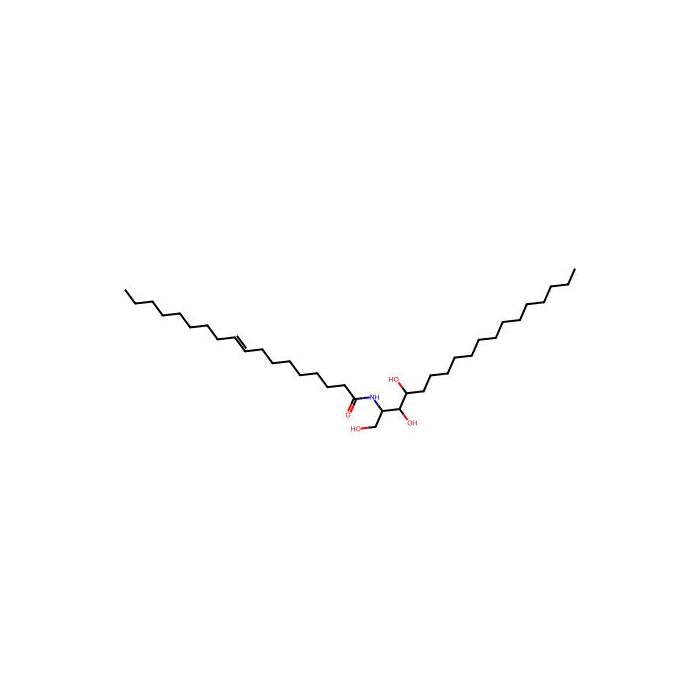
Ceramides Mixture - ≥95% , CAS No.100403-19-8
En stock
SKU
C647629
Ceramides Mixture is an endogenous ceramide and consists of hydroxy and non-hydroxy fatty acid-containing ceramides. Ceramides Mixture is a main lipid component of the permeability barrier in epidermis. Ceramides Mixture is involved in the regulation of growth inhibition, cell cycle arrest, and modulation of telomerase activity.
In Vitro
Endogenous Ceramides (generated in response to bacterial sphingomyelinase overexpression or daunorubicin treatment) inhibits mRNA synthesis of telomerase reverse transcriptase and telomerase activity via inactivation of c-Myc transcription factor in the A549 human lung adenocarcinoma cell line. The sustained generation of long chain endogenous ceramide requires the biochemical recycling of the sphingosine backbone of C6-ceramide, which involves deacylation and reacylation of ceramide for the generation of endogenous long chain ceramide (mainly C16:0- and C24:1-Ceramides), most likely by CoA-dependent ceramide synthase, which is inhibited by fumonisin B1. In A549 cells the generation of long chain endogenous ceramide mediates the effects of exogenous C6-ceramide on growth inhibition, cell cycle arrest, and the modulation of telomerase activity. MCE has not independently confirmed the accuracy of these methods. They are for reference only.
Form:Solid
| CAS | 100403-19-8 |
|---|---|
| Synonymes | Ceramide 3 | SY343426 | N-[(2S,3S,4R)-1,3,4-Trihydroxy-2-octadecyl]oleamide | FT-0623551 |
| Spécifications et pureté | ≥95% |
| Conditions de stockage de stockage | Room temperature |
| Expédié en | Normal |
| Product Description | Ceramides Mixture is an endogenous ceramide and consists of hydroxy and non-hydroxy fatty acid-containing ceramides. Ceramides Mixture is a main lipid component of the permeability barrier in epidermis. Ceramides Mixture is involved in the regulation of growth inhibition, cell cycle arrest, and modulation of telomerase activity. In Vitro Endogenous Ceramides (generated in response to bacterial sphingomyelinase overexpression or daunorubicin treatment) inhibits mRNA synthesis of telomerase reverse transcriptase and telomerase activity via inactivation of c-Myc transcription factor in the A549 human lung adenocarcinoma cell line. The sustained generation of long chain endogenous ceramide requires the biochemical recycling of the sphingosine backbone of C6-ceramide, which involves deacylation and reacylation of ceramide for the generation of endogenous long chain ceramide (mainly C16:0- and C24:1-Ceramides), most likely by CoA-dependent ceramide synthase, which is inhibited by fumonisin B1. In A549 cells the generation of long chain endogenous ceramide mediates the effects of exogenous C6-ceramide on growth inhibition, cell cycle arrest, and the modulation of telomerase activity. MCE has not independently confirmed the accuracy of these methods. They are for reference only. Form:Solid |
| Pubchem Sid | 528774434 |
| Solubilité | DMSO : 100 mg/mL (Need ultrasonic) H2O : 33.33 mg/mL (Need ultrasonic) Methanol : 25 mg/mL (Need ultrasonic) |
| Numéro CE | 309-560-3 |
| PubChem CID | 74945544 |