This compound belongs to the class of organic compounds known as halomethanes. These are organic compounds in which at least one of the four hydrogen atoms of methane (CH4) are replaced by halogen atoms.
External Descriptors
Not available
1. Djoumbou Feunang Y, Eisner R, Knox C, Chepelev L, Hastings J, Owen G, Fahy E, Steinbeck C, Subramanian S, Bolton E, Greiner R, and Wishart DS. ClassyFire: Automated Chemical Classification With A Comprehensive, Computable Taxonomy. Journal of Cheminformatics, 2016, 8:61.
Determine the necessary mass, volume, or concentration for preparing a solution.
Dilution Calculator
Determine the dilution needed to prepare a stock solution.
Reconstitution Calculator
Avis
Avis des clients
Application Protocols
No biological assay protocols apply to this reagent. For chemical applications, consider the general procedures outlined under Reaction Conditions and Synthetic Utility. Always tailor stoichiometry, solvent, and temperature to your substrate and catalyst system. Consult the SDS and primary literature before scaling.
Biological Roles
Chloroiodomethane is a synthetic, non-natural organohalide with no known physiological role.
Biochemical interactions: As a small, hydrophobic halomethane, it may partition into lipid phases; however, specific enzyme targets or metabolic pathways are not established for research utility. Oxidative dehalogenation or reductive pathways might occur in environmental/biodegradation contexts but are outside typical laboratory use.
Research context: Utilized exclusively as a chemical reagent in synthetic organic chemistry, not as a biochemical probe.
For life-science experiments: Use only as a synthetic intermediate or reagent upstream of biological testing. No claims are made for cellular compatibility or bioactivity. Always remove residual reagent thoroughly and verify absence by appropriate analytical methods before any bioassay work.
Buffer Applications
Not typically applicable. Chloroiodomethane is a hydrophobic halomethane reagent and is not used to prepare aqueous buffers or to control pH. For work involving this reagent, focus on the solvent and reaction sections for guidance on compatible organic media and handling.
Green Alternatives
When selecting a methylene source or halomethylating agent, consider both hazard and lifecycle impacts.
Greener choices and trade-offs (literature/general):
Substitute reagent options:
Diiodomethane (CH2I2): higher reactivity for Simmons–Smith but greater iodine content and similar environmental concerns; not greener.
Diazomethane surrogates (e.g., TMS-diazomethane) for methylenation: can avoid heavy halogens but introduce acute toxicity and explosion risks; typically not greener in practice.
Haloform-free protocols: Organocatalytic or metal-carbene cyclopropanations from safer precursors (e.g., ethyl diazoacetate) may be preferable for certain substrates, though functional group tolerance differs.
Solvent choices around CH2ClI use:
Replace DCM/Et2O where feasible with 2-MeTHF, CPME, or toluene to lower VOC impact and improve safety.
Comparison snapshot (general):
CH2ClI vs CH2I2: CH2ClI offers built-in chemoselectivity (I leaves first), sometimes enabling fewer steps; however, it still contains a heavy halogen and should be minimized by scale and improved workup.
Process considerations:
Employ closed systems and efficient condensers to reduce fugitive emissions.
Implement solvent recovery and halogenated waste segregation.
Conclusion: While chloroiodomethane is not a “green” reagent, thoughtful solvent selection, stoichiometry control, and waste minimization can materially reduce environmental burden.
Pharmaceutical Uses
Chloroiodomethane is not used as a pharmaceutical excipient or additive.
Typical role: synthetic intermediate/reagent for small-molecule preparation in discovery chemistry (literature/general). Any presence in pharmaceutical process chemistry would be strictly upstream, followed by rigorous removal and specification of residual halomethanes per regulatory guidance.
Pharmacopeial status: no monograph known for use as an excipient (literature/general).
Note: This product is for research use only, as indicated in the Product Data. It is not intended for human or veterinary use, clinical diagnostics, or household applications.
Physical Properties
Only general/literature values are provided here for context. They are NOT specifications for this item.
Appearance: Not specified for this item; refer to CoA/Spec Sheet.
Grade/Purity: Not specified for this item; refer to CoA/Spec Sheet.
Melting point: approximately −50 to −48 °C (literature)
Density: ~2.16–2.20 g/mL at 20–25 °C (literature)
Refractive index (n20 D): ~1.59–1.60 (literature)
Vapor pressure: moderate at ambient temperature (qualitative; literature)
Solubility: sparingly soluble in water; miscible with many organic solvents (ethers, chlorinated solvents, aromatics) (literature)
LogP (estimate): expected to be >2 due to heavy halogenation and low polarity (literature/estimation)
Dielectric constant: relatively low; behaves as a weakly polar, halogenated organic liquid (literature/general)
pKa: not applicable (no ionizable protons under standard conditions)
Notes
Values above are typical literature ranges for chloroiodomethane and may vary with source and measurement conditions.
For exact acceptance criteria for this catalog item, consult the product’s CoA/Spec Sheet.
Quality and Grades
Item-specific details
Grade/Purity: Not specified for this item; refer to CoA/Spec Sheet.
UV cutoff, water content, metal content, stabilizers: Not specified for this item; refer to CoA/Spec Sheet.
Guidance on typical grades (general information):
Analytical/Reagent grade: Intended for general laboratory synthesis; impurity profiles suitable for most synthetic steps.
High-purity/Anhydrous variants: Beneficial when forming sensitive organozinc carbenoids or performing low-tolerance catalysis. If moisture or halide impurities impact your transformation, request a CoA detailing halide assay and moisture.
Stabilizers: Some halomethanes are shipped without stabilizers; others may include trace inhibitors. If present, stabilizer identity and level should be disclosed on the CoA.
Practical QA/QC considerations for chloroiodomethane (general):
Purity assessment by GC with FID is common; monitor for diiodomethane (CH2I2), dichloromethane (CH2Cl2), and higher halomethanes.
Water can be measured by Karl Fischer if warranted by application; ensure method compatibility with halogenated matrices.
Verify density/refractive index as quick identity checks; corroborate with GC-MS or 1H/13C NMR (singlet for CH2 typically ~4–5 ppm, literature).
Reaction and Applications
Chloroiodomethane (CH2ClI) is a versatile geminal dihalide valued for its differentiated leaving groups.
Key application families (literature/general):
Chemoselective SN2 alkylation: Nucleophiles typically displace iodide first, furnishing chloromethylated products (Nu–CH2–Cl) in one step. Useful for installing a latent chloromethyl handle that can undergo subsequent substitution/cyclization.
Halide exchange and homologation:
Finkelstein-type iodination to diiodomethane (CH2I2) using excess iodide (e.g., NaI in acetone).
Formation of mixed carbenoids (ICH2ZnCl) from Zn or Zn/Cu in ether solvents for cyclopropanation of alkenes (a milder variant relative to ICH2ZnI from CH2I2); see Simmons–Smith–type methodologies.
Radical chemistry:
Under photoredox or thermal initiation, homolysis can generate iodo- or chloromethyl radicals for halomethylation and related transformations; iodine typically engages first due to weaker C–I bond.
Building block in halomethylation protocols:
Reagents such as tertiary phosphines or thiolates can convert CH2ClI into functionalized halomethyl derivatives; iodide departure provides selectivity, leaving a reactive C–Cl bond for subsequent elaboration.
Practical tips:
Work under dry, oxygen-free conditions for organozinc/carbenoid chemistry.
Control temperature (0 to room temperature) during carbenoid generation to limit side reactions (β-hydride transfer, elimination).
Monitor by GC or 1H NMR; disappearance of CH2 singlet and formation of cyclopropane resonances can track progress (literature practice).
Reaction Conditions
General literature guidance (optimize for your substrate; not item specifications):
Temperature: 0–25 °C (often ambient). Reaction times: 1–12 h.
Outcome: preferential iodide departure affords Nu–CH2–Cl; monitor by GC/NMR.
Halide exchange to CH2I2 (Finkelstein-type):
Reagents: excess NaI in dry acetone.
Conditions: reflux or ambient with extended time; NaCl precipitation drives equilibrium. Work under anhydrous conditions.
Carbenoid generation (Simmons–Smith–type):
Reagents: zinc–copper couple or activated Zn in Et2O or THF; sometimes additives (e.g., ZnCl2) for control.
Temperature: 0 °C to room temperature; add alkene substrate after initial carbenoid formation.
Notes: Mixed carbenoid ICH2ZnCl is typically less reactive than ICH2ZnI, offering selectivity in sensitive substrates.
Radical halomethylation:
Initiation: photoredox (blue LEDs, Ir/Ru catalysts) or thermal peroxides (AIBN alternatives) in chlorinated/aromatic solvents.
Control: favor C–I bond activation; limit over-halogenation by stoichiometry.
Yields vary with substrate class; consult primary literature for substrate-specific outcomes and further optimization.
Safety and Handling
Safety information below is general for chloroiodomethane and does not replace the SDS. Always consult the product-specific SDS before use.
GHS/Classification (general expectations for alkyl halides):
Often classified as harmful/irritant. Specific signal word, pictograms, and H-statements: Not specified for this item; refer to SDS.
Principal hazards (literature/general):
Irritation to eyes, skin, respiratory tract; harmful if swallowed or inhaled.
Halomethanes can cause CNS effects at high vapor concentrations; use adequate ventilation.
PPE and engineering controls:
Work in a fume hood. Wear chemical-resistant gloves (e.g., nitrile), lab coat, splash goggles.
Avoid inhalation and skin contact; prevent aerosol formation.
Incompatibilities and reactivity:
Strong bases and nucleophiles (risk of vigorous substitution); reactive metals; strong reducing agents.
Avoid contact with finely divided metals when heated; can form carbenoids with Zn/Cu.
Handling advice:
Minimize moisture exposure when moisture-sensitive reagents are present in the same setup.
Use glass syringes or PTFE components; halogenated liquids can extract plasticizers from some plastics.
First aid (summary; defer to SDS):
Inhalation: move to fresh air; seek medical attention if symptoms persist.
Skin/eye contact: rinse with water for at least 15 minutes; remove contaminated clothing; get medical advice.
Ingestion: rinse mouth; do not induce vomiting; seek medical attention.
Solvent Selection
Chloroiodomethane is typically a reagent rather than a bulk solvent. When used, it is often added neat to a reaction or dissolved in a compatible medium.
Polarity/miscibility (literature/general):
Weakly polar halogenated liquid; immiscible with water; miscible with many organic solvents (THF, diethyl ether, toluene, dichloromethane, acetonitrile).
Choosing a reaction solvent around this reagent:
For carbenoid generation with Zn/Cu: ethers (diethyl ether, THF) are commonly used to stabilize organozinc species.
For nucleophilic substitutions (SN2) on CH2ClI: polar aprotic solvents (acetone, DMF, DMSO, MeCN) accelerate substitution, often favoring iodide departure to give chloromethylated products.
For halide exchange (Finkelstein-type): acetone is preferred to precipitate NaI/NaCl as appropriate and drive equilibrium.
Comparison to alternatives:
Diiodomethane (CH2I2) is more polarizable/reactive in carbenoid chemistry; chloroiodomethane offers a milder, sometimes more selective alternative with built-in chemoselectivity (I vs Cl leaving groups).
Dichloromethane (CH2Cl2) is a common solvent but is significantly less reactive as a methylene source.
Note: This section gives general guidance; optimize solvent choice empirically for your substrate and catalyst system.
Storage and Reconstitution
Storage conditions (item-specific): Room temperature (per Product Data). Keep container tightly closed in a cool, well-ventilated place.
Shipping (item-specific): Shipped at ambient conditions (Normal) per Product Data.
Atmosphere/light: For best shelf life, store under inert gas (nitrogen/argon) and protect from prolonged light exposure (general good practice for halomethanes).
Moisture: While not highly moisture sensitive, avoid water ingress to maintain purity and prevent unintended hydrolysis in reactive setups.
Stabilizers/inhibitors: Not specified for this item; refer to CoA/Spec Sheet.
Packaging: Use compatible caps/liners (PTFE-lined) to minimize permeation and extractables.
Reconstitution: Not applicable (neat liquid reagent). If a solution is desired, prepare fresh in a dry, oxygen-free solvent compatible with your application (e.g., THF, Et2O, MeCN). Label and date any prepared solutions; store cold and use promptly.
Shelf life: Not specified for this item; monitor by GC/NMR for decomposition (formation of CH2I2/CH2Cl2 or color change).
Structure and Identity
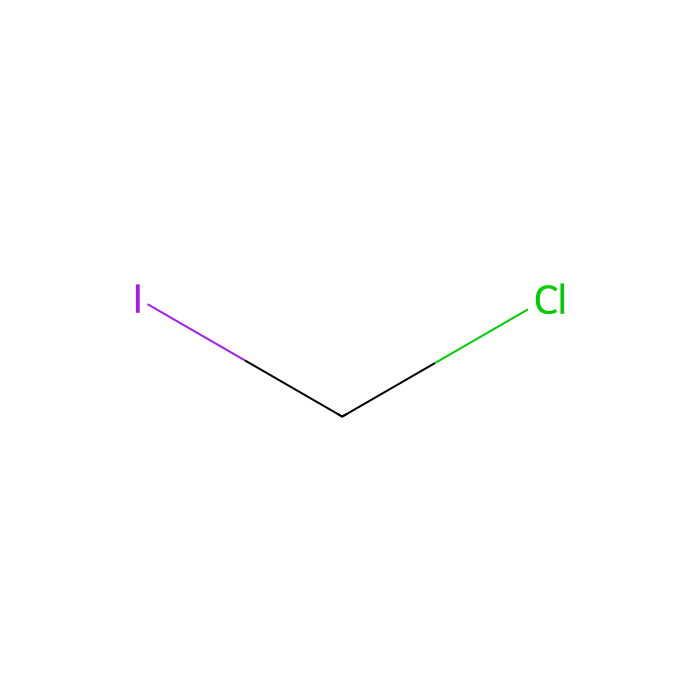
Chloroiodomethane is a geminal dihalomethane bearing both chlorine and iodine on the same methylene carbon.
Item-specific identifiers (from Product Data):
SKU: C106574
CAS: 593-71-5
CID: 11644
InChIKey: 278893 (as provided)
SMILES: Not specified for this item; refer to CoA/Spec Sheet.
Composition and empirical identity (literature/general):
Molecular formula: CH2ClI (literature)
Molecular weight: ~176.38 g/mol (literature, calculated from C 12.01, H2 2.02, Cl 35.45, I 126.90)
Preferred SMILES: C(Cl)I or ICH2Cl (literature)
Structural features (general description):
One tetrahedral carbon (sp3) bearing two hydrogens and two different halogens (Cl and I); no stereocenters.
Functional class: gem-dihalomethane; primary alkyl dihalide with differentiated leaving groups (I > Cl), enabling chemoselective reactions.
2D depiction in words: a central carbon bonded to H, H, Cl, and I. The polarized C–I bond is weaker and more labile than the C–Cl bond, often dictating reaction pathways (e.g., preferential iodide departure in SN2 and carbenoid formation).
Synthetic Utility
Functional group logic (literature/general):
Dual leaving groups with differentiated lability (I > Cl) enable stepwise transformations from a single carbon unit.
As an electrophile, CH2ClI undergoes SN2 with a wide range of nucleophiles (O, N, S, P, C), preferentially expelling I− to deliver chloromethylated products that retain a handle for further substitution.
Named/related methodologies:
Simmons–Smith family cyclopropanations: generation of iodomethylzinc chloride (ICH2ZnCl) from Zn or Zn/Cu in etheric solvents, used to transfer a methylene unit to alkenes; the mixed halide carbenoid can modulate reactivity vs ICH2ZnI.
Finkelstein halide exchange: conversion to CH2I2 for higher reactivity when needed.
Appel-type and phosphine-driven halomethylations: with PPh3 or related reagents to generate reactive intermediates for halomethyl transfer.
Radical halomethylation under photoredox or peroxide initiation.
Retrosynthetic value:
Provides a compact entry to chloromethyl fragments (–CH2Cl) from a reagent that can be tuned to deliver either –CH2Cl products or serve as a methylene donor under carbenoid conditions.
Practical considerations:
Control nucleophile strength/base to avoid over-alkylation or elimination.
Sequence planning: Perform selective iodide displacement first; reserve the remaining chloride for subsequent installation of the final functionality.
Target Specificity
Not applicable. This product is a small-molecule chemical reagent and is not an antibody, enzyme, or biological probe with defined biomolecular targets. No antigen/epitope or species reactivity applies.
Foire aux questions
What is the purity of this product, and how is it determined?
This product is supplied at ≥97% purity, determined by gas chromatography (GC). Lot-specific values are stated on the Certificate of Analysis.
How should this product be stored?
Store at room temperature.
How is this product shipped?
This product ships under standard ambient conditions. No temperature-controlled packaging is required.
What are the CAS number, molecular formula and molecular weight?
The CAS Number is 593-71-5, the molecular formula is CH2ClI, and the molecular weight is 176.38 g/mol. InChIKey PJGJQVRXEUVAFT-UHFFFAOYSA-N.
What documentation is provided?
Available product documentation, including Certificates of Analysis (COA), Safety Data Sheets (SDS), and specification sheets, is shown in the product document area. Document availability and access follow the current site policy.
Nous utilisons des cookies pour garantir le bon fonctionnement du site et, lorsque cela est autorisé, pour améliorer votre expérience. Vous pouvez gérer vos préférences à tout moment dans les Paramètres. Pour en savoir plus, consultez notre Politique relative aux cookies.
Souhaitez-vous que nous vous envoyions un message lorsque des réductions seront disponibles?
Me rappeler plus tard
Merci ! Veuillez vérifier votre boîte de réception e-mail pour confirmer.
Products are supplied to verified businesses, institutions, and qualified professionals for research and development use only. Not for use in humans, animals, diagnosis, or therapy.

 E2203134