QUALITÉ & PURETÉMoligand™?Moligand™ — Aladdin's line of ligands and bioactive small molecules. Use for receptor, pathway, and binding studies needing defined small-molecule tools.10mM in DMSO
Moligand™, 10mM in DMSO Moligand™ pour les flux de travail chromatographiques et analytiques sensibles nécessitant une interférence de ligne de base minimale.
🌡
Stockage & expédition
Store at -80°C Expédition Dry ice packs + Cold packs. Consultez le COA spécifique au lot pour les spécifications exactes.
📋
Documents qualité
SDS, COA, fiche technique et fiche de spécifications disponibles au téléchargement. COA spécifique au lot accessible via la recherche par numéro de lot.
📚
Preuve documentaire
Cité dans 1 publications à comité de lecture couvrant la chromatographie, la synthèse organique et les réactions de couplage croisé.
Vue d’ensemble
Information
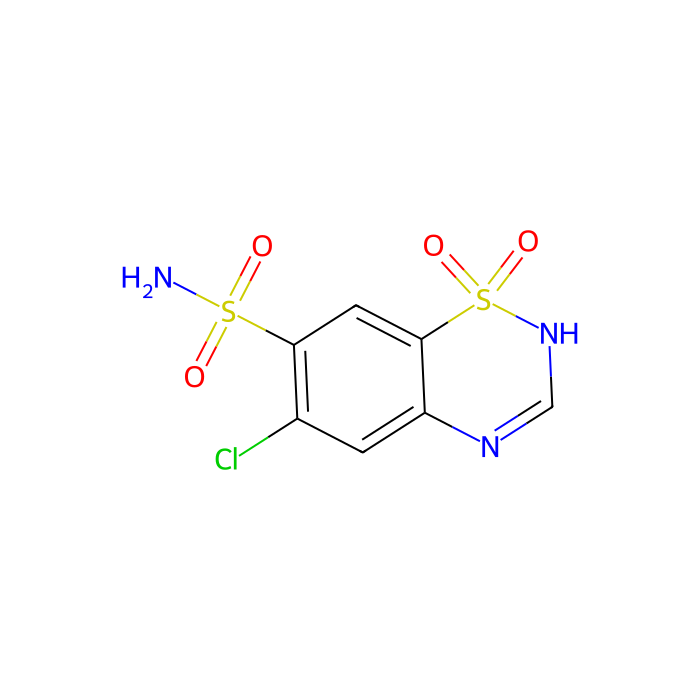
Chlorothiazide is a diuretic and antihypertensive. (IC50=3.8 mM) In vitro
Determine the necessary mass, volume, or concentration for preparing a solution.
Dilution Calculator
Determine the dilution needed to prepare a stock solution.
Reconstitution Calculator
Avis
Avis des clients
Application Protocols
Item-specific validated application protocols are not provided in the Product Data. The following are general, non-clinical research guidelines for handling small-molecule ligands like Chlorothiazide:
Stock solution preparation
Weigh quickly in a low-humidity environment. Dissolve in anhydrous DMSO to prepare 10–50 mM stocks. Gentle warming (≤40 °C) and sonication may aid dissolution.
Optional: Prepare basic aqueous stocks (e.g., 10–50 mM) by dissolving in minimal 0.1–0.2 M Na2CO3, then dilute into assay buffer. Filter sterilize (0.22 µm) if sterility is required.
Working solutions for assays
Dilute DMSO stocks into buffer or media to the desired concentration, keeping final DMSO ≤0.1–0.5% v/v. Mix thoroughly to avoid local supersaturation.
For pH-sensitive assays, verify that any pH adjustment used to enhance solubility does not affect readouts.
Analytical reference use
Establish calibration curves in matched matrices (mobile phase, plasma, etc.). Use internal standards where appropriate. Store working standards cold and protected from light.
These are general suggestions. Optimize concentrations, vehicles, and handling for your specific assay or analytical platform.
Biological Roles
Note: The following describes literature biology for Chlorothiazide as a research small molecule; no medical or clinical claims are made.
Primary biochemical interaction (literature): Inhibits the Na+/Cl− cotransporter (NCC; SLC12A3) located in the distal convoluted segment of renal epithelia, altering transmembrane sodium/chloride transport.
Secondary interactions (literature): Benzothiadiazine sulfonamides may exhibit weak carbonic anhydrase inhibition; relative potency and selectivity depend on substitution pattern and ionization state.
Physicochemical determinants: The acidic sulfonamide and electron-deficient heteroaromatic core influence membrane permeability and protein binding. Ionization (pH-dependent) affects target engagement and distribution in model systems.
Research use: Serves as a comparator/tool compound in transporter assays, ion homeostasis studies, and as a benchmark for SAR within the thiazide chemotype.
Caution: Specific potency values, binding constants, and off-target profiles can vary by assay and are not specified for this item; consult primary literature for quantitative parameters relevant to your system.
Buffer Applications
Chlorothiazide is not a buffering agent and is not used to control pH. Accordingly, classical buffer system guidance (e.g., phosphate, Tris, HEPES) does not apply directly.
Practical note for assay buffers (general guidance):
To prepare aqueous working solutions, use biologically compatible buffers (e.g., phosphate or HEPES) and consider mild basification (pH 8–9) to enhance solubility via sulfonamide deprotonation. Validate that pH adjustments do not perturb your assay.
Maintain organic cosolvent (e.g., DMSO) at minimal levels consistent with solubility to preserve assay integrity.
Item-specific buffer capacities/pKa values are not specified; refer to method development literature for system-specific optimization.
Green Alternatives
Because Chlorothiazide is a solid analyte/ligand rather than a process solvent, greener practice centers on solvent choice for dissolution and any derivatization steps.
Greener dissolution and processing (general guidance)
Prefer ethanol/water mixtures when feasible (subject to solubility) to reduce reliance on dipolar aprotics. Slightly basic aqueous buffers (e.g., carbonate, pH ≥ 8) can markedly increase solubility via sulfonamide deprotonation.
Minimize DMF usage; if high solvency is required, DMSO is generally less problematic from a worker exposure standpoint, though still not “green.”
If conducting synthetic modifications
Replace DMF/DMAc with alternatives like Cyrene or propylene carbonate where compatible.
Consider 2-MeTHF or CPME instead of chlorinated solvents for extractions/works-ups.
Illustrative comparison (general)
DMSO: High solubility; low volatility; persistent in waste streams; acceptable for small-scale stocks.
Ethanol/water (basic): Improved EHS profile; may require pH control and affords lower max concentrations.
Propylene carbonate: Greener polar aprotic; higher viscosity; compatibility must be verified.
Adopt microscale preparations, aliquoting to reduce waste, and solvent recycling where practical.
Pharmaceutical Uses
No clinical or therapeutic claims are made for this product. For research use only.
Reference standard: Frequently employed as an analytical reference for method development and validation (e.g., HPLC, LC–MS) in pharmaceutical research and quality laboratories.
Compendial context: Chlorothiazide has been described in pharmacopeial monographs (e.g., USP/EP) as an active substance; such monographs can guide analytical conditions and impurity profiling. This listing does not assert compliance—verify against the CoA if compendial use is intended.
Formulation studies: Used to explore salt formation, dissolution enhancement, and stability in pre-formulation research due to its acidic sulfonamide and heteroaromatic core.
Any GMP, lot traceability, or regulatory suitability must be confirmed independently; item-specific regulatory status is not specified for this product.
Physical Properties
Item-specific values
Appearance: Not specified for this item; refer to CoA/Spec Sheet.
Storage and shipping (from Product Data)
Storage: Store at -80°C
Shipped: Dry ice packs + Cold packs
Literature/general properties (for context; not item-specific specs)
Physical state: Solid, typically a crystalline powder.
Melting point: High, reported to decompose upon melting; literature reports commonly around the upper 200s °C with decomposition (values vary by source and form).
Solubility: Sparingly soluble in water at neutral pH; solubility increases in basic media due to deprotonation of the sulfonamide. Readily soluble in polar aprotic solvents such as DMSO and DMF; limited solubility in alcohols; practically insoluble in nonpolar hydrocarbons.
Acid–base behavior: Contains an acidic sulfonamide NH; deprotonation under basic conditions improves aqueous solubility. Multiple nitrogens within the benzothiadiazine can participate in hydrogen bonding.
Partitioning: The presence of two sulfonyl oxygens and a sulfonamide gives relatively low lipophilicity compared to many aromatic chlorides; ionization state strongly modulates distribution between aqueous and organic phases.
For exact numeric specifications (mp, solubility values, pKa, logP, density, refractive index), consult the item’s CoA/Spec Sheet; they are not specified for this item.
Quality and Grades
Item-specific information (Product Data)
Grade/Purity designation: Moligand™
What Moligand™ implies (general description)
Moligand™ denotes a curated small-molecule/ligand grade intended for discovery screening, assay development, and chemical biology applications. Emphasis is placed on identity confirmation and suitability for library use rather than chromatographic solvent performance.
Typical quality controls for ligand/library items (general): structure confirmation by spectroscopic methods (e.g., NMR/MS), purity assessment by LC/MS or HPLC, and documentation suitable for screening workflows.
Not specified for this item; refer to CoA/Spec Sheet
Exact assay purity, residual solvents, metal content, water content, stabilizers, and UV cutoffs are not provided in the Product Data. The CoA/Spec Sheet will contain definitive lot-specific data.
Practical implications
For bioassays and screening, verify purity and potency requirements of your protocol against the CoA.
If quantitative analysis (e.g., as a reference standard) is intended, confirm compendial/traceability needs and analytical criteria with the supplied documentation.
Reaction and Applications
This product’s primary use
As a Moligand™ small molecule, Chlorothiazide is commonly employed as a reference compound or tool ligand in chemical biology, transporter/pharmacology studies, and analytical method development. No clinical use is implied.
Chemical reactivity and derivatization (literature/general)
Functional handles: One primary sulfonamide (–SO2NH–) and an electron-deficient benzothiadiazine ring bearing an aryl chloride.
Sulfonamide chemistry: The NH can be deprotonated (e.g., NaH, K2CO3) enabling N-acylation, N-alkylation, or carbamoylation to prepare analogs and prodrugs.
Aromatic substitution: The 6-chloro substituent resides on an electron-poor ring; nucleophilic aromatic substitution (SNAr) with amines/thiols can occur under forcing conditions (polar aprotic solvent, heat, base), enabling library diversification.
Salt formation: Deprotonation affords salts that can enhance solubility for processing or formulation studies.
Analytical applications
Acts as a system suitability/reference standard for chromatographic method development (e.g., RP-HPLC stability-indicating methods) in research and QC environments.
Note: No item-specific reactivity specifications are provided; conditions below are general literature guidance and should be optimized experimentally.
Reaction Conditions
General literature guidance for transformations on the chlorothiazide scaffold (optimize per lab):
N-alkylation/acylation of sulfonamide
Base: K2CO3, Cs2CO3 (acylations), or NaH for more challenging alkylations.
Solvent: DMF, DMSO, MeCN; temperature: rt to 60 °C for acylation; 40–80 °C for alkylation.
Notes: Protect from moisture; monitor for over-alkylation; work up by quench then aqueous extraction or direct crystallization.
Solvent: Polar aprotic (DMSO, DMF); Base: DIPEA, K2CO3; Temperature: 80–140 °C (sealed tube/oil bath) depending on nucleophile strength.
Notes: Electron-withdrawing sulfonyls facilitate displacement; competing hydrolysis can occur under strongly basic aqueous conditions.
Salt formation/neutralization for solubility tuning
Reagents: NaHCO3/Na2CO3 or organic amines to form salts; acidify to recover free base sulfonamide.
Medium: Water/ethanol or water/acetone mixtures; Temperature: ambient.
Expected yields and kinetics depend strongly on nucleophile, temperature, and solvent; no item-specific performance data are provided. Validate by LC/MS or HPLC and confirm identity by NMR.
Safety and Handling
GHS and hazard statements (Product Data)
Signal Word: Not specified for this item; refer to SDS.
H-Statements: Not specified for this item; refer to SDS.
GHS Classification: Not specified for this item; refer to SDS.
Pictograms: Not specified for this item; refer to SDS.
General laboratory safety (good practice; consult SDS for authoritative guidance)
PPE: Use appropriate PPE including lab coat, safety glasses, and nitrile gloves. Handle powders in a fume hood to avoid inhalation of dust.
Avoid: Inhalation of dust, skin/eye contact, and ingestion. Prevent aerosolization during weighing and transfers. Wash thoroughly after handling.
First aid (general): If inhaled, move to fresh air; if on skin, wash with soap and water; if in eyes, rinse cautiously with water for several minutes; if swallowed, rinse mouth and seek medical attention. Always follow your institution’s emergency procedures.
Incompatibilities: Strong bases can deprotonate the sulfonamide (may be used deliberately for dissolution); strong oxidizers should be avoided as a general precaution. Thermal decomposition may produce nitrogen oxides, sulfur oxides, and HCl.
Environmental: Avoid uncontrolled release to the environment; collect waste according to local regulations.
Note: No medical/clinical use. For research use only. Always defer to the product-specific SDS for classification and response details.
Solvent Selection
Relevance: Chlorothiazide is a polar, heteroatom-rich aromatic sulfonamide. Solvent choice primarily concerns dissolution for stock solutions and assay compatibility rather than use as a reaction solvent.
Preferred solvents: DMSO and DMF typically afford concentrated stocks (e.g., 10–50 mM) due to strong hydrogen-bond-accepting character.
Secondary options: Ethanol or methanol may dissolve modest amounts; heat/sonication can help. Aqueous solubility improves at basic pH (e.g., carbonate or phosphate buffers ≥ pH 8) via sulfonamide deprotonation.
Poor choices: Nonpolar solvents (hexanes, toluene) and weakly polar ethers generally provide negligible solubility.
Assay compatibility
For biochemical/cellular assays, prepare DMSO stocks and dilute into buffer/media keeping final DMSO ≤0.1–0.5% v/v to minimize solvent effects. If higher aqueous solubility is needed, adjust buffer pH upward within assay tolerance.
Comparison (general considerations)
DMSO: Highest solvating power; excellent chemical stability; may affect some biological readouts at >0.5%.
DMF: Similar solvency but less favored in bioassays; consider only for chemical operations.
Ethanol: More biocompatible but lower solubility; flammable; volatility can change concentrations.
Always verify actual solubility for your lot/assay conditions; item-specific solubility is not specified in the Product Data.
Storage and Reconstitution
From Product Data
Storage condition: Store at -80°C.
Shipping: Dry ice packs + Cold packs.
Research Use: For research use only.
General handling guidance (applicable to small-molecule solids)
Upon receipt: Keep frozen at -80°C. Allow the container to equilibrate to room temperature in a desiccator before opening to prevent moisture condensation.
Aliquoting: If frequent use is expected, subdivide into single-use aliquots under dry, inert conditions (optional) to minimize freeze–thaw and moisture exposure.
Light/moisture: Protect from light and humidity. Reseal promptly; include desiccant in secondary containment if possible.
Reconstitution (general)
Solvents: DMSO recommended for concentrated stocks. Ethanol or basic aqueous buffers may be used depending on assay needs.
Procedure: Add calculated solvent volume to achieve desired molarity; gently vortex and, if needed, sonicate or warm mildly (≤40 °C). For aqueous use, adjust pH as required and sterile-filter if necessary.
Storage of solutions: Store DMSO stocks at -20 to -80 °C in tightly sealed, inert vials. Avoid repeated freeze–thaw cycles; use aliquots. Inspect for precipitation or discoloration before use.
Item-specific stability in solution and exact solubility are not specified; consult the CoA and perform small-scale stability checks under your conditions.
Structure and Identity
Item-specific identifiers (from Product Data)
CAS: 58-94-6
Grade: Moligand™
SKU: C408191
InChIKey: Not specified for this item; refer to CoA/Spec Sheet.
SMILES: Not specified for this item; refer to CoA/Spec Sheet.
Literature identity (general reference, not item-specific)
Heterocycle: 1,2,4-benzothiadiazine ring system fused to a benzene ring.
Functional groups: One sulfonamide (–SO2NH–) pendant at the 7-position; a cyclic sulfonamide/sulfamide motif within the benzothiadiazine; an aryl chloride at the 6-position.
Oxidation state: The sulfur in the diazine ring is present as a sulfone (1,1-dioxide), rendering the ring strongly electron-withdrawing.
2D description: A benzene ring bearing adjacent (ortho) substituents that close into a –S(=O)2–N–N– diazine across the ortho positions, with a chlorine on the aromatic ring and a sulfonamide group para to the ring nitrogen.
Note: Exact structural strings (SMILES/InChI) for this specific lot are not provided in the Product Data; consult the CoA for definitive identifiers.
Synthetic Utility
Although Chlorothiazide is primarily a finished small molecule, its functional groups permit targeted modifications useful for SAR and probe development.
Transformable motifs (literature/general)
Sulfonamide NH: Can undergo N-alkylation/acylation/carbamoylation after deprotonation (bases such as K2CO3, Cs2CO3, NaH). Enables prodrug or polarity-tuning derivatives.
Electron-poor aryl chloride: Positioned on a ring activated by adjacent sulfonyls, allowing SNAr with N/O/S nucleophiles under elevated temperature in polar aprotic solvents.
Ring nitrogens: Potential sites for transient coordination and, in some cases, N-oxide or directed metallation strategies are reported for related systems, albeit with caution due to sensitivity.
Retrosynthetic perspective
The benzothiadiazine-1,1-dioxide scaffold can be accessed from anthranilic acid derivatives via cyclization with sulfamoyl chloride/sulfonylating agents; conversely, late-stage diversification of Chlorothiazide often focuses on N-substitution or displacement of the chloro substituent.
These strategies are provided as general literature guidance; optimize conditions experimentally for the specific substitution pattern of Chlorothiazide.
Target Specificity
This section typically applies to biologics/antibodies where clone, isotype, and species reactivity are defined from product data. For this small-molecule ligand, such target-specific metadata are not provided in the Product Data and are not applicable.
For biological context, see the Biological Roles tab for literature notes on transporter interactions.
Foire aux questions
What is Moligand??
Moligand? is one of Aladdin Scientific's premium product lines, formulated for high-purity applications across multiple workflows. Compared to standard grades in the same workflow, Moligand? products typically offer tighter specifications, more rigorous QC, and stronger lot-to-lot consistency.
How should this product be stored?
Store at ?80 °C. Ultra-low temperature storage is required to maintain the specified shelf life.
How is this product shipped?
This product ships frozen with dry ice and cold packs. Unpack on arrival and transfer it to the storage condition stated above; handle dry ice with insulated gloves in a ventilated area.
What are the CAS number, molecular formula and molecular weight?
The CAS Number is 58-94-6, the molecular formula is C7H6ClN3O4S2, and the molecular weight is 373.44 g/mol.
What documentation is provided?
Available product documentation, including Certificates of Analysis (COA), Safety Data Sheets (SDS), and specification sheets, is shown in the product document area. Document availability and access follow the current site policy.
Notre guide de sélection des qualités couvre la pureté, le statut du stabilisant et l'adéquation à l'application pour toutes les variantes de notre catalogue.
Nous utilisons des cookies pour garantir le bon fonctionnement du site et, lorsque cela est autorisé, pour améliorer votre expérience. Vous pouvez gérer vos préférences à tout moment dans les Paramètres. Pour en savoir plus, consultez notre Politique relative aux cookies.
Souhaitez-vous que nous vous envoyions un message lorsque des réductions seront disponibles?
Me rappeler plus tard
Merci ! Veuillez vérifier votre boîte de réception e-mail pour confirmer.
Products are supplied to verified businesses, institutions, and qualified professionals for research and development use only. Not for use in humans, animals, diagnosis, or therapy.