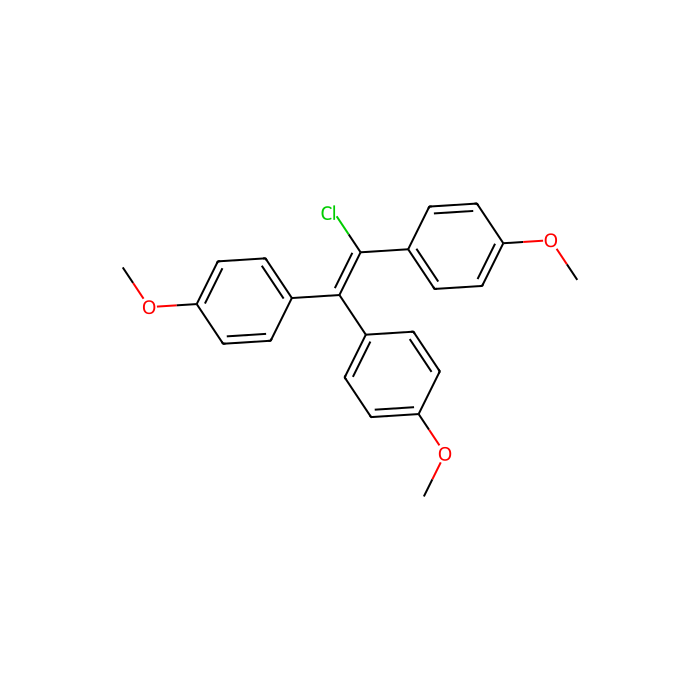
Chlorotrianisene - Moligand™, ≥99% , Estrogen receptor beta modulator, CAS No.569-57-3, Estrogen receptor beta modulator

CAS: 569-57-3 Cat. No.: C304022 Formule: C23H21ClO3 Poids moléculaire: 380.86
DISPONIBLE À COMMANDE
QUALITÉ & PURETÉ Moligand™ ? Moligand™ — Aladdin's line of ligands and bioactive small molecules. Use for receptor, pathway, and binding studies needing defined small-molecule tools. ≥99%
Synonyms
Chlortrianizen|Benzene, 1,1',1''-(1-chloro-1-ethenyl-2-ylidene)tris[4-methoxy-|Chlorotris(p-methoxyphenyl)ethylene|Chlortrianisen|Clorotrianisene|Chlortrianisestrol|Metace|1-[1-chloro-2,2-bis(4-methoxyphenyl)ethenyl]-4-methoxybenzene|CHLOROTRIANISENE [ORANGE BOOK]|Clorotrianiseno [INN-Spanish]|Rianil|Chlortrianisoestrolum|chlorotrianisene|Chlorotrisin|Khlortrianizen|Tris(p-methoxyphenyl)chloroethylene|Anisene|CHLOROTRIANISENE [MI]|Chlorotrianisene [Nonsteroidal oestrogens]|Clorotrianiseno|Ethylene, chlorotris(p-methoxyphenyl)-|1,1',1''-(2-chloroethene-1,1,2-triyl)tris(4-methoxybenzene)|Tri-p-anisylchloroethylene|Triagen|CHLOROTRIANISENE [VANDF]|1,1',1''-(2-chloroethene-1,1,2-triyl)tris[4-(methyloxy)benzene]|TACE (TN)|1,1',1''-(1-Chloro-1-ethenyl-2-ylidene)-tris(4-methoxybenzene)|Chlorotrianisenum [INN-Latin]|Chlorotrianisenum|CHLOROTRIANISENE [INN]|Chlorotrianisene [USP:INN:BAN]|CHLOROTRIANISENE [HSDB]|CHLOROTRIANISENE [MART.]|Clorestrolo|Merbentul|Benzene, 1,1',1''-(1-chloro-1-ethenyl-2-ylidene)tris(4-methoxy)-|Benzene, 1,1',1'-(1-chloro-1-ethenyl-2-ylidene)tris(4-methoxy)-|Chlorotrianisine|Clorotrisin|CTA|4,4',4''-(2-chloroethene-1,1,2-triyl)tris(methoxybenzene)|Benzene, 1,1',1''-(1-chloro-1-ethenyl-2-ylidene)tris(4-methoxy-|Chloortrianisestrol|Chlortrianisene|Opera_ID_1728|Trianisestrol|Chlorestrolo|1-[2-chloro-1,2-bis(4-methoxyphenyl)ethenyl]-4-methoxybenzene|Clorotrianisene [DCIT]|Tace-fn|Hormonisene|TACE|Tace (pharmaceutical)
Storage
Store at -20°C
Shipped In
Ice chest + Ice pads
★
Taille
Allemagne (EU)
USA*
Prix
Qté
25mg
C304022-25mg
—
5 En stock

39,83€

59,79€
Enregistrer 19,96 € (33.38%)
100mg
C304022-100mg
—
2 En stock

132,68€

199,49€
Enregistrer 66,82 € (33.49%)
Enter a quantity for the sizes you want to add.

Spécifications

Synonymes
Chlortrianizen | Benzene, 1,1',1''-(1-chloro-1-ethenyl-2-ylidene)tris[4-methoxy- | Chlorotris(p-methoxyphenyl)ethylene | Chlortrianisen | Clorotrianisene | Chlortrianisestrol | Metace | 1-[1-chloro-2,2-bis(4-methoxyphenyl)ethenyl]-4-methoxybenzene | CHLOROTRIANISENE [ORANGE BOOK] | Clorotrianiseno [INN-Spanish] | Rianil | Chlortrianisoest Afficher plus
Spécifications et pureté
Moligand™, ≥99%
Conditions de stockage de stockage
Store at -20°C
Expédié en
Ice chest + Ice pads
Ce produit nécessite l'expédition en chaîne froide. Les services terrestres et autres services économiques ne sont pas disponibles.
Grade
Moligand™
Type d'action
MODULATOR
Mécanisme d'action
Estrogen receptor beta modulator
Pureté
≥99%
Propriétés du produit
ALogP
6.4
Noms et identifiants
Pubchem Sid
Pubchem Sid Url
https://pubchem.ncbi.nlm.nih.gov/substance/488181300
SMILES
COC1=CC=C(C=C1)C(=C(C2=CC=C(C=C2)OC)Cl)C3=CC=C(C=C3)OC
IUPAC Name
1-[1-chloro-2,2-bis(4-methoxyphenyl)ethenyl]-4-methoxybenzene
InChIKey
BFPSDSIWYFKGBC-UHFFFAOYSA-N
InChI
1S/C23H21ClO3/c1-25-19-10-4-16(5-11-19)22(17-6-12-20(26-2)13-7-17)23(24)18-8-14-21(27-3)15-9-18/h4-15H,1-3H3
Isomères SMILES
COC1=CC=C(C=C1)C(=C(C2=CC=C(C=C2)OC)Cl)C3=CC=C(C=C3)OC
Poids moléculaire
380.86
Reaxys
1891845
Reaxys-RN_link_address
https://www.reaxys.com/reaxys/secured/hopinto.do?context=S&query=IDE.XRN=1891845&ln=

Données avancées

Taxonomic Classification

Taxonomy Tree

KingdomOrganic compounds
SuperclassPhenylpropanoids and polyketides
ClasseStilbenes
SubclassNot available
Intermediate Tree Nodes Not available
Direct ParentStilbenes
Alternative Parents Diphenylmethanes  Phenoxy compounds  Methoxybenzenes  Anisoles  Alkyl aryl ethers  Vinyl chlorides  Chloroalkenes  Organochlorides  Hydrocarbon derivatives  
Molecular FrameworkAromatic homomonocyclic compounds
Substituents Stilbene - Diphenylmethane - Phenoxy compound - Anisole - Methoxybenzene - Phenol ether - Alkyl aryl ether - Monocyclic benzene moiety - Benzenoid - Chloroalkene - Haloalkene - Ether - Vinyl halide - Vinyl chloride - Organohalogen compound - Organochloride - Organooxygen compound - Organic oxygen compound - Hydrocarbon derivative - Aromatic homomonocyclic compound
DescriptionThis compound belongs to the class of organic compounds known as stilbenes. These are organic compounds containing a 1,2-diphenylethylene moiety. Stilbenes (C6-C2-C6 ) are derived from the common phenylpropene (C6-C3) skeleton building block. The introduction of one or more hydroxyl groups to a phenyl ring lead to stilbenoids.
External Descriptors chloroalkene
Structure 3D
Modèle de structure chimique interactif


Cibles associées (humaines)
CYP2C19 Tchem Cytochrome P450 2C19 (1 Activities)
Activity TypeActivity Value -log(M)Mechanism of ActionActivity ReferencePublications (PubMed IDs)
ESR1 Tclin Estrogen receptor alpha (17718 Activities)
Activity TypeRelationActivity valueUnitsAction TypeJournalPubMed IddoiAssay Aladdin ID
NR3C1 Tclin Glucocorticoid receptor (14987 Activities)
Activity TypeRelationActivity valueUnitsAction TypeJournalPubMed IddoiAssay Aladdin ID
PGR Tclin Progesterone receptor (8562 Activities)
Activity TypeRelationActivity valueUnitsAction TypeJournalPubMed IddoiAssay Aladdin ID
ADRB2 Tclin Beta-2 adrenergic receptor (11824 Activities)
Activity TypeRelationActivity valueUnitsAction TypeJournalPubMed IddoiAssay Aladdin ID
CHRM2 Tclin Muscarinic acetylcholine receptor M2 (10671 Activities)
Activity TypeRelationActivity valueUnitsAction TypeJournalPubMed IddoiAssay Aladdin ID
ADRB1 Tclin Beta-1 adrenergic receptor (6630 Activities)
Activity TypeRelationActivity valueUnitsAction TypeJournalPubMed IddoiAssay Aladdin ID
HTR1A Tclin Serotonin 1a (5-HT1a) receptor (14969 Activities)
Activity TypeRelationActivity valueUnitsAction TypeJournalPubMed IddoiAssay Aladdin ID
ADRA2A Tclin Alpha-2a adrenergic receptor (9450 Activities)
Activity TypeRelationActivity valueUnitsAction TypeJournalPubMed IddoiAssay Aladdin ID
AR Tclin Androgen Receptor (11781 Activities)
Activity TypeRelationActivity valueUnitsAction TypeJournalPubMed IddoiAssay Aladdin ID
CHRM1 Tclin Muscarinic acetylcholine receptor M1 (12690 Activities)
Activity TypeRelationActivity valueUnitsAction TypeJournalPubMed IddoiAssay Aladdin ID
DRD2 Tclin Dopamine D2 receptor (23596 Activities)
Activity TypeRelationActivity valueUnitsAction TypeJournalPubMed IddoiAssay Aladdin ID
GABRA1 Tclin GABA receptor alpha-1 subunit (399 Activities)
Activity TypeRelationActivity valueUnitsAction TypeJournalPubMed IddoiAssay Aladdin ID
TSHR Tclin Thyroid stimulating hormone receptor (29986 Activities)
Activity TypeRelationActivity valueUnitsAction TypeJournalPubMed IddoiAssay Aladdin ID
MAOA Tclin Monoamine oxidase A (11911 Activities)
Activity TypeRelationActivity valueUnitsAction TypeJournalPubMed IddoiAssay Aladdin ID
CNR1 Tclin Cannabinoid CB1 receptor (20913 Activities)
Activity TypeRelationActivity valueUnitsAction TypeJournalPubMed IddoiAssay Aladdin ID
DRD1 Tclin Dopamine D1 receptor (9720 Activities)
Activity TypeRelationActivity valueUnitsAction TypeJournalPubMed IddoiAssay Aladdin ID
PTGS1 Tclin Cyclooxygenase-1 (9233 Activities)
Activity TypeRelationActivity valueUnitsAction TypeJournalPubMed IddoiAssay Aladdin ID
SLC6A2 Tclin Norepinephrine transporter (10102 Activities)
Activity TypeRelationActivity valueUnitsAction TypeJournalPubMed IddoiAssay Aladdin ID
HRH2 Tclin Histamine H2 receptor (5428 Activities)
Activity TypeRelationActivity valueUnitsAction TypeJournalPubMed IddoiAssay Aladdin ID
HTR2A Tclin Serotonin 2a (5-HT2a) receptor (14758 Activities)
Activity TypeRelationActivity valueUnitsAction TypeJournalPubMed IddoiAssay Aladdin ID
HTR2C Tclin Serotonin 2c (5-HT2c) receptor (11471 Activities)
Activity TypeRelationActivity valueUnitsAction TypeJournalPubMed IddoiAssay Aladdin ID
AVPR2 Tclin Vasopressin V2 receptor (2912 Activities)
Activity TypeRelationActivity valueUnitsAction TypeJournalPubMed IddoiAssay Aladdin ID
ADORA1 Tclin Adenosine A1 receptor (17603 Activities)
Activity TypeRelationActivity valueUnitsAction TypeJournalPubMed IddoiAssay Aladdin ID
AGTR1 Tclin Type-1 angiotensin II receptor (5176 Activities)
Activity TypeRelationActivity valueUnitsAction TypeJournalPubMed IddoiAssay Aladdin ID
SLC6A4 Tclin Serotonin transporter (12625 Activities)
Activity TypeRelationActivity valueUnitsAction TypeJournalPubMed IddoiAssay Aladdin ID
ADRA1A Tclin Alpha-1a adrenergic receptor (8359 Activities)
Activity TypeRelationActivity valueUnitsAction TypeJournalPubMed IddoiAssay Aladdin ID
PTGS2 Tclin Cyclooxygenase-2 (13999 Activities)
Activity TypeRelationActivity valueUnitsAction TypeJournalPubMed IddoiAssay Aladdin ID
HRH1 Tclin Histamine H1 receptor (7573 Activities)
Activity TypeRelationActivity valueUnitsAction TypeJournalPubMed IddoiAssay Aladdin ID
OPRM1 Tclin Mu opioid receptor (19785 Activities)
Activity TypeRelationActivity valueUnitsAction TypeJournalPubMed IddoiAssay Aladdin ID
DRD3 Tclin Dopamine D3 receptor (14368 Activities)
Activity TypeRelationActivity valueUnitsAction TypeJournalPubMed IddoiAssay Aladdin ID
PPARG Tclin Peroxisome proliferator-activated receptor gamma (15191 Activities)
Activity TypeRelationActivity valueUnitsAction TypeJournalPubMed IddoiAssay Aladdin ID
AVPR1A Tclin Vasopressin V1a receptor (5412 Activities)
Activity TypeRelationActivity valueUnitsAction TypeJournalPubMed IddoiAssay Aladdin ID
OPRD1 Tclin Delta opioid receptor (15096 Activities)
Activity TypeRelationActivity valueUnitsAction TypeJournalPubMed IddoiAssay Aladdin ID
OPRK1 Tclin Kappa opioid receptor (16155 Activities)
Activity TypeRelationActivity valueUnitsAction TypeJournalPubMed IddoiAssay Aladdin ID
HTR3A Tclin Serotonin 3a (5-HT3a) receptor (3366 Activities)
Activity TypeRelationActivity valueUnitsAction TypeJournalPubMed IddoiAssay Aladdin ID
SLC6A3 Tclin Dopamine transporter (10535 Activities)
Activity TypeRelationActivity valueUnitsAction TypeJournalPubMed IddoiAssay Aladdin ID
GRIN1 Tclin Glutamate (NMDA) receptor subunit zeta 1 (122 Activities)
Activity TypeRelationActivity valueUnitsAction TypeJournalPubMed IddoiAssay Aladdin ID
KCNH2 Tclin HERG (29587 Activities)
Activity TypeRelationActivity valueUnitsAction TypeJournalPubMed IddoiAssay Aladdin ID
CACNA1C Tclin Voltage-gated L-type calcium channel alpha-1C subunit (766 Activities)
Activity TypeRelationActivity valueUnitsAction TypeJournalPubMed IddoiAssay Aladdin ID
PDE3A Tclin Phosphodiesterase 3A (3309 Activities)
Activity TypeRelationActivity valueUnitsAction TypeJournalPubMed IddoiAssay Aladdin ID
SLC29A1 Tclin Equilibrative nucleoside transporter 1 (1711 Activities)
Activity TypeRelationActivity valueUnitsAction TypeJournalPubMed IddoiAssay Aladdin ID
ADRA2B Tclin Alpha-2b adrenergic receptor (4412 Activities)
Activity TypeRelationActivity valueUnitsAction TypeJournalPubMed IddoiAssay Aladdin ID
ADRA2C Tclin Alpha-2c adrenergic receptor (4876 Activities)
Activity TypeRelationActivity valueUnitsAction TypeJournalPubMed IddoiAssay Aladdin ID
CHRM3 Tclin Muscarinic acetylcholine receptor M3 (7750 Activities)
Activity TypeRelationActivity valueUnitsAction TypeJournalPubMed IddoiAssay Aladdin ID
HTR2B Tclin Serotonin 2b (5-HT2b) receptor (10323 Activities)
Activity TypeRelationActivity valueUnitsAction TypeJournalPubMed IddoiAssay Aladdin ID
TBXA2R Tclin Thromboxane A2 receptor (5717 Activities)
Activity TypeRelationActivity valueUnitsAction TypeJournalPubMed IddoiAssay Aladdin ID
EDNRA Tclin Endothelin receptor ET-A (5008 Activities)
Activity TypeRelationActivity valueUnitsAction TypeJournalPubMed IddoiAssay Aladdin ID
ADORA2A Tclin Adenosine A2a receptor (16305 Activities)
Activity TypeRelationActivity valueUnitsAction TypeJournalPubMed IddoiAssay Aladdin ID
ADORA3 Tchem Adenosine A3 receptor (15931 Activities)
Activity TypeRelationActivity valueUnitsAction TypeJournalPubMed IddoiAssay Aladdin ID
BDKRB2 Tclin Bradykinin B2 receptor (3970 Activities)
Activity TypeRelationActivity valueUnitsAction TypeJournalPubMed IddoiAssay Aladdin ID
Cibles associées (non humaines)
Mc4r Melanocortin receptor 4 (1205 Activities)
Activity TypeRelationActivity valueUnitsAction TypeJournalPubMed IddoiAssay Aladdin ID
Npy1r Neuropeptide Y receptor type 1 (8 Activities)
Activity TypeRelationActivity valueUnitsAction TypeJournalPubMed IddoiAssay Aladdin ID
Cruzipain (33337 Activities)
Activity TypeRelationActivity valueUnitsAction TypeJournalPubMed IddoiAssay Aladdin ID
Cckar Cholecystokinin A receptor (90 Activities)
Activity TypeRelationActivity valueUnitsAction TypeJournalPubMed IddoiAssay Aladdin ID
Pde4d Phosphodiesterase 4D (4 Activities)
Activity TypeRelationActivity valueUnitsAction TypeJournalPubMed IddoiAssay Aladdin ID
Mapk1 MAP kinase ERK2 (650 Activities)
Activity TypeRelationActivity valueUnitsAction TypeJournalPubMed IddoiAssay Aladdin ID
Hdac6 Histone deacetylase 6 (222 Activities)
Activity TypeRelationActivity valueUnitsAction TypeJournalPubMed IddoiAssay Aladdin ID
Plasmodium falciparum (966862 Activities)
Activity TypeRelationActivity valueUnitsAction TypeJournalPubMed IddoiAssay Aladdin ID
lef Anthrax lethal factor (7585 Activities)
Activity TypeRelationActivity valueUnitsAction TypeJournalPubMed IddoiAssay Aladdin ID
Npsr1 Neuropeptide S receptor (260 Activities)
Activity TypeRelationActivity valueUnitsAction TypeJournalPubMed IddoiAssay Aladdin ID
rep Replicase polyprotein 1ab (378 Activities)
Activity TypeRelationActivity valueUnitsAction TypeJournalPubMed IddoiAssay Aladdin ID
Mapt Microtubule-associated protein tau (6 Activities)
Activity TypeRelationActivity valueUnitsAction TypeJournalPubMed IddoiAssay Aladdin ID
Nfe2l2 Nuclear factor erythroid 2-related factor 2 (214 Activities)
Activity TypeRelationActivity valueUnitsAction TypeJournalPubMed IddoiAssay Aladdin ID
Rorc Nuclear receptor ROR-gamma (89407 Activities)
Activity TypeRelationActivity valueUnitsAction TypeJournalPubMed IddoiAssay Aladdin ID
FTL Ferritin light chain (43324 Activities)
Activity TypeRelationActivity valueUnitsAction TypeJournalPubMed IddoiAssay Aladdin ID
Nr1i2 Nuclear receptor subfamily 1 group I member 2 (14 Activities)
Activity TypeRelationActivity valueUnitsAction TypeJournalPubMed IddoiAssay Aladdin ID
SARS-CoV-2 (38078 Activities)
Activity TypeRelationActivity valueUnitsAction TypeJournalPubMed IddoiAssay Aladdin ID
Mécanismes d'action
Certificats (CoA, COO, BSE/TSE et tableau d'analyse)
C of A & Other Certificates(BSE/TSE, COO):
Analytical Chart:

Find and download the COA for your product by matching the lot number on the packaging.

4 results found

Lot NumberCertificate TypeDateArticle
C2323605C2323605Certificate of AnalysisJan 19, 2026 C304022
C2323629C2323629Certificate of AnalysisJan 19, 2026 C304022
C2323638C2323638Certificate of AnalysisJan 19, 2026 C304022
C2323671C2323671Certificate of AnalysisJan 19, 2026 C304022
Propriétés chimiques et physiques
Solubilitéinsoluble in H2O; insoluble in EtOH; ≥16.1 mg/mL in DMSO
Poids moléculaire380.9
XLogP36.400
Hydrogen Bond Donor Count0
Hydrogen Bond Acceptor Count3
Rotatable Bond Count6
Exact Mass380.118 Da
Monoisotopic Mass380.118 Da
Topological Polar Surface Area27.700 Ų
Heavy Atom Count27
Formal Charge0
Complexity442.000
Isotope Atom Count0
Defined Atom Stereocenter Count0
Undefined Atom Stereocenter Count0
Defined Bond Stereocenter Count0
Undefined Bond Stereocenter Count0
The total count of all stereochemical bonds0
Covalently-Bonded Unit Count1
Sécurité et dangers (GHS)
Reaxys
1891845
Reaxys-RN_link_address
https://www.reaxys.com/reaxys/secured/hopinto.do?context=S&query=IDE.XRN=1891845&ln=
FAQ et articles
Calculateurs de solution
Avis

Avis des clients

Application Protocols

No vendor-validated application protocols are provided in the Product Data for this item.

General research-use suggestions (literature/practice; not validated for this product):

  • Ligand binding assays: prepare 10–50 mM DMSO stocks; perform serial dilutions into assay buffer to achieve a final DMSO of 0.1–1%. Include detergent (e.g., 0.01% Tween-20) or carrier protein (0.1% BSA) to mitigate nonspecific binding.
  • Chemical synthesis: for generating the triarylmethyl cation, dissolve in dry CH2Cl2 under nitrogen, cool to 0°C, then add a stoichiometric halide abstractor (e.g., AgBF4). Stir until halide precipitation ceases; proceed to substrate addition.

These are general guidelines only. For definitive, item-specific instructions, refer to your internal SOPs and primary literature.

Biological Roles

Research context only (no clinical claims):

  • Nuclear receptor ligand: Chlorotrianisene is widely described in literature as a synthetic xenoestrogen that binds estrogen receptors (ERα/ERβ). It has been used as a reference ligand in competitive binding assays and for profiling selectivity across steroid hormone receptor panels.
  • Mechanistic considerations: The triarylethyl/triarylmethyl pharmacophore confers high hydrophobicity and aromatic surface area conducive to interactions within the ER ligand-binding domain. The para-methoxy groups contribute to electronic distribution and potential hydrogen-bond acceptor interactions.
  • Biochemical utility: Suitable for in vitro assays such as radioligand displacement, fluorescence polarization binding, or cell-free coactivator recruitment assays. Typical workflows employ DMSO stock solutions followed by serial dilution into aqueous assay buffers containing carrier proteins or detergents to manage solubility.

Important notes:

  • Item-specific biological activity specifications (e.g., KD/IC50) are not provided in the Product Data; verify activity in your assay format.
  • Solubility management is critical: maintain final DMSO content (e.g., 0.1–1%) to avoid compound precipitation while minimizing solvent effects on protein conformation.
  • Adsorptive losses: Hydrophobic triaryl compounds may adsorb to plastics; use low-bind plates/tubes and include nonionic surfactants as appropriate.

All values above are general literature guidance and are not product specifications.

Buffer Applications

This compound is a hydrophobic small molecule and is not used as a buffering agent. For biochemical assays involving Chlorotrianisene:

  • Prepare concentrated DMSO stocks and dilute into your chosen buffer (e.g., phosphate, HEPES) while maintaining low final DMSO (0.1–1%).
  • Include solubilizing aids (0.01–0.1% nonionic surfactant or 0.1% BSA) if needed to minimize precipitation and nonspecific binding.

No buffer pKa or buffering ranges apply to this compound.

Green Alternatives

Context: Chlorotrianisene use often coincides with non-green solvents (DCM, CHCl3) and strong Lewis acids. Greener strategies focus on solvent swaps and milder catalysts without compromising the unique reactivity of the stabilized triarylmethyl cation.

Possible greener choices (literature/general):

  • Solvent substitution: replace DCM/CHCl3 with toluene, 2-MeTHF, CPME, or ethyl acetate when solubility and selectivity allow.
  • Catalysis: employ solid acids (e.g., Amberlyst-15) or milder Brønsted acids in place of metal halides; consider halide scavengers with less persistent heavy-anion waste (e.g., NaBArF vs. SbF6−) as appropriate to EHS policies.

Trade-offs:

  • 2-MeTHF/CPME offer lower toxicity and better sustainability but may alter ionization kinetics and solubility; sometimes require elevated temperature.
  • Toluene is greener than chlorinated solvents but higher bp can complicate workup; also may enable competing Friedel–Crafts reactions due to its arene nature.

Mini comparison table (general guidance):

| Aspect | DCM | Toluene | 2-MeTHF | |---|---|---|---| | Polarity (relative) | Medium-low | Low | Medium-low | | Nucleophilicity | Very low | Very low | Low | | Green score | Poor | Better | Better | | Solubility of triarylmethyl chlorides | Excellent | Good | Variable |

Note: The feasibility of greener substitutions should be verified experimentally for your specific reaction or assay. No item-specific EHS metrics are provided in the Product Data.

Pharmaceutical Uses

No excipient or pharmacopeial status is provided in the Product Data. This listing is for research use only.

Research/formulation context (general):

  • Analytical reference: may serve as a reference standard for analytical method development (e.g., LC–UV/LC–MS) in receptor-ligand profiling workflows.
  • Preformulation for in vitro use: typically handled as DMSO stock solutions due to hydrophobicity; for dispersion into aqueous systems, co-solvents or cyclodextrin complexation can be evaluated experimentally.

No claims are made regarding therapeutic applications, dosage forms, or clinical use. For any regulated application, consult appropriate pharmacopeial monographs and regulatory guidance; none are specified for this item.

Physical Properties

Item-specific specifications:

  • Molecular Formula: Not specified for this item; refer to CoA/Spec Sheet.
  • Molecular Weight: Not specified for this item; refer to CoA/Spec Sheet.
  • Appearance: Not specified for this item; refer to CoA/Spec Sheet.

General/literature information (for reference; not product specifications):

  • Physical state: typically a crystalline, hydrophobic triarylmethyl chloride.
  • Solubility profile: sparingly soluble in water; soluble in common organic solvents such as dichloromethane, chloroform, aromatic hydrocarbons, THF, acetone, and hot ethanol (literature).
  • Acid/base behavior: forms a highly stabilized triarylmethyl cation in strong Brønsted or Lewis acids; methoxy groups are weakly basic and can engage in resonance donation.
  • Partitioning: expected high logP due to three aryl rings and three methoxy substituents (literature qualitative assessment).
  • Spectroscopic handles: strong aromatic and methoxy signatures by 1H/13C NMR; benzylic carbon deshielded; IR shows Ar–O–CH3 stretches and C–Cl (aryl tertiary chloride) region (literature).
  • Thermal behavior: stable under ambient lab conditions, but prolonged heating in protic or strongly acidic media can promote ionization or solvolysis (literature guidance).

Note: Exact numeric values (mp, bp, density, nD, pKa/logP) are not specified for this item; consult CoA/Spec Sheet or primary literature if you require specific numbers for method validation.

Quality and Grades

Item-specific grade (from Product Data):

  • Grade/Purity: Moligand™

What Moligand™ implies (general explanation):

  • Moligand™ indicates suitability for use as a small-molecule ligand in screening libraries, affinity studies, or biochemical assay development. Emphasis is typically on identity confirmation and assay-ready handling rather than chromatography-specific solvent metrics.
  • Documentation typically includes identity verification (e.g., NMR/HRMS/HPLC) appropriate for library curation. For exact release tests and limits for this catalog item, refer to the CoA/Spec Sheet.

Not included/Not specified for this item:

  • UV cutoff, metal content, residual solvent limits, water content, inhibitor/stabilizer content: Not specified for this item; refer to CoA/Spec Sheet.

Best practices for use at this grade (general guidance):

  • For biochemical binding assays, consider preparing accurately weighed DMSO stocks with validated purity checks (LC or 1H NMR) where your workflow requires.
  • If using as a synthetic reagent (e.g., precursor to triarylmethyl cations), assess halide content and assay for trace acids that may initiate ionization; additional purification (recrystallization or column) may be beneficial for sensitive applications.
Reaction and Applications

Manufacturer application note: Not provided in Product Data.

General/literature applications relevant to this compound type:

  • Carbocation precursor: Chlorotrianisene (tris(4-methoxyphenyl)methyl chloride) readily forms a stabilized triarylmethyl cation under Lewis or Brønsted acidic conditions. This cation is useful for hydride abstraction, alkylation of electron-rich aromatics, and initiation of cationic polymerizations.
  • Protecting group chemistry: As a trityl-type chloride with strongly electron-donating substituents, it can form trianisyl ethers with alcohols/phenols under acid catalysis; these groups are acid-labile and used selectively under mild conditions (literature practice).
  • Halide abstraction pathways: Treatment with AgBF4, AgSbF6, or other halophiles in non-nucleophilic solvents generates the corresponding carbenium salts, which serve as potent electrophiles for stoichiometric or catalytic transformations.
  • Biochemical research: Employed as a reference ligand for estrogen receptor (ER) binding assays and SAR studies in nuclear receptor panels (research use only; no clinical claims).

Practical tips (literature):

  • Rigorous exclusion of nucleophiles and moisture preserves the chloride; introducing controlled acidity/Lewis acidity enables smooth ionization when desired.
  • For ether formation, use mild acid catalysts (e.g., PPTS, catalytic TsOH) in DCM or toluene with the alcohol substrate; monitor by TLC/LC–MS.
  • When generating carbenium salts in situ, cooling and slow addition improve selectivity; glassware dryness is critical.

All examples are general literature guidance and are not product specifications.

Reaction Conditions

General literature conditions for transformations involving chlorotrianisene (not product specifications):

  • Generation of triarylmethyl cation:

    • Reagents: AgBF4, AgSbF6, or Tl(ClO4) can abstract chloride; alternatively, strong Brønsted acids (TfOH, HBF4·Et2O) or Lewis acids (BF3·OEt2) in non-nucleophilic solvents.
    • Solvents: CH2Cl2, CHCl3, nitromethane, or toluene; rigorously dry and oxygen-free recommended.
    • Temperature: 0 to 25°C commonly sufficient; lower temperatures (-78 to 0°C) for sensitive substrates.
  • Formation of trianisyl ethers (RO–C(Ar)3):

    • Conditions: catalytic acid (TsOH/PPTS) in DCM or toluene; stoichiometric base post-reaction for neutralization.
    • Typical times: 0.5–12 h depending on alcohol nucleophilicity and temperature.
  • Electrophilic arylation/alkylation:

    • Conditions: in situ generated cation with electron-rich aromatics (anisoles, indoles) in DCM or nitromethane; catalytic acid; monitor to prevent polyalkylation.
  • Workup and purification:

    • Quench with saturated NaHCO3 or dilute amine to consume residual acid.
    • Silica gel chromatography using hexane/EtOAc or toluene gradients; avoid highly polar eluents that may promote ionization on silica.
  • Expected outcomes:

    • High selectivity for O-alkylation over N-alkylation with appropriately protected substrates; yields are substrate dependent and should be optimized empirically.

Note: Specific temperatures, equivalents, and yields vary widely by substrate; consult primary literature for your transformation class.

Safety and Handling

Item-specific hazard details:

  • Signal Word: Not specified for this item; refer to SDS.
  • H-Statements: Not specified for this item; refer to SDS.
  • GHS Classification/Pictograms: Not specified for this item; refer to SDS.

General safety guidance (literature/practice; defer to SDS as authoritative):

  • Likely hazards: organic halide, aromatic compound; may cause irritation to skin/eyes/respiratory tract. Avoid dust generation and inhalation.
  • PPE: lab coat, safety glasses or splash goggles, and appropriate chemically resistant gloves (e.g., nitrile). Use in a fume hood to control vapors/particulates.
  • Handling: keep away from strong acids, strong Lewis acids, and strong nucleophiles if ionization or solvolysis is undesired; avoid moisture and prolonged light exposure when preparing carbenium reagents.
  • Incompatibilities (literature): strong acids (promote carbocation formation), strong oxidizers (can affect anisyl rings), potent nucleophiles/bases (may induce substitution/elimination or O-demethylation under harsh conditions).
  • First aid (overview): if on skin/eyes, rinse with water for at least 15 minutes; remove contaminated clothing. If inhaled, move to fresh air. If swallowed, rinse mouth—do not induce vomiting; seek medical attention. Provide SDS to responders.
  • Spill/accidental release: avoid dust; collect solids with inert absorbent, dispose according to institutional and local regulations.
  • Fire safety: treat as combustible organic solid; use CO2, dry chemical, or foam. Combustion can produce CO/CO2, HCl-containing fumes.

Always consult the product SDS for definitive hazard and response information.

Solvent Selection

Compound type: hydrophobic triarylmethyl chloride bearing three para-methoxy groups; essentially nonpolar-aromatic with modest donor capability at methoxy oxygens.

Solubility/miscibility (literature/general):

  • Water: negligible to very low.
  • Organic solvents: good solubility in dichloromethane (DCM), chloroform, toluene, benzene, THF, acetone; moderate in acetonitrile and ethanol; DMSO excellent for stock solutions.

Polarity and media:

  • Prefers low- to medium-polarity organic media. For biochemical screening, DMSO stocks (10–50 mM) subsequently diluted into assay buffer with final DMSO 0.1–1% are commonly used.

When to choose which solvent (practical notes):

  • DMSO: robust for weigh–dissolve–aliquot workflows; minimizes volatility, ideal for microtiter plating.
  • DCM/CHCl3: ideal for reactions that may generate the triarylmethyl cation or for halide abstraction with Ag(I)/SbF6−; low nucleophilicity.
  • Toluene/PhMe: higher thermal headroom for kinetic control, useful for Friedel–Crafts-type transformations.
  • THF/Et2O: for low-temperature operations; ensure dryness to avoid adventitious ionization.

Small comparison (general):

  • DCM vs. MeCN: DCM is less coordinating and better preserves carbocation reactivity; MeCN can coordinate and alter rates/selectivity.
  • Toluene vs. chlorinated solvents: toluene is less hazardous and sometimes preferred for greener profiles, but may reduce solubility at lower temperatures.

Note: Exact solubility values for this item are not specified; verify experimentally for your system.

Storage and Reconstitution

Item-specific conditions (from Product Data):

  • Storage Conditions: Store at -20°C
  • Shipped In: Ice chest + Ice pads
  • Appearance: Not specified for this item; refer to CoA/Spec Sheet.

General handling and stock preparation (research use):

  • Upon receipt: Allow the sealed container to equilibrate to room temperature in a desiccator before opening to minimize moisture condensation.
  • Solid handling: Work quickly under dry air or nitrogen if subsequent use involves carbocation generation or moisture-sensitive reactions.
  • Stock solutions: For screening or biochemical work, prepare DMSO stocks (e.g., 10–50 mM). Filter through 0.2 µm PTFE if particulates are observed. Aliquot and store at -20°C to avoid repeated freeze–thaw cycles.
  • Solution stability: In aprotic, anhydrous solvents and neutral conditions, solutions are generally stable; avoid strong acids or nucleophiles unless intentional ionization is desired.
  • Freeze–thaw guidance: Prefer single-use aliquots. If thawing is required, thaw rapidly at room temperature, mix gently, and refreeze promptly. Inspect for precipitation or discoloration before use.

Disposal: Treat as halogenated organic waste according to institutional and local regulations.

For authoritative, item-specific stability and reconstitution instructions, consult the CoA/Spec Sheet and SDS.

Structure and Identity

Overview: Chlorotrianisene is a triarylmethyl chloride bearing three p-methoxyphenyl rings; it is the p-anisyl analogue of trityl chloride and a well-known estrogen-receptor ligand (research use).

Item-specific identifiers (from Product Data):

  • CAS: 569-57-3
  • SKU: C304022
  • Product Name: Chlorotrianisene
  • PubChem CID: 11289
  • InChIKey: 23574 (as provided)
  • SMILES: Not specified for this item; refer to CoA/Spec Sheet.

Structural features (literature/general description):

  • Core scaffold: triarylmethyl chloride (C(Ar)3–Cl) with each aryl = 4-methoxyphenyl (p-anisyl).
  • Functional groups: benzene rings (3×), three para-methoxy substituents (–OCH3), benzylic tertiary chloride (–C(Ar)3–Cl).
  • Electron-donating methoxy groups strongly stabilize the corresponding trityl cation (tris(4-methoxyphenyl)methyl cation), enhancing electrophilicity relative to unsubstituted trityl chloride.
  • 2D description: a central quaternary carbon bonded to three para-methoxyphenyl rings and one chloride. Each phenyl bears a methoxy group at the para position relative to the central carbon attachment.

Molecular formula & molecular weight:

  • Not specified for this item; refer to CoA/Spec Sheet.

Stereochemistry:

  • Achiral (no stereocenters); the molecule is conformationally flexible around the C–Ar bonds but lacks defined stereochemistry.
Synthetic Utility

Functional identity: tris(4-methoxyphenyl)methyl chloride (triarylmethyl chloride) with enhanced cation stability due to three para-methoxy substituents.

Key uses (literature/general):

  • Precursor to triarylmethyl cations via halide abstraction (AgBF4, AgSbF6) or protonation/Lewis acid activation; the resulting carbocation is a strong, persistent electrophile.
  • Hydride abstraction/electron-transfer initiator: the cation can abstract hydride from activated donors, enabling oxidative transformations or cationic chain initiation.
  • Protecting group reagent: formation of trianisyl ethers (RO–C(Ar)3) under mild acid catalysis; deprotection under dilute acid provides orthogonal selectivity relative to other protecting groups.
  • Arene alkylation: electrophilic aromatic substitution on highly activated rings (e.g., anisoles, indoles) using the in situ generated cation.

Retrosynthetic value:

  • Converts alcohols to acid-labile trianisyl ethers, facilitating multistep sequences with mild deprotection.
  • Serves as a tunable probe for cation-stabilization studies; substituent effects on carbocation lifetime and reactivity can be explored by comparison with trityl chloride analogues.

Practical notes:

  • Use non-nucleophilic media (DCM, nitromethane, toluene) and rigorously dry conditions.
  • Control acidity to bias ionization vs. direct substitution; catalytic TfOH or BF3·OEt2 are common choices (literature guidance).
  • Quench carefully with weak nucleophiles or buffers to avoid over-reaction; monitor by TLC/NMR.

All content is general literature guidance and not product specifications.

Target Specificity

Item-specific biological target data (e.g., receptor subtype selectivity, KD/IC50 values, tested species) are not provided for this product.

General note (literature): Chlorotrianisene is commonly referenced as an estrogen receptor ligand in research; however, quantitative binding parameters and selectivity profiles depend on assay format and are not specified here. Verify target engagement in your system using appropriate positive controls and orthogonal readouts.

Foire aux questions

What is the purity of this product?
This product is supplied at ≥99% purity (chemical assay). Lot-specific values are stated on the Certificate of Analysis.
What is Moligand??
Moligand? is one of Aladdin Scientific's premium product lines, formulated for high-purity applications across multiple workflows. Compared to standard grades in the same workflow, Moligand? products typically offer tighter specifications, more rigorous QC, and stronger lot-to-lot consistency.
How should this product be stored?
Store at ?20 °C. Freezer storage is required to maintain the specified shelf life.
How is this product shipped?
This product ships in an insulated container with ice pads. Unpack on arrival and transfer it to the storage condition stated above.
What are the CAS number, molecular formula and molecular weight?
The CAS Number is 569-57-3, the molecular formula is C23H21ClO3, and the molecular weight is 380.86 g/mol. InChIKey BFPSDSIWYFKGBC-UHFFFAOYSA-N.
What documentation is provided?
Available product documentation, including Certificates of Analysis (COA), Safety Data Sheets (SDS), and specification sheets, is shown in the product document area. Document availability and access follow the current site policy.

Souhaitez-vous que nous vous envoyions un message lorsque des réductions seront disponibles?

Me rappeler plus tard

Merci ! Veuillez vérifier votre boîte de réception e-mail pour confirmer.

Oups ! Les notifications sont désactivées.