40% aqueous solution pour les flux de travail chromatographiques et analytiques sensibles nécessitant une interférence de ligne de base minimale.
🌡
Stockage & expédition
Room temperature Expédition Normal. Consultez le COA spécifique au lot pour les spécifications exactes.
📋
Documents qualité
SDS, COA, fiche technique et fiche de spécifications disponibles au téléchargement. COA spécifique au lot accessible via la recherche par numéro de lot.
📚
Preuve documentaire
Cité dans 10 publications à comité de lecture couvrant la chromatographie, la synthèse organique et les réactions de couplage croisé.
Transition metal sulfate - Inorganic oxide - Inorganic salt
Description
This compound belongs to the class of inorganic compounds known as transition metal sulfates. These are inorganic compounds in which the largest oxoanion is sulfate, and in which the heaviest atom not in an oxoanion is a transition metal.
External Descriptors
metal sulfate
1. Djoumbou Feunang Y, Eisner R, Knox C, Chepelev L, Hastings J, Owen G, Fahy E, Steinbeck C, Subramanian S, Bolton E, Greiner R, and Wishart DS. ClassyFire: Automated Chemical Classification With A Comprehensive, Computable Taxonomy. Journal of Cheminformatics, 2016, 8:61.
Determine the necessary mass, volume, or concentration for preparing a solution.
Dilution Calculator
Determine the dilution needed to prepare a stock solution.
Reconstitution Calculator
Avis
Avis des clients
Application Protocols
No assay‑validated protocols are provided in the Product Data for this inorganic salt.
General preparation guidance (literature):
Aqueous stock solutions: Prepare with deionized water to the desired molarity. For consistent stoichiometry, correct for hydration by loss‑on‑drying or metal assay when calculating concentration.
Filtration: Clarify solutions through 0.2–0.45 μm membranes to remove particulates before use in kinetic or spectroscopic experiments.
pH control: Use mildly acidic buffers (sulfate/acetate) to minimize hydrolysis and precipitation. Avoid strong chelators unless complexation is desired.
Redox sensitivity: If working with Cr(II) solutions, prepare and use under inert atmosphere; degas solvents and glassware.
For method‑specific, item‑qualified protocols, refer to the CoA/Spec Sheet for SKU B302062.
Biological Roles
Applicability: The product is an inorganic research reagent; no clinical or therapeutic claims are made.
General biochemical context (literature):
Chromium speciation matters. Trivalent chromium (Cr(III)) forms kinetically inert octahedral complexes with oxygen/nitrogen donors and exhibits limited bioavailability; divalent chromium (Cr(II)) is a strong reductant and is not stable in aerobic biological media. Hexavalent chromium (Cr(VI)) is not present in chromium sulfate salts but is well known for high toxicity; avoid oxidative conditions that could alter chromium speciation.
Protein/biopolymer binding: Cr(III) can crosslink carboxylate‑rich biomaterials (e.g., collagen, polysaccharides) via coordination to carboxylate/phenolate sites; this underpins tanning/mordanting models used in materials biochemistry.
Enzymology: Chromium is not a common enzymatic cofactor in higher organisms; any observed interactions are typically nonspecific coordination effects rather than defined catalytic roles.
Practical implications for research use:
Maintain acidic pH and oxygen control appropriate to the intended chromium oxidation state to avoid unwanted speciation changes during bio‑related experiments.
Quantify total chromium by ICP‑OES/MS and consider speciation analysis if biological outcomes depend on oxidation state.
All uses are for research only.
Buffer Applications
Not typically used as a buffering agent. Chromium sulfate salts can acidify water via aquo complex hydrolysis but do not constitute defined buffer systems.
Practical guidance (literature):
If conducting experiments in buffered media with chromium present, select buffers that do not strongly chelate trivalent metals (avoid high concentrations of EDTA, citrate, or phosphate when free Cr(III) is required). Good choices include acetate or sulfate buffers in the mildly acidic range (pH ~3–5), which help maintain chromium solubility and suppress hydrolysis.
Always document buffer composition, ionic strength, and pH drift over time, as metal–buffer interactions can subtly shift speciation.
Green Alternatives
Context: Selecting greener options depends on the role chromium sulfate plays in your process (precursor, mordant model, reductant). Chromium compounds carry environmental persistence and toxicity considerations; minimizing use and ensuring proper waste handling are primary levers.
Alternative choices and trade-offs (literature):
For tanning/crosslinking studies: Aluminum potassium sulfate (alum) or iron(III) sulfate can model trivalent metal crosslinking with lower toxicological footprint than chromium; however, coordination chemistry differs (harder Lewis acids), potentially altering mechanical properties and binding selectivity.
For reductive chemistry (if Cr(II) functionality is sought): Ascorbate, sodium dithionite, or zinc dust in acidic media can provide reducing equivalents with improved environmental profiles; yet they may introduce additional salts/gases and offer less precise one‑electron control.
For coordination complex synthesis: Use of benign metal centers (e.g., Fe(III), Al(III)) or ligand frameworks enabling milder, aqueous synthesis can reduce hazards, though spectroscopic/magnetic properties will differ.
Operational greening tips:
Employ water as solvent, at ambient temperature when feasible.
Right-size batch scale; standardize metal content to prevent excess.
Implement closed-loop rinse water treatment and segregated heavy‑metal waste streams.
Note: These are general recommendations. Evaluate alternatives against your target properties and regulatory requirements.
Pharmaceutical Uses
This product is offered strictly for research use only; no medical or clinical applications are implied.
General formulation context (literature/industry):
Chromium sulfate salts are not typical pharmaceutical excipients. Historically, chromium alum and basic chromium sulfate have been used industrially for leather tanning and dye mordanting, not for drug formulation.
In specialized materials R&D, chromium(III) sulfate may be used to crosslink biopolymers to explore mechanical properties of hydrogels or films; such studies are pre‑formulation/materials science in nature and are not pharmaceutical excipient uses.
If your work relates to regulated products, consult pharmacopeial monographs and ensure no chromium carryover; chromium impurities are heavily restricted in pharmaceutical contexts.
Physical Properties
Item-specific physical properties:
Appearance: Not specified for this item; refer to CoA/Spec Sheet.
Grade/Purity: Not specified for this item; refer to CoA/Spec Sheet.
Molecular weight: Not specified for this item; refer to CoA/Spec Sheet.
General physical properties (literature, for chromium sulfate hydrates):
Phase: Ionic crystalline solid; hydrates range from pale blue/purple to green depending on Cr oxidation state, ligand field, and hydration.
Solubility: Readily soluble in water; insoluble/poorly soluble in nonpolar organic solvents. Aqueous solubility increases with temperature; solutions are acidic (due to aquo complex hydrolysis).
Density: Typically ~2.0–3.0 g/cm³ for hydrated chromium sulfates (literature ranges, compound- and hydrate-specific).
Thermal behavior: Progressive dehydration upon heating, followed by decomposition of sulfate and formation of basic/oxide species; melting points are not sharply defined due to hydrate loss.
Hygroscopicity: Many chromium sulfate hydrates are hygroscopic; they can gain/lose water depending on humidity.
Important reminder: Do not treat the above literature values as specifications. For definitive numerical data (mp/bp, density, solubility limits, refractive index, logP, pKa), see the CoA/Spec Sheet for this exact hexahydrate material (SKU B302062).
Quality and Grades
Item-specific quality/grade information:
Grade/Purity: Not specified for this item; refer to CoA/Spec Sheet.
General guidance on grades (context for chromium salts):
Reagent grade/ACS grade: Indicates suitability for general analytical and synthetic use, with limits on common metal and anion impurities. For transition-metal salts, grades often specify maximum levels of alkali/alkaline earth metals, chloride/nitrate, and insoluble matter.
Chromatography grade: Rarely assigned to inorganic salts like chromium sulfate; when present, it implies low UV-absorbing impurities and high solubility/clarity in water.
Titrant/standard grade: Materials certified for redox or complexometric titration may specify exact metal assay and hydration content.
What to check on the CoA for this item:
Verified chromium assay (% Cr), sulfate content, hydration state (loss-on-drying or TGA), trace metal impurities, insoluble matter, pH of a defined aqueous solution, and UV-Vis absorbance (if relevant to your application).
Stabilizer note: If the material is chromium(II) sulfate hexahydrate, suppliers sometimes note air-sensitive handling; if chromium(III), materials may include basic chromium sulfate species. The presence/absence of stabilizers is Not specified for this item; refer to CoA/Spec Sheet.
Reaction and Applications
Manufacturer applications: Not provided in the Product Data.
General research uses (literature; for chromium sulfate hydrates):
Precursor to chromium coordination complexes: Aquo complexes [Cr(H2O)6]n+ are convenient starting points for ligand substitution to form Cr–N/O chelates (e.g., with bipyridine, salicylates). Reaction conditions typically involve mildly acidic aqueous media and controlled heating to promote ligand exchange.
Tanning/mordant chemistry model systems: Chromium(III) sulfate is widely studied as a model for collagen crosslinking and dye mordanting; in research settings, it is used to probe metal–protein and metal–polyphenol interactions (non-clinical, materials chemistry context).
Redox chemistry: Chromium(II) sulfate (if present) functions as a one-electron reductant in aqueous media and can reduce Fe(III), Cu(II), and certain organic substrates; experiments require inert atmosphere to prevent aerial oxidation (literature guidance).
Inorganic synthesis: Sulfate counter‑ions facilitate formation of mixed-metal sulfates and basic chromium sulfate phases; controlled basification precipitates Cr(OH)3·xH2O, which can be converted to Cr2O3 on calcination.
Practical notes:
Maintain acidic pH (e.g., acetate or sulfate media) to keep chromium in solution and suppress hydrolysis.
For reproducible complexation kinetics, pre-equilibrate hydrate content or standardize by loss‑on‑drying to correct stoichiometry.
Avoid chloride introduction if downstream analyses are chloride-sensitive (e.g., Mössbauer/ICP workflows).
Reaction Conditions
General conditions for common uses (literature guidance):
Ligand substitution to form Cr(III) complexes: Aqueous solution, pH 2–4 (sulfate/acetate buffers), 25–90 C. Inert ligands (e.g., aqua) are replaced slowly; heating and/or excess chelating ligand (2–5 equiv) accelerates substitution. Reaction times: hours to days depending on ligand field strength. Monitor by UV‑Vis (d–d bands) and ICP for metal balance.
Precipitation of hydroxides: Slow addition of base (e.g., NH4OH or Na2CO3) to 0.05–0.5 M aqueous chromium sulfate at 0–25 C to pH ~7–8 gives gelatinous Cr(OH)3·xH2O. Aging at 50–90 C densifies the precipitate. Wash sulfate thoroughly before calcination to Cr2O3 (400–800 C).
Generation of Cr(II) in situ (if needed): Chemical reduction of Cr(III) with Zn/Hg amalgam or Zn dust in acidic sulfate media under N2, 0–25 C; maintain oxygen‑free conditions. Use immediately due to rapid aerial oxidation (literature caution).
Solvent and atmosphere:
Water as the default medium; oxygen exclusion recommended for redox‑sensitive operations. Avoid strong complexants (EDTA, phosphate) unless intended.
Yields/outcomes:
Highly system‑dependent; consult primary literature for your ligand set and stoichiometry. Always standardize metal content by assay to ensure reproducible yields.
Safety and Handling
Item-specific hazard data (from Product Data):
Signal word: Not specified for this item; refer to SDS.
H-statements: Not specified for this item; refer to SDS.
GHS classification/pictograms: Not specified for this item; refer to SDS.
General safety guidance for chromium sulfate hydrates (literature/typical):
Hazards: Chromium sulfate salts are irritating to skin, eyes, and respiratory tract. Chromium(III) compounds are generally of lower toxicity than hexavalent chromium, but should still be handled as hazardous. Chromium(II) salts are strong reducing agents and can be air sensitive, generating acidic solutions that may evolve heat upon dissolution.
PPE: Laboratory coat, chemical-resistant gloves (e.g., nitrile), splash goggles; use in a fume hood to avoid dust/aerosol inhalation.
Incompatibilities: Strong oxidizers/reductants (depending on the chromium oxidation state present), strong bases (can precipitate chromium hydroxides), and cyanides (avoid due to potential complexation concerns). For Cr(II) salts, avoid exposure to air/oxygen; for all chromium sulfates, avoid contact with strong bases and reactive metals.
First aid (overview; defer to SDS): Eye/skin contact—flush with water for at least 15 minutes; remove contaminated clothing. Inhalation—move to fresh air. Ingestion—rinse mouth; seek medical attention.
Spill/cleanup: Avoid raising dust. Sweep up carefully; collect for disposal as hazardous waste. Neutralize aqueous residues in accordance with institutional procedures.
Always consult the SDS for SKU B302062 for authoritative hazard, exposure limits, and emergency measures.
Solvent Selection
Applicability: As an inorganic sulfate salt, solvent considerations center on aqueous and polar protic systems rather than organic media.
General solvent behavior (literature):
Primary solvent: Water—good to excellent solubility for most chromium sulfate hydrates; solutions are typically acidic due to aquo complex hydrolysis.
Polar protics: Methanol and ethanol may dissolve small amounts, but solubility is far lower than in water; alcohol solutions can undergo esterification side equilibria with sulfate only under strong acid conditions.
Polar aprotics: DMSO, DMF—limited direct dissolution as free ions; however, strong donor solvents can coordinate to chromium centers under specific conditions, altering speciation.
Nonpolar solvents (e.g., hexanes, toluene): Not suitable; salts are effectively insoluble.
When to choose water vs alternatives:
Use deionized, oxygen-controlled water if working with air-sensitive chromium(II) species (literature), and CO2-free water to minimize basic precipitation at higher pH.
Employ buffered aqueous media when reproducible speciation is required; unbuffered solutions can drift in pH and form hydroxo complexes.
Practical tips:
Filter freshly prepared solutions to remove trace insolubles.
If coordinating solvents are used intentionally, document their effects on ligand exchange and redox stability.
Storage and Reconstitution
Item-specific from Product Data:
Storage conditions: Room temperature.
Shipped in: Normal.
General storage guidance (literature):
Keep container tightly closed in a dry, well‑ventilated area. Hydrated chromium sulfates can be hygroscopic; limit exposure to ambient humidity to preserve defined hydration.
Protect from contamination with strong bases and oxidants/reductants. If the material is a Cr(II) sulfate hydrate, minimize air exposure; however, the specific oxidation state for this item is Not specified—consult the CoA/SDS.
Reconstitution/preparation:
Dissolve in deionized water with gentle stirring. If precise concentration is required, standardize by ICP‑OES/MS or complexometric titration, or correct for hydration via LOD/TGA.
Filter solutions to remove insoluble residues. Prepare fresh solutions for redox‑sensitive work; store working solutions at 2–8 C when compatible with your application, and discard if turbidity or color changes occur.
Always consult the product’s CoA and SDS for definitive storage limits, shelf life, and compatibility for SKU B302062.
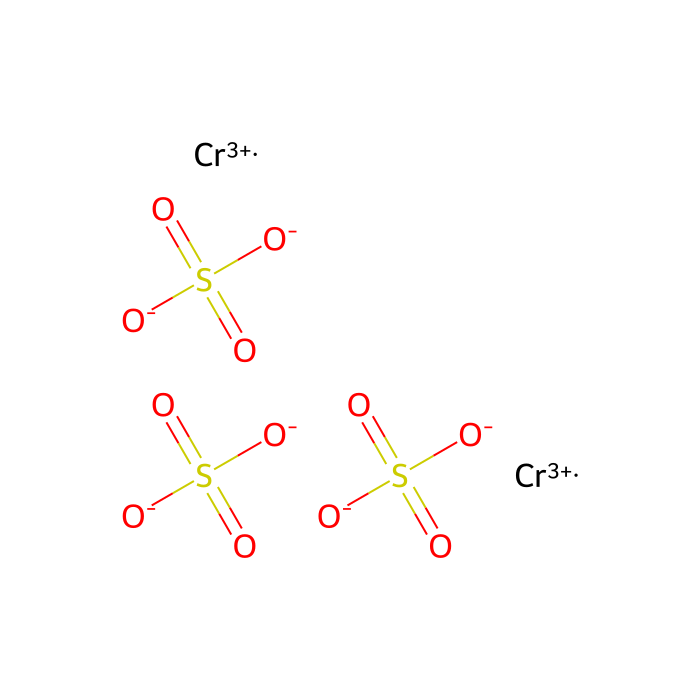
Structure and Identity
Item-specific identifiers from Product Data:
CAS: 10101-53-8
InChIKey: 109930 (as provided)
SMILES: Not specified for this item; refer to CoA/Spec Sheet.
Molecular formula: Not specified for this item; refer to CoA/Spec Sheet.
Molecular weight: Not specified for this item; refer to CoA/Spec Sheet.
General structural description (literature):
“Chromium sulfate hexahydrate” is used in the literature for hydrated chromium sulfate salts in which chromium is octahedrally coordinated by water, with sulfate as the counter‑anion. Representative inner‑sphere cations include [Cr(H2O)6]3+ (chromium(III)) or [Cr(H2O)6]2+ (chromium(II)), paired with sulfate anions (SO4)2−; the exact speciation and hydration depend on oxidation state and preparation history.
Typical features: octahedral Cr–O coordination, hydrogen bonding between aquo ligands and sulfate oxygens, and extended ionic lattice with bound and lattice waters.
2D depiction in words: central Cr cation surrounded by six H2O (octahedron); discrete sulfate tetrahedra (S at center with four O vertices) balance charge and engage in hydrogen bonding to coordinated waters.
Notes:
The precise oxidation state, hydration pattern, and stoichiometry for this catalog item are not specified above; consult the CoA/Spec Sheet for the definitive structural assignment for SKU B302062.
Synthetic Utility
General utility in synthesis (literature):
Metal source: Serves as a convenient aqueous precursor to Cr(III) (and, if reduced, to Cr(II)) for assembling chromium coordination complexes. Ligand exchange from [Cr(H2O)6]n+ with chelators (e.g., bipyridine, salicylates, amino alcohols) affords stable octahedral complexes.
Precursor to oxides/hydroxides: Controlled basification yields amorphous Cr(OH)3·xH2O, convertible to Cr2O3 by calcination—useful for pigment and catalyst support preparation in materials chemistry.
Redox mediator (if Cr(II) form is generated): Chromium(II) sulfate is a one‑electron reductant for activating halides, reducing Fe(III) to Fe(II), or initiating radical chains in aqueous media. Requires inert atmosphere to prevent re‑oxidation.
Ion‑exchange/doping: Sulfate anion facilitates co‑precipitation with other metal cations to form mixed sulfates or to dope host lattices during hydrothermal synthesis.
Practical notes:
Control hydration: Normalize by LOD/TGA to ensure accurate stoichiometry in metal‑ligand reactions.
Avoid high chloride when chloride‑free products are desired; sulfate counter‑ions are often preferred for clean anion backgrounds in characterization (IR, elemental analysis).
Target Specificity
Not applicable. This product is an inorganic salt, not a biological targeting reagent (e.g., antibody, ligand-directed probe). No antigen, epitope, isotype, or species reactivity information applies.
Foire aux questions
How should this product be stored?
Store at room temperature.
How is this product shipped?
This product ships under standard ambient conditions. No temperature-controlled packaging is required.
What are the CAS number, molecular formula and molecular weight?
The CAS Number is 10101-53-8, the molecular formula is Cr2(SO4)3·6H2O, and the molecular weight is 500.25 g/mol. InChIKey GRWVQDDAKZFPFI-UHFFFAOYSA-H.
What documentation is provided?
Available product documentation, including Certificates of Analysis (COA), Safety Data Sheets (SDS), and specification sheets, is shown in the product document area. Document availability and access follow the current site policy.
Nous utilisons des cookies pour garantir le bon fonctionnement du site et, lorsque cela est autorisé, pour améliorer votre expérience. Vous pouvez gérer vos préférences à tout moment dans les Paramètres. Pour en savoir plus, consultez notre Politique relative aux cookies.
Souhaitez-vous que nous vous envoyions un message lorsque des réductions seront disponibles?
Me rappeler plus tard
Merci ! Veuillez vérifier votre boîte de réception e-mail pour confirmer.
Products are supplied to verified businesses, institutions, and qualified professionals for research and development use only. Not for use in humans, animals, diagnosis, or therapy.

 H2617436