This compound belongs to the class of organic compounds known as aminobenzamides. These are organic compounds containing a benzamide moiety with an amine group attached to the benzene ring.
External Descriptors
Not available
1. Djoumbou Feunang Y, Eisner R, Knox C, Chepelev L, Hastings J, Owen G, Fahy E, Steinbeck C, Subramanian S, Bolton E, Greiner R, and Wishart DS. ClassyFire: Automated Chemical Classification With A Comprehensive, Computable Taxonomy. Journal of Cheminformatics, 2016, 8:61.
Determine the necessary mass, volume, or concentration for preparing a solution.
Dilution Calculator
Determine the dilution needed to prepare a stock solution.
Reconstitution Calculator
Avis
Avis des clients
Application Protocols
General laboratory protocols (guidance; not item specifications)
Preparation of DMSO stock
Allow vial to equilibrate to room temperature in a desiccator (argon headspace per Product Data).
Accurately weigh required amount quickly to minimize atmospheric moisture exchange.
Dissolve in anhydrous DMSO to 10–50 mM. Vortex and, if needed, sonicate briefly. Filter (0.2 μm PTFE) if particulates remain.
Preparation of aqueous working solutions
Add DMSO stock to pre-warmed buffer (e.g., PBS or HEPES) to a final DMSO fraction ≤1% v/v.
For enhanced solubility, use mildly acidic buffers (acetate/citrate, pH 5–6). Mix gently and inspect for precipitation over 30–60 minutes.
Cell-based assays
Use low-binding labware. Prepare serial dilutions freshly. Include vehicle controls matching DMSO content.
Optionally add 0.01% nonionic surfactant to reduce adsorption/precipitation, validating lack of assay interference.
Analytical QC (incoming material)
Record NMR (1H), LC–MS, and HPLC purity. If potency by weight is needed, determine water content (KF or TGA) to account for monohydrate stoichiometry.
Not provided for this item
Tested application types, validated dilutions, and specific positive controls are Not specified for this item; refer to CoA/Spec Sheet and optimize per your assay platform.
Biological Roles
Literature context (biochemistry; not item specifications, no clinical claims)
Mechanistic class: cisapride is widely studied as a serotonergic modulator, acting primarily as an agonist at 5-HT4 receptors in vitro, with secondary interactions reported at other serotonergic targets. These activities have been used to probe GI motility signaling pathways, neurotransmitter release, and receptor trafficking in cell-based systems.
Functional readouts: increases in cAMP and downstream PKA signaling are typical markers of 5-HT4 receptor activation. In neuronal/enteric models, modulation of acetylcholine release has been monitored as a functional endpoint.
Selectivity considerations: literature describes appreciable affinity shifts across 5-HT receptor subtypes and species variants; assay conditions (buffer composition, pH, DMSO content) can significantly influence apparent potency.
ADME-related observations: as a lipophilic, basic small molecule, cisapride exhibits pH-dependent solubility and membrane permeability in vitro. Protein binding in serum-containing media can reduce free concentration; careful control of serum content is advised during cellular assays.
Safety pharmacology markers: hERG channel interactions have been noted in the literature and are commonly measured in in vitro cardiotoxicity screening panels; such studies inform safety profiling without implying any therapeutic use.
Item-specific bioactivity data (EC50/Ki/kon–koff): Not specified for this item; researchers should confirm activity in their assay format and consult primary literature for comparative benchmarks.
Buffer Applications
Applicability
Cisapride monohydrate is not a buffering reagent. However, buffer choice is important for preparing assay-ready solutions of this basic small molecule.
Practical guidance (general)
Solubilization: prepare concentrated stocks in DMSO (e.g., 10 mM as a starting point), then dilute into aqueous buffers while maintaining a low final DMSO fraction (≤0.5–1% v/v) to avoid assay interference.
pH control: mildly acidic buffers (e.g., 10–50 mM acetate pH 4.5–5.5 or citrate pH 5–6) can increase solubility by protonating the tertiary amine. For neutral pH assays, pre-dissolve in DMSO before dilution into phosphate or HEPES buffers.
Surfactants: in some cell-based assays, 0.01–0.05% nonionic surfactant (e.g., Tween 20) may help maintain homogeneity; validate for your assay.
Adsorption: basic, lipophilic compounds can adsorb to plastic. Use low-binding polypropylene or silanized glass when working at low nanomolar concentrations.
Not specified for this item
Exact solubility limits in specific buffers, precipitation boundaries, and UV spectra are Not specified for this item; refer to CoA/Spec Sheet and confirm empirically.
Green Alternatives
Context
For this small-molecule research material, the principal environmental considerations arise from solvent choice, waste minimization, and energy use during dissolution, purification, and analysis—rather than from the molecule itself.
Greener solvent choices (general guidance)
Preferred: water (acidified if necessary), ethanol, and ethyl acetate where compatible.
Acceptable with caveats: acetone, isopropanol, acetonitrile (consider recovery), and 2-methyltetrahydrofuran (bio-based, replace THF where appropriate).
Minimize: dichloromethane, DMF, NMP, and hexanes due to toxicity or environmental burdens; if used, ensure proper capture/recycling.
Comparison (illustrative; not item-specific)
DMSO vs DMF for stock solutions: DMSO offers lower chronic toxicity and better biodegradability potential; DMF has regulatory scrutiny. Choose DMSO when feasible.
Acidified aqueous buffers vs purely organic: small additions of acetic/citric acid in water can increase solubility of basic compounds, reducing organic solvent usage in assays.
Operational practices
Use microscale screening to identify the minimum organic cosolvent needed for clear solutions.
Reuse mobile phases where allowed; switch to LC–MS-compatible volatile buffers (ammonium formate/acetate) to ease solvent recovery.
Room-temperature operations are preferred; avoid unnecessary heating of hydrates that may alter stoichiometry.
Item-specific environmental metrics (biodegradability, EHS scores): Not specified for this item; refer to SDS and institutional green-chemistry tools.
Pharmaceutical Uses
Scope of this listing
For research use only. Not for human or veterinary use, clinical administration, compounding, or diagnostic purposes.
Laboratory/formulation roles (general; not item specifications)
Reference standard: frequently used as a system suitability or calibration standard in pharmaceutical analytical methods (e.g., HPLC/LC–MS) for method development and training.
In vitro tool compound: employed to interrogate serotonergic pathways in receptor binding/functional assays and to benchmark assay performance.
Salt/solid-state studies: the monohydrate form is relevant for exploring hydrate–anhydrate equilibria, solvate screening, and polymorphism, which are instructive in solid-state pharmaceutics courses and research.
Regulatory/compendial
Any pharmacopeial monographs, acceptance criteria, or identification tests applicable to cisapride or its salts/hydrates are not provided here. Verify requirements in relevant pharmacopeias if using as a secondary reference material.
Item-specific excipient or GMP grade information: Not specified for this item; refer to CoA/Spec Sheet. Users in regulated environments should qualify the material per internal SOPs (identity, purity, potency assignment, water content for hydrate correction).
Physical Properties
Item-specific (from Product Data)
Appearance: Not specified for this item; refer to CoA/Spec Sheet.
Grade/Purity: Not specified for this item; refer to CoA/Spec Sheet.
Literature/General properties (context; not item specifications)
Physical state: typically an off-white to white crystalline solid for hydrate forms of small-molecule benzamide derivatives.
Acid–base: contains a tertiary amine (base) and a non-ionizing amide; expected to be protonated in acidic media and neutral/basic in non-acidic media.
Solubility (qualitative): usually sparingly soluble in water as the free base/hydrate, but readily soluble in polar aprotic solvents (DMSO, DMF) and moderately soluble in lower alcohols (MeOH, EtOH). Aqueous solubility can be improved by acidification (e.g., dilute HCl) to form the ammonium salt.
Hygroscopicity: monohydrates can exchange water with ambient humidity; mass can drift slightly with drying or prolonged exposure to dry atmosphere.
Partition behavior: amphiphilic; literature reports for related benzamide tertiary amines suggest moderate-to-high lipophilicity (logP typically in the 2–4 range), modulated by protonation state.
Thermal behavior: hydrates may show a dehydration step on TGA/DSC prior to melting or decomposition of the organic phase.
Not provided for this specific item; refer to CoA/Spec Sheet for: exact melting range, water content, assay/purity, residual solvents, elemental analysis, and any spectral identifiers (NMR/IR/MS).
Quality and Grades
Item-specific (from Product Data)
Grade/Purity: Not specified for this item; refer to CoA/Spec Sheet.
Guidance on interpreting quality for this material (general; not item specifications)
Research-use grade: suitable for discovery chemistry, screening, and general laboratory applications. For quantitative bioassays or analytical reference purposes, users often seek materials with a defined assay (e.g., ≥98% by HPLC) and well-documented impurity and water content. Verify by CoA.
Hydrate form considerations: the monohydrate contains one equivalent of water of crystallization; reported assay may be on “as-is” basis or anhydrous basis—check the CoA to interpret potency by weight correctly in dose-response assays.
Stabilization/inerting: product is supplied argon charged per Product Data, which limits oxidative/hydrolytic exposure during storage. Maintain the inert headspace when possible.
Analytical suitability: for use as a reference or system suitability standard, confirm batch-specific chromatographic purity, residual solvents, and identity (MS/NMR/IR). If low-UV-absorbing impurities matter, request a UV trace or HPLC chromatogram.
Trace specifications: Metal content, residual peroxide, UV cutoff, and detailed impurity profiles are Not specified for this item; refer to CoA/Spec Sheet.
Recommendations
On receipt, document appearance, check CoA version/lot match, and perform a quick ID (e.g., LC–MS) if using in regulated or critical assays. Record moisture content if exact stoichiometry impacts potency calculations.
Reaction and Applications
Applicability
This product is primarily a finished small molecule supplied for research use (screening, reference, mechanism studies). It is not typically used as a general-purpose reagent or building block. Accordingly, its key “applications” are in biochemical/pharmacological assays, method development (LC–MS, HPLC), and as a reference standard.
Target engagement: widely used in receptor-binding or functional assays exploring serotonergic signaling pathways (e.g., 5-HT4 activation) and GI motility mechanisms in vitro. Avoid any in vivo/clinical use; research only.
Analytical: system suitability, calibration curves, and recovery studies in bioanalytical LC–MS/MS workflows; solubility/partitioning studies across pH.
Chemical reactivity (if used synthetically; general)
Functional handles: tertiary amine (salt formation, quaternization), amide (generally inert but can partake in activation/hydrolysis under forcing conditions), aryl ethers (robust), haloaryl (if present, may undergo cross-coupling under palladium catalysis in model studies).
Derivatization: preparation of analytical derivatives (e.g., isotopologues or labeled analogs) typically proceeds from the corresponding intermediates rather than from the final molecule.
Practical tips
Drying: prolonged vacuum at ambient or mild heat may partially dehydrate hydrates; verify stoichiometry if exact mass potency is critical.
Stock solutions: use dry DMSO for high-concentration stocks; filter through 0.2 μm PTFE/PP if particulate persists.
Item-specific performance parameters (e.g., activity constants, assay-verified EC50): Not specified for this item; consult literature and validate in-house.
Reaction Conditions
Not a typical reagent
Cisapride monohydrate is not generally employed as a substrate/reagent in routine synthetic reactions. Therefore, there are no canonical “reaction conditions” specific to this product.
General guidance if performing transformations or preparations for studies
Salt formation: dissolve in anhydrous EtOAc/MeOH or acetone and add equimolar acid (e.g., HCl in IPA/Et2O) to precipitate the amine salt; isolate by filtration and dry under vacuum. Verify hydrate/solvate state by Karl Fischer/TGA.
Quaternization (analytical derivatives): treat a solution in MeCN or acetone with a slight excess of an alkyl halide at ambient to 50 C; monitor by LC–MS. Neutralize and isolate by crystallization or preparative chromatography.
Cross-coupling on haloaryl analogs: standard Pd-catalyzed Suzuki conditions (e.g., Pd(PPh3)4, base, toluene/EtOH/H2O, 60–90 C) are literature precedents for related scaffolds but are generally applied to intermediates, not the final molecule.
Assay-solution preparation (more typical use)
Stock solutions: prepare 10–50 mM in dry DMSO; warm gently (≤40 C) and vortex/sonicate. Filter if needed (0.2 μm PTFE).
Working solutions: dilute into buffer to desired concentration, maintaining DMSO ≤1% v/v.
Item-specific kinetic/thermodynamic data, optimal catalysts, or yields: Not specified for this item; refer to literature for analogous transformations.
Safety and Handling
Item-specific (from Product Data)
GHS classification, pictograms, signal word, and H-statements: Not specified for this item; refer to SDS.
General safety guidance (literature/practice; not item specifications)
Likely hazards: organic amide/tertiary amine solids commonly cause eye/skin irritation and may be harmful if swallowed or inhaled. Dust may be irritating to the respiratory tract. Avoid generating dust and aerosols.
PPE: lab coat, safety glasses or goggles, and suitable gloves (e.g., nitrile). Handle in a fume hood to minimize inhalation exposure, especially during weighing or dissolution in volatile solvents.
Incompatibilities: strong oxidizers; strong acids/bases can alter protonation state and solubility. Avoid contact with reactive acylation or alkylation reagents unless intended in controlled synthesis.
First aid (overview): if inhaled—move to fresh air; if on skin—wash with soap/water; if in eyes—rinse cautiously with water for several minutes; if ingested—rinse mouth, seek medical advice. Always follow institutional protocols.
Fire safety: treat as a combustible organic solid. Use CO2, dry chemical, or foam. Thermal decomposition can emit irritating/harsh fumes.
Waste: dispose of according to local regulations for organic chemical waste. Avoid release to the environment.
Always consult the product SDS for authoritative hazard classification, exposure controls, and spill/fire-fighting measures.
Solvent Selection
Use-case focus: dissolution for assays, stock solutions, or synthetic manipulations.
General solubility/miscibility guidance (literature/practice)
Polar aprotic solvents: DMSO and DMF typically afford high solubility and are preferred for concentrated stocks (e.g., 10–50 mM). DMSO is broadly compatible with biochemical assays at ≤1% v/v final concentration.
Alcohols: methanol and ethanol often dissolve this class of benzamide tertiary amines at useful levels; isopropanol is sometimes adequate.
Aqueous media: free-base/hydrate forms are often only sparingly soluble in neutral water. Solubility increases significantly in mildly acidic buffers (e.g., acetate, citrate) that protonate the tertiary amine. A DMSO cosolvent (2–10% v/v) can help.
Nonpolar solvents: poor solubility expected in hexanes/heptane; limited in toluene/EtOAc unless heated or modified (salt/exchange not applicable for free base in nonpolar media).
Selection tips
Bioassays: prepare a DMSO stock, then dilute into buffered aqueous media, keeping final DMSO content low to avoid assay interference. If precipitation occurs, reduce concentration, warm gently, or acidify slightly (maintain assay compatibility).
Prep/analytical chromatography: MeOH/ACN–water (with 0.1% acid) mobile phases usually give sharp peaks for tertiary amine benzamides; for normal-phase or SFC, consider amine modifiers to suppress tailing.
Synthetic use: if engaged in transformations (e.g., salt formation), select solvent according to the counterion and desired crystallization behavior (e.g., EtOAc/MTBE for crystallization screens).
Item-specific specs (solubility numbers, UV cutoff, etc.): Not specified for this item; refer to CoA/Spec Sheet.
Storage and Reconstitution
Item-specific (from Product Data)
Storage conditions: Room temperature, Argon charged. Keep container tightly closed under an inert atmosphere to minimize oxidative/hydrolytic exposure and water-of-crystallization exchange.
Shipping: Normal (ambient) conditions.
General best practices (guidance; not item specifications)
Container handling: open vials in a low-humidity environment when feasible. Reseal promptly; if available, backfill with argon or nitrogen. Store in a desiccator or dry cabinet to help maintain hydrate stoichiometry.
Light sensitivity: many aromatic amides/tertiary amines are photostable, but to be conservative, store in amber glass or protect from strong light.
Reconstitution: for stock solutions, use anhydrous DMSO or suitable solvent. Record concentration, date, and solvent. Filter through a 0.2 μm PTFE syringe filter if necessary.
Solution stability: small-molecule DMSO stocks are often stable for weeks to months at −20 to −80 C; however, confirm stability by LC before critical use. Avoid repeated freeze–thaw; aliquot into single-use portions.
Solid stability: hydrates can lose/gain water with changing RH. If precise assay potency is required, verify water content periodically (Karl Fischer) and adjust calculations.
Not specified for this item
Exact shelf life, retest date, and solution stability data are Not specified for this item; refer to CoA/Spec Sheet and the SDS for authoritative guidance.
Structure and Identity
Item-specific (from Product Data)
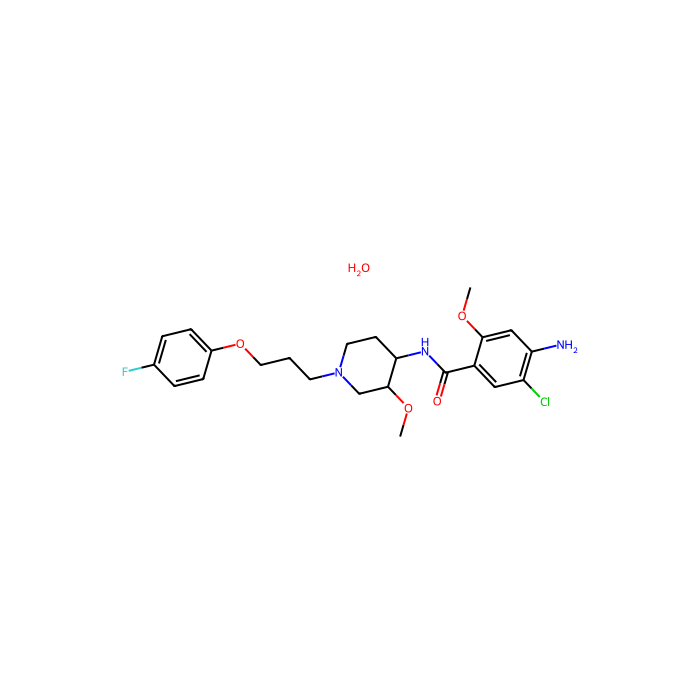
Name: Cisapride monohydrate (SKU: C346766)
CAS: 260779-88-2
PubChem CID: 13677778
InChIKey: 292962 (as provided)
Molecular formula: Not specified for this item; refer to CoA/Spec Sheet.
Molecular weight: Not specified for this item; refer to CoA/Spec Sheet.
Literature/General identity (for context; not item specifications)
Compound class: small-molecule benzamide derivative bearing a basic tertiary amine and ether linkages; supplied as a monohydrate.
Monohydrate form: incorporates one equivalent of water of crystallization, which can influence crystal habit, hygroscopicity, and melting behavior compared with the anhydrous form.
2D structural description (general)
A halogenated substituted benzamide core is connected via an oxyalkyl chain to a tertiary amine (often piperidinyl) moiety. The architecture features two aromatic rings, at least one amide carbonyl conjugated to an aryl ring, and one or more ether linkers bridging the aryl and amine portions. The tertiary amine is protonatable, imparting basicity and salt-forming tendencies; the amide is largely neutral under physiological pH. Stereochemistry is not typically a defining feature (no assigned stereocenters in common representations). Refer to the CoA/SDS for definitive identifiers for this specific lot.
Synthetic Utility
Relevance
As a finished, complex small molecule, cisapride monohydrate is not commonly used as a synthetic intermediate. Nonetheless, understanding its functional groups informs potential modifications in SAR or analytical derivatization studies.
Functional group reactivity (general)
Tertiary amine: forms salts with mineral/organic acids (pKa-dependent). Can be quaternized (e.g., with alkyl halides) to produce permanently charged derivatives for analytical or mechanistic probes.
Amide: generally inert under mild conditions; under strong activation can be transformed (e.g., to imidates or via coupling after activation), though such routes are seldom practical on the final molecule.
Aryl ether and haloaryl motifs (if present): robust under many conditions; haloaryl groups can, in principle, undergo cross-coupling (Suzuki, Buchwald–Hartwig), but such transformations are typically applied earlier in a synthetic route.
Strategic use-cases
Isotopic labeling: tritiation or 13C/15N incorporation is usually pursued at precursor stages; final-molecule exchange labeling may be possible at specific aryl positions with specialized methods.
Solid-state modifications: salt screening and co-crystallization can tune physicochemical properties for study (solubility, stability), without covalent modification of the parent.
Item-specific reactivity data, yields, or procedures: Not specified for this item; consult primary literature for preparative chemistry on cisapride analogs rather than on the final API-like scaffold.
Target Specificity
Applicability note
This section typically pertains to biologics (e.g., antibodies) with defined antigen targets. For a small-molecule tool compound like cisapride monohydrate, “target specificity” refers to literature-described molecular targets in biochemical assays.
Literature context (not item specifications)
Primary target: serotonin 5-HT4 receptors—functional agonism has been widely reported in vitro, assessed by cAMP accumulation assays in cells expressing 5-HT4.
Off-targets: interactions with other serotonergic receptors and ion channels (notably hERG) have been reported in safety pharmacology literature. Affinity and selectivity vary with assay system, species isoforms, and membrane composition.
Assay-dependent variability: DMSO content, buffer pH/ionic strength, receptor expression level, and presence of serum proteins can shift apparent potency/efficacy; benchmarking against a known reference under identical conditions is recommended.
Item-specific validated targets, Ki/EC50 values, or selectivity panels: Not specified for this item; users should establish in-house under their specific conditions.
We use cookies to ensure the website functions properly and, where permitted, to improve your experience. You can manage your preferences at any time in Settings. Learn more in our Cookie Policy.
Shall we send you a message when we have discounts available?
Remind me later
Thank you! Please check your email inbox to confirm.
Products are supplied to verified businesses, institutions, and qualified professionals for research and development use only. Not for use in humans, animals, diagnosis, or therapy.

 J2213480