Determine the necessary mass, volume, or concentration for preparing a solution.
| Activity Type | Activity Value -log(M) | Mechanism of Action | Activity Reference | Publications (PubMed IDs) |
|---|

≥97% pour les flux de travail chromatographiques et analytiques sensibles nécessitant une interférence de ligne de base minimale.
Store at -20°C Expédition Ice chest + Ice pads. Consultez le COA spécifique au lot pour les spécifications exactes.
SDS, COA, fiche technique et fiche de spécifications disponibles au téléchargement. COA spécifique au lot accessible via la recherche par numéro de lot.
Cité dans 0 publications à comité de lecture couvrant la chromatographie, la synthèse organique et les réactions de couplage croisé.
Information
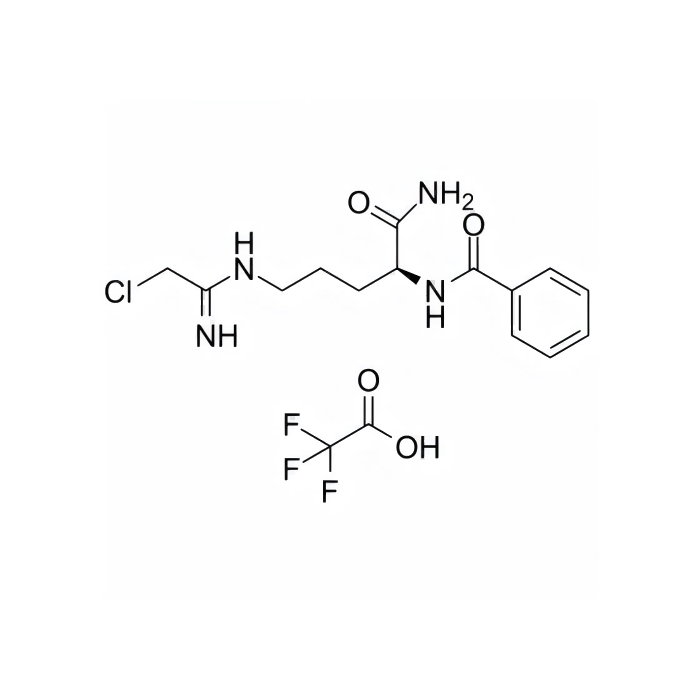
Cl-amidine Cl-amidine is an irreversible pan- peptidylarginine deiminase (PAD) inhibitor with IC50 values of 5.9 ± 0.3 μM, 0.8 ± 0.3 μM, 6.2 ± 1.0 μM for PAD4, PAD1 and PAD3, respectively. Cl-amidine induces apoptosis .
Targets
PAD1 (Cell-free assay); PAD4 (Cell-free assay); PAD3 (Cell-free assay) 0.8 μM; 5.9 μM; 6.2 μM
In vitro
Cl-amidine antagonizes the PAD4-mediated enhancement of the the p300GBD-GRIP1 interaction in a dose-dependent manner. The inhibitory effect of this compound is not a nonspecific one but is targeted at the active PAD4 enzyme. Cl-amidine increases p53 expression in CD45 positive immune cells. It triggers the differentiation and apoptosis of multiple cancer cell lines that are p53+/+ and p53−/− (e.g., HL60, HT29, TK6, and U2-OS cells). Cl-amidine induces the expression of p53 and several downstream target genes including the cyclin dependent kinase inhibitor p21, GADD45, and the proapoptotic protein PUMA in U2-OS osteosarcoma cells.
In vivo
Cl-amidine treatment inhibits NZM(New Zealand mixed 2328) NET(neutrophil extracellular trap) formation in vivo and significantly alters circulating autoantibody profiles and complement levels while reducing glomerular IgG deposition. Further, Cl-amidine increases the differentiation capacity of bone marrow endothelial progenitor cells, improves endothelium-dependent vasorelaxation, and markedly delays time to arterial thrombosis induced by photochemical injury. Cl-amidine delays thrombosis development in NZM mice. It inhibits PADs in mice without significant toxicity and improves disease phenotypes in animal models of inflammatory arthritis and inflammatory bowel disease. And It is shown to reduce disease severity in mouse models of ulcerative colitis and RA.
Cell Research(from reference)
Cell lines:CV-1 cells
Concentrations:0-200 μM
Incubation Time:40 h
Document complet couvrant les dangers, la manipulation, le stockage et la conformité réglementaire.
<<<<<<< HEAD Télécharger la SDS → ======= Télécharger la SDS → >>>>>>> release248-p3Données qualité spécifiques au lot. Saisissez votre numéro de lot pour récupérer le COA exact.
Rechercher le COA →Résumé de référence rapide des spécifications et applications du produit.
Voir la fiche technique →Attributs de qualité complets et critères d'acceptation pour cette qualité.
Voir la fiche de spécifications →Taxonomy Tree
| Kingdom | Organic compounds |
|---|---|
| Superclass | Benzenoids |
| Classe | Benzene and substituted derivatives |
| Subclass | Benzoic acids and derivatives |
| Intermediate Tree Nodes | Benzamides |
| Direct Parent | Hippuric acids and derivatives |
| Alternative Parents | N-acyl-alpha amino acids and derivatives Benzoyl derivatives Fatty amides Alpha-halocarboxylic acids Secondary carboxylic acid amides Primary carboxylic acid amides Propargyl-type 1,3-dipolar organic compounds Carboxamidines Monocarboxylic acids and derivatives Carboximidamides Carboxylic acids Hydrocarbon derivatives Organic oxides Carbonyl compounds Organochlorides Organofluorides Alkyl fluorides Alkyl chlorides |
| Molecular Framework | Not available |
| Substituents | Hippuric acid or derivatives - N-acyl-alpha amino acid or derivatives - N-substituted-alpha-amino acid - Alpha-amino acid or derivatives - Benzoyl - Fatty acyl - Fatty amide - Alpha-halocarboxylic acid - Alpha-halocarboxylic acid or derivatives - Carboxamide group - Secondary carboxylic acid amide - Primary carboxylic acid amide - Amidine - Organic 1,3-dipolar compound - Carboxylic acid amidine - Propargyl-type 1,3-dipolar organic compound - Carboxylic acid derivative - Carboxylic acid - Carboximidamide - Monocarboxylic acid or derivatives - Organic oxygen compound - Organic nitrogen compound - Alkyl halide - Carbonyl group - Alkyl fluoride - Organic oxide - Hydrocarbon derivative - Organooxygen compound - Alkyl chloride - Organonitrogen compound - Organohalogen compound - Organochloride - Organofluoride - Aromatic homomonocyclic compound |
| Description | This compound belongs to the class of organic compounds known as hippuric acids and derivatives. These are compounds containing a hippuric acid or a derivative, with a structure characterized the presence of a benzoyl group linked to the N-terminal of a glycine. |
| External Descriptors | Not available |
| Activity Type | Activity Value -log(M) | Mechanism of Action | Activity Reference | Publications (PubMed IDs) |
|---|
| Activity Type | Relation | Activity value | Units | Action Type | Journal | PubMed Id | doi | Assay Aladdin ID |
|---|
| Activity Type | Relation | Activity value | Units | Action Type | Journal | PubMed Id | doi | Assay Aladdin ID |
|---|
| Activity Type | Relation | Activity value | Units | Action Type | Journal | PubMed Id | doi | Assay Aladdin ID |
|---|
| Activity Type | Relation | Activity value | Units | Action Type | Journal | PubMed Id | doi | Assay Aladdin ID |
|---|
| Activity Type | Relation | Activity value | Units | Action Type | Journal | PubMed Id | doi | Assay Aladdin ID |
|---|
Find and download the COA for your product by matching the lot number on the packaging.
| Lot Number | Certificate Type | Date | Article |
|---|---|---|---|
 F2603403 | Certificate of Analysis | May 18, 2026 | C413918 |
| F2603402 | Certificate of Analysis | May 18, 2026 | C413918 |
| F2603401 | Certificate of Analysis | May 18, 2026 | C413918 |
| F2603379 | Certificate of Analysis | May 18, 2026 | C413918 |
| F2603378 | Certificate of Analysis | May 18, 2026 | C413918 |
| D2312924 | Certificate of Analysis | Jan 21, 2026 | C413918 |
| D2312977 | Certificate of Analysis | Jan 21, 2026 | C413918 |
| D2312961 | Certificate of Analysis | Jan 21, 2026 | C413918 |
| D2312959 | Certificate of Analysis | Jan 21, 2026 | C413918 |
| D2312946 | Certificate of Analysis | Jan 21, 2026 | C413918 |
| D2312945 | Certificate of Analysis | Jan 21, 2026 | C413918 |
| D2312942 | Certificate of Analysis | Jan 21, 2026 | C413918 |
| D23121012 | Certificate of Analysis | Jan 21, 2026 | C413918 |
| I2404295 | Certificate of Analysis | Aug 26, 2024 | C413918 |
| I2404296 | Certificate of Analysis | Aug 26, 2024 | C413918 |
| D2312986 | Certificate of Analysis | Feb 28, 2023 | C413918 |
| D2312958 | Certificate of Analysis | Feb 28, 2023 | C413918 |
| Solubilité | Solubility (25°C) In vitro DMSO: 84 mg/mL warmed with 50ºC Water: bath (197.74 mM); Ethanol: 84 mg/mL warmed with 50ºC Water: bath (197.74 mM); Water: 70 mg/mL warmed with 50ºC Water: bath (164.78 mM); |
|---|---|
| DMSO (mg/mL) Solubilité maximale | 84 |
| DMSO (mM) Solubilité maximale | 197.740113 |
| Eau (mg/mL) Solubilité maximale | 70 |
| Eau (mM) Solubilité maximale | 164.7834275 |
| Poids moléculaire | 424.800 g/mol |
| XLogP3 | |
| Hydrogen Bond Donor Count | 4 |
| Hydrogen Bond Acceptor Count | 8 |
| Rotatable Bond Count | 8 |
| Exact Mass | 424.113 Da |
| Monoisotopic Mass | 424.113 Da |
| Topological Polar Surface Area | 148.000 Ų |
| Heavy Atom Count | 28 |
| Formal Charge | 0 |
| Complexity | 465.000 |
| Isotope Atom Count | 0 |
| Defined Atom Stereocenter Count | 1 |
| Undefined Atom Stereocenter Count | 0 |
| Defined Bond Stereocenter Count | 0 |
| Undefined Bond Stereocenter Count | 0 |
| The total count of all stereochemical bonds | 0 |
| Covalently-Bonded Unit Count | 2 |