QUALITÉ & PURETÉMoligand™?Moligand™ — Aladdin's line of ligands and bioactive small molecules. Use for receptor, pathway, and binding studies needing defined small-molecule tools.10 mM in DMSO
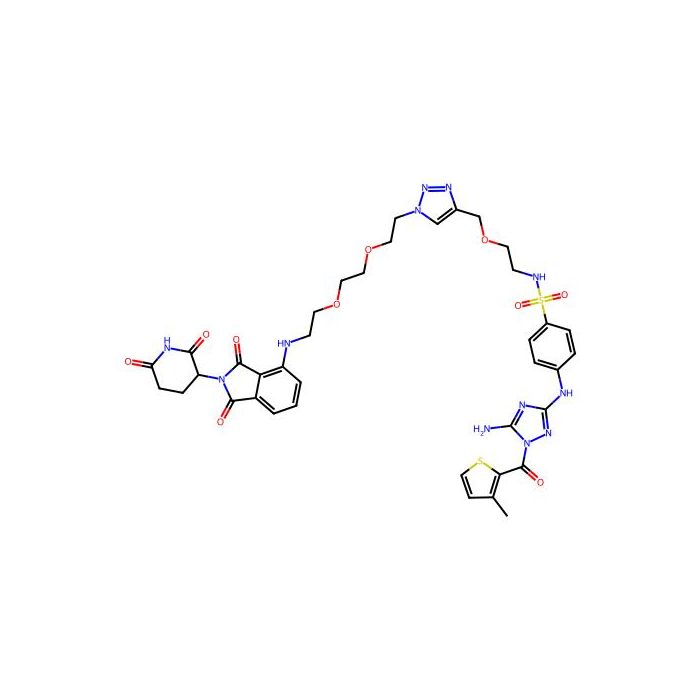
CPS2 is a first-in-class, highly potent, selective and irreversible PROTAC CDK2 degrader ( IC 50 = 24 nM). CPS2 can be used for the research of acute myeloid leukemia.
Spécifications
Spécifications et pureté
Moligand™, 10 mM in DMSO
Conditions de stockage de stockage
Store at -80°C
Expédié en
Dry ice packs + Cold packs
Ce produit nécessite l'expédition en chaîne froide. Les services terrestres et autres services économiques ne sont pas disponibles.
Grade
Moligand™
Type d'action
INHIBITOR
Noms et identifiants
Poids moléculaire
890.94
Données avancées
Certificats (CoA, COO, BSE/TSE et tableau d'analyse)
C of A & Other Certificates(BSE/TSE, COO):
Analytical Chart:
Calculateurs de solution
Molarity Calculator
Determine the necessary mass, volume, or concentration for preparing a solution.
Dilution Calculator
Determine the dilution needed to prepare a stock solution.
Reconstitution Calculator
Avis
Avis des clients
Application Protocols
No tested or validated applications are provided for CPS2. The following generic workflows apply to small-molecule screening items; adapt as needed.
Stock preparation (general)
Equilibrate the -80°C vial to room temperature in a desiccator before opening. Dissolve in anhydrous DMSO to 10–50 mM. Vortex and, if needed, sonicate briefly. Filter through 0.2 μm PTFE if particulate persists.
Plate-based assays (general)
Create a plate map with controls: positive control (known modulator), negative control (vehicle), and, if applicable, orthogonal readouts.
Dispense compound using an acoustic or pin tool to maintain constant final DMSO (typically 0.1–1%). Perform serial dilutions for CRC generation (e.g., 10-point, 1:3 or 1:2 series).
Incubation: Follow assay-specific conditions. Monitor for precipitation or color/fluorescence that may interfere with detection.
Data QC: Include Z’ factor, signal window, and intra-plate CV metrics. Confirm hits in independent runs and via orthogonal assays.
Biophysical binding (general)
For SPR/MST/DSF, exchange into compatible buffers and remove DMSO if required by the platform. Run reference channels and DMSO-matching controls to mitigate bulk effects.
Not specified for this item; refer to CoA/Spec Sheet.
Biological Roles
No biological function or mechanistic information is provided for CPS2. Without structural and target data, specific roles in metabolism, signaling, or enzymology cannot be inferred.
General guidance for small-molecule library members
Treat as a chemical matter starting point for discovery. Any observed biological effects must be validated with orthogonal assays and counter-screens to exclude artifacts (e.g., aggregation, redox cycling, fluorescence interference).
If a target is later assigned, confirm on-target activity by genetic perturbation (knockdown/knockout/rescue), use of multiple chemotypes, and structure–activity relationships.
Item-specific target/pathway information
Not specified for this item; refer to CoA/Spec Sheet or associated screening documentation.
Buffer Applications
CPS2 is a small-molecule library member rather than a buffering agent. It is not typically used to formulate buffers or control pH.
Practical notes for assay buffers (general)
Prepare assay buffers independently (e.g., HEPES, PBS, Tris at appropriate pH/ionic strength), then add CPS2 from a concentrated stock, maintaining consistent final solvent content across samples.
If precipitation occurs on dilution, adjust co-solvent percentage, ionic strength, or include compatible surfactant (e.g., 0.01–0.05% nonionic) after confirming assay tolerance.
Item-specific buffer-related properties
Not specified for this item; refer to CoA/Spec Sheet.
Green Alternatives
Without item-specific solubility and stability data, solvent substitution must be validated experimentally. The following are general greener or lower-hazard considerations for stock preparation and assays.
Potential alternatives to conventional solvents (general)
Replace or reduce DMSO with:
2-methyltetrahydrofuran (2-MeTHF) or cyclopentyl methyl ether (CPME) for non-aqueous processing steps; limited use in aqueous assays.
Bio-based ethanol or propylene carbonate for certain preparations where compatible.
Aqueous co-solvent systems (e.g., 10–30% ethanol or acetonitrile) when assay permits.
Minimize solvent volumes via higher-concentration master stocks and accurate low-volume dispensing.
Operational green practices
Use sealed plates and low-evaporation lids to reduce solvent loss and VOCs.
Standardize DMSO percentage across plates to minimize repeats and waste.
Adopt miniaturized assay formats (384/1536-well) to reduce material use.
Trade-offs
Many “green” solvents have different evaporation rates, viscosities, and assay compatibility profiles. Validate signal stability, background, and compound solubility prior to large-scale screening.
Item-specific environmental/hazard data
Not specified for this item; refer to SDS and CoA/Spec Sheet.
Pharmaceutical Uses
No excipient or pharmacopeial information is provided for CPS2. This product is supplied for research use only and is not intended for human or veterinary use, clinical diagnostics, or as an API/excipient.
General formulation context
In discovery settings, small molecules may be formulated into DMSO stocks and subsequently diluted into appropriate vehicles for in vitro studies. For any preformulation exploration, assess solubility, stability, and compatibility with the intended matrix.
Item-specific pharmacopeial status, residuals, or limits
Not specified for this item; refer to CoA/Spec Sheet.
Physical Properties
Item-specific physical properties are not provided in the current Product Data. Use the CoA/Spec Sheet for authoritative values.
Item-specific
Appearance: Not specified for this item; refer to CoA/Spec Sheet.
Molecular weight: Not specified for this item; refer to CoA/Spec Sheet.
Melting point: Not specified for this item; refer to CoA/Spec Sheet.
Boiling point: Not specified for this item; refer to CoA/Spec Sheet.
Density: Not specified for this item; refer to CoA/Spec Sheet.
Refractive index: Not applicable unless liquid; not specified for this item.
Solubility: Not specified for this item; refer to CoA/Spec Sheet.
LogP/logD: Not specified for this item; refer to CoA/Spec Sheet.
pKa: Not specified for this item; refer to CoA/Spec Sheet.
General guidance for small-molecule library members (literature/general)
For unknown solids, initial stock preparation commonly uses DMSO (10–50 mM), followed by solubility screening into aqueous assay buffers with co-solvent ≤1–2% v/v.
If hygroscopic or light-sensitive behavior is suspected, handle under dry, inert conditions and protect from light. Confirm via CoA.
For plate-based screening, verify that the working solution remains clear (no turbidity/precipitation) across the intended dilution range and assay buffer composition.
Quality and Grades
Item-specific quality attributes beyond the label “Moligand” are not provided in the current Product Data. Refer to the CoA/Spec Sheet for assay, identity confirmation, residual solvent limits, and any impurity profiling.
About Moligand (general description)
Moligand denotes a curated small-molecule ligand/compound collection intended for research screening and discovery workflows. Products are for laboratory use only.
Documentation: Expect an accompanying CoA specifying identity (e.g., structural identifier), batch number, and storage guidance. Purity methodology (e.g., HPLC/LC–MS, NMR) and exact values are batch-dependent and must be taken from the CoA.
What to verify for this item (practical checklist)
Identity confirmation method(s): Not specified for this item; refer to CoA/Spec Sheet.
Purity and assay basis: Not specified for this item; refer to CoA/Spec Sheet.
Residual solvents/metals, water content, stabilizers: Not specified for this item; refer to CoA/Spec Sheet.
Form supplied (solid vs solution) and concentration (if solution): Not specified for this item; refer to CoA/Spec Sheet.
Implications for use
For HTS and SAR, consistent lot-to-lot identity and purity are critical. Align your QC acceptance criteria with the CoA and internal thresholds (e.g., minimum purity, single major component by LC).
If low-UV impurities are suspected for optical assays, run blank corrections or pre-screen the solvent and compound at assay wavelengths.
Reaction and Applications
This product is positioned as a small-molecule library member (Moligand). Without structural information, synthetic reaction use cannot be specified. The most relevant applications are discovery and screening workflows.
Discovery/screening use cases (general)
Primary screening: Assess activity in biochemical or cell-based assays to identify hits affecting a target/pathway of interest.
Dose–response and profiling: Generate concentration–response curves, determine apparent potency metrics (e.g., IC50/EC50 in your assay context), and evaluate selectivity across orthogonal assays.
Target engagement: Apply biophysical methods (e.g., DSF, SPR, MST) and cellular target engagement assays where appropriate.
Mechanistic follow-up: Use orthogonal readouts to deconvolute assay interferences (fluorescence quenching, redox activity, aggregation). Include detergent controls and counter-screens.
Analytical/controls
Aggregation/covalency checks: Include 0.01–0.05% nonionic detergent and employ DLS/AIDA where available.
Interference assessment: Evaluate absorbance/fluorescence spectra against assay wavelengths; use redox and PAINS filters judiciously (do not exclude solely by substructures; confirm experimentally).
Synthetic chemistry remarks
Without a defined structure, guidance on reactivity or named reactions is not applicable for this item.
Reaction Conditions
No structure or functional group information is available for CPS2; therefore, specific reaction conditions, catalysts, or temperature windows cannot be provided.
Item-specific conditions
Not specified for this item; refer to CoA/Spec Sheet.
General discovery operations
For assay preparation: Dissolve in DMSO to prepare a 10–50 mM master stock, then dilute into assay buffer or media while maintaining consistent solvent content across all wells.
For stability checks: Perform time-course LC–MS of stock solutions at room temperature and at 4°C to understand short-term handling limits before large experiments.
For plate logistics: Use low-bind polypropylene plates/tubes, avoid repeated freeze–thaw, and employ desiccation/light protection as needed.
Safety and Handling
Hazard information for CPS2 is not provided in the current Product Data. Treat as a substance of unknown hazards and consult the SDS for authoritative guidance.
Item-specific
GHS classification: Not specified for this item; refer to SDS.
Signal word / H-statements / pictograms: Not specified for this item; refer to SDS.
Research use: For research use only (non-clinical, non-diagnostic).
Storage conditions: Store at -80°C. Shipped on dry ice packs + cold packs.
General laboratory precautions (good practice)
Engineering controls: Work in a chemical fume hood or biosafety cabinet appropriate to your assay to minimize inhalation/dermal exposure.
PPE: Lab coat, safety glasses, and appropriate chemical-resistant gloves (e.g., nitrile). Avoid skin and eye contact; do not ingest or inhale aerosols/powders.
Handling: Minimize freeze–thaw cycles; keep containers tightly closed. Allow vials shipped on dry ice to equilibrate to room temperature in a desiccated environment before opening to avoid condensation.
Incompatibilities: Unknown; avoid mixing with strong oxidizers/reductants/acids/bases until compatibility is assessed. Use small-scale tests when combining with reactive reagents.
First aid (overview; refer to SDS): In case of skin/eye contact, rinse with water for at least 15 minutes and seek medical advice. If inhaled, move to fresh air. If ingested, seek medical attention.
Waste: Dispose according to institutional chemical waste procedures; do not discharge to drains.
Solvent Selection
Item-specific solubility data are not available. The following guidance reflects common practice for small-molecule library members; verify with your CoA and small-scale tests.
Primary stock preparation (general practice)
DMSO is the default solvent for discovery libraries due to broad solvating power and assay compatibility at ≤1–2% v/v in most biochemical assays. Start at 10–50 mM.
If DMSO is unsuitable, consider DMF, acetonitrile, ethanol, or PEG 400 as alternates, ensuring assay compatibility and evaporation control.
Aqueous compatibility
For buffer-based assays, dilute DMSO stocks into buffer while vortexing to minimize precipitation. Use surfactants (e.g., 0.01–0.05% Tween-20) only if compatible with the assay.
Maintain constant DMSO percentage across all wells (compound and controls) to control for solvent effects.
Selection guidance
If compound is hydrophobic (observed precipitation at low DMSO), increase DMSO to the assay’s tolerated maximum or introduce co-solvents (ethanol ≤2–5%).
For cell-based assays, keep total organic solvent low (commonly ≤0.5–1% DMSO) and confirm cell-line tolerance.
Stability considerations
Protect from moisture and light if instability is suspected. Prepare single-use aliquots to avoid freeze–thaw.
Item-specific solubility, partitioning, and pKa
Not specified for this item; refer to CoA/Spec Sheet.
Storage and Reconstitution
Item-specific storage is provided; detailed reconstitution parameters are not. Follow these best practices for small-molecule library compounds.
Item-specific
Storage conditions: Store at -80°C.
Shipping: Dry ice packs + cold packs.
General guidance
Upon receipt: Keep frozen. Before opening, allow the vial to warm to room temperature in a desiccator or under dry inert gas to prevent moisture condensation.
Aliquoting: Prepare single-use aliquots of dry solid or concentrated DMSO stock to minimize freeze–thaw. Use low-bind, airtight tubes or crimp-sealed vials.
Reconstitution: If supplied as a solid, dissolve in anhydrous DMSO to 10–50 mM unless otherwise specified. If supplied as a solution, verify concentration and solvent on the CoA.
Stability: Short-term handling at room temperature should be minimized. Track cumulative time out of cold storage. Protect from light if chromophoric.
Freeze–thaw: Avoid repeated cycles; discard aliquots that show precipitation, discoloration, or degraded purity by LC–MS/HPLC.
Documentation: Record lot number, concentration, solvent, and date of preparation on each aliquot.
Item-specific solvent/stability limits
Not specified for this item; refer to CoA/Spec Sheet.
Structure and Identity
Item-specific identifiers for CPS2 are not provided in the current Product Data. Please consult the item’s Certificate of Analysis (CoA) or Specification Sheet for definitive identity information.
Item-specific (from Product Data)
Product name: CPS2 (SKU: C1496914)
CAS: 2756741-90-7
Grade/Purity: Moligand
Molecular formula: Not specified for this item; refer to CoA/Spec Sheet.
Molecular weight: Not specified for this item; refer to CoA/Spec Sheet.
InChIKey: Not specified for this item; refer to CoA/Spec Sheet.
SMILES: Not specified for this item; refer to CoA/Spec Sheet.
General notes (applicability)
CPS2 is listed under a small-molecule/compound library category (Moligand), suggesting use as a screening ligand or chemical probe candidate. Without structural data, no assumptions can be made regarding functional groups, stereochemistry, or ring systems.
If structural identifiers are provided on the CoA, align all analytical methods (HPLC, LC–MS, NMR) to that structure for verification.
2D structural description
Not available for this item; refer to CoA/Spec Sheet. No structural features can be described without authoritative identifiers.
Synthetic Utility
Synthetic transformation guidance requires knowledge of functional groups and reactivity, which are not provided for CPS2.
Item-specific reactivity and roles in synthesis
Not specified for this item; refer to CoA/Spec Sheet.
General considerations
If CPS2 is to be used as a reference standard or intermediate in synthetic studies, obtain structural confirmation and purity data from the CoA. Establish stability under planned reaction conditions (temperature, pH, redox environment) using small-scale trials.
If derivatization is desired (e.g., for SAR), ensure that the core scaffold and reactive handles are known and compatible with the intended chemistry (protection/deprotection, cross-coupling, acylation/alkylation, etc.). Without a structure, no named-reaction guidance can be given.
Target Specificity
No target, pathway, or selectivity data are provided for CPS2 in the Product Data.
Item-specific
Target(s), off-targets, and species reactivity: Not specified for this item; refer to CoA/Spec Sheet or screening data.
General advice
If CPS2 emerges as a hit, evaluate specificity with orthogonal biochemical readouts, target engagement measurements, chemotype diversity, and counter-screens against common assay interferences and related protein families.
Foire aux questions
What are the CAS number, molecular formula and molecular weight?
The CAS Number is 2756741-90-7, the molecular formula is C38H42N12O10S2, and the molecular weight is 890.94 g/mol.
How should this product be stored?
Store at ?80 °C. Ultra-low temperature storage is required to maintain the specified shelf life.
How is this product shipped?
This product ships frozen with dry ice and cold packs. Unpack on arrival and transfer it to the storage condition stated above; handle dry ice with insulated gloves in a ventilated area.
What is Moligand??
Moligand? is one of Aladdin Scientific's premium product lines, formulated for high-purity applications across multiple workflows. Compared to standard grades in the same workflow, Moligand? products typically offer tighter specifications, more rigorous QC, and stronger lot-to-lot consistency.
What documentation is provided?
Available product documentation, including Certificates of Analysis (COA), Safety Data Sheets (SDS), and specification sheets, is shown in the product document area. Document availability and access follow the current site policy.
Besoin d'aide pour choisir la qualité ?
Notre guide de sélection des qualités couvre la pureté, le statut du stabilisant et l'adéquation à l'application pour toutes les variantes de notre catalogue.
Nous utilisons des cookies pour garantir le bon fonctionnement du site et, lorsque cela est autorisé, pour améliorer votre expérience. Vous pouvez gérer vos préférences à tout moment dans les Paramètres. Pour en savoir plus, consultez notre Politique relative aux cookies.
Souhaitez-vous que nous vous envoyions un message lorsque des réductions seront disponibles?
Me rappeler plus tard
Merci ! Veuillez vérifier votre boîte de réception e-mail pour confirmer.
Products are supplied to verified businesses, institutions, and qualified professionals for research and development use only. Not for use in humans, animals, diagnosis, or therapy.