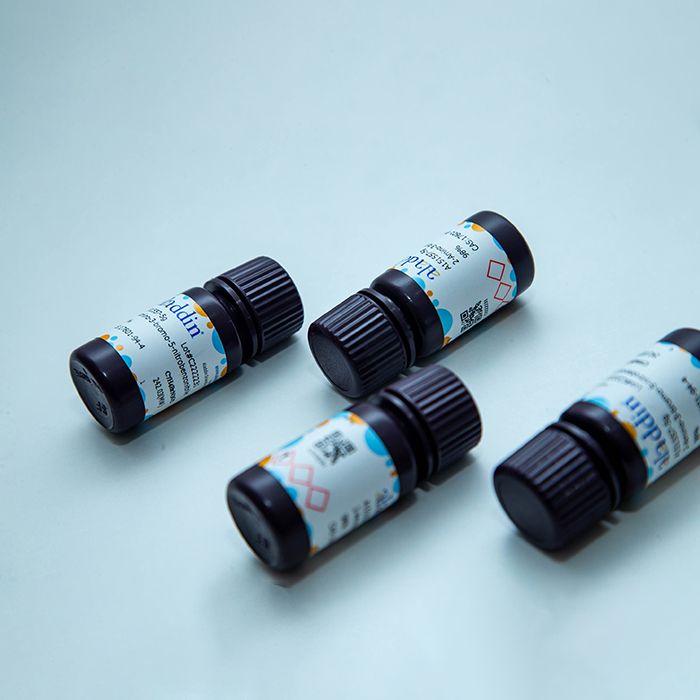
Cy2-SE (iodine) - ≥95%, Em:510nm;Ex:492nm , CAS No.186205-33-4

CAS: 186205-33-4 Cat. No.: C649855 Formule: C29H30IN3O6 Poids moléculaire: 643.5
DISPONIBLE À COMMANDE
GRADE & PURITY ≥95% Em:510nm;Ex:492nm
Synonyms
Cyanine2-SE | Cyanine2-SE (iodine)
Storage
Protected from light,Store at -20°C,Desiccated
Shipped In
Ice chest + Ice pads
★
Size
Allemagne (EU)
USA*
Price
Qty
5mg
C649855-5mg
—
1 En stock
53,71€
10mg
C649855-10mg
—
1 En stock
86,69€
25mg
C649855-25mg
Sur commande · 8–12 semaines
164,78€
50mg
C649855-50mg
Sur commande · 8–12 semaines
289,74€
Enter a quantity for the sizes you want to add.
🧪
Why this grade

≥95%, Em:510nm;Ex:492nm for sensitive chromatographic and analytical workflows requiring minimal baseline interference.

🌡

Storage & shipping

Protected from light,Store at -20°C,Desiccated Ships Ice chest + Ice pads Check lot-specific COA for exact specifications.

📋

Quality documents

SDS, COA, datasheet, and spec sheet available for download. Lot-specific COA accessible via lot number lookup.

📚

Literature proof

Cited in 0 peer-reviewed publications across chromatography, organic synthesis, and cross-coupling reactions.

Vue d’ensemble

Cy2-SE iodine is a CY dye. CY, short for Cyanine, is a compound consisting of two nitrogen atoms connected by an odd number of methyl units. Cyanine compounds have the characteristics of long wavelength, adjustable absorption and emission, high extinction coefficient, good water solubility and relatively simple synthesis. CY dyes are of en used for the labeling of proteins, antibodies and small molecular compounds. For the labeling of protein antibodies, the combination can be completed through a simple mixing reaction. Below, we introduce the labeling method of protein antibody labeling, which has certain reference significance .

In Vitro

Protocol 1.Protein Preparetion 1) In order to obtain the best labeling effect, please prepare the protein (antibody) concentration as 2 mg/mL. 2) The pH value of protein solution shall be 8.5±0.5. If the pH is lower than 8.0, 1 M sodium bicarbonate shall be used for adjustment. 3) If the protein concentration is lower than 2 mg/mL, the labeling efficiency will be greatly reduced. In order to obtain the best labeling efficiency, it is recommended that the final protein concentration range is 2-10 mg/mL. 4) The protein must be in the buffer without primary amine (such as Tris or glycine) and ammonium ion, otherwise the labeling efficiency will be affected. 2.Dye Preparation (Example for CY3-NHS ester) Add anhydrous DMSO into the vial of CY3-NHS ester to make a 10 mM stock solution. Mix well by pipetting or vortex. 3.Calculation of dye dosage The amount of CY3-NHS ester required for reaction depends on the amount of protein to be labeled, and the optimal molar ratio of CY3-NHS ester to protein is about 10. Example: assuming the required marker protein is 500 μL 2 mg/mL IgG (MW=150,000), use 100 μL DMSO dissolve 1 mg CY3-NHS ester, the required CY3-NHS ester volume is 5.05 μL, and the detailed calculation process is as follows: 1) mmol (IgG) = mg/mL (IgG) ×mL (IgG) / MW (IgG) =2 mg/mL × 0.5 mL / 150,000 mg/mmol= 6.7×10⁻⁶ mmol 2) mmol (CY3-NHS ester) = mmol (IgG) × 10 = 6.7×10⁻⁶ mmol×10 = 6.7 × 10⁻⁵ mmol 3) μL (CY3-NHS ester) = mmol (CY3-NHS ester) ×MW (CY3-NHS ester) / mg/μL (CY3-NHS ester) = 6.7 ×10⁻⁵ mmol ×753.88 mg/mmol / 0.01 mg/μL = 5.05 μL (CY3-NHS ester) 4.Run conjugation reaction 1) A good volume of freshly prepared 10 mg/mL CY3-NHS ester is slowly added to 0.5 mL protein sample In solution, gently shake to mix, then centrifuge briefly to collect the sample at the bottom of the reaction tube. Don'tmix well to prevent protein samples from denaturation and inactivation. 2) The reaction tubules were placed in a dark place and incubated gently at room temperature for 60 minutes at intervals.For 10-15 minutes, gently reverse the reaction tubules several times to fully mix the two reactants and raise the bar efficiency. 5.Purify the conjugation The following protocol is an example of dye-protein conjugate purification by using a SepHadex G-25 column. 1) Prepare SepHadex G-25 column according to the manufacture instruction. 2) Load the reaction mixture (From \Run conjugation reaction\) to the top of the SepHadex G-25 column. 3) Add PBS (pH 7.2-7.4) as soon as the sample runs just below the top resin surface. 4) Add more PBS (pH 7.2-7.4) to the desired sample to complete the column purification. Combine the fractions that contain the desired dye-protein conjugate. MCE has not independently confirmed the accuracy of these methods. They are for reference only.

Form:Solid

Specifications

Synonymes
Cyanine2-SE | Cyanine2-SE (iodine)
Spécifications et pureté
≥95%, Em:510nm;Ex:492nm
Mécanismes biochimiques et physiologiques
Cy2-SE iodine is a CY dye. CY, short for Cyanine, is a compound consisting of two nitrogen atoms connected by an odd number of methyl units. Cyanine compounds have the characteristics of long wavelength, adjustable absorption and emission, high extinction
Conditions de stockage de stockage
Protected from light,Store at -20°C,Desiccated
Expédié en
Ice chest + Ice pads
Ce produit nécessite l'expédition en chaîne froide. Les services terrestres et autres services économiques ne sont pas disponibles.
Pureté
≥95%
Noms et identifiants
Pubchem Sid
Sourires canoniques
CCN1C2=CC=CC=C2OC1=CC=CC3=[N+](C4=CC=CC=C4O3)CCCCCC(=O)ON5C(=O)CCC5=O.[I-]
IUPAC Name
(2,5-dioxopyrrolidin-1-yl) 6-[2-[(E,3Z)-3-(3-ethyl-1,3-benzoxazol-2-ylidene)prop-1-enyl]-1,3-benzoxazol-3-ium-3-yl]hexanoate;iodide
InChIKey
RQYPAAVMQSMNBY-UHFFFAOYSA-M
INCHI
1S/C29H30N3O6.HI/c1-2-30-21-11-5-7-13-23(21)36-27(30)15-10-16-28-31(22-12-6-8-14-24(22)37-28)20-9-3-4-17-29(35)38-32-25(33)18-19-26(32)34;/h5-8,10-16H,2-4,9,17-20H2,1H3;1H/q+1;/p-1
Poids moléculaire
643.5

Documentation

📋 Safety Data Sheet (SDS)

Comprehensive hazard, handling, storage, and regulatory compliance document.

Download SDS →

✅ Certificate of Analysis (COA)

Lot-specific quality data. Enter your lot number to retrieve the exact COA.

Look up COA →

📊 Datasheet

Quick-reference summary of product specifications and applications.

View datasheet →

🔬 Specification Sheet

Full quality attributes and acceptance criteria for this grade.

View spec sheet →

Advanced Data

Taxonomic Classification

Taxonomy Tree

KingdomOrganic compounds
SuperclassOrganoheterocyclic compounds
ClasseBenzoxazolines
SubclassNot available
Intermediate Tree Nodes Not available
Direct ParentBenzoxazolines
Alternative Parents Benzoxazoles  Pyrrolidine-2-ones  Benzenoids  Oxazoles  Dicarboximides  Heteroaromatic compounds  Lactams  Ketene acetals  Oxacyclic compounds  Azacyclic compounds  Monocarboxylic acids and derivatives  Amines  Hydrocarbon derivatives  Carbonyl compounds  Organic iodide salts  Organic oxides  Organic cations  
Molecular FrameworkAromatic heteropolycyclic compounds
Substituents Benzoxazole - Benzoxazoline - Pyrrolidone - 2-pyrrolidone - Benzenoid - Azole - Dicarboximide - Oxazole - Pyrrolidine - Heteroaromatic compound - Ketene acetal or derivatives - Lactam - Oxacycle - Azacycle - Carboxylic acid derivative - Monocarboxylic acid or derivatives - Hydrocarbon derivative - Organic iodide salt - Organonitrogen compound - Organooxygen compound - Amine - Organic nitrogen compound - Organic oxide - Carbonyl group - Organic oxygen compound - Organic salt - Organic cation - Aromatic heteropolycyclic compound
DescriptionThis compound belongs to the class of organic compounds known as benzoxazolines. These are organic compounds containing a benzene ring fused to an oxazoline ring. Oxazoline is five-membered unsaturated ring with a nitrogen atom and an oxygen atom at the 1- and 3-position, respectively. Additionally, it contains two double bonds.
External Descriptors Not available
Structure 3D
Modèle de structure chimique interactif


Certificats (CoA, COO, BSE/TSE et tableau d'analyse)
C of A & Other Certificates(BSE/TSE, COO):
Analytical Chart:

Find and download the COA for your product by matching the lot number on the packaging.

6 results found

Lot NumberCertificate TypeDateArticle
B2526397Certificate of AnalysisSep 01, 2026 C649855
B2526405Certificate of AnalysisSep 01, 2026 C649855
B2526413Certificate of AnalysisSep 01, 2026 C649855
B2526400Certificate of AnalysisJan 06, 2025 C649855
B2526402Certificate of AnalysisJan 06, 2025 C649855
B2526404Certificate of AnalysisJan 06, 2025 C649855
Propriétés chimiques et physiques
SolubilitéDMSO : 62.5 mg/mL (97.13 mM; ultrasonic and warming and heat to 60°C)
FAQ et articles
Calculateurs de solution
Avis

Avis des clients

Shall we send you a message when we have discounts available?

Remind me later

Thank you! Please check your email inbox to confirm.

Oops! Notifications are disabled.