≥99% for sensitive chromatographic and analytical workflows requiring minimal baseline interference.
🌡
Storage & shipping
Protected from light,Store at -20°C,Argon charged Ships Ice chest + Ice pads Check lot-specific COA for exact specifications.
📋
Quality documents
SDS, COA, datasheet, and spec sheet available for download. Lot-specific COA accessible via lot number lookup.
📚
Literature proof
Cited in 0 peer-reviewed publications across chromatography, organic synthesis, and cross-coupling reactions.
Vue d’ensemble
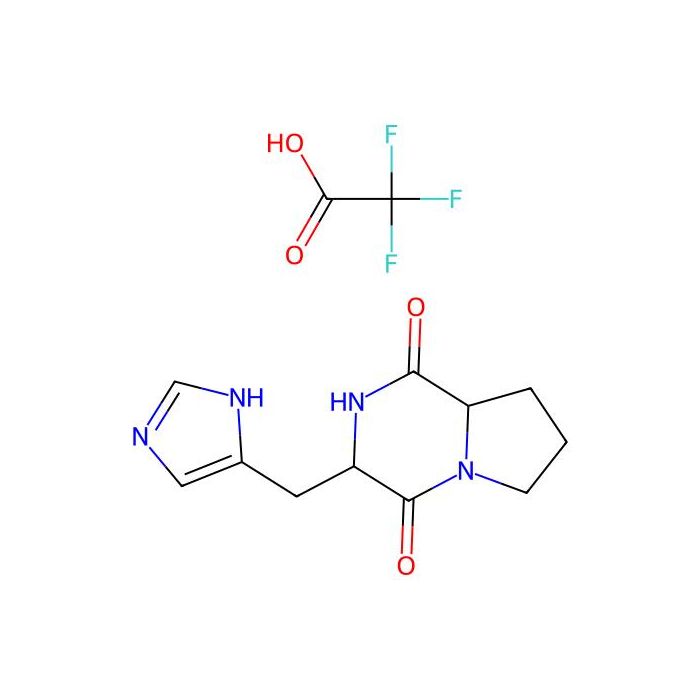
Cyclo(his-pro) TFA (Cyclo(histidyl-proline) TFA) is an orally active cyclic dipeptide structurally related to tyreotropin-releasing hormone Cyclo(his-pro) TFA could inhibit NF-κB nuclear accumulation. Cyclo(his-pro) TFA can cross the brain-blood-barrier and affect diverse inflammatory and stress responses .
In Vitro
Cyclo(his-pro) TFA (Cyclo(histidyl-proline) TFA; 50 μM; 1-48 hours) increases the nuclear level of Nrf2 and inhibits NF-κB nuclear translocation. Cyclo(His-Pro) alone has no effect on nuclear translocation of these transcription factors. Cyclo(his-pro) TFA (50 μM; prior to PQ exposure for 48 hours) abolishes protein nitration that followed paraquat (PQ) exposure and lessenes its functional consequences, as shown by decrease in cell apoptosis, detected by caspase 3 activity and by cytochrome c release. Cyclo(his-pro) TFA inhibits NF-κB nuclear accumulation induced by paraquat in rat pheochromocytoma PC12 cells via the Nrf2/heme oxygenase-1 pathway. MCE has not independently confirmed the accuracy of these methods. They are for reference only. Western Blot AnalysisCell Line: PC12 cells Concentration: 50 μM Incubation Time: 1, 2, 4, 8, 24, 48 hours Result: Increased the nuclear level of Nrf2 and inhibited NF-κB nuclear translocation.
In Vivo
Cyclo(his-pro) TFA (Cyclo(histidyl-proline) TFA; 1.8 mg/ear; topical application on the right ear; 30 min prior to TPA) reduces TPA-induced ear oedema confirming that it can exert anti-inflammatory effect. Cyclo(his-pro) TFA exerts in vivo anti-inflammatory effects in the central nervous system by down-regulating hepatic and cerebral TNFα expression thereby counteracting LPS-induced gliosis. Moreover, by up-regulating Bip, Cyclo(his-pro) increases the ER stress sensitivity andtriggers the unfolded protein response to alleviate the ER stress. MCE has not independently confirmed the accuracy of these methods. They are for reference only. Animal Model: Sixty two/three month-old male C57BL/6 mice (25-30 g)Dosage: 1.8 mg/ear Administration: Topical application on the right ear; 30 min prior to TPA Result: Reduced TPA-induced ear oedema.
Form:Solid
IC50& Target:NF-κB Human Endogenous Metabolite
Specifications
Spécifications et pureté
≥99%
Mécanismes biochimiques et physiologiques
Cyclo(his-pro) TFA (Cyclo(histidyl-proline) TFA) is an orally active cyclic dipeptide structurally related to tyreotropin-releasing hormone. Cyclo(his-pro) TFA could inhibit NF-κB nuclear accumulation. Cyclo(his-pro) TFA can cross the brain-blood-bar
Conditions de stockage de stockage
Protected from light,Store at -20°C,Argon charged
Expédié en
Ice chest + Ice pads
Ce produit nécessite l'expédition en chaîne froide. Les services terrestres et autres services économiques ne sont pas disponibles.
This compound belongs to the class of organic compounds known as alpha amino acids and derivatives. These are amino acids in which the amino group is attached to the carbon atom immediately adjacent to the carboxylate group (alpha carbon), or a derivative thereof.
External Descriptors
Not available
1. Djoumbou Feunang Y, Eisner R, Knox C, Chepelev L, Hastings J, Owen G, Fahy E, Steinbeck C, Subramanian S, Bolton E, Greiner R, and Wishart DS. ClassyFire: Automated Chemical Classification With A Comprehensive, Computable Taxonomy. Journal of Cheminformatics, 2016, 8:61.
Certificats (CoA, COO, BSE/TSE et tableau d'analyse)
C of A & Other Certificates(BSE/TSE, COO):
Analytical Chart:
Propriétés chimiques et physiques
Solubilité
DMSO : 260 mg/mL (746.53 mM; Need ultrasonic) H2O : 125 mg/mL (358.91 mM; ultrasonic and adjust pH to 10 with NaOH)
Calculateurs de solution
Molarity Calculator
Determine the necessary mass, volume, or concentration for preparing a solution.
Dilution Calculator
Determine the dilution needed to prepare a stock solution.
Reconstitution Calculator
Avis
Avis des clients
Foire aux questions
What is the purity of this product?
This product is supplied at ≥99% purity (chemical assay). Lot-specific values are stated on the Certificate of Analysis.
How should this product be stored?
Store at ?20 °C, protected from light, under argon. It is supplied under an argon blanket; reseal under inert gas after each use.
How is this product shipped?
This product ships in an insulated container with ice pads. Unpack on arrival and transfer it to the storage condition stated above.
What are the CAS number, molecular formula and molecular weight?
The CAS Number is 936749-56-3, the molecular formula is C13H15F3N4O4, and the molecular weight is 348.28 g/mol. InChIKey YOFCDSUBRJNLBB-OZZZDHQUSA-N.
What documentation is provided?
Available product documentation, including Certificates of Analysis (COA), Safety Data Sheets (SDS), and specification sheets, is shown in the product document area. Document availability and access follow the current site policy.
We use cookies to ensure the website functions properly and, where permitted, to improve your experience. You can manage your preferences at any time in Settings. Learn more in our Cookie Policy.
Shall we send you a message when we have discounts available?
Remind me later
Thank you! Please check your email inbox to confirm.
Products are supplied to verified businesses, institutions, and qualified professionals for research and development use only. Not for use in humans, animals, diagnosis, or therapy.