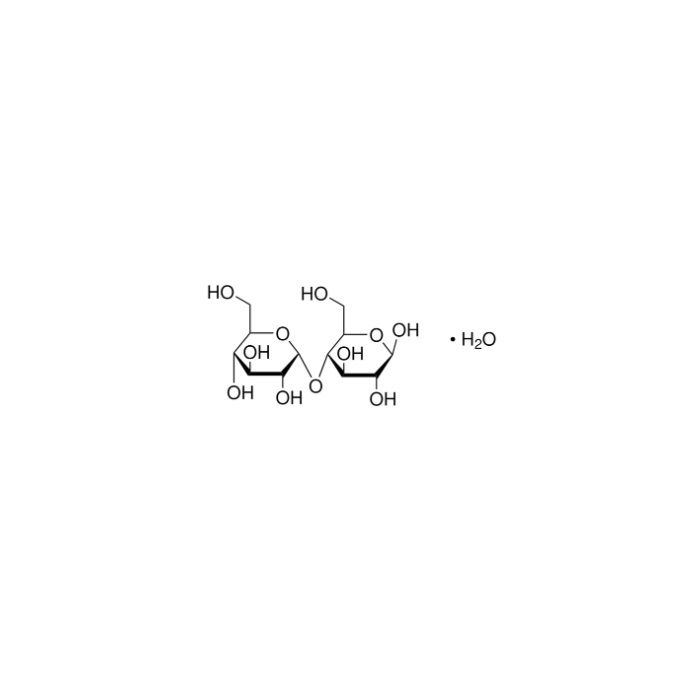
D-(+)-Maltose monohydrate - UltraBio™, ≥99%(HPLC) , CAS No.6363-53-7

CAS: 6363-53-7 Cat. No.: D755720 Formule: C12H22O11•H2O Poids moléculaire: 360.31 Beilstein Registry Number: 93798 Numéro CE: 613-294-6 PubChem CID: 23615261
DISPONIBLE À COMMANDE
QUALITÉ & PURETÉ UltraBio™ ? UltraBio™ — Aladdin's line for molecular-biology applications. Use for nuclease-free, high-consistency reagents across molecular workflows. ≥99%(HPLC)
Synonyms
Maltobiose|Malt Sugar|Beta-Maltose|D-Maltose|Maltose monohydrate
Storage
Room temperature
Shipped In
Normal
★
Taille
Allemagne (EU)
USA*
Prix
Qté
25g
D755720-25g
Sur commande · 8–12 semaines
142,22€
100g
D755720-100g
Sur commande · 8–12 semaines
429,44€
500g
D755720-500g
Sur commande · 8–12 semaines
1 251,19€
Enter a quantity for the sizes you want to add.

Vue d’ensemble

D-Maltose, an α(1→4) linked disaccharide of D-glucose, is used as a substrate for the identification, differentiation and characterization of enzymes such as maltase(s); maltose α-D-glucosyltransferase(s); maltose-transporting ATPase(s); maltose O-acetyltransferase(s) and maltose epimerase(s) and phosphorylase(s). D-Maltose is used to study maltose-binding proteins and disaccharide transport systems.

Spécifications

Synonymes
Maltobiose | Malt Sugar | Beta-Maltose | D-Maltose | Maltose monohydrate
Spécifications et pureté
UltraBio™, ≥99%(HPLC)
Mécanismes biochimiques et physiologiques
Maltose is a disaccharide containing two glucose molecules with an α(1→4) glycosidic linkage. Maltose can be derived from starch in food through the action of amylase. Maltose can be found in many food products, including beer, cereals, and pasta.
Conditions de stockage de stockage
Room temperature
Expédié en
Normal
Grade
UltraBio™
Pureté
≥99%(HPLC)
Noms et identifiants
PH
5.0-7.0 (25 °C, 0.5 M in H 2 O)
SMILES
C(C1C(C(C(C(O1)OC(C(CO)O)C(C(C=O)O)O)O)O)O)O.O
IUPAC Name
(2R,3R,4R,5R)-2,3,5,6-tetrahydroxy-4-[(2R,3R,4S,5S,6R)-3,4,5-trihydroxy-6-(hydroxymethyl)oxan-2-yl]oxyhexanal;hydrate
InChIKey
HBDJFVFTHLOSDW-DNDLZOGFSA-N
InChI
1S/C12H22O11.H2O/c13-1-4(16)7(18)11(5(17)2-14)23-12-10(21)9(20)8(19)6(3-15)22-12;/h1,4-12,14-21H,2-3H2;1H2/t4-,5+,6+,7+,8+,9-,10+,11+,12+;/m0./s1
Isomères SMILES
C([C@@H]1[C@H]([C@@H]([C@H]([C@H](O1)O[C@H]([C@@H](CO)O)[C@@H]([C@H](C=O)O)O)O)O)O)O.O
WGK Allemagne
3
RTECS
OO5250000
PubChem CID
23615261
Poids moléculaire
360.31
Beilstein
93798
Reaxys
5784659

Données avancées

Taxonomic Classification

Taxonomy Tree

KingdomOrganic compounds
SuperclassLipids and lipid-like molecules
ClasseFatty Acyls
SubclassFatty acyl glycosides
Intermediate Tree Nodes Not available
Direct ParentFatty acyl glycosides of mono- and disaccharides
Alternative Parents Alkyl glycosides  O-glycosyl compounds  Disaccharides  Oxanes  Beta-hydroxy aldehydes  Alpha-hydroxyaldehydes  Secondary alcohols  Polyols  Oxacyclic compounds  Acetals  Primary alcohols  Organic oxides  Hydrocarbon derivatives  
Molecular FrameworkAliphatic heteromonocyclic compounds
Substituents Fatty acyl glycoside of mono- or disaccharide - Alkyl glycoside - Disaccharide - Glycosyl compound - O-glycosyl compound - Beta-hydroxy aldehyde - Oxane - Alpha-hydroxyaldehyde - Secondary alcohol - Polyol - Acetal - Organoheterocyclic compound - Oxacycle - Organooxygen compound - Hydrocarbon derivative - Carbonyl group - Organic oxide - Organic oxygen compound - Aldehyde - Alcohol - Primary alcohol - Aliphatic heteromonocyclic compound
DescriptionThis compound belongs to the class of organic compounds known as fatty acyl glycosides of mono- and disaccharides. These are compounds composed of a mono- or disaccharide moiety linked to one hydroxyl group of a fatty alcohol or of a phosphorylated alcohol (phosphoprenols), a hydroxy fatty acid or to one carboxyl group of a fatty acid (ester linkage) or to an amino alcohol.
External Descriptors Not available
Structure 3D
Modèle de structure chimique interactif


Certificats (CoA, COO, BSE/TSE et tableau d'analyse)
C of A & Other Certificates(BSE/TSE, COO):
Analytical Chart:

Find and download the COA for your product by matching the lot number on the packaging.

3 results found

Lot NumberCertificate TypeDateArticle
H2619067H2619067Certificate of AnalysisAug 25, 2026 D755720
H2619081H2619081Certificate of AnalysisAug 25, 2026 D755720
H2619087H2619087Certificate of AnalysisAug 22, 2026 D755720
Propriétés chimiques et physiques
SolubilitéH 2 O: 0.5 M at 20 °C, clear, colorless
Rotation spécifique [α]130° (C=10,H2O(add NH4aq.(2+3)))
Point de fusion (°C)130°C
Poids moléculaire360.31
XLogP3
Hydrogen Bond Donor Count9
Hydrogen Bond Acceptor Count12
Rotatable Bond Count8
Exact Mass360.127 Da
Monoisotopic Mass360.127 Da
Topological Polar Surface Area198.000 Ų
Heavy Atom Count24
Formal Charge0
Complexity367.000
Isotope Atom Count0
Defined Atom Stereocenter Count9
Undefined Atom Stereocenter Count0
Defined Bond Stereocenter Count0
Undefined Bond Stereocenter Count0
The total count of all stereochemical bonds0
Covalently-Bonded Unit Count2
Sécurité et dangers (GHS)
WGK Allemagne
3
RTECS
OO5250000
Reaxys
5784659
Index Merck
5714
FAQ et articles
UltraBio™: Defining Excellence in Molecular Biology Applications
Maltose: Structural Chemistry, Physicochemical Behavior, and Key Industrial Application Considerations
Trehalose: Physicochemical Characteristics, Manufacturing Processes, and Application Guidelines
Protein Structure Analysis: An Experimental Path from Defining the Question to Functional Validation
Comparison of Reducing Sugar Detection Methods: Selection of Fehling’s Reagent, Benedict’s Method, DNS Method, and HPLC
The Moisturizing and Low-Moisture Protective Mechanisms of Trehalose: From Its α,α-1,1 Structure and Hydration Dynamics to In Vitro Skin Barrier Research
Citations of This Product
Calculateurs de solution
Avis

Avis des clients

Souhaitez-vous que nous vous envoyions un message lorsque des réductions seront disponibles?

Me rappeler plus tard

Merci ! Veuillez vérifier votre boîte de réception e-mail pour confirmer.

Oups ! Les notifications sont désactivées.