Determine the necessary mass, volume, or concentration for preparing a solution.
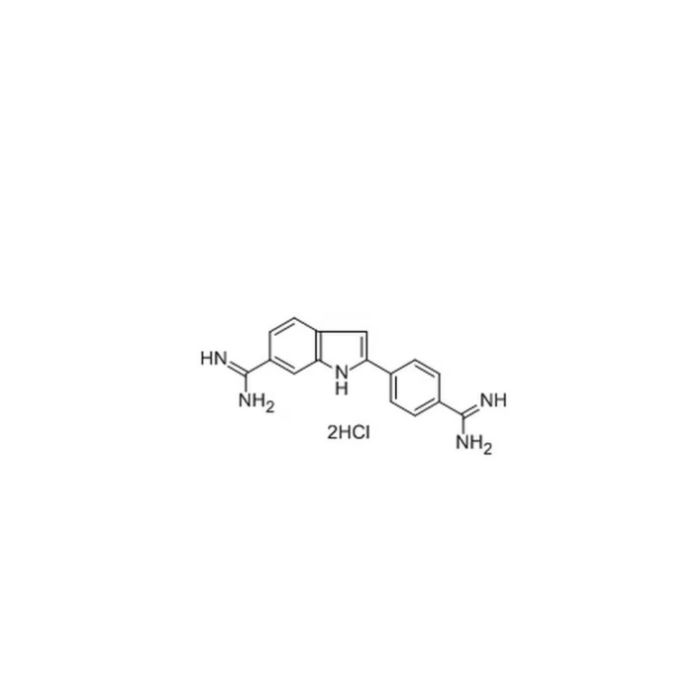
DAPI staining solution (ready to use) , CAS No.28718-90-3
DISPONIBLE À COMMANDE
Storage
Protected from light,Store at -20°C
Shipped In
Ice chest + Ice pads

for sensitive chromatographic and analytical workflows requiring minimal baseline interference.
Protected from light,Store at -20°C Ships Ice chest + Ice pads Check lot-specific COA for exact specifications.
SDS, COA, datasheet, and spec sheet available for download. Lot-specific COA accessible via lot number lookup.
Cited in 271 peer-reviewed publications across chromatography, organic synthesis, and cross-coupling reactions.
Product introduction:
DAPI is a nuclear staining reagent that can stain DNA. It releases blfluorescence after embedding double stranded DNA, and the brightness is enhanced about 20 times. DAPI is often used for apoptosis detection, and it is observed by fluorescence microscope or detected by flow cytometry after staining. DAPI has a high photobleaching tolerance and can be used to detect yeast mitochondrial DNA, chloroplast DNA, viral DNA and stained DNA. Take adherent cells (96 well plate) as an example, 100 per well μ L staining working solution, 10 ml can be used for the staining of 100 wells.
Product parameters:
Ex/em (bound DNA) =360/460 nmcas No.: 28718-90-3 molecular weight: 350.3 molecular formula: c16h17cl2n5
Matters needing attention:
1. please centrifuge the product to the bottom of the tube immediately before use, and then conduct subsequent experiments. 2. the concentration of this dyeing solution is optimized to meet the needs of various conventional dyeing. If you need to adjust the concentration, please select D489987 or D106471 ,and configure the appropriate working fluid concentration by yourself. 3. DAPI is harmful to human body. Please wear experimental clothes and disposable gloves for operation, and pay attention to proper protection. 4. fluorescent dyes have quenching problems. Please try to avoid light to slow down quenching.
Scope of application:
Nuclear staining
Instruction:
For cell or tissue samples, after fixation, appropriate washing to remove the fixative. If immunofluorescence staining is performed, DAPI staining is performed after staining. If no other staining is required, subsequent DAPI staining is performed directly.
1.For adherent cells ( remove the medium in the orifice plate ) or tissue sections, add a small amount of DAPI staining solution and cover the sample. For suspension cells, at least 3 times the volume of the sample to be stained was added and mixed.
2.Cells were cultured at room temperature for 10-20 min.
3.The cells were washed twice with PBS or appropriate buffer, 3-5 min each time, and 50 μL PBS was added after washing to prevent the cells from drying out.
4.Cells were observed under a fluorescence microscope with a filter with 360 nm excitation wavelength and 460 nm emission wavelength.
Comprehensive hazard, handling, storage, and regulatory compliance document.
Download SDS →Lot-specific quality data. Enter your lot number to retrieve the exact COA.
Look up COA →Full quality attributes and acceptance criteria for this grade.
View spec sheet →Taxonomy Tree
| Kingdom | Organic compounds |
|---|---|
| Superclass | Organoheterocyclic compounds |
| Classe | Indoles and derivatives |
| Subclass | Indoles |
| Intermediate Tree Nodes | Not available |
| Direct Parent | 2-phenylindoles |
| Alternative Parents | Phenylpyrroles Benzene and substituted derivatives Heteroaromatic compounds Carboximidamides Carboxamidines Azacyclic compounds Organopnictogen compounds Hydrochlorides Hydrocarbon derivatives |
| Molecular Framework | Aromatic heteropolycyclic compounds |
| Substituents | 2-phenylindole - 2-phenylpyrrole - Monocyclic benzene moiety - Substituted pyrrole - Benzenoid - Pyrrole - Heteroaromatic compound - Amidine - Carboxylic acid amidine - Azacycle - Carboximidamide - Organopnictogen compound - Organonitrogen compound - Hydrocarbon derivative - Organic nitrogen compound - Hydrochloride - Aromatic heteropolycyclic compound |
| Description | This compound belongs to the class of organic compounds known as 2-phenylindoles. These are indoles substituted at the 2-position with a phenyl group. |
| External Descriptors | Not available |
Find and download the COA for your product by matching the lot number on the packaging.
| Lot Number | Certificate Type | Date | Article |
|---|---|---|---|
 C2613463 | Certificate of Analysis | Mar 05, 2026 | D598342 |
| G2531413 | Certificate of Analysis | Jul 15, 2025 | D598342 |
| B2512130 | Certificate of Analysis | Feb 07, 2025 | D598342 |
| B2512131 | Certificate of Analysis | Feb 07, 2025 | D598342 |
| K2422103 | Certificate of Analysis | Oct 25, 2024 | D598342 |
| G2415125 | Certificate of Analysis | Jun 20, 2024 | D598342 |
| D2412505 | Certificate of Analysis | Mar 29, 2024 | D598342 |
| D2412508 | Certificate of Analysis | Mar 29, 2024 | D598342 |
| L2319293 | Certificate of Analysis | Dec 06, 2023 | D598342 |
| J2320245 | Certificate of Analysis | Oct 13, 2023 | D598342 |
| Poids moléculaire | 350.200 g/mol |
|---|---|
| XLogP3 | |
| Hydrogen Bond Donor Count | 7 |
| Hydrogen Bond Acceptor Count | 2 |
| Rotatable Bond Count | 3 |
| Exact Mass | 349.086 Da |
| Monoisotopic Mass | 349.086 Da |
| Topological Polar Surface Area | 116.000 Ų |
| Heavy Atom Count | 23 |
| Formal Charge | 0 |
| Complexity | 413.000 |
| Isotope Atom Count | 0 |
| Defined Atom Stereocenter Count | 0 |
| Undefined Atom Stereocenter Count | 0 |
| Defined Bond Stereocenter Count | 0 |
| Undefined Bond Stereocenter Count | 0 |
| The total count of all stereochemical bonds | 0 |
| Covalently-Bonded Unit Count | 3 |