Determine the necessary mass, volume, or concentration for preparing a solution.
≥95%(T) for sensitive chromatographic and analytical workflows requiring minimal baseline interference.
Room temperature,Argon charged Ships Normal Check lot-specific COA for exact specifications.
SDS, COA, datasheet, and spec sheet available for download. Lot-specific COA accessible via lot number lookup.
Cited in 10 peer-reviewed publications across chromatography, organic synthesis, and cross-coupling reactions.
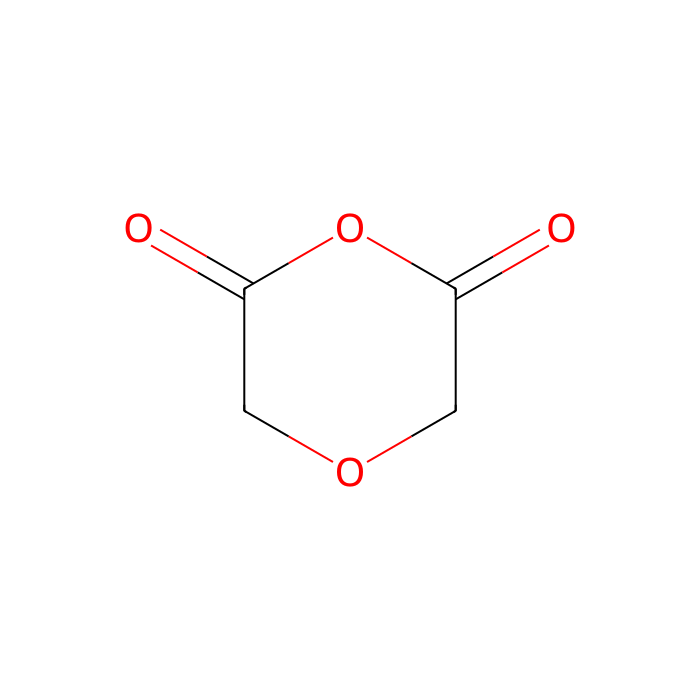
Diglycolic anhydride (DGA), derived from diglycolic acid, is known for its ability to synthesize polyesters and polyamides. Its low molecular weight and high reactivity due to its hydroxyl and amine groups make it suitable as an intermediate in polymer production. It promotes the formation of crosslinked networks and enhances the mechanical properties of polymers.
Application
Diglycolic anhydride can be used:
As a raw material for the synthesis of bio-based polyesters and polyesteramides, imparting excellent thermal stability and good solubility in organic solvents.
Functionalized modification of polyethylene terephthalate (PET) nanofibers for rare earth element recovery. In aqueous rare earth element ion recovery, diglycolic anhydride exhibits rapid binding kinetics and high selectivity, enhancing metal adsorption.
As a precursor for the preparation of biodegradable polyester network coatings for preventing biofouling on medical device surfaces.
Comprehensive hazard, handling, storage, and regulatory compliance document.
Download SDS →Lot-specific quality data. Enter your lot number to retrieve the exact COA.
Look up COA →Full quality attributes and acceptance criteria for this grade.
View spec sheet →Taxonomy Tree
| Kingdom | Organic compounds |
|---|---|
| Superclass | Organoheterocyclic compounds |
| Classe | Dioxanes |
| Subclass | 1,4-dioxanes |
| Intermediate Tree Nodes | Not available |
| Direct Parent | 1,4-dioxanes |
| Alternative Parents | Dicarboxylic acids and derivatives Carboxylic acid anhydrides Oxacyclic compounds Dialkyl ethers Organic oxides Hydrocarbon derivatives Carbonyl compounds |
| Molecular Framework | Aliphatic heteromonocyclic compounds |
| Substituents | Dicarboxylic acid or derivatives - Para-dioxane - Carboxylic acid anhydride - Oxacycle - Ether - Dialkyl ether - Carboxylic acid derivative - Organic oxygen compound - Organic oxide - Hydrocarbon derivative - Organooxygen compound - Carbonyl group - Aliphatic heteromonocyclic compound |
| Description | This compound belongs to the class of organic compounds known as 1,4-dioxanes. These are organic compounds containing 1,4-dioxane, an aliphatic six-member ring with two oxygen atoms in ring positions 1 and 4. |
| External Descriptors | Not available |
Find and download the COA for your product by matching the lot number on the packaging.
| Lot Number | Certificate Type | Date | Article |
|---|---|---|---|
| Certificate of Analysis | May 05, 2026 | D154432 | |
| Certificate of Analysis | May 05, 2026 | D154432 | |
| Certificate of Analysis | May 05, 2026 | D154432 | |
| Certificate of Analysis | May 05, 2026 | D154432 | |
| Certificate of Analysis | Dec 09, 2025 | D154432 | |
| Certificate of Analysis | Dec 09, 2025 | D154432 | |
| Certificate of Analysis | Oct 22, 2025 | D154432 | |
| Certificate of Analysis | Oct 21, 2025 | D154432 | |
| Certificate of Analysis | Oct 21, 2025 | D154432 | |
| Certificate of Analysis | Oct 21, 2025 | D154432 | |
| Certificate of Analysis | Jun 09, 2025 | D154432 | |
| Certificate of Analysis | Apr 03, 2025 | D154432 | |
| Certificate of Analysis | Apr 03, 2025 | D154432 | |
| Certificate of Analysis | Dec 04, 2023 | D154432 | |
| Certificate of Analysis | Dec 04, 2023 | D154432 | |
| Certificate of Analysis | Dec 04, 2023 | D154432 | |
| Certificate of Analysis | Dec 04, 2023 | D154432 | |
| Certificate of Analysis | Dec 04, 2023 | D154432 | |
| Certificate of Analysis | Dec 04, 2023 | D154432 | |
| Certificate of Analysis | Feb 25, 2023 | D154432 | |
| Certificate of Analysis | Feb 25, 2023 | D154432 | |
| Certificate of Analysis | Feb 25, 2023 | D154432 | |
| Certificate of Analysis | Feb 25, 2023 | D154432 | |
| Certificate of Analysis | Feb 25, 2023 | D154432 | |
| Certificate of Analysis | Feb 25, 2023 | D154432 | |
| Certificate of Analysis | Feb 25, 2023 | D154432 | |
| Certificate of Analysis | Dec 07, 2022 | D154432 | |
| Certificate of Analysis | Mar 02, 2022 | D154432 | |
| Certificate of Analysis | Mar 02, 2022 | D154432 |
| Sensibilité | Moisture sensitive |
|---|---|
| Point d'ébullition (°C) | 130°C |
| Point de fusion (°C) | 94-98°C |
| Poids moléculaire | 116.070 g/mol |
| XLogP3 | -0.400 |
| Hydrogen Bond Donor Count | 0 |
| Hydrogen Bond Acceptor Count | 4 |
| Rotatable Bond Count | 0 |
| Exact Mass | 116.011 Da |
| Monoisotopic Mass | 116.011 Da |
| Topological Polar Surface Area | 52.600 Ų |
| Heavy Atom Count | 8 |
| Formal Charge | 0 |
| Complexity | 114.000 |
| Isotope Atom Count | 0 |
| Defined Atom Stereocenter Count | 0 |
| Undefined Atom Stereocenter Count | 0 |
| Defined Bond Stereocenter Count | 0 |
| Undefined Bond Stereocenter Count | 0 |
| The total count of all stereochemical bonds | 0 |
| Covalently-Bonded Unit Count | 1 |