Determine the necessary mass, volume, or concentration for preparing a solution.
≥98%,≥99 atom% D for sensitive chromatographic and analytical workflows requiring minimal baseline interference.
Store at 2-8°C,Protected from light,Desiccated Ships Wet ice Check lot-specific COA for exact specifications.
SDS, COA, datasheet, and spec sheet available for download. Lot-specific COA accessible via lot number lookup.
Cited in 0 peer-reviewed publications across chromatography, organic synthesis, and cross-coupling reactions.
Comprehensive hazard, handling, storage, and regulatory compliance document.
Download SDS →Lot-specific quality data. Enter your lot number to retrieve the exact COA.
Look up COA →Full quality attributes and acceptance criteria for this grade.
View spec sheet →Taxonomy Tree
| Kingdom | Organic compounds |
|---|---|
| Superclass | Organic acids and derivatives |
| Classe | Organic carbonic acids and derivatives |
| Subclass | Carbonic acid diesters |
| Intermediate Tree Nodes | Not available |
| Direct Parent | Carbonic acid diesters |
| Alternative Parents | Organic oxides Hydrocarbon derivatives Carbonyl compounds |
| Molecular Framework | Aliphatic acyclic compounds |
| Substituents | Carbonic acid diester - Organic oxygen compound - Organic oxide - Hydrocarbon derivative - Organooxygen compound - Carbonyl group - Aliphatic acyclic compound |
| Description | This compound belongs to the class of organic compounds known as carbonic acid diesters. These are compounds comprising the carbonic acid diester functional group. |
| External Descriptors | Not available |
| Point d'éclair (°F) | 60.8 °F |
|---|---|
| Point d'éclair (°C) | 16 °C |
| Point d'ébullition (°C) | 90 °C |
| Point de fusion (°C) | 2-4 °C |
| Poids moléculaire | 96.110 g/mol |
| XLogP3 | 0.500 |
| Hydrogen Bond Donor Count | 0 |
| Hydrogen Bond Acceptor Count | 3 |
| Rotatable Bond Count | 2 |
| Exact Mass | 96.0694 Da |
| Monoisotopic Mass | 96.0694 Da |
| Topological Polar Surface Area | 35.500 Ų |
| Heavy Atom Count | 6 |
| Formal Charge | 0 |
| Complexity | 44.000 |
| Isotope Atom Count | 6 |
| Defined Atom Stereocenter Count | 0 |
| Undefined Atom Stereocenter Count | 0 |
| Defined Bond Stereocenter Count | 0 |
| Undefined Bond Stereocenter Count | 0 |
| The total count of all stereochemical bonds | 0 |
| Covalently-Bonded Unit Count | 1 |
No antibody/assay protocols are associated with this reagent. For synthetic use, see Reaction Conditions and Synthetic Utility for literature‑based procedures and optimization tips.
Analytical suggestions (general):
Always consult the product’s SDS and CoA for handling and quality details specific to this item.
This product is a small organic carbonate used for chemical synthesis and analytical labeling. No endogenous biological role is associated with dimethyl carbonate or its deuterated analog.
Relevant notes (general/literature):
Compliance note: This product is designated “For research use only” (per Product Data). It is not intended for diagnostic, therapeutic, or clinical applications.
If using labeled standards in bioanalytical workflows, verify isotopic purity, absence of exchangeable deuterium in the targeted moiety under assay conditions, and lack of interfering impurities. Validate stability in sample preparation steps (e.g., pH, temperature, and solvent exposure) to avoid back‑exchange or hydrolysis of carbonate/ether linkages.
Dimethyl‑d6 carbonate is not a buffering agent and is not typically used to formulate aqueous biological buffers. It lacks acid/base functionality in the physiological pH range and exhibits only limited water miscibility.
Practical guidance:
Refer to other sections (Reaction & Applications; Synthetic Utility) for relevant, non‑buffer uses of this reagent.
Dimethyl carbonate is widely cited as a green reagent/solvent relative to traditional alkylating agents and chlorinated solvents. The deuterated isotopologue retains these advantages for isotopic labeling campaigns. Literature comparison (qualitative):
Compact comparison (literature):
Greener process suggestions:
No pharmacopeial status or excipient designation is specified for this item. Dimethyl‑d6 carbonate is supplied for research use only.
General, non‑clinical context (literature/industry practice):
Caveats:
Always verify suitability with internal quality systems; this product is not intended for clinical or GMP use unless specifically qualified.
Item-specific measured specifications are not provided in the Product Data. The following values are typical for dimethyl carbonate and are expected to be essentially similar for dimethyl‑d6 carbonate (isotopic substitution minimally affects bulk properties). All values are literature/typical unless noted; consult the item’s CoA/SDS for authoritative data.
Notes for deuterated material:
Interpretation and guidance (general):
Recommendation: For quantitative isotopic labeling or analytical internal standards, request the latest CoA/Spec Sheet to align isotopic enrichment and impurity profile with your application’s acceptance criteria.
Dimethyl‑d6 carbonate serves as a dual‑role reagent: a solvent and a benign methylating/carbonylating agent that transfers trideuteriomethyl groups (–OCD3) under suitable conditions. The following are literature applications, expected to translate directly to the deuterated isotopologue:
Practical notes: Remove water rigorously (molecular sieves, distillation); control basicity to bias O‑ vs N‑alkylation; consider sealed‑tube/pressure setups for CO2‑releasing variants; verify deuterium incorporation by 1H/2H NMR and MS.
The following are representative, literature‑based conditions for dimethyl carbonate chemistry that apply analogously to dimethyl‑d6 carbonate. Optimize per substrate and verify deuterium incorporation.
General advice:
GHS classification, signal word, and H‑statements are not specified for this item in the Product Data. Always consult the SDS for authoritative hazard and precautionary information.
General safety considerations for carbonate solvents (literature/good practice):
Storage per Product Data: Store at 2–8 °C, protected from light, desiccated. Ship on wet ice.
Dimethyl‑d6 carbonate (DMC‑d6) functions both as a polar aprotic solvent and as a deuterated methyl/carbonylating reagent. Selection guidance (general literature values for DMC):
Note: For moisture‑sensitive work, dry over molecular sieves and maintain desiccated storage as per Product Data.
Note: Appearance, grade/purity, and additional specifications are not specified for this item; consult the lot‑specific CoA/Spec Sheet for details.
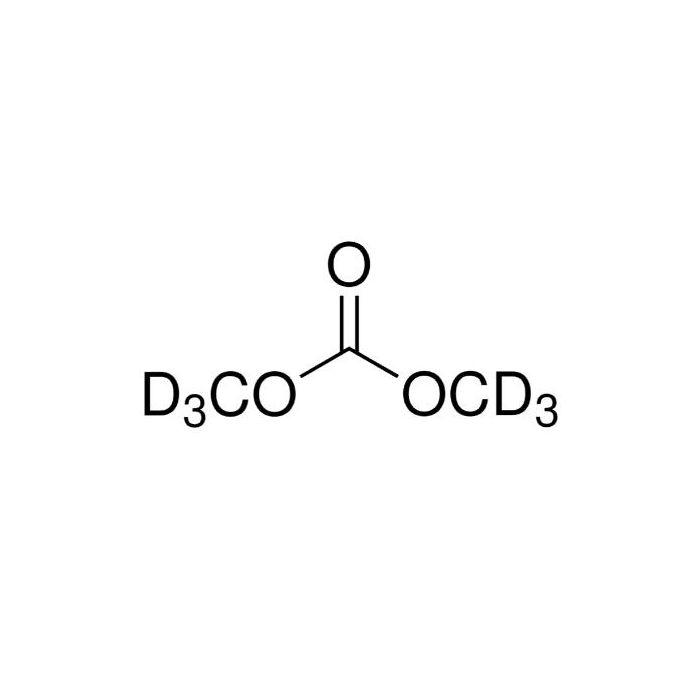
Dimethyl‑d6 carbonate is the fully deuterated isotopologue of dimethyl carbonate, featuring two trideuteriomethoxy groups bound to a central carbonyl carbon via carbonate linkages.
Structural features (general description):
2D structure in words (general): A central carbonyl carbon double‑bonded to one oxygen and single‑bonded to two alkoxy oxygens. Each alkoxy oxygen is bound to a CD3 group (three deuteriums attached to a methyl carbon). The molecule is symmetric about the carbonyl carbon, giving two equivalent trideuteriomethoxy termini.
Functional profile: Dimethyl‑d6 carbonate is a symmetric dialkyl carbonate capable of acting as a source of trideuteriomethyl (–CD3) and carbonyl (–CO2–) fragments. Its reactivity is governed by ambident electrophilicity at the methyl carbons (SN2) and at the carbonyl carbon (acyl substitution/transcarbonylation).
Key transformations (literature):
Strategic uses:
Operational tips:
Not applicable. This product is a small‑molecule carbonate reagent/solvent and is not a biological targeting agent, antibody, or probe. No target, epitope, clone, isotype, or species reactivity data are associated with this item.