This compound belongs to the class of organic compounds known as alpha amino acid esters. These are ester derivatives of alpha amino acids.
External Descriptors
Not available
1. Djoumbou Feunang Y, Eisner R, Knox C, Chepelev L, Hastings J, Owen G, Fahy E, Steinbeck C, Subramanian S, Bolton E, Greiner R, and Wishart DS. ClassyFire: Automated Chemical Classification With A Comprehensive, Computable Taxonomy. Journal of Cheminformatics, 2016, 8:61.
Determine the necessary mass, volume, or concentration for preparing a solution.
Dilution Calculator
Determine the dilution needed to prepare a stock solution.
Reconstitution Calculator
Avis
Avis des clients
Application Protocols
Not applicable. No immunoassay or bioassay protocols (e.g., WB, IHC, IF, FC) are associated with this small-molecule building block. For synthetic protocols relevant to this item, see the Reaction Conditions, Synthetic Utility, and Reaction & Applications sections.
Biological Roles
Scope note: The product is intended for research use only. The following describes general biochemical context of the pyroglutamate motif; it does not imply biological activity of this particular methyl ester in vivo.
Pyroglutamate is formed by intramolecular cyclization of N‑terminal glutamine or glutamate residues in peptides/proteins, impacting stability and recognition. Enzymes such as glutaminyl cyclase catalyze this conversion.
5‑Oxoproline is an intermediate in the γ‑glutamyl cycle (glutathione metabolism), interconverted with L‑glutamate by 5‑oxoprolinase.
As a structural motif, pyroglutamate can modulate peptide conformation and resistance to aminopeptidases.
Relevance of the methyl ester derivative (general):
The methyl ester increases lipophilicity and reduces acidity versus the free acid, often used as a protecting/transport form in chemical biology experiments and as a pro-moiety in synthetic analogs.
In aqueous/physiological conditions, esters may hydrolyze to the free acid, but the rate depends strongly on pH, enzymes, and substituents; no specific rates for this compound are provided here.
Practical takeaway:
Use DL‑pyroglutamic acid methyl ester as a chemical tool or intermediate to assemble pyroglutamyl-containing constructs for biochemical assays or probe synthesis; do not infer biological efficacy or safety from this description.
Buffer Applications
This compound is not a conventional buffering agent. It lacks a suitable conjugate acid/base pair within a narrow pKa window for practical laboratory buffering. For protocols requiring buffers, select established systems such as phosphate, HEPES, MOPS, or acetate. If the compound is present in buffered media (e.g., for hydrolysis or aminolysis studies), choose buffer components and pH to minimize ester hydrolysis unless hydrolysis is the objective.
Green Alternatives
Context: As a mid‑polarity lactam ester building block, the principal environmental footprint usually stems from solvent choice and coupling reagents rather than the substrate itself.
Greener solvent swaps (literature/general):
Replace DCM/CHCl3 with EtOAc, 2‑MeTHF, or CPME where solubility permits.
Favor MeCN or EtOAc over DMF/DMSO in aminolysis when feasible; MeCN is easier to remove and has a preferable EHS profile than DMF.
For chromatography, use heptane in place of hexane and EtOAc/IPA as polar modifiers.
Coupling reagent considerations:
EDC·HCl with catalytic DMAP and benign buffers can reduce urea waste compared to DCC; water‑soluble carbodiimides simplify workup.
Enzymatic or organocatalytic ester/amide formations (where compatible) can reduce hazardous waste, though compatibility with lactams must be validated.
Comparison snapshot (general):
DCM vs EtOAc: EtOAc has lower toxicity and better biodegradability; may require slightly higher volumes for equivalent solvency.
DMF vs MeCN: MeCN is more volatile/easier to remove; DMF provides superior solvation but is more problematic from an EHS standpoint.
Operational tips:
Employ solvent recovery for MeCN/EtOAc.
Minimize excess amines and use solid-supported scavengers to curb aqueous waste in aminolysis workups.
Pharmaceutical Uses
Scope: For research use only. No therapeutic or clinical claims are made.
General formulation/manufacturing context (literature/practice):
DL‑Pyroglutamic acid methyl ester can serve as an intermediate in the preparation of peptidomimetics and small molecules incorporating the pyroglutamyl motif.
The methyl ester can be used as a protecting group variant for the carboxylate during multistep synthesis, with final deprotection via hydrolysis under controlled conditions.
Racemic (DL) material is typically used when chirality at C‑2 is inconsequential or when resolution occurs at a later stage; for chiral drug intermediates, enantioenriched L‑ or D‑isomers are preferred and controlled by chiral synthesis or resolution.
Regulatory/compendial status: Not specified for this item; consult pharmacopeial monographs if an enantiopure or specific salt/hydrate form is contemplated in a regulated context.
Physical Properties
Item-specific (Product Data) specifications:
Appearance: Not specified for this item; refer to CoA/Spec Sheet.
Molecular formula: Not specified for this item; refer to CoA/Spec Sheet.
Molecular weight: Not specified for this item; refer to CoA/Spec Sheet.
Literature/general data (for reference; not item specifications):
Typical molecular formula: C6H9NO3 (methyl ester of 5‑oxoproline)
Approx. molecular weight: ~143.14 g/mol
Polarity: moderately polar due to one lactam C=O and one ester C=O; hydrogen-bond acceptor (2), weak donor via lactam NH
Solubility profile (qualitative):
Good solubility in polar organic solvents (MeOH, EtOH, MeCN), chlorinated solvents (DCM, CHCl3), and moderately in EtOAc
Limited solubility in nonpolar hydrocarbons (hexanes)
Partial solubility in water expected for DL methyl ester is low-to-moderate relative to the free acid
Volatility: low; typically a low-melting solid or viscous oil depending on lot/crystallinity (varies in literature)
Partitioning: logP is expected to be near neutral to slightly positive due to esterification, but reduced by the lactam (literature qualitative assessment)
Practical notes:
Hygroscopicity/hydrolytic sensitivity: the ester can undergo slow hydrolysis under moisture/acid/base; keep dry
Refractive index, melting/boiling points, density, UV cutoff: Not specified for this item; consult literature or CoA/SDS if required for method development.
Quality and Grades
Item-specific (Product Data):
Grade/Purity: Not specified for this item; refer to CoA/Spec Sheet.
General guidance on quality considerations for this molecule type:
Typical quality offerings for amino acid derivatives and lactam esters include: synthetic grade for general synthesis, ≥95–99% purity for building block use, and specialized low-water/low-residual-solvent grades when used in moisture‑sensitive couplings.
Purity implications: trace water and acids/bases can catalyze ester hydrolysis to the free acid; headspace inerting and low moisture are beneficial for long shelf-life.
Residual solvent/volatiles: for peptide-coupling applications, low residual protic solvents (e.g., MeOH) is preferred to avoid transesterification or premature aminolysis.
Optical quality: this listing is DL (racemic). If enantioselective synthesis is required, source the L- or D- enantiomer with defined ee and document via chiral HPLC.
Documentation: request and review the CoA/Spec Sheet for assay method (e.g., HPLC), impurity profile, water content (Karl Fischer), and any stabilizers if present.
Stabilizers: none are indicated in Product Data; if present, they would be listed on the CoA. Absence/presence of stabilizers can affect reactivity in coupling reactions.
Reaction and Applications
Functional profile:
Bifunctional building block bearing a lactam (poorly nucleophilic N, stable amide C=O) and an activated methyl ester (electrophilic carbonyl). Useful in preparing N‑acylated pyroglutamates, converting to amides via aminolysis, or hydrolyzing back to DL‑pyroglutamic acid under controlled conditions.
Common synthetic uses (literature/practice):
Aminolysis to amides: reaction with amines (aliphatic or anilines) in MeCN, THF, or DCM with base (e.g., Et3N, DIPEA) or catalysts (DMAP) to afford pyroglutamamide derivatives.
Hydrolysis: acid- or base-catalyzed hydrolysis to regenerate DL‑pyroglutamic acid; buffered conditions help control racemization.
Coupling chemistry: convert to corresponding acid (or activate in situ) for peptide-coupling steps involving the pyroglutamyl unit; common reagents: EDC·HCl/HOBt, HATU, or DCC.
N‑Acylation: the lactam nitrogen can be acylated under strong conditions (e.g., acid chlorides with base) to yield N‑acyl pyroglutamate derivatives used as protecting/modulating groups in peptide synthesis.
Ring transformations: strong nucleophiles (e.g., methoxide, amines) under forcing conditions can open the lactam to glutamate derivatives, enabling entry to protected glutamic acid scaffolds.
Applications in research/manufacturing:
Precursor for N‑terminal pyroglutamyl motifs in peptides/proteins (post-synthetic introduction on small molecules/peptidomimetics)
Intermediate toward GSH-cycle probes and 5‑oxoproline derivatives used in enzymology studies
Chiral pool access (if using enantiopure material) to constrained γ‑lactam building blocks.
Practical tips:
Control pH and temperature to minimize racemization at C‑2 during transformations.
Use anhydrous conditions to avoid premature ester hydrolysis; inert atmosphere handling aligns with the product’s argon storage recommendation.
Reaction Conditions
General, literature-style guidance (optimize per substrate and scale):
Aminolysis to amides:
Solvent: MeCN, THF, or DCM
Reagents: amine (1.2–3.0 equiv), base (Et3N or DIPEA, 1.0–2.0 equiv), catalytic DMAP (0.05–0.2 equiv) optional
Temperature/time: 20–60 °C, 2–16 h; less reactive anilines may require reflux
Workup: dilute with DCM/EtOAc, wash with dilute acid/base as appropriate, dry, and concentrate; silica gel purification with 0.1–1% Et3N
Hydrolysis to DL‑pyroglutamic acid:
Acidic: MeOH/H2O with 0.5–1.0 M HCl, 0–25 °C to reflux, 1–6 h
Basic: THF/H2O with Na2CO3/NaOH (0.5–1.0 M), 0–25 °C to 50 °C, 1–4 h; neutralization and extraction required
Note: control pH and temperature to limit racemization at C‑2
N‑Acylation (lactam N):
Base: NaH or K2CO3 in DMF/THF; electrophile: acyl chloride or alkyl halide (1.1–1.5 equiv)
Temperature: 0 °C to rt for acylation; 0–50 °C for alkylation depending on reactivity
Coupling after hydrolysis (to incorporate pyroglutamate):
Reagents: EDC·HCl/HOBt or HATU with DIPEA in DMF/MeCN
Conditions: 0 °C to rt, 1–12 h; monitor by LC/MS or TLC
Expected outcomes (typical literature):
Aminolysis and hydrolysis often provide good to excellent yields (60–90%) under optimized conditions; actual yields vary with substrate and scale.
These are general guidelines; adjust stoichiometry and conditions based on reaction monitoring and specific substrate behavior.
Safety and Handling
Item-specific (Product Data) hazard fields:
Signal Word: Not specified for this item; refer to SDS.
H-Statements: Not specified for this item; refer to SDS.
GHS Classification: Not specified for this item; refer to SDS.
Pictograms: Not specified for this item; refer to SDS.
General safety guidance (literature/practice; defer to SDS for authoritative data):
Likely hazards: organic amide/ester; may cause irritation to skin, eyes, or respiratory tract on contact or inhalation of dust/aerosols
PPE: lab coat, safety glasses, appropriate gloves (e.g., nitrile); handle powders/solids in a fume hood to avoid dust inhalation
First aid overview: rinse skin/eyes with water for several minutes if contacted; move to fresh air if inhaled; seek medical attention if symptoms persist (follow SDS)
Fire safety: treat as a combustible organic; use CO2, dry chemical, or foam; avoid water jets that may spread material
Spills: contain and collect solids with inert absorbent; avoid generating dust; dispose per institutional and local regulations
Special risks/notes:
Hydrolysis sensitivity: ester functionality can hydrolyze; maintain dry, inert conditions during long-term storage and handling
Not a known peroxide former; no special peroxide precautions required.
Always consult the product SDS for full and current hazard classifications and response measures.
Solvent Selection
Polarity class and miscibility (literature/general):
Moderately polar, neutral compound; soluble in MeOH, EtOH, i-PrOH, MeCN, acetone, DCM, CHCl3, and EtOAc; limited in alkanes. Water solubility is reduced versus the free acid but may be appreciable due to the lactam.
Choosing solvents by operation:
Reaction medium: for aminolysis or coupling at the ester carbonyl, use polar aprotic solvents (MeCN, DMF, DCM) to enhance nucleophilicity of amines; add base or coupling agents as appropriate.
Crystallization: EtOAc/hexanes or EtOAc/toluene can be effective antisolvent systems if the product is a crystalline solid; adjust based on small-scale solubility tests.
Chromatography: normal-phase silica with EtOAc/hexanes or DCM/MeOH gradients; the lactam can cause tailing—add 0.1–1% Et3N to suppress adsorption if needed.
Comparison to alternatives:
Methanol/ethanol: maximize solubility but may promote transesterification or background hydrolysis under acidic/basic conditions.
DCM/EtOAc: good balance of solubility and mildness; commonly used for workups and purifications.
DMF/DMSO: strong solubilizers for polar intermediates; ensure thorough removal due to high boiling points.
Practical notes:
Avoid prolonged exposure to aqueous media during workup; quench reactions quickly and extract into organics to limit hydrolysis of the ester.
For moisture-sensitive steps, dry solvents and work under argon or nitrogen (consistent with product’s inert storage recommendation).
Keep tightly closed under inert gas (argon or nitrogen) to limit moisture and oxygen exposure, which can promote ester hydrolysis or slow degradation.
Store in a desiccated environment; avoid prolonged exposure to humid air.
Protect from strong light and heat; room temperature is acceptable per Product Data, but cooler storage (e.g., 2–8 °C) can further limit hydrolysis for long-term keeping if allowed by your workflow.
Use clean, dry tools; recap promptly after dispensing. If repeated access is expected, consider aliquoting under inert atmosphere.
Reconstitution/dispensing:
The product typically dissolves readily in polar organics (MeOH, EtOH, MeCN, DCM, EtOAc). Use anhydrous solvents when preparing stock solutions.
For aqueous work, prepare solutions immediately before use to minimize hydrolysis; adjust pH to neutral where possible.
Stability notes:
Avoid contact with strong acids/bases unless hydrolysis or transesterification is intended.
Monitor for appearance changes or new impurities by HPLC/LC–MS over time if stored for extended periods.
Research use note: For research use only.
Structure and Identity
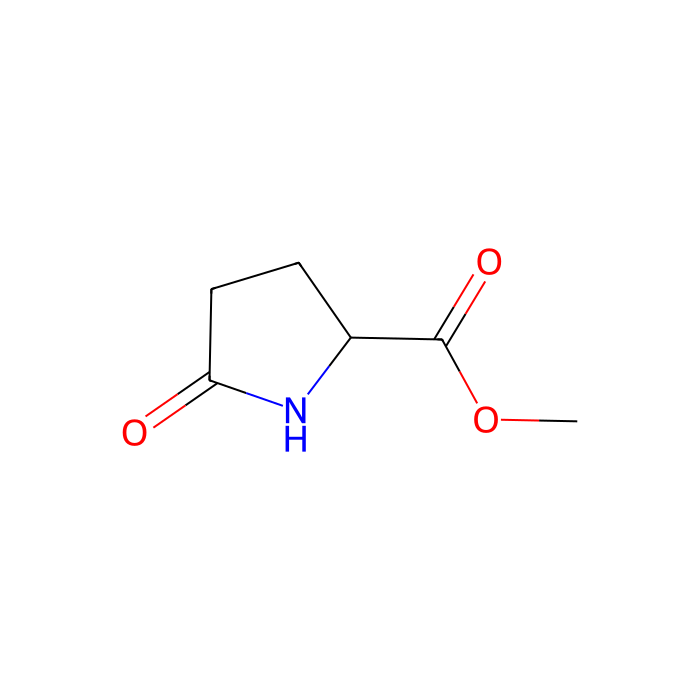
Brief overview: DL-Pyroglutamic Acid Methyl Ester is the racemic methyl ester of 5-oxoproline (pyroglutamic acid), featuring a five-membered lactam (2-pyrrolidone) ring bearing a methyl ester at the 2-carboxyl position.
Stereochemistry: single stereocenter at C-2 of the ring; DL product indicates racemic mixture
2D description: a 2-pyrrolidone ring bearing at C-2 a carboxyl function esterified as a methyl ester; the ring carbonyl at C-5 (lactam) and side-chain ester carbonyl render the molecule bifunctional and moderately polar.
Synthetic Utility
Key reactive sites:
Ester carbonyl: electrophilic center for nucleophilic acyl substitution (aminolysis to amides, alcoholysis/transesterification, hydrolysis to acid).
Lactam nitrogen: relatively non-nucleophilic; can be acylated or alkylated under forcing/basic conditions to tailor electronic and steric properties.
Transformations (literature/practice):
Aminolysis: primary/secondary amines (1.0–2.0 equiv) with base (Et3N/DIPEA) ± catalytic DMAP in MeCN/THF give amides in good yields; heat may be required for less reactive anilines.
Hydrolysis/deprotection: aqueous MeOH or THF/H2O with catalytic acid (HCl, TsOH) or base (Na2CO3/NaOH) to revert to DL‑pyroglutamic acid; buffered workups minimize racemization.
N‑Acylation/alkylation: NaH or strong base to deprotonate the lactam N, followed by alkyl halides or acyl chlorides for N‑substituted derivatives.
Ring opening: with strong nucleophiles (e.g., methoxide, amines) under elevated temperature to access protected glutamate derivatives.
Couplings: after hydrolysis to the acid, standard peptide coupling (EDC/HOBt, HATU, DCC) introduces the pyroglutamyl unit into peptides or peptidomimetics.
Retrosynthetic value:
Useful as a masked glutamate synthon; lactam constrains conformation and can act as a temporary protecting group influencing downstream selectivity.
Practical notes:
Monitor stereochemical integrity at C‑2; minimize strong base and high temperatures when chirality matters.
Maintain anhydrous conditions for transformations targeting the ester to avoid competitive hydrolysis.
Target Specificity
Not applicable. This product is a small-molecule chemical building block and is not an antibody, enzyme, or affinity reagent. No target, epitope, or species specificity data apply.
We use cookies to ensure the website functions properly and, where permitted, to improve your experience. You can manage your preferences at any time in Settings. Learn more in our Cookie Policy.
Shall we send you a message when we have discounts available?
Remind me later
Thank you! Please check your email inbox to confirm.
Products are supplied to verified businesses, institutions, and qualified professionals for research and development use only. Not for use in humans, animals, diagnosis, or therapy.

 C23151794