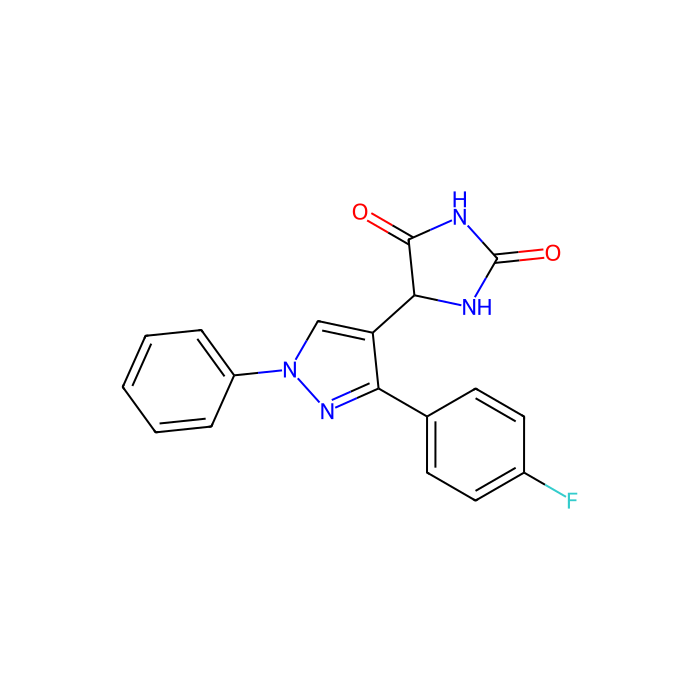
DPH binds and changes the conformation of the c-Abl tyrosine kinase myristoyl-binding site. Shows potent enzymatic and cellular activity that stimulates c-Abl activation.
DPH is a potent cell-permeable c-Abl activator. DPH binds to the myristoyl binding s
Conditions de stockage de stockage
Store at -20°C
Expédié en
Ice chest + Ice pads
Ce produit nécessite l'expédition en chaîne froide. Les services terrestres et autres services économiques ne sont pas disponibles.
This compound belongs to the class of organic compounds known as phenylpyrazoles. These are compounds containing a phenylpyrazole skeleton, which consists of a pyrazole bound to a phenyl group.
External Descriptors
Not available
1. Djoumbou Feunang Y, Eisner R, Knox C, Chepelev L, Hastings J, Owen G, Fahy E, Steinbeck C, Subramanian S, Bolton E, Greiner R, and Wishart DS. ClassyFire: Automated Chemical Classification With A Comprehensive, Computable Taxonomy. Journal of Cheminformatics, 2016, 8:61.
Determine the necessary mass, volume, or concentration for preparing a solution.
Dilution Calculator
Determine the dilution needed to prepare a stock solution.
Reconstitution Calculator
Avis
Avis des clients
Application Protocols
Item-specific facts (from Product Data)
No tested applications or protocols are provided for this item.
General protocols for small-molecule library usage (not item-specific)
Preparation of DMSO stock: Weigh compound quickly at room temperature, dissolve to 10–50 mM in anhydrous DMSO, vortex and, if needed, sonicate briefly. Filter through 0.2 µm PTFE if particulate persists and the compound is DMSO-stable.
Aliquoting: Dispense into low-bind, amber microvials or 96-well plates (where applicable) to desired volumes for single-use to minimize freeze–thaw.
Storage/use: Store aliquots at −20 °C. Thaw on ice or at ambient temperature briefly, use immediately, and re-freeze unopened aliquots. Avoid repeated temperature cycling.
Analytical check: Verify concentration by UV (if a known extinction coefficient is available) or by quantitative NMR/LC with internal standard. Confirm identity by LC-MS.
Assay dosing: Dilute into assay buffer maintaining acceptable vehicle (e.g., ≤0.1–1% DMSO). Include vehicle-only and positive-control wells as appropriate.
Biological Roles
No biological role, target class, or pathway information is provided for this specific item. Without a definitive structure, assigning endogenous roles or mechanistic biology would be speculative.
If the compound is to be used as a probe or modulator in biological assays, first confirm identity and purity (CoA), then consult the corresponding PubChem (CID 660311) or primary literature for any reported bioactivities. Validate activity in-house since library compounds may lack comprehensive pharmacology.
General best practices for biological testing (not item-specific):
Establish compound integrity by LC-MS before and after assays to monitor stability.
Assess solubility and aggregation propensity (e.g., DLS, detergent tests) to avoid assay interference.
Include orthogonal readouts and counter-screens to deconvolute mechanism-independent artifacts (redox cycling, fluorescence interference, colloidal aggregation).
Use appropriate vehicle controls (DMSO ≤0.1–1% v/v) and run concentration–response curves spanning at least 8–10 points with replicates.
Research use only: This product is intended strictly for laboratory research. No clinical, diagnostic, or therapeutic applications are supported or implied.
Buffer Applications
This product is a small-molecule library compound; it is not a buffering reagent. No pKa or buffering range data are provided, and no buffer system use is implied.
Practical note for assays: If the compound will be dosed into aqueous buffers, prepare concentrated DMSO stocks and dilute into standard assay buffers (e.g., PBS, HEPES, Tris) keeping final DMSO low (≤0.1–1% v/v). Adjust buffer composition (e.g., add 0.01–0.05% nonionic surfactant or 0.1% carrier protein) to mitigate nonspecific adsorption or precipitation as needed.
For electrophoresis or chromatography methods development, treat the compound as an analyte, not a buffer component; optimize mobile-phase pH and organic content based on compound pKa/logD once known from the CoA or database entry.
Green Alternatives
Context
Without the structure and intended use, green-chemistry substitutions can only be discussed at the workflow level (solvent and process choices), not at the molecule level.
Greener handling strategies (general)
Solution preparation: Favor aqueous buffers with minimal DMSO (≤1% v/v) for bioassays where feasible.
Solvent selection in synthesis/purification (if applicable): Prefer EtOAc, 2-MeTHF, CPME, MeOH, or IPA over chlorinated solvents where performance allows. Use heptane over hexane to reduce n-hexane exposure risks.
Energy efficiency: Store at −20 °C as required, but avoid excessive sub-ambient processing unless stability data necessitate it. Thaw only what you need; minimize freeze–thaw cycles via aliquoting.
Waste minimization: Micro-scale reaction screening and design-of-experiments can reduce solvent/consumable use before scale-up.
2-MeTHF vs THF: 2-MeTHF (biorenewable, higher boiling, water-immiscible) can simplify workups and reduce peroxide risks relative to THF; monitor for residual water.
EtOAc vs DCM: EtOAc is biodegradable and less persistent; may require larger volumes or altered gradients in chromatography to match DCM elution strength.
Note: Select alternatives based on performance data once the compound’s polarity and stability profile are known from the CoA.
Pharmaceutical Uses
No pharmacopeial status, excipient role, or formulation use is provided for this item. It is supplied for research use only and is not intended for human or veterinary administration.
If used in pre-formulation research (in vitro only), standard practices apply (general, not item-specific):
Determine solubility in biorelevant media and common excipient systems once the structure is known.
Evaluate stability versus pH, light, and oxidative conditions; conduct forced-degradation studies to identify degradation pathways.
For analytical control, develop stability-indicating LC methods with photodiode array and MS detection after confirming identity via CoA.
Do not reference clinical indications or make therapeutic claims; all work should remain at the laboratory research stage pending comprehensive safety/toxicology data that are not provided here.
Physical Properties
Item-specific facts (from Product Data)
Appearance: Not specified for this item; refer to CoA/Spec Sheet.
Molecular weight: Not specified for this item; refer to CoA/Spec Sheet.
Physical constants (literature/computed)
Because the structure is not provided, literature boiling point, melting point, density, refractive index, pKa, logP, solubility, and UV/Vis characteristics cannot be reported without risk of misassignment. Consult the CoA/SDS or the PubChem entry tied to CID 660311 for authoritative values.
Practical handling notes (general guidance for library solids)
Many screening compounds are supplied as crystalline solids or powders with variable hygroscopicity. If the supplied form is uncertain, open under dry air/nitrogen and promptly recap after aliquoting.
For initial solubility assessment, a typical approach is to prepare a 10–50 mM DMSO stock, vortex/sonicate gently, then dilute into assay buffer or organic media as needed. If precipitation occurs on aqueous dilution, increase co-solvent fraction (DMSO, ethanol, or acetonitrile) or warm to 30–40 °C with mixing.
If volatility is suspected (unknown), minimize exposure time of open vials and avoid elevated temperatures until the physical state is confirmed from the CoA.
Quality and Grades
Item-specific facts (from Product Data)
Grade/Purity: Not specified for this item; refer to CoA/Spec Sheet.
Guidance on grade interpretation (general)
For small-molecule library items, suppliers often specify a purity threshold (e.g., ≥95% by HPLC/LC-MS) suitable for screening and non-GLP discovery work. Absence of a listed purity in the Product Data means you should verify lot-specific purity and analytical method on the CoA.
If an inhibitor/ligand library standard: Purity is typically reported as area% by HPLC (UV) with orthogonal confirmation (MS); water/volatile content may be by Karl Fischer/LOD. Impurity profile and residual solvents should be consulted when planning sensitive biological assays.
Stabilizers/salt forms: If provided, these influence solubility and storage. None are specified here; confirm free base/acid vs salt on CoA.
What to request for QA documentation
CoA with: structure confirmation (NMR and/or HRMS), chromatographic purity, residual solvent, water content/LOD, and salt/formulation details.
If planning quantitative studies, request a reference value assignment (assay on dried basis) and extinction coefficient if UV-quantification is intended.
For LC-MS readiness, obtain recommended ionization mode and major adducts.
Reaction and Applications
Item-specific facts (from Product Data)
Manufacturer applications: Not provided beyond inclusion in a small-molecule/compound library; therefore, no compound-specific reactivity claims are made.
General applications (library compounds; not item-specific)
Screening/Discovery: Suitable for inclusion in biochemical, cell-based, or phenotypic screens as a test article when used strictly for research. Ensure identity/purity via CoA before data interpretation.
Analytical reference: Can serve as a reference standard in method development/validation once identity is independently verified.
Chemical research: If structure is confirmed, the compound may be leveraged as a building block, ligand, or probe depending on functional groups; however, these roles cannot be assigned without structure.
Practical considerations
Handling: Prepare small aliquots of DMSO stock to minimize freeze–thaw. Use amber vials if chromophoric or light-sensitive functional groups are later confirmed on the CoA/SDS.
If pursuing synthetic derivatization or SAR, obtain structural data first (SMILES/InChI, NMR, MS) to select appropriate reaction manifolds and protective-group strategies.
Reaction Conditions
No reaction conditions can be recommended without knowledge of the compound’s functional groups and stability. Any proposed temperatures, catalysts, or solvents would be speculative.
General workflow if derivatization is intended (not item-specific)
Start with small-scale screens (0.01–0.05 mmol) to probe reactivity under mild conditions.
Employ inert atmosphere and anhydrous solvents when testing air/moisture-sensitive manifolds (organometallic couplings, reductions), escalating only after stability is verified by TLC/LC-MS.
Use orthogonal analytics (LC-MS/NMR) after short timepoints to confirm conversion and detect decomposition.
Document all observations (color change, gas evolution, precipitation) and compare with reference spectra once the compound’s structure is confirmed.
Safety and Handling
Item-specific facts (from Product Data)
GHS classification: Not specified for this item; refer to SDS.
Signal word / H-statements / Pictograms: Not specified for this item; refer to SDS.
Storage: Store at −20 °C (per Product Data). Shipped cold (ice chest + ice pads).
General laboratory safety guidance (not item-specific; follow SDS once available)
PPE: Lab coat, safety glasses, and suitable chemical-resistant gloves (e.g., nitrile). Work in a fume hood to avoid inhalation of dusts/vapors and to control exposures of unknown toxicity.
Avoid contact with skin and eyes. Do not ingest or inhale. Wash thoroughly after handling.
Incompatibilities cannot be assigned without structure; as a precaution, segregate from oxidizers, strong acids/bases, and ignition sources until the SDS specifies otherwise.
First aid (overview): Inhalation—move to fresh air; Skin—wash with soap and water; Eyes—rinse with water for several minutes; Ingestion—rinse mouth. Seek medical attention; provide SDS to responders.
Spill response: Avoid dust generation. Absorb solids with inert material, collect for disposal. Ventilate area.
Waste: Dispose according to institutional chemical waste procedures. Unknown hazard profile warrants treating as hazardous organic waste until classified.
Always defer to the Aladdin Scientific SDS for authoritative hazard, exposure limits, and emergency measures once issued for this SKU.
Solvent Selection
Item-specific facts (from Product Data)
No solvent preferences or solubility data are provided for this item.
General guidance for small-molecule library compounds (not item-specific)
Stock solutions: DMSO is the default solvent for discovery screening; typical concentrations 10–50 mM. Verify complete dissolution (visual clarity, no particulates). If solubility is limited, consider DMF, NMP, or co-solvent blends.
Assay dilution: Dilute DMSO stocks into aqueous buffers keeping final DMSO ≤0.1–1% v/v as permitted by the assay. Use surfactants (e.g., 0.01–0.05% Tween-20) or 0.1% BSA if nonspecific adsorption is suspected.
Organic synthesis/use: In absence of structure, polarity/class cannot be assigned. If performing reactions or analytical methods, screen a small panel: MeOH/ACN (polar protic/aprotic), EtOAc/THF/IPA (medium polarity), and toluene/DCM (nonpolar to medium) to map solubility.
Comparison notes (general)
DMSO vs DMF: DMSO is less volatile and often preferred for HTS stocks; DMF may improve solubilization for certain heteroaromatics but is more hygroscopic.
ACN vs MeOH for analytics: ACN typically offers lower backpressure and better peak shape in reversed-phase LC; MeOH can alter selectivity and may be safer in some contexts.
Storage and Reconstitution
Item-specific facts (from Product Data)
Storage conditions: Store at −20 °C.
Shipping: Ice chest + ice pads.
Appearance: Not specified for this item; refer to CoA/Spec Sheet.
General guidance (not item-specific)
Protect from moisture and light until structural and stability data are confirmed. Use desiccant and amber secondary containment as a precaution for library compounds.
Reconstitution: For screening use, prepare concentrated DMSO stock solutions (e.g., 10–50 mM). Label with concentration, solvent, date, and lot.
Aliquoting: Create single-use aliquots to avoid repeated freeze–thaw. Store tightly capped at −20 °C. If precipitation appears upon thawing, warm gently to ambient and vortex.
Stability checks: Periodically confirm integrity by LC-MS or HPLC. If hydrolysis/oxidation is suspected, consider storing under inert gas and at lower temperature (e.g., −80 °C), guided by CoA/SDS stability notes.
Do not store in aqueous buffer unless immediate use is intended; many small molecules exhibit limited aqueous stability.
Note
Specific limits (water content, residual solvents, UV cutoff, peroxide content, metals) are not specified for this item; refer to the lot-specific CoA/Spec Sheet and SDS for authoritative guidance.
Structure and Identity
Item-specific facts (from Product Data)
Product name: DPH (SKU: D126816)
CAS: 484049-04-9
PubChem CID: 660311
InChIKey: 225359 (as provided; note that standard InChIKeys are typically 27 characters — consult CoA/SDS for confirmation)
SMILES: Not specified for this item; refer to CoA/Spec Sheet.
Molecular formula: Not specified for this item; refer to CoA/Spec Sheet.
Molecular weight: Not specified for this item; refer to CoA/Spec Sheet.
Interpretive notes (general)
The abbreviation “DPH” is not unique in the literature. Without a structure (SMILES/InChI), definitive assignment of functional groups, ring systems, or stereochemistry cannot be made.
Category: Small-molecule/compound library item (per catalog path). Typically supplied for screening, method development, or reference purposes.
How to reference/verify
For unambiguous identification in publications or ELNs, pair the CAS (484049-04-9) and the PubChem CID (660311) with the product SKU. Retrieve exact structure, synonyms, and identifiers from the product CoA or PubChem record corresponding to CID 660311 before structural analyses.
If you require exact 2D/3D depictions or computed descriptors (e.g., cLogP, TPSA), obtain the definitive canonical SMILES from the CoA/SDS or the referenced database entry and compute using cheminformatics tools (e.g., RDKit, ChemAxon).
Synthetic Utility
The absence of a disclosed structure (SMILES/InChI) precludes assigning concrete synthetic roles (e.g., electrophile/nucleophile behavior, protecting-group strategies, or named-reaction suitability).
General considerations if structure becomes available:
Map functional groups to common transformations (e.g., aryl halides for cross-coupling; carbonyls for condensations; amines for acylation/alkylation). Identify potential chemoselectivity conflicts.
If heteroaryl or polyaromatic, assess metal-catalyzed coupling compatibility (Pd, Ni) and propensity for coordination/inhibition effects.
For libraries, late-stage diversification (C–H functionalization, Minisci, photoredox) can be considered once reactive handles are known.
Until the CoA provides definitive structural information, treat DPH primarily as a test article or reference compound rather than a synthetic building block.
Target Specificity
Not applicable. This item is not supplied as a biological macromolecule (e.g., antibody, enzyme) and no target, epitope, or selectivity profile is provided.
If intended as a chemical probe, determine target engagement using orthogonal biochemical/biophysical assays (e.g., enzymatic IC50/Ki, SPR, DSF, CETSA) only after confirming identity and purity via CoA. Report conditions transparently to avoid overinterpretation of nonspecific effects.
We use cookies to ensure the website functions properly and, where permitted, to improve your experience. You can manage your preferences at any time in Settings. Learn more in our Cookie Policy.
Shall we send you a message when we have discounts available?
Remind me later
Thank you! Please check your email inbox to confirm.
Products are supplied to verified businesses, institutions, and qualified professionals for research and development use only. Not for use in humans, animals, diagnosis, or therapy.
 K2219647