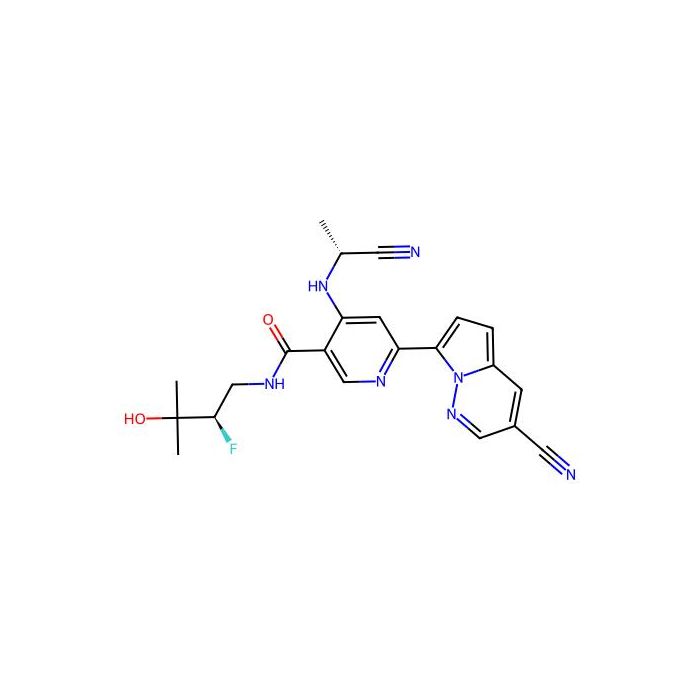
Edecesertib (GS-5718) is a selective, potent, orally active IRAK-4 inhibitor. Edecesertib has anti-inflammatory activity. Edecesertib can be used for rheumatoid arthritis (RA) and lupus erythematosus (LE) research.
Form:Solid
Spécifications
Spécifications et pureté
≥99%
Mécanismes biochimiques et physiologiques
Edecesertib (GS-5718) is a selective, potent, orally active IRAK-4 inhibitor. Edecesertib has anti-inflammatory activity. Edecesertib can be used for rheumatoid arthritis (RA) and lupus erythematosus (LE) research.
Conditions de stockage de stockage
Store at 2-8°C,Protected from light,Desiccated
Expédié en
Wet ice
Ce produit nécessite l'expédition en chaîne froide. Les services terrestres et autres services économiques ne sont pas disponibles.
Certificats (CoA, COO, BSE/TSE et tableau d'analyse)
C of A & Other Certificates(BSE/TSE, COO):
Analytical Chart:
Calculateurs de solution
Molarity Calculator
Determine the necessary mass, volume, or concentration for preparing a solution.
Dilution Calculator
Determine the dilution needed to prepare a stock solution.
Reconstitution Calculator
Avis
Avis des clients
Application Protocols
No item-specific, validated application protocols are provided for this product.
General starting points for small-molecule use in discovery assays (to be optimized per lab)
Stock preparation: Dissolve at 10–50 mM in anhydrous DMSO. Filter through 0.22 µm PTFE if particulate persists and the compound is filter-stable.
Aliquoting: Dispense into amber vials or 96-well plates (low-bind) under dry conditions. Seal immediately; store refrigerated as indicated.
Biochemical assays: Prepare serial dilutions in assay buffer with a constant DMSO background (e.g., 0.5% v/v). Include vehicle controls and, where available, positive/negative controls.
Cellular assays: Verify tolerable DMSO levels for the cell model (commonly ≤0.1–0.5% v/v). Monitor for precipitation or adsorption to plastics; consider low-bind plates and gentle mixing after dosing.
Analytical reference use: Establish identity/purity by UPLC-UV/MS before quantitation. For calibration, confirm stability in autosampler vials over the analytical run time.
All procedures should be validated internally. Refer to the CoA/SDS for any constraints related to stability, solubility, or hazards.
Biological Roles
Item-specific biological targets, mechanisms, or pathway roles for Edecesertib are not provided in the product data. Avoid inferring biological activity solely from the catalog name.
General considerations for small-molecule tool compounds (for research use only)
Tool compounds are used to perturb biochemical pathways in cell- or enzyme-based assays to elucidate signaling cascades, synthetic lethal interactions, or feedback regulation.
Establish on-target vs. off-target profiles with orthogonal assays (e.g., biochemical potency versus cellular phenotype) and counter-screens for frequent hitters (aggregators, redox cyclers, PAINS motifs if applicable once structure is verified).
Determine kinetic behavior (reversible vs. time-dependent effects) and evaluate basic ADME parameters relevant to the assay context (permeability, efflux liability, nonspecific binding) when designing experiments. These assessments are model- and assay-specific and should be sourced from primary literature or internal studies.
Important
Any biological role or target specificity for this item must be confirmed from the CoA/SDS or peer-reviewed literature linked to the exact CAS (2408839-73-4). Without such confirmation, treat the compound as an uncharacterized small molecule for exploratory research only.
No medical or clinical claims are made; this product is supplied strictly for laboratory research.
Buffer Applications
This product is a small-molecule research compound and is not a buffering agent. Therefore, buffer formulation guidance (pH ranges, buffering capacity) is not applicable.
Practical handling in buffered systems (general)
Prepare concentrated DMSO stock solutions and dilute into assay buffers immediately before use, keeping final DMSO content low (≤0.5–1% v/v) to preserve biological activity and minimize solvent effects.
If precipitation is observed upon dilution, increase the DMSO fraction slightly (as assay permits) or add the compound more slowly under vigorous mixing. Consider including inert protein (e.g., 0.1% BSA) or nonionic surfactant if compatible with the assay to mitigate nonspecific adsorption.
Green Alternatives
Because this item is a small-molecule research compound rather than a process solvent or reagent, “green alternatives” considerations mainly concern solvent choices and handling during analytical and assay workflows.
Greener handling strategies (general)
Prefer water-compatible assays with minimal DMSO content (≤0.5–1% v/v) to reduce organic solvent use.
Use MeCN or ethanol over chlorinated solvents for sample prep when chromatographic and solubility requirements allow.
DMSO vs. DMF/NMP: DMSO often provides comparable solvency with a more favorable EHS profile; choose DMSO first for stock solutions.
MeCN vs. dichloromethane: MeCN is widely accepted as a greener alternative for many analytical workflows; avoid chlorinated solvents unless necessary for method performance.
Waste minimization
Consolidate compatible organic wastes; employ on-site solvent recovery for MeCN/MeOH where infrastructure exists.
Adopt stability-indicating methods to extend solution shelf-life and reduce remakes.
Note: No process-scale synthesis guidance is provided for this compound; assess green metrics only within your laboratory’s use case.
Pharmaceutical Uses
No pharmacopeial status, excipient role, or formulation designation is provided for this item. It is offered strictly for research use only.
May serve as an analytical reference standard for method development (HPLC/UPLC-MS) and calibration after appropriate qualification.
Can be used in preformulation-like studies within discovery settings to understand solubility behavior, stability under stress (light, heat, oxidative, hydrolytic), and compatibility with common assay matrices.
For any GLP/GMP-relevant activities, perform full qualification/validation of identity, purity, and potency using traceable reference materials. This catalog item is not represented as a GMP-grade material.
Important limitations
No therapeutic, diagnostic, or clinical use is intended or implied.
Do not incorporate into human or veterinary products. Follow institutional approval processes for any regulated research use.
Physical Properties
Item-specific physical property data have not been provided for this catalog entry.
Melting point: Not specified for this item; refer to CoA/Spec Sheet.
Boiling point: Not specified for this item; refer to CoA/Spec Sheet.
Density: Not specified for this item; refer to CoA/Spec Sheet.
LogP/logD: Not specified for this item; refer to CoA/Spec Sheet.
pKa: Not specified for this item; refer to CoA/Spec Sheet.
Refractive index: Not applicable/unknown for solids; Not specified for this item; refer to CoA/Spec Sheet.
Solubility: Not specified for this item; refer to CoA/Spec Sheet.
General guidance (literature/practice, not item-specific)
Small-molecule screening compounds are commonly handled as DMSO stock solutions (e.g., 10–50 mM), then diluted into aqueous assay buffers with a final DMSO content typically ≤0.5–1% v/v to maintain solubility and minimize matrix effects.
When physical form and crystallinity are unknown, pre-wet with a minimal volume of DMSO before adding buffer to avoid localized precipitation.
If chromatographic purity is to be confirmed, reversed-phase UPLC with a water/acetonitrile + 0.1% formic acid gradient and diode-array detection is a robust starting point. Adjust wavelength based on observed UV absorbance profile from a scan (190–400 nm).
For hygroscopic or light-sensitive materials, perform weighings in a low-humidity environment and use amber glassware as appropriate.
Quality and Grades
Grade/purity: Not specified for this item; refer to CoA/Spec Sheet.
Stabilizers/additives: Not specified for this item; refer to CoA/Spec Sheet.
How to interpret quality information (general guidance)
For screening library compounds, the CoA typically reports chromatographic purity (e.g., HPLC/UPLC area %), identity confirmation (NMR, HRMS), and water/volatile content (KF, LOD). In the absence of a stated grade here, defer to the lot-specific CoA.
If low UV background is required (e.g., LC-UV quantification), verify UV spectrum and report wavelength cutoffs from the CoA; do not assume HPLC grade without documentation.
If salt form vs. free base/acid influences potency readouts, confirm exact form and counterion on the CoA. Adjust stock concentrations by molecular-weight correction accordingly.
When exact purity specifications are not disclosed in the catalog, internal QC of incoming lots should include at minimum: orthogonal purity (UPLC-UV and UPLC-MS), residual solvent screening (GC), and moisture determination (KF), especially for hygroscopic or amorphous materials.
For stability-indicating purposes, establish a retention sample and periodic re-test interval aligned with your laboratory’s quality system.
Reaction and Applications
This product is supplied as a small-molecule research compound for discovery workflows rather than as a synthetic reagent. No item-specific reactivity or application claims are provided in the product data.
Research usage contexts (general, non-clinical)
As a reference material or tool compound in target/pathway studies, high-throughput screening (HTS), hit confirmation, and structure–activity relationship (SAR) development.
Analytical applications: LC/MS method development, retention time indexing, and stability-indicating studies (stress tests under light, heat, moisture as permitted by sample quantity and safety documentation).
Assay development: Establish dynamic range, signal window, and solvent tolerances using DMSO stock solutions; confirm absence of assay interference (aggregation, fluorescence quenching, redox activity) via counter-screens.
Practical tips
Prepare single-use aliquots of concentrated DMSO stocks to minimize freeze–thaw and adsorption losses.
Validate concentration by UV-Vis only if the compound’s extinction coefficient is known; otherwise, prefer quantitative NMR (qNMR) or gravimetric preparation with balance verification.
If mechanism-of-action information is needed, consult primary literature associated with the CAS/CID and your institutional approvals. Do not rely on catalog names for biological inference.
Note: No named synthetic or catalytic transformations are recommended for this material; it is not positioned as a reagent.
Reaction Conditions
Classical synthetic “reaction conditions” are not applicable because this item is supplied as a research compound, not a reagent or catalyst.
Useful laboratory conditions for handling and analysis (general)
Stock solutions: Prepare in DMSO at 10–50 mM. Mix thoroughly (vortex/sonicate briefly). Verify complete dissolution visually; if needed, warm gently (≤40 °C) and cool before use.
Working solutions: Dilute into assay buffer immediately before use. Typical final DMSO 0.1–1% v/v (assay-dependent). Avoid prolonged pre-dilution in aqueous media to limit precipitation or degradation.
Chromatography: Start with reversed-phase UPLC (C18, 1.7–3 µm). Mobile phase A: H2O + 0.1% FA; B: MeCN + 0.1% FA. Gradient 5–95% B over 5–10 min at 30–40 °C. Adjust based on retention and stability (general guidance).
Mass spectrometry: Screen both ESI+ and ESI−; use 10 mM ammonium formate or formic acid as volatile modifiers. Tune cone/fragment voltages empirically.
Stability checks: Perform short-term bench-top and autosampler stability assessments (e.g., 4–24 h at ambient and 4–10 °C). Protect from light as indicated in product data.
Note: Any reaction chemistry on this molecule (derivatization, conjugation) should be designed only after structural data are confirmed from the CoA/literature.
Safety and Handling
GHS and hazard classifications specific to this item have not been provided.
Signal word: Not specified for this item; refer to SDS.
Hazard statements (H-codes): Not specified for this item; refer to SDS.
GHS classification and pictograms: Not specified for this item; refer to SDS.
General laboratory safety (always defer to the SDS for authoritative guidance)
Handle in a chemical fume hood with appropriate PPE: lab coat, safety glasses, and disposable nitrile gloves. For weighing fine powders, consider double-gloving and antistatic measures; avoid aerosol generation.
Avoid inhalation, ingestion, and skin contact. Wash thoroughly after handling. Prevent release to the environment.
Storage incompatibilities: Keep separate from strong oxidizers and strong acids/bases unless compatibility is confirmed by the SDS/CoA.
Light and moisture sensitivity: Product data indicate protection from light and desiccation; minimize ambient exposure. Use amber vials and desiccant packs.
First-aid (overview; see SDS): In case of skin contact, wash with soap and water. If eye contact occurs, rinse cautiously with water for several minutes and seek medical attention. If inhaled, move to fresh air. If ingested, rinse mouth and seek medical advice.
Spill response: Cover small spills with inert absorbent, collect for disposal in accordance with institutional and local regulations. Decontaminate surfaces with suitable solvent/detergent.
Waste: Dispose via approved chemical waste streams; do not pour to drain.
Solvent Selection
Item-specific solubility and polarity data are not provided; select solvents empirically and verify by small-scale tests.
General practices for small-molecule research compounds
Primary stock solvent: DMSO is typically preferred due to broad solvency and assay compatibility. Start at 10–50 mM depending on expected potency and solubility.
Alternative polar aprotic solvents: DMF or NMP can be used for difficult-to-dissolve analytes; subsequently dilute into DMSO or aqueous buffers as appropriate.
Aqueous work: Dilute DMSO stocks into buffer just before use. Maintain final DMSO ≤0.5–1% v/v in biochemical assays to limit solvent effects (general guidance).
Less polar media: For spectroscopic or preparative work, acetonitrile, methanol, or ethanol can be useful co-solvents. Verify stability against transesterification or solvolysis if functional groups are sensitive (consult CoA/SDS when structure is available).
Comparison snapshot (general)
DMSO: Highest solvency, miscible with water; may plasticize some lab plastics at high concentrations.
DMF/NMP: Strong solvency; higher boiling points; consider stricter handling due to safety profiles.
MeCN/MeOH: Good for LC and sample preparation; volatile and easy to remove; lower solvency for very lipophilic scaffolds.
Tip: If precipitation occurs upon aqueous dilution, add in small increments under vortexing, or include 0.01–0.1% nonionic surfactant where assay-compatible.
Store at 2–8 °C, protected from light, and desiccated.
Shipped on wet ice.
General storage guidance
Keep container tightly closed in the original amber vial with desiccant. Minimize headspace and limit opening time to reduce moisture uptake and photodegradation.
Upon receipt, allow the sealed container to equilibrate to room temperature before opening to avoid condensation. Reseal promptly after each use.
Reconstitution and solution handling (general best practice)
Prepare concentrated stock solutions in anhydrous DMSO (typical 10–50 mM). Mix thoroughly until fully dissolved; brief sonication or gentle warming (≤40 °C) can assist.
Aliquot stocks into single-use portions to avoid repeated freeze–thaw cycles. Store aliquots refrigerated and protected from light; if longer-term storage is needed, consider −20 °C to −80 °C after confirming stability for this item on the CoA.
Before assay use, dilute DMSO stocks into the desired buffer immediately, keeping final DMSO low (≤0.5–1% v/v) and verifying absence of precipitation.
Stability notes
Lot-specific stability, hygroscopicity, and solution shelf-life: Not specified for this item; refer to CoA/Spec Sheet and SDS.
Always inspect solutions for discoloration or precipitate prior to use; discard if changes are observed.
Structure and Identity
Product name: Edecesertib (SKU: E647505)
CAS: 2408839-73-4 (product data)
PubChem CID: 147817927 (product data)
Molecular formula: Not specified for this item; refer to CoA/Spec Sheet.
Molecular weight: Not specified for this item; refer to CoA/Spec Sheet.
InChIKey: Not specified for this item; refer to CoA/Spec Sheet.
SMILES: Not specified for this item; refer to CoA/Spec Sheet.
Structural features
Item-specific structural descriptors (ring systems, heteroatoms, stereochemistry): Not specified for this item; refer to CoA/Spec Sheet.
Notes for identity confirmation (general best practice)
Verify identity by orthogonal methods where possible: HRMS (exact mass), 1H/13C NMR, and HPLC/UPLC purity profiling.
Cross-reference CAS and CID with internal databases and the Certificate of Analysis (CoA) prior to use in screening or reference-standard workflows.
For LC/MS methods development, begin with a broad ESI polarity screen (positive/negative) and gradient scouting due to unknown ionization behavior when structural details are not provided.
Synthetic Utility
Edecesertib is provided as a finished small molecule for research; it is not positioned as a synthetic building block or reagent in the product data.
General remarks (when structure is known from CoA/literature)
If functional groups are identified (e.g., amide, heteroaryl, anilide, sulfonamide, etc.), standard transformations for analog generation could include amide coupling, SNAr on activated heterocycles, or cross-couplings (Suzuki–Miyaura, Buchwald–Hartwig). Such activities fall under medicinal chemistry follow-up rather than the use of this exact catalog item as a reagent.
Given typical tool-compound complexity, late-stage diversification may be limited by protecting-group needs and functional-group compatibility; consult primary literature for any published routes specific to the CAS.
Bottom line
Treat this item as a final compound for bioassays or analytical reference. For synthetic campaigns, procure appropriate intermediates or design retrosynthetic routes rather than consuming this catalog material as a reagent.
Target Specificity
Item-specific biological target(s), binding mode, and selectivity panels are not provided in the product data.
Target, family, and species reactivity: Not specified for this item; refer to CoA/Spec Sheet and primary literature tied to CAS 2408839-73-4.
Mechanism of action, KD/IC50 values, and selectivity: Not specified for this item; refer to CoA/Spec Sheet.
Guidance
If using this compound as a tool molecule, independently verify target engagement using orthogonal assays (biochemical and cellular) and confirm selectivity across relevant off-targets before drawing conclusions.
Nous utilisons des cookies pour garantir le bon fonctionnement du site et, lorsque cela est autorisé, pour améliorer votre expérience. Vous pouvez gérer vos préférences à tout moment dans les Paramètres. Pour en savoir plus, consultez notre Politique relative aux cookies.
Souhaitez-vous que nous vous envoyions un message lorsque des réductions seront disponibles?
Me rappeler plus tard
Merci ! Veuillez vérifier votre boîte de réception e-mail pour confirmer.
Products are supplied to verified businesses, institutions, and qualified professionals for research and development use only. Not for use in humans, animals, diagnosis, or therapy.