QUALITÉ & PURETÉMoligand™?Moligand™ — Aladdin's line of ligands and bioactive small molecules. Use for receptor, pathway, and binding studies needing defined small-molecule tools.10 mM in DMSO
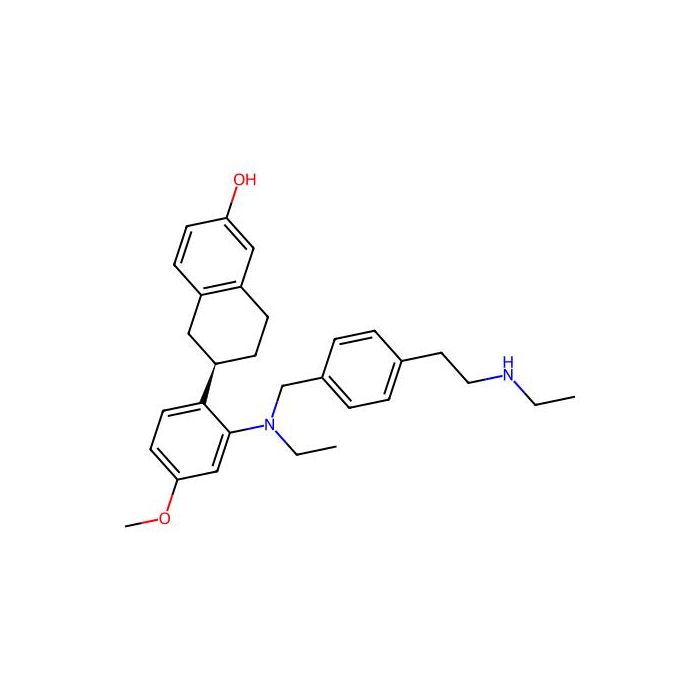
Elacestrant (RAD1901) is an orally available and selective estrogen receptor degrader (SERD) with IC 50 s of 48 and 870 nM for ERα and ERβ , respectively. Elacestrant also can inhibit growth of ER + breast cancer cell lines in vitro and in vivo .
Spécifications
Spécifications et pureté
Moligand™, 10 mM in DMSO
Conditions de stockage de stockage
Protected from light,Argon charged,Store at -80°C
Expédié en
Dry ice packs + Cold packs
Ce produit nécessite l'expédition en chaîne froide. Les services terrestres et autres services économiques ne sont pas disponibles.
Certificats (CoA, COO, BSE/TSE et tableau d'analyse)
C of A & Other Certificates(BSE/TSE, COO):
Analytical Chart:
Calculateurs de solution
Molarity Calculator
Determine the necessary mass, volume, or concentration for preparing a solution.
Dilution Calculator
Determine the dilution needed to prepare a stock solution.
Reconstitution Calculator
Avis
Avis des clients
Application Protocols
The following are general research-use guidelines; optimize for your specific system. No item-specific validated protocols are provided.
Stock solution preparation
Equilibrate vial to room temperature in the dark. Open under dry conditions.
Dissolve in anhydrous DMSO to prepare a concentrated stock (e.g., 10–50 mM). Vortex until fully dissolved. If needed, sonicate briefly. Filter through 0.22 μm PTFE if particulates persist.
Cell-based assays (general)
Dilute stock into pre-warmed media to achieve the desired final concentration while keeping DMSO ≤0.1–0.5% v/v.
Typical exploratory ranges: 1 nM to 10 μM, with serial 3× or 10× dilutions for potency curves. Include vehicle control and known ER modulators as controls where appropriate.
Incubation: 6–24 h for transcriptional readouts; 24–72 h for receptor level changes/degradation. Confirm non-cytotoxic vehicle levels.
Biochemical assays
Use assay buffer compatible with ER LBD constructs and detection modality (e.g., TR-FRET). Maintain consistent DMSO across wells (commonly 1–2% v/v in biochemical formats).
Stability checks
Minimize freeze–thaw cycles by aliquoting. Protect from light during setup. Assess carryover precipitation visually and by test wells.
Biological Roles
Role (research context; literature)
Elacestrant is characterized in the literature as a nonsteroidal selective estrogen receptor degrader/antagonist (SERD) targeting ERα (ESR1). It binds the ligand-binding domain (LBD), induces antagonist conformations, and can promote receptor turnover, leading to reduced ER signaling in cellular systems.
Mechanistic considerations (literature)
Binding mode: Occupies the ERα LBD with high affinity, disfavoring coactivator recruitment and favoring corepressor interactions.
Degradation: Engagement can trigger ubiquitin–proteasome-mediated receptor degradation in cells; kinetics and extent are cell-context dependent.
Mutant receptors: Frequently studied against ESR1 mutations (e.g., Y537S, D538G) to probe activity in constitutively active ER variants.
Research applications
Probe for estrogen-responsive transcription (e.g., ERE-luciferase assays).
Tool for dissecting ER-dependent proliferation pathways in hormone-responsive cell lines.
Benchmark/reference in nuclear receptor selectivity panels and target deconvolution.
Note: All statements above refer to in vitro/in vivo research literature. No medical or clinical claims are made. Use strictly for research purposes as indicated by the product’s Research Use Only designation.
Buffer Applications
This item is not a buffering agent and is not used to establish solution pH ranges. However, it is frequently dosed into biological buffers for assays.
Practical notes for buffer use (general)
Vehicle: Deliver via a DMSO stock into the assay buffer (e.g., PBS, HBSS, culture media) with vigorous mixing. Maintain constant vehicle percentage across samples.
Precipitation control: Add the DMSO stock last while vortexing; consider 0.01–0.1% nonionic surfactant or protein carriers (e.g., BSA) if compatible with the assay to improve apparent solubility.
Adsorption: Hydrophobic ligands may adsorb to plastic; use low-bind consumables and precondition surfaces when necessary.
Buffer recipes and pH systems
Not applicable for this compound; select the buffer based on the biological assay requirements (receptor binding, reporter assays, cell viability), not on a buffering role of the compound itself.
Green Alternatives
As a target-directed bioactive, the primary environmental considerations relate to solvent choice for stock preparation and assay dilution rather than replacing the compound itself.
Greener handling strategies
Use minimal DMSO: Optimize stock concentration to keep final DMSO ≤0.1–0.5% v/v in aqueous assays without oversizing stock volumes.
Prefer aqueous-compatible delivery: Where feasible, employ solubilizing excipients (e.g., cyclodextrins, nonionic surfactants at minimal effective levels) to reduce organic solvent.
Micro-scale workflows: Miniaturize assays (384/1536-well plates) to cut solvent usage and waste.
Waste management: Segregate halogenated vs non-halogenated solvent waste; avoid unnecessary rinses with strong organics.
Comparison of solvent options (general)
DMSO: High solvency, good assay compatibility; not “green” but effective at low final %.
Ethanol: More benign; may have limited solubility headroom and risk of precipitation on dilution.
PEG400 or aqueous vehicles with cyclodextrins: Potentially greener in-use; verify impact on assay readouts.
Note: The compound’s identity is fixed by the study design; the most impactful greening lever is solvent minimization and smart assay design.
Pharmaceutical Uses
This product is supplied strictly for research use only and is not intended for human or veterinary use, diagnostics, or as an excipient in finished dosage forms.
Relevant uses in pharmaceutical R&D (non-clinical)
Reference standard: Analytical method development and qualification (e.g., LC–MS/MS calibration standards) in discovery-stage studies.
Tool compound: In vitro pharmacology for ER target validation, structure–activity relationship (SAR) benchmarking, and mechanistic investigations.
Formulation research: Solubility screening and preformulation studies for understanding compound handling under various solvent systems (laboratory scale only).
Compliance status
No pharmacopeial monograph information is provided for this item. Any GMP or clinical manufacturing use would require separate sourcing and qualification.
Documentation
For impurity profiling, residual solvent limits, or spectral reference data, consult the CoA/Spec Sheet. No therapeutic claims are made or implied.
Physical Properties
Item-specific values
Molecular weight: Not specified for this item; refer to CoA/Spec Sheet.
Molecular formula: Not specified for this item; refer to CoA/Spec Sheet.
Appearance: Not specified for this item; refer to CoA/Spec Sheet.
General/literature guidance for handling as a bioactive small molecule
Solubility (literature/general): Typically formulated as concentrated stocks in anhydrous DMSO due to limited aqueous solubility common to ER ligands. Aqueous working solutions are prepared by serial dilution into assay buffers containing carrier proteins or surfactants as needed to mitigate precipitation.
pKa/logP (literature): ER-targeted small molecules often exhibit moderate-to-high lipophilicity (positive logP) to ensure cell permeability; exact values for Elacestrant should be confirmed from primary databases.
Thermal behavior: Stable solids are generally robust at ambient temperatures for short handling but are often stored at deep-cold temperatures to minimize degradation; follow item-specific storage below.
Hygroscopicity/photolability (general): Many heteroatom-containing bioactives show gradual degradation upon prolonged light exposure or moisture uptake. This item is specified to be protected from light and stored under argon at −80 °C (see Storage tab).
Note: For authoritative physico-chemical constants (bp, mp, density, refractive index), consult the CoA/Spec Sheet or validated literature databases.
Quality and Grades
Grade provided
Moligand™ grade (item-specific): Research-grade small-molecule ligand suitable for screening libraries and mechanistic studies. Emphasis is placed on structural identity and consistency for bioassay use.
What Moligand™ typically implies (general explanation)
Identity/consistency: Batch-to-batch reproducibility in identity and purity appropriate for discovery research and SAR studies.
Handling controls: Supplied with deep-cold storage recommendations, inert gas charging, and light protection to preserve integrity.
Stabilizer content: Not specified for this item; refer to CoA/Spec Sheet.
Fit for purpose
Appropriate for target-engagement assays, reporter assays, cell-based pharmacology, and as a reference control compound. Not intended for clinical use, GMP manufacture, or in vivo diagnostic applications.
Note: If low-UV background, metal limits, residual solvents, or impurity profiles are critical to your workflow, consult the CoA/Spec Sheet for actual release specifications.
Reaction and Applications
This product is supplied as a research bioactive ligand rather than a synthetic reagent. It is not typically employed as a solvent, base, catalyst, or stoichiometric reagent in standard organic transformations.
Degradation/antagonism studies (literature): Used to evaluate ERα degradation, receptor turnover pathways, and downstream transcriptional effects in hormone-responsive cell lines.
Profiling: Reference control in screening panels assessing ER selectivity versus nuclear receptor off-targets.
Not typically applicable
Grignard, cross-coupling, oxidations/reductions, or general synthetic reaction roles are not standard use-cases for this item. For such applications, refer to synthetic reagents in our catalog.
Practical tips
Prepare fresh DMSO stocks and filter (0.22 μm) if particulate is observed after dilution.
Verify adsorption to plastics; use low-bind plates/tubes where needed.
Include vehicle controls at matching solvent concentrations to deconvolute solvent effects.
Reaction Conditions
This product is not intended for use as a reagent in chemical synthesis; therefore, conventional reaction condition guidance (solvent, temperature, catalyst, stoichiometry) is not applicable.
Assay-oriented handling conditions (general)
Stock preparation: Dissolve in anhydrous DMSO under low light; typical working stocks are prepared at high millimolar concentrations to minimize vehicle volumes.
Dilution: Add to aqueous assay media with vigorous mixing; maintain consistent vehicle across controls and treatments.
Incubation: For cell-based assays, common exposure times range from hours to 72 h depending on readout (e.g., transcriptional response vs. protein level changes). Optimize empirically.
Data integrity
Include time-matched vehicle controls and, where relevant, positive/negative control ligands. Confirm stability of the compound over the assay window (e.g., by LC–MS of spent media if critical).
For bona fide synthetic reaction guidance, please refer to reagents designed for transformations (bases, catalysts, solvents) in our catalog.
Safety and Handling
GHS and hazard data (item-specific)
Signal word: Not specified for this item; refer to SDS.
H-statements: Not specified for this item; refer to SDS.
GHS classification and pictograms: Not specified for this item; refer to SDS.
General laboratory precautions (for research-use bioactives)
PPE: Wear lab coat, nitrile gloves, and safety glasses. Use in a chemical fume hood to avoid inhalation of dust/aerosol.
Avoid exposure: Prevent skin/eye contact and inhalation. Handle powders gently to minimize airborne particulates. Decontaminate surfaces after use.
Incompatibilities: Avoid strong oxidizers and strong acids/bases that may degrade the molecule. Keep away from light and moisture as noted by the storage guidance.
First aid (general): If inhaled—move to fresh air; if on skin—wash with soap and water; if in eyes—rinse with water for several minutes; if ingested—rinse mouth. Seek medical attention as appropriate. Always follow SDS instructions.
Environmental precautions: Prevent release to the environment. Dispose of waste via approved chemical waste streams.
Special risks and best practices
Prepare small-volume DMSO stocks to limit repeated freeze-thaw and adsorption losses.
Use amber vials or foil wrapping to protect from light.
Purge headspace with inert gas (argon) after aliquoting to match the product’s inert-atmosphere handling.
Solvent Selection
Intended use
Elacestrant is a lipophilic ER-ligand. Stock solutions are typically prepared in high-boiling polar aprotic solvents for biochemical and cell-based assays.
Common solvents (general/literature practice)
DMSO: Primary choice for concentrated stocks (e.g., 10–50 mM) due to solubilizing power and assay compatibility at low final percentages.
DMF or NMP: Alternative solvents when higher stock concentrations are required; verify cell compatibility and final % solvent.
Ethanol: Sometimes suitable for lower-concentration stocks; monitor for precipitation upon aqueous dilution.
Aqueous buffers: Direct dissolution is often poor; use co-solvent strategies (DMSO seed plus buffer, or inclusion of cyclodextrins/surfactants when compatible with the assay).
Miscibility and polarity (general)
DMSO is miscible with water; maintain final DMSO typically ≤0.1–0.5% v/v in sensitive cell assays to minimize solvent effects.
Comparison pointers
If high aqueous compatibility is required, consider solubilizing aids (e.g., HP-β-CD) versus switching to less polar organics that may impact biology.
Note: The exact solubility of this item is not specified; confirm workable concentrations empirically and refer to the CoA/Spec Sheet.
Storage and Reconstitution
Item-specific storage and shipping
Storage: Protected from light, Argon charged, Store at −80 °C (as provided by product data).
Upon receipt: Keep at −80 °C. Allow vial to equilibrate to room temperature before opening to avoid moisture condensation. Open quickly under dry, inert conditions if possible.
Aliquoting: Prepare small, single-use aliquots in amber vials or low-bind tubes. Re-purge headspace with argon before re-freezing.
Freeze–thaw: Avoid repeated cycles. Thaw only what is needed for immediate use.
Reconstitution guidance (general)
Solvent: Use anhydrous DMSO for initial dissolution unless your assay requires an alternative. Mix thoroughly to ensure complete dissolution.
Working solutions: Dilute into assay media/buffer immediately before use with vigorous mixing to prevent precipitation. Maintain constant vehicle concentration across samples.
Stability notes
Long-term stability is enhanced by deep-cold, inert, light-protected storage. Item-specific shelf-life and retest intervals are Not specified for this item; refer to CoA/Spec Sheet.
Research Use Only: For research use only. Not for human or veterinary use.
Molecular formula: Not specified for this item; refer to CoA/Spec Sheet. (Literature identifiers for Elacestrant are available in public databases.)
Molecular weight: Not specified for this item; refer to CoA/Spec Sheet.
SMILES: Not specified for this item; refer to CoA/Spec Sheet. (Literature SMILES available via CID 23642301.)
InChIKey: Not specified for this item; refer to CoA/Spec Sheet.
Structural features (general/literature description)
Elacestrant is a nonsteroidal estrogen receptor (ER) ligand classified as a selective estrogen receptor degrader/antagonist (SERD/SERM-like). It engages the ER ligand-binding domain (LBD) and promotes receptor antagonism and degradation in cellular systems (literature).
Typical functional motifs (literature): multi-ring, heteroatom-rich scaffold designed to occupy the ER LBD; features that favor high affinity and conformational changes associated with receptor turnover. No stereogenic centers are commonly discussed for this scaffold in the literature.
2D structural description (literature)
Compact, polycyclic/aryl-rich framework with polar functionality enabling hydrogen-bonding and hydrophobic interactions in the ER pocket. The overall topology balances lipophilicity (for cell permeability) with heteroatoms (for target engagement). Exact atom-level arrangement should be confirmed from a primary database or the item CoA.
Synthetic Utility
Elacestrant is supplied as a finished bioactive ligand and is not typically employed as a synthetic intermediate or reagent.
Context for synthetic chemists
Structure-guided design: Chemists may use Elacestrant as a benchmark scaffold in ER-ligand SAR programs to compare substituent effects on binding/degradation profiles.
Analog design: The scaffold may inspire modifications to explore potency, selectivity, metabolic stability, and physicochemical tuning.
Not typically applicable
It is not used in named reactions as a coupling partner, nor as a catalyst, ligand (in the organometallic sense), base, or oxidant/reductant.
Practical note
For synthetic route development or analog synthesis, consult primary literature describing ER degraders/antagonists; this product serves as a reference compound for biological evaluation rather than a building block.
Target Specificity
Item-specific target data such as Ki, Kd, EC50/IC50, selectivity ratios, or off-target panels are not provided here; refer to the CoA or literature for quantitation.
Secondary considerations: Activity is often assessed against ERβ to characterize isoform selectivity; broader nuclear receptor selectivity panels may be consulted to evaluate off-target interactions.
Functional outcome in cells: Antagonism of ER-mediated transcription and promotion of ERα degradation have been reported in the literature; magnitude is cell-line and context dependent.
Assay readouts
Binding assays (radioligand displacement, TR-FRET), coactivator recruitment assays, ERE-driven reporter assays, and receptor level quantitation (e.g., immunoblot) are common to define target engagement and functional specificity.
Note: No guarantees are made regarding performance or selectivity in any particular assay system. Validate in your system of interest.
Foire aux questions
What is Moligand??
Moligand? is one of Aladdin Scientific's premium product lines, formulated for high-purity applications across multiple workflows. Compared to standard grades in the same workflow, Moligand? products typically offer tighter specifications, more rigorous QC, and stronger lot-to-lot consistency.
How should this product be stored?
Store at ?80 °C, protected from light, under argon. It is supplied under an argon blanket; reseal under inert gas after each use.
How is this product shipped?
This product ships frozen with dry ice and cold packs. Unpack on arrival and transfer it to the storage condition stated above; handle dry ice with insulated gloves in a ventilated area.
What are the CAS number, molecular formula and molecular weight?
The CAS Number is 722533-56-4, the molecular formula is C30H38N2O2, and the molecular weight is 458.6 g/mol.
What documentation is provided?
Available product documentation, including Certificates of Analysis (COA), Safety Data Sheets (SDS), and specification sheets, is shown in the product document area. Document availability and access follow the current site policy.
Besoin d'aide pour choisir la qualité ?
Notre guide de sélection des qualités couvre la pureté, le statut du stabilisant et l'adéquation à l'application pour toutes les variantes de notre catalogue.
Nous utilisons des cookies pour garantir le bon fonctionnement du site et, lorsque cela est autorisé, pour améliorer votre expérience. Vous pouvez gérer vos préférences à tout moment dans les Paramètres. Pour en savoir plus, consultez notre Politique relative aux cookies.
Souhaitez-vous que nous vous envoyions un message lorsque des réductions seront disponibles?
Me rappeler plus tard
Merci ! Veuillez vérifier votre boîte de réception e-mail pour confirmer.
Products are supplied to verified businesses, institutions, and qualified professionals for research and development use only. Not for use in humans, animals, diagnosis, or therapy.