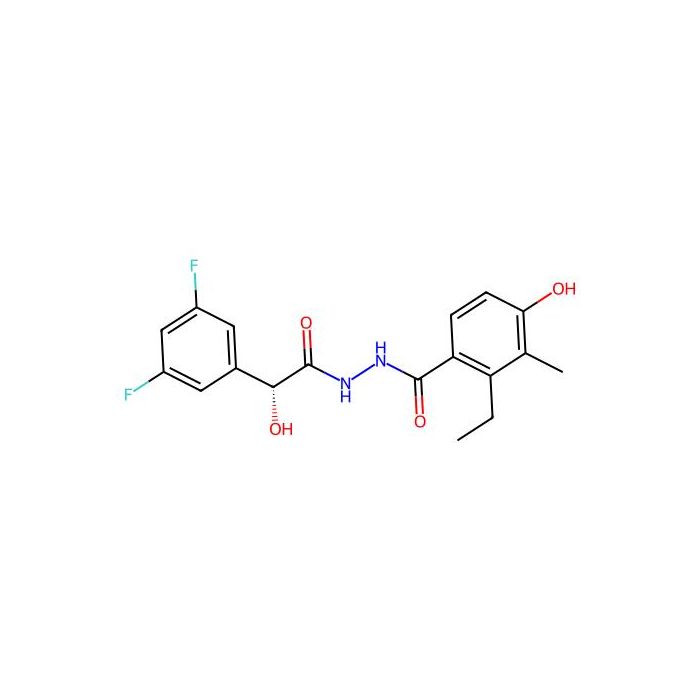
EMD638683 R-Form - ≥99% , CAS No.1184940-47-3

CAS: 1184940-47-3 Cat. No.: E647755 Formule: C18H18F2N2O4 Poids moléculaire: 364.34
DISPONIBLE À COMMANDE
GRADE & PURITY ≥99%
Synonyms
A926968 | EMD638683 (R-Form) | EMD638683 R-Form | DTXSID40735349 | AKOS030526292 | 1184940-47-3 | (R)-N'-(2-(3,5-Difluorophenyl)-2-hydroxyacetyl)-2-ethyl-4-hydroxy-3-methylbenzohydrazide | MS-25799 | SCHEMBL880175 | F84814 | N'-[(2R)-2-(3,5-Difluorophenyl
Storage
Store at -20°C
Shipped In
Ice chest + Ice pads
★
Size
Allemagne (EU)
USA*
Price
Qty
5mg
E647755-5mg
Sur commande · 8–12 semaines
532,70€
10mg
E647755-10mg
Sur commande · 8–12 semaines
799,10€
50mg
E647755-50mg
Sur commande · 8–12 semaines
1 776,17€
100mg
E647755-100mg
Sur commande · 8–12 semaines
2 840,89€
Enter a quantity for the sizes you want to add.
🧪

Why this grade

≥99% for sensitive chromatographic and analytical workflows requiring minimal baseline interference.

🌡

Storage & shipping

Store at -20°C Ships Ice chest + Ice pads Check lot-specific COA for exact specifications.

📋

Quality documents

SDS, COA, datasheet, and spec sheet available for download. Lot-specific COA accessible via lot number lookup.

📚

Literature proof

Cited in 0 peer-reviewed publications across chromatography, organic synthesis, and cross-coupling reactions.

Vue d’ensemble

EMD638683 R-Form is the R-form of EMD638683. EMD638683 is a highly selective SGK1 inhibitor with IC 50 of 3 μM.

Form:Solid

IC50& Target:SGK1

Specifications

Synonymes
A926968 | EMD638683 (R-Form) | EMD638683 R-Form | DTXSID40735349 | AKOS030526292 | 1184940-47-3 | (R)-N'-(2-(3,5-Difluorophenyl)-2-hydroxyacetyl)-2-ethyl-4-hydroxy-3-methylbenzohydrazide | MS-25799 | SCHEMBL880175 | F84814 | N'-[(2R)-2-(3,5-Difluorophenyl
Spécifications et pureté
≥99%
Mécanismes biochimiques et physiologiques
EMD638683 R-Form is the R-form of EMD638683. EMD638683 is a highly selective SGK1 inhibitor with IC 50 of 3 μM.
Conditions de stockage de stockage
Store at -20°C
Expédié en
Ice chest + Ice pads
Ce produit nécessite l'expédition en chaîne froide. Les services terrestres et autres services économiques ne sont pas disponibles.
Type d'action
INHIBITOR
Pureté
≥99%
Noms et identifiants
Sourires canoniquesCCC1=C(C=CC(=C1C)O)C(=O)NNC(=O)C(C2=CC(=CC(=C2)F)F)O
IUPAC NameN'-[(2R)-2-(3,5-difluorophenyl)-2-hydroxyacetyl]-2-ethyl-4-hydroxy-3-methylbenzohydrazide
InChIKeySSNAPUUWBPZGOY-MRXNPFEDSA-N
INCHI1S/C18H18F2N2O4/c1-3-13-9(2)15(23)5-4-14(13)17(25)21-22-18(26)16(24)10-6-11(19)8-12(20)7-10/h4-8,16,23-24H,3H2,1-2H3,(H,21,25)(H,22,26)/t16-/m1/s1
Isomères SMILES CCC1=C(C=CC(=C1C)O)C(=O)NNC(=O)[C@@H](C2=CC(=CC(=C2)F)F)O
CAS alternatif 1184940-47-3
Poids moléculaire 364.34
Reaxy-Rn 21240670
Reaxys-RN_link_address https://www.reaxys.com/reaxys/secured/hopinto.do?context=S&query=IDE.XRN=21240670&ln=

Documentation

📋 Safety Data Sheet (SDS)

Comprehensive hazard, handling, storage, and regulatory compliance document.

Download SDS →

✅ Certificate of Analysis (COA)

Lot-specific quality data. Enter your lot number to retrieve the exact COA.

Look up COA →

📊 Datasheet

Quick-reference summary of product specifications and applications.

View datasheet →

🔬 Specification Sheet

Full quality attributes and acceptance criteria for this grade.

View spec sheet →

Advanced Data

Taxonomic Classification

Taxonomy Tree

KingdomOrganic compounds
SuperclassBenzenoids
ClasseBenzene and substituted derivatives
SubclassPhenylacetamides
Intermediate Tree Nodes Not available
Direct ParentPhenylacetamides
Alternative Parents m-Toluamides  Benzoic acids and derivatives  Ortho cresols  Benzoyl derivatives  Fluorobenzenes  1-hydroxy-2-unsubstituted benzenoids  Aryl fluorides  Secondary alcohols  Carboxylic acid hydrazides  Organonitrogen compounds  Organofluorides  Organic oxides  Hydrocarbon derivatives  Carbonyl compounds  Aromatic alcohols  
Molecular FrameworkAromatic homomonocyclic compounds
Substituents Phenylacetamide - Benzoic acid or derivatives - M-toluamide - Toluamide - Benzoyl - O-cresol - 1-hydroxy-2-unsubstituted benzenoid - Toluene - Phenol - Fluorobenzene - Halobenzene - Aryl fluoride - Aryl halide - Secondary alcohol - Carboxylic acid hydrazide - Carboxylic acid derivative - Alcohol - Organohalogen compound - Organofluoride - Organonitrogen compound - Organooxygen compound - Aromatic alcohol - Carbonyl group - Hydrocarbon derivative - Organic oxide - Organic oxygen compound - Organic nitrogen compound - Aromatic homomonocyclic compound
DescriptionThis compound belongs to the class of organic compounds known as phenylacetamides. These are amide derivatives of phenylacetic acids.
External Descriptors Not available
Structure 3D
Modèle de structure chimique interactif


Certificats (CoA, COO, BSE/TSE et tableau d'analyse)
C of A & Other Certificates(BSE/TSE, COO):
Analytical Chart:
Propriétés chimiques et physiques
SolubilitéDMSO : 66.67 mg/mL (182.99 mM; ultrasonic and warming and heat to 60°C)
Poids moléculaire364.300 g/mol
XLogP32.800
Hydrogen Bond Donor Count4
Hydrogen Bond Acceptor Count6
Rotatable Bond Count4
Exact Mass364.123 Da
Monoisotopic Mass364.123 Da
Topological Polar Surface Area98.700 Ų
Heavy Atom Count26
Formal Charge0
Complexity498.000
Isotope Atom Count0
Defined Atom Stereocenter Count1
Undefined Atom Stereocenter Count0
Defined Bond Stereocenter Count0
Undefined Bond Stereocenter Count0
The total count of all stereochemical bonds0
Covalently-Bonded Unit Count1
Calculateurs de solution
Avis

Avis des clients

Application Protocols

No tested application protocols (e.g., specific assay formats, recommended concentrations, or analytical methods) are provided in the Product Data for this item.

General workflow for small-molecule screening stocks:

  • Allow vial to warm in a desiccator to room temperature before opening (if stored cold) to avoid condensation.
  • Prepare a concentrated DMSO stock (e.g., 10–50 mM), recording the exact mass and volume for traceability.
  • Vortex and, if needed, sonicate briefly to ensure complete dissolution; sterile-filter through 0.2 µm PTFE for cell-based work if required.
  • Aliquot into low-bind, amber vials or PCR tubes to minimize freeze–thaw cycles; label with lot, concentration, solvent, and date.
  • For assays, dilute into buffer/media to the desired final concentration while maintaining acceptable vehicle levels; include vehicle controls.
  • Confirm concentration by UV or LC quantitation if the molar absorptivity or response factor is known/established experimentally.

Please refer to the CoA/Spec Sheet and SDS for any item-specific instructions if supplied.

Biological Roles

The Product Data do not specify any biological targets or pathways for EMD638683 R-Form. Consequently, no item-specific biological role can be asserted here.

General considerations for small-molecule research compounds:

  • Such compounds may serve as chemical probes in discovery research to interrogate biochemical mechanisms; however, any specific target engagement, selectivity, or cellular effects must be verified from primary literature or the product’s CoA/technical note.
  • When planning biological experiments:
    • Establish compound identity and purity (including enantiomeric composition) to ensure reproducibility.
    • Determine assay-compatible solvent systems and acceptable vehicle percentages (e.g., DMSO levels) to avoid confounding results.
    • Perform dose–response and time-course evaluations, as chirality can influence potency and kinetics.
  • Consider metabolic stability and protein binding as they can vary dramatically between enantiomers; generate empirical data under your exact conditions.

No clinical or therapeutic claims are made. For any work in biological systems, consult relevant institutional biosafety and chemical safety guidelines and rely on peer-reviewed sources for mechanism/target details specific to this compound.

Buffer Applications

This product is a small organic research compound and is not itself a buffering agent. Therefore, no dedicated buffer system or buffering capacity information applies.

Practical guidance (general):

  • Prepare concentrated DMSO stocks, then dilute into your chosen buffer (e.g., phosphate, HEPES) while maintaining a low final organic solvent percentage (commonly ≤0.1–1% v/v) to preserve buffer function and biological compatibility.
  • Filter assay buffers (0.22 µm) to remove particulates before adding the compound solution.
  • If precipitation occurs upon dilution, consider:
    • Slightly increasing co-solvent percentage within assay tolerance.
    • Warming gently (room temperature to 37°C) and vortexing/sonication.
    • Adjusting buffer ionic strength or pH only if consistent with the biology of interest.

Always verify that your buffer formulation does not react with the compound (e.g., avoid nucleophilic components if the compound contains labile electrophiles; confirm by LC analysis).

Green Alternatives

Greener considerations here focus on solvent use and handling practices for small-molecule stock solutions and assay dilutions, since the compound itself is fixed.

Greener solvent choices (general guidance):

| Use case | Conventional option | Greener-leaning alternative | Considerations | |---|---|---|---| | Stock solution | DMSO | Remains standard; ensure minimal volumes | DMSO is not “green” but is low volatility and effective; limit final assay % to reduce impacts | | Co-solvent for dilution | DMF, NMP | Ethanol, isopropanol, propylene carbonate | Balance solubility vs. biocompatibility; check assay tolerance | | Analytical prep | ACN | Ethanol/water or MeOH/water (where validated) | ACN has supply/HC concerns; EtOH/MeOH can be acceptable if method allows |

Operational improvements:

  • Use micro-scale aliquots to minimize waste and reduce freeze-thaw cycles.
  • Adopt closed-vial dissolution and low-headspace storage to limit emissions and degradation.
  • Validate room-temperature short-term stability to avoid unnecessary dry-ice shipments between nearby facilities.

Trade-offs:

  • More benign co-solvents can reduce solubility for lipophilic analytes—perform solubility screens.
  • Changing analytical solvents may alter chromatographic selectivity; revalidate methods accordingly.
Pharmaceutical Uses

No pharmacopeial status, excipient role, or formulation use is specified in the Product Data.

Context and guidance (general, non-therapeutic):

  • Compounds of this class are typically used as discovery research tools or analytical references rather than as formulated drug substances or excipients.
  • If used in formulation feasibility studies (preclinical research only):
    • Evaluate solubility enhancement approaches such as co-solvents, cyclodextrins, or lipid-based systems in small-scale screens.
    • Assess chemical stability under ICH-like stress conditions (light, heat, pH) to inform storage and handling.
  • No medical, diagnostic, or therapeutic use is implied. This product is designated for research use only.
Physical Properties

Item-specific physicochemical specifications have not been provided in the Product Data. Do not treat any values below as specifications; consult the CoA/Spec Sheet for release criteria.

  • Appearance: Not specified for this item; refer to CoA/Spec Sheet.
  • Melting point / Boiling point: Not specified for this item; refer to CoA/Spec Sheet.
  • Density: Not specified for this item; refer to CoA/Spec Sheet.
  • Refractive index: Not applicable/Not specified; typical for solids not reported. Refer to CoA/Spec Sheet.
  • Solubility: Not specified for this item; refer to CoA/Spec Sheet. General practice for small-molecule library compounds is initial dissolution in anhydrous DMSO to prepare concentrated stock solutions (e.g., 10–50 mM), then dilution into assay media/aqueous buffers with co-solvent as needed.
  • pKa / logP: Not specified for this item; refer to CoA/Spec Sheet.
  • UV-Vis characteristics: Not specified for this item; refer to CoA/Spec Sheet.

General laboratory handling guidance (non-specification):

  • If supplied as a solid, allow vial to equilibrate to room temperature in a desiccator before opening to minimize moisture condensation.
  • If supplied in solution, verify solvent, concentration, and stabilizers on label/CoA prior to use.

All numeric specifications and acceptance limits should be taken from the current batch CoA/Spec Sheet.

Quality and Grades
  • Grade/Purity: Not specified for this item; refer to CoA/Spec Sheet.

Interpretation and guidance:

  • In the absence of a declared “grade” (e.g., ≥98% purity, HPLC grade, screening grade), rely on the lot-specific CoA for assay/purity (HPLC/UPLC), identity confirmation (NMR/HRMS), residual solvents, and chiral purity when applicable.
  • For a chiral listing designated as R-Form, best practice is to verify:
    • Enantiomeric excess (ee) or enantiomeric ratio (er) by chiral HPLC/GC on the CoA.
    • Absolute configuration assignment (e.g., optical rotation sign/value, or comparison to literature standard).
  • If using for SAR or screening:
    • Request impurity profiles and residual metal screening if your application is sensitive.
    • Verify salt form or solvate/hydrate content.
  • Stabilizers/inhibitors: Not specified for this item. If present in any lot, they will be disclosed on the label/CoA; consider potential assay interferences.

Documentation to request when necessary:

  • Current batch CoA (purity, identity, chiral analysis, water content if applicable).
  • Spec Sheet defining acceptance criteria.
  • SDS for safety and shipping classifications.
Reaction and Applications

This product is offered as a small-molecule research compound (R-enantiomer). It is typically used as a reference or screening compound rather than as a stoichiometric reagent. No manufacturer application notes were provided beyond the general research-use statement.

Potential laboratory applications (general, non-item-specific):

  • Biochemical and cell-based assay tool: Preparation of DMSO stock solutions for in vitro screening, profiling, or mechanistic studies in discovery workflows.
  • Analytical reference: Use as a system-suitability or retention-time reference in chiral/achiral LC method development once identity and purity are confirmed.
  • Chiroptical characterization training: Assess enantiopurity and absolute configuration by chiral HPLC/GC and optical rotation.

Practical tips:

  • Verify enantiomeric purity on receipt (chiral HPLC) if chirality is critical to your study.
  • Conduct solubility scouting (DMSO, DMF, ACN, EtOH) at small scale to establish a robust handling protocol.
  • For long experiments, test solution stability over time/temperature and under light exposure by LC.

Note: No specific synthetic or named-reaction roles are attributed to this item in the Product Data; it is not typically used as a reagent or catalyst in preparative chemistry.

Reaction Conditions

No preparative or catalytic reaction roles are specified for this product in the provided data. Accordingly, no item-specific reaction conditions can be recommended.

General laboratory guidance for handling as a small-molecule analyte or probe:

  • Solution preparation: Dissolve in anhydrous DMSO to make a concentrated stock (e.g., 10–50 mM). Confirm complete dissolution visually and by analytical LC.
  • Dilution: Add stock to assay medium/buffer with vigorous mixing to reach the desired final concentration while keeping DMSO typically ≤0.1–1% v/v.
  • Stability checks: Evaluate solution stability at room temperature and 4°C over representative timeframes (e.g., 24–72 h) using LC to detect degradation or adsorption losses.
  • Light/air sensitivity: If any chromophoric or oxidizable motifs are indicated on the CoA/SDS, protect from light and air; otherwise, standard amber vials and inert headspace are prudent.

Note: If you intend to use this compound in a chemical reaction (e.g., as a substrate in mechanistic studies), first confirm functional groups and reactivity from an authoritative source for the exact CAS and enantiomer.

Safety and Handling

Safety data specific to this item are not provided in the Product Data. Always consult the official SDS for the definitive hazard classification and response measures.

  • GHS Classification / Signal Word / Pictograms / H-Statements: Not specified for this item; refer to SDS.
  • Primary use: For research use only (as stated). Not for human or veterinary use.
  • General PPE: Lab coat, safety glasses or chemical splash goggles, and appropriate chemically resistant gloves (e.g., nitrile). Use in a chemical fume hood to avoid inhalation of dust/aerosol.
  • Handling notes:
    • Avoid dust generation and aerosolization. Prevent contact with skin, eyes, and clothing.
    • Do not ingest or inhale. Wash hands thoroughly after handling.
  • Incompatibilities: Item-specific incompatibilities are not provided. As general good practice for small organic molecules, avoid strong oxidizers and strong acids/bases unless compatibility is known.
  • First aid (general):
    • Skin/eye contact: Rinse with copious water for at least 15 minutes; remove contaminated clothing. Seek medical attention if irritation persists.
    • Inhalation: Move to fresh air; seek medical attention if symptoms occur.
    • Ingestion: Rinse mouth; seek medical attention. Do not induce vomiting unless directed by medical personnel.
  • Spill/accidental release: Avoid dust; absorb solids with inert material and collect for disposal. Ventilate area.
  • Disposal: Dispose of contents/container in accordance with local/regional regulations; consult SDS for waste codes.

Always defer to the SDS for authoritative safety and regulatory information.

Solvent Selection

With no item-specific solubility data provided, choose solvents based on common practice for small-molecule library compounds and your assay requirements.

  • Primary stock solvent (typical practice): Anhydrous DMSO for preparing concentrated stocks (e.g., 10–50 mM). Filter if needed (0.2 µm PTFE) to remove particulates.
  • Secondary solvents/co-solvents:
    • Polar aprotics: DMF, NMP (use with caution for toxicity/practicality in biology assays).
    • Semi-polar: Ethanol, isopropanol, acetonitrile.
    • Aqueous: Dilute DMSO stocks into buffer/media; maintain final DMSO ≤0.1–1% v/v for most biochemical/cell assays to limit solvent effects.
  • pH effects: Without pKa information, avoid aggressive pH adjustments during dissolution; if ionizable, solubility may increase under appropriate pH.
  • Material compatibility: Use glass vials or solvent-resistant plastics (PP, PTFE). Avoid polystyrene for strong organic solvents.

Quick comparison (general):

  • DMSO: Highest solvating power; miscible with water; can impact biological systems at >0.5–1%.
  • Ethanol: Easier evaporation; miscible with water; limited solubility for very lipophilic compounds.
  • Acetonitrile: Low viscosity, fast evaporation; miscible with water; may be less biocompatible than ethanol.

Always verify actual solubility and stability with a small test preparation before committing valuable samples.

Storage and Reconstitution
  • Storage Conditions (per Product Data): Store at −20°C.
  • Shipping (per Product Data): Shipped in an ice chest with ice pads.
  • Stability: Item-specific stability data are not provided; consult the CoA for retest/expiry dating. As general practice, protect from moisture, excessive heat, and light.

Reconstitution and handling (general guidance for small-molecule solids):

  • Allow the sealed container to equilibrate to room temperature in a desiccator before opening to prevent moisture condensation.
  • Dissolve the material in anhydrous DMSO to prepare a concentrated stock (e.g., 10–50 mM). Mix thoroughly (vortex/sonication) until fully dissolved.
  • If particulates persist, warm gently to ambient/37°C and/or pass through a 0.2 µm PTFE filter.
  • Aliquot into small volumes in amber vials/tubes to minimize headspace and freeze–thaw cycles. Clearly label with lot number, solvent, concentration, and date.
  • Storage of solutions: Keep at −20°C or below. Avoid repeated freeze–thaw; thaw only what is needed. Inspect for precipitation or discoloration prior to use.
  • Aqueous working solutions: Prepare fresh prior to use. If stability in buffer is required, verify empirically by LC over the intended assay duration.

All item-specific acceptance criteria and special precautions, if any, should be taken from the current CoA/Spec Sheet and SDS.

Structure and Identity

Brief overview: EMD638683 R-Form is supplied as a chiral small-molecule research compound. The specific structural data for this catalog item has not been provided in the current Product Data.

  • SKU: E647755
  • Product Name: EMD638683 R-Form
  • CAS: 1184940-47-3
  • PubChem CID: 66577016 (per Product Data)
  • InChIKey (as provided): 344214
  • SMILES: Not specified for this item; refer to CoA/Spec Sheet.
  • Molecular Formula: Not specified for this item; refer to CoA/Spec Sheet.
  • Molecular Weight: Not specified for this item; refer to CoA/Spec Sheet.

Structural features (general):

  • The “R-Form” designation indicates at least one defined stereogenic center with absolute configuration R at a specified locus.
  • Without a supplied structure, ring systems, heteroatoms, and functional groups cannot be detailed for this item. See the product’s CoA/SDS or an authoritative structure database entry tied to the exact CAS for definitive features.

2D structure description (general guidance):

  • Not available in the Product Data. If you require a 2D depiction (skeletal formula) for documentation or screening libraries, please request the current CoA/Spec Sheet or SDS, which typically include identifiers (SMILES/InChI) enabling unambiguous reconstruction of the 2D structure.
Synthetic Utility

The Product Data describe a defined R-enantiomer of a small molecule but do not provide functional groups or reactivity details. As such, this compound is not generally positioned as a reagent or building block and no item-specific transformations can be recommended.

General considerations for chiral small molecules (non-item-specific):

  • If the compound is used as a reference standard in asymmetric synthesis projects, it may assist in method validation (e.g., chiral HPLC method development, assignment of absolute configuration by comparison of optical rotation or retention time with a known standard).
  • If further derivatization is explored for SAR or tagging:
    • Confirm presence of suitable handles (e.g., free amine, alcohol, carboxyl, halide) on the actual structure from the CoA before planning reactions.
    • Conduct small-scale scouting for protection/deprotection compatibility if sensitive moieties are present.

Given the absence of structural details in the Product Data, treat any synthetic use as exploratory and verify feasibility experimentally.

Target Specificity

The Product Data do not provide any target, pathway, or selectivity information for EMD638683 R-Form. In keeping with the instruction to rely only on provided product data for this section, no target specificity claims are made.

For researchers requiring target information, consult primary literature associated with the exact CAS number or contact Aladdin Scientific for the latest technical note tied to the current lot.

Shall we send you a message when we have discounts available?

Remind me later

Thank you! Please check your email inbox to confirm.

Oops! Notifications are disabled.