This compound belongs to the class of organic compounds known as dicarboxylic acids and derivatives. These are organic compounds containing exactly two carboxylic acid groups.
External Descriptors
Not available
1. Djoumbou Feunang Y, Eisner R, Knox C, Chepelev L, Hastings J, Owen G, Fahy E, Steinbeck C, Subramanian S, Bolton E, Greiner R, and Wishart DS. ClassyFire: Automated Chemical Classification With A Comprehensive, Computable Taxonomy. Journal of Cheminformatics, 2016, 8:61.
Determine the necessary mass, volume, or concentration for preparing a solution.
Dilution Calculator
Determine the dilution needed to prepare a stock solution.
Reconstitution Calculator
Avis
Avis des clients
Application Protocols
No item-specific, validated application protocols are provided in the Product Data. The following generic research-use procedures may be adapted:
Preparation of stock solutions (general)
DMSO stock: Dissolve to 10–100 mM in anhydrous DMSO; vortex until clear. Store aliquots to limit freeze–thaw.
Aqueous stock: Dissolve in water or buffer (pH 3–6 often aids solubility for amine salts). Filter through 0.22 µm PES if sterility/clarity is required.
HPLC assay (general)
Prepare calibration standards across the expected range in water:acetonitrile (1:1) with 0.1% formic acid. Inject onto a C18 column; monitor in the UV 200–300 nm region. Validate linearity, precision, and recovery.
Counterion assay (fumarate; general)
Titrate with standardized NaOH in aqueous medium to the second equivalence point or employ ion chromatography with suppressed conductivity detection to quantify fumarate.
These procedures are exemplars only and are not specifications for this SKU. Optimize conditions for your instrumentation and verify performance with appropriate controls.
Emedastine is widely described in biochemical literature as a histamine H1 receptor antagonist. The difumarate is a salt form used to provide a crystalline, processable solid and improve aqueous compatibility for in vitro studies.
Mechanistic role: Competitive antagonism at the H1 GPCR blocks histamine-induced downstream signaling (e.g., PLC activation, IP3/Ca2+ mobilization) in cellular assays. This property is utilized in receptor-binding studies, signal transduction research, and pharmacology method development—strictly for research use only.
Salt effects: The difumarate counterion is generally inert with respect to H1 binding but determines solubility, pH of solutions, and potentially solid-state stability. In vitro, the protonated amine (salt form) influences cell permeability and assay medium compatibility; researchers often adjust pH or convert to the free base depending on the system.
Metabolic considerations (literature, general): Amines of this class are frequently substrates for hepatic oxidative metabolism (e.g., CYP-mediated N-dealkylation and aromatic oxidation) in microsomal studies. Such information guides the design of in vitro metabolism experiments, though exact pathways for this compound should be taken from primary literature.
No medical or therapeutic claims are made. All uses are limited to laboratory research and method development.
Buffer Applications
This product is not a buffering reagent and is not typically used to prepare defined buffer systems. For experiments requiring controlled pH, select an appropriate buffer (e.g., phosphate, HEPES, acetate) and dissolve Emedastine Difumarate into that medium as needed.
Practical notes (general):
The difumarate salt may slightly acidify unbuffered water due to the acidic fumarate counterion; verify final pH after dissolution and adjust with compatible bases or buffers.
When preparing biological assay media, ensure the final DMSO concentration (if used to solubilize stock) remains within tolerated limits for your cells/enzymes.
Filter-sterilize solutions through PTFE or PES membranes if sterility is required.
Green Alternatives
As an active organic salt used primarily for analytical, formulation, or reference purposes, the principal “green” considerations involve solvent use and process minimization rather than replacement of the substance itself.
Greener handling strategies (general):
Prefer water and bio-based alcohols (ethanol) over chlorinated or high-toxicity solvents for dissolution, crystallization, and cleaning where compatible.
Use DMSO or glycerol-water as high-boiling, low-volatility vehicles for concentrated stock solutions to reduce VOC emissions, provided they are compatible with downstream assays.
Implement miniaturized analytical methods (UHPLC, microflow) to reduce solvent consumption and waste.
Comparison of common solvent choices (general guidance)
Water/ethanol: low toxicity, renewable (EtOH), suitable for many salt handling tasks; may limit solubility at high loadings.
Isopropanol: good compromise between solvency and safety; higher flash point than methanol; check solubility.
Acetonitrile: excellent for HPLC but higher environmental burden; optimize gradients to minimize use.
Waste minimization
Consolidate batches of similar aqueous-organic waste, segregate halogenated streams, and employ in-house solvent recovery where feasible.
Note: Substitution of the fumarate salt with a different counterion is not typically viewed as a “green alternative,” as it changes material identity; instead, focus on greener processing around this material.
Pharmaceutical Uses
No clinical or therapeutic claims are made for this catalog item. The following describes formulation/manufacturing research contexts only.
Research and development roles (general):
Reference standard: Employed as a chemical reference for identity, purity, and assay development in quality control laboratories.
Salt form selection: The difumarate salt is useful for studying counterion effects on solubility, hygroscopicity, and stability vs. other salt forms (e.g., hydrochloride). Solid-state studies can include XRPD, DSC, TGA, and moisture sorption analysis.
Process development: Evaluation of crystallization parameters (solvent, temperature, antisolvent addition) to optimize particle size distribution and polymorphic purity for the difumarate.
Formulation screening: Assessment in prototype solid or aqueous dosage-form models in preclinical R&D settings to understand excipient compatibility (e.g., with lactose, microcrystalline cellulose) and pH-dependent solubility—strictly for research use only.
Regulatory/compendial status: Not specified for this item; refer to CoA/Spec Sheet and relevant pharmacopeias if compendial use is contemplated in a regulated environment.
Physical Properties
Item-specific physicochemical specifications for this catalog entry are not provided in the Product Data.
Appearance: Not specified for this item; refer to CoA/Spec Sheet.
Grade/Purity: Not specified for this item; refer to CoA/Spec Sheet.
Molecular Weight: Not specified for this item; refer to CoA/Spec Sheet.
Molecular Formula: Not specified for this item; refer to CoA/Spec Sheet.
Melting point, boiling point, density, refractive index, UV cutoff: Not specified for this item; refer to CoA/Spec Sheet.
General/literature context (non-spec):
Physical state: Typically a crystalline solid for difumarate salts (literature, general for fumarate salts).
Solubility profile: Salt forms such as difumarates often exhibit enhanced solubility in water and polar protic solvents (e.g., water, methanol, ethanol). Actual solubility of this lot should be verified experimentally and/or via CoA.
pKa/logP (base): The free base of emedastine is a basic amine; protonation by fumaric acid increases aqueous compatibility. Numerical pKa/logP values vary by source and are not assigned here—consult primary literature or analytical characterization for your use case.
Notes for users:
If you require exact physicochemical constants (e.g., water content, residual solvent, specific MP), obtain the item’s CoA/Specification Sheet for authoritative values for this SKU/lot. Avoid substituting literature values for method validation without verification.
Quality and Grades
Grade/Purity: Not specified for this item; refer to CoA/Spec Sheet.
Interpretation and guidance:
For small-molecule reference salts such as Emedastine Difumarate, typical research grades include analytical grade (AR), reference-standard grade, or general laboratory grade. Each grade differs in impurity profiling, residual solvent limits, and assay methodology. Because no specific grade is given in the Product Data, consult the CoA for:
Assay method and result (e.g., HPLC, titration)
Related substance limits (process impurities, degradants)
None are stated in the Product Data. If stabilizers are employed in a given lot, they will be declared on the CoA/Spec Sheet. Absence of a declared stabilizer should not be interpreted as a guarantee of no additives—always verify on the lot-specific documentation.
Use-case alignment:
Method development and analytical: seek tight related-substance specs and UV transparency data for HPLC.
Formulation/process R&D: verify polymorph/solid form and salt stoichiometry; obtain DSC/TGA/XRPD data as needed.
For regulated workflows, request enhanced documentation (CoA, origin traceability) and consider obtaining a reference standard where available.
Reaction and Applications
This product is typically used as a research chemical standard, salt form for formulation/process studies, or as a reference material rather than as a reactive building block. Nevertheless, several practical laboratory applications are relevant:
Analytical and reference applications
System suitability and calibration for chromatographic methods (e.g., RP-HPLC, UHPLC) when studying amine-containing APIs and fumarate counterions.
Counterion content verification: fumarate quantitation by ion chromatography or titration; base content by nonaqueous titration.
Salt chemistry and processing
Salt exchange studies: conversion between difumarate and other pharmaceutically acceptable counterions (e.g., hydrochloride, mesylate) by acid–base workup in biphasic or alcoholic media; monitor by XRPD and 1H NMR (counterion signals, e.g., fumarate vinyl protons).
Polymorph/solvate screening: recrystallization from aqueous alcohols to explore solid-state forms.
Derivatization (general for amine-containing aromatics; literature)
Formation of neutral free base: basify an aqueous solution of the salt (e.g., Na2CO3/NaOH) and extract with an organic solvent; immediately characterize to avoid carbonation/oxidation.
Quaternization or acylation of the free base can be explored synthetically, but this is outside typical use for a defined reference salt.
Practical tips
Drying: Vacuum-dry at ambient to mild temperature to constant weight to remove adventitious moisture/solvent, avoiding temperatures that could trigger fumarate dehydration or solid-state transitions.
Characterization: Confirm salt stoichiometry by 1H NMR integration (fumarate vinylic protons ~6–7 ppm, literature), TGA for solvates, and elemental analysis.
Reaction Conditions
No reaction conditions are specified for this item in the Product Data. The following general conditions pertain to common laboratory manipulations of amine difumarate salts and should be adapted based on small-scale trials and analytical verification.
Free base liberation (general)
Solvent: Water or aqueous ethanol for dissolution; basify with Na2CO3 or NaOH at 0–25 °C.
Workup: Extract with an immiscible organic solvent (e.g., dichloromethane, ethyl acetate). Dry over anhydrous MgSO4/Na2SO4. Avoid prolonged air exposure to limit CO2 uptake.
Typical time: 10–30 min after pH adjustment (>10) with efficient stirring; monitor by TLC or LC.
Salt exchange to alternate counterions (general)
Dissolve free base in alcoholic solvent (MeOH/EtOH/i-PrOH) and add stoichiometric acid (e.g., HCl in ether/i-PrOH, methanesulfonic acid) at 0–25 °C.
Crystallization: Slow antisolvent addition (e.g., MTBE/Et2O) or cooling to induce crystallization. Age 1–12 h; isolate and dry under vacuum.
Analytical method development (RP-HPLC; literature generalization)
Mobile phase: Water (with 0.1% formic acid or ammonium formate) / acetonitrile or methanol gradient.
Column: C18, 2.1–4.6 mm ID; 1.7–5 µm.
Detection: UV in the 200–300 nm range; actual λmax should be verified experimentally.
These are illustrative guidelines only. Always confirm identity, salt stoichiometry, and purity by NMR, MS, and XRPD.
Safety and Handling
Hazard classification for this specific item is not provided in the Product Data. Always consult the SDS for authoritative guidance.
GHS classification, pictograms, signal word, H-statements: Not specified for this item; refer to SDS.
General laboratory safety (applicable to organic ammonium salts/dicarboxylate salts):
Potential hazards: May cause irritation to eyes, skin, and respiratory tract upon contact with dust. Avoid generation of dust and inhalation of particulates. Organic powders can present a combustible dust hazard; handle away from ignition sources and minimize dust clouds.
PPE: Wear lab coat, appropriate chemical-resistant gloves (e.g., nitrile), safety glasses or splash goggles. Use a dust mask or respirator if airborne particulates cannot be controlled (per institutional risk assessment).
Engineering controls: Handle solids in a fume hood or ventilated enclosure. Employ antistatic measures and local exhaust if weighing fine powders.
Storage incompatibilities: Keep away from strong oxidizers and strong bases/acids that could alter the salt form. Avoid excessive moisture which may cause caking or deliquescence.
First aid (overview; defer to SDS):
Inhalation: Move to fresh air, seek medical attention if symptoms persist.
Skin contact: Wash with soap and water; remove contaminated clothing.
Eye contact: Rinse cautiously with water for several minutes; remove contact lenses if present and easy to do; seek medical attention for persistent irritation.
Ingestion: Rinse mouth; seek medical advice.
Waste: Dispose of in accordance with local regulations for organic laboratory chemicals; do not release to the environment.
Solvent Selection
Emedastine Difumarate is an organic salt; salt forms generally show enhanced affinity for polar and protic solvents.
General/literature guidance (non-spec):
Polarity class: Polar ionic organic; typically favors high-dielectric media.
Expected miscibility/solubility trends:
Water: Often appreciable due to protonated amine and dicarboxylate counterion; verify experimentally for your lot.
Alcohols (MeOH, EtOH): Commonly good solvents for preparation of stock solutions and for recrystallization screens.
Polar aprotic (DMSO, DMF): Typically excellent solubility; frequently used to prepare concentrated analytical stock solutions.
Nonpolar (hexanes, toluene): Generally poor solubility.
Selection tips:
For bioassay stock solutions: prepare a concentrated DMSO stock, then dilute into aqueous buffers to minimize precipitation; confirm compatibility with your assay matrix.
For preparative handling or salt exchange: aqueous ethanol or aqueous methanol can be useful to balance solubility and volatility.
For HPLC sample prep: water/acetonitrile or water/methanol mixtures, optionally with a volatile acid/base modifier to maintain ionization state.
Small comparison (literature-based generalization):
Free base vs difumarate: the salt generally increases water/alcohol solubility and reduces volatility; the free base may be preferred for extractions into organic phases. Choose the form that matches the required medium and downstream step.
Storage and Reconstitution
Storage conditions (from Product Data): Room temperature. Protect from excessive humidity and direct sunlight. Keep container tightly closed.
Shipping (from Product Data): Shipped at ambient conditions (Normal).
Reconstitution and solution handling (general guidance; not a specification):
Solvents: For concentrated stocks, DMSO or water/alcohol mixtures are commonly effective for difumarate salts. Confirm solubility on a small scale.
Concentrations: Prepare only what is needed for near-term use; for longer-term storage, aliquot to minimize headspace and freeze–thaw cycles.
Filtration: Clarify solutions with 0.22 µm PES/PTFE filters if particulate-free solutions are required for analytical or bioassay work.
Stability: Salt forms often show good solid-state stability at room temperature when kept dry. In solution, stability can depend on pH, solvent, light, and temperature. Verify stability by periodic HPLC.
Do not use for human or veterinary applications. For research use only (per Product Data). For lot-specific details such as water content, residual solvents, salt stoichiometry, and exact solubility, consult the CoA/Spec Sheet.
Structure and Identity
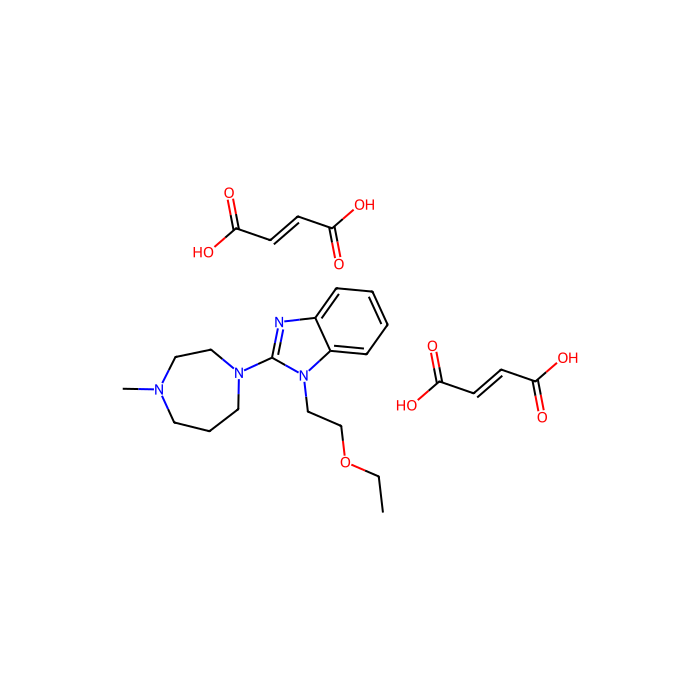
Emedastine Difumarate is the fumaric acid salt form of the small-molecule amine emedastine, supplied as the difumarate salt for improved solid-state handling and aqueous compatibility.
Item-specific identifiers (from Product Data)
SKU: E134559
Product Name: Emedastine Difumarate
CAS: 87233-62-3
PubChem CID: 5282485
InChIKey: 94004 (as provided)
SMILES: Not specified for this item; refer to CoA/Spec Sheet.
Molecular Formula: Not specified for this item; refer to CoA/Spec Sheet.
Molecular Weight: Not specified for this item; refer to CoA/Spec Sheet.
Salt form: difumarate indicates a fumarate counterion pairing; exact stoichiometry of base:acid (e.g., 1:2) should be confirmed from the CoA/Spec Sheet for this catalog item.
Functional groups (emedastine free base): typically contains a basic tertiary or secondary amine center capable of protonation; aromatic ring system(s) conferring lipophilicity; ether/alkyl linkages are often present in this class. Consult structural drawings in literature databases (e.g., CID 5282485) for precise atom connectivity.
Stereochemistry: Emedastine is commonly marketed as an achiral molecule (literature); confirm for this item via CoA.
2D structure in words (general)
An aromatic scaffold bearing a basic amine side chain; the difumarate comprises fumarate anions (HOOC–CH=CH–COO−) associated via ionic interactions with the protonated amine center(s).
Synthetic Utility
While Emedastine Difumarate is generally handled as a finished salt rather than a synthetic intermediate, several chemistry utilities are relevant in research settings:
Access to free base: The difumarate can be converted to the free base via basification (e.g., aqueous Na2CO3 or NaOH), followed by extraction into an organic solvent. This enables derivatization (acylation, carbamoylation, quaternization) or mechanistic studies on the amine free base. Confirm identity by NMR and MS; ensure complete removal of fumarate.
Counterion exchange: Preparation of alternate salts (e.g., hydrochloride, mesylate, tartrate) for comparative solubility and stability studies. Monitor salt identity and stoichiometry by 1H NMR (counterion resonances), IR (carboxylate stretches), and XRPD.
Solid-state transformations: Recrystallization screens may reveal hydrates/solvates or polymorphs of the difumarate; these are of interest for materials science aspects but do not change the molecular structure of the cation.
Reactivity considerations (general for amine-containing aromatics):
The protonated amine in the salt is less nucleophilic; free-base generation is usually required before nucleophilic reactions (e.g., amide formation with acyl chlorides or activated esters).
Aromatic substitution or oxidative functionalization typically proceeds on the neutral free base and is not common practice for a defined reference material.
Note: Do not rely on the salt for stoichiometric reactions unless the exact salt stoichiometry is confirmed for your lot.
Target Specificity
This section applies to biological affinity reagents (e.g., antibodies, ligands with validated target-binding specifications). No such item-specific target-binding data are provided for this small-molecule salt.
Target/antigen, species reactivity, clone/isotype: Not applicable for this product.
For biochemical studies involving receptors (e.g., histamine H1), consult primary literature for binding assay conditions and interpret any observed effects within the confines of research use only.
Nous utilisons des cookies pour garantir le bon fonctionnement du site et, lorsque cela est autorisé, pour améliorer votre expérience. Vous pouvez gérer vos préférences à tout moment dans les Paramètres. Pour en savoir plus, consultez notre Politique relative aux cookies.
Souhaitez-vous que nous vous envoyions un message lorsque des réductions seront disponibles?
Me rappeler plus tard
Merci ! Veuillez vérifier votre boîte de réception e-mail pour confirmer.
Products are supplied to verified businesses, institutions, and qualified professionals for research and development use only. Not for use in humans, animals, diagnosis, or therapy.

 G1506064