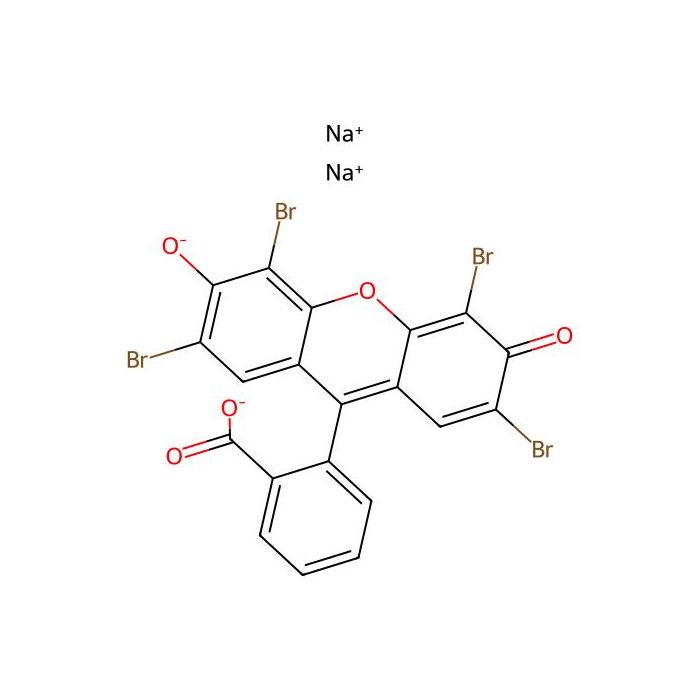
Eosin Y(water soluble) - 10mM in DMSO , CAS No.17372-87-1

CAS: 17372-87-1 Cat. No.: E422128 Formule: C20H6Br4Na2O5 Poids moléculaire: 691.85 Numéro CE: 241-409-6
DISPONIBLE À COMMANDE
GRADE & PURITY 10mM in DMSO
Synonyms
Eosin|Acid red 87|Eosin yellowish|Eosine Yellowish|Eosine|C.I. Acid Red 87|Eosine G|Eosin YS|Bromoeosine|Sodium eosine|Bromo acid|Eosine Y|Sodium eosinate|548-26-5|D and C Red No. 22|Bromofluoresceic acid|Bronze Bromo|Certiqual Eosine|Aizen eosine GH|Brom
Storage
Store at -80°C
Shipped In
Dry ice packs + Cold packs
★
Size
Allemagne (EU)
USA*
Price
Qty
1ml
E422128-1ml
Sur commande · 8–12 semaines
24,21€
Enter a quantity for the sizes you want to add.
🧪
Why this grade

10mM in DMSO for sensitive chromatographic and analytical workflows requiring minimal baseline interference.

🌡

Storage & shipping

Store at -80°C Ships Dry ice packs + Cold packs Check lot-specific COA for exact specifications.

📋

Quality documents

SDS, COA, datasheet, and spec sheet available for download. Lot-specific COA accessible via lot number lookup.

📚

Literature proof

Cited in 112 peer-reviewed publications across chromatography, organic synthesis, and cross-coupling reactions.

Vue d’ensemble

Eosin Y, a red xanthene dye, has been noted to reduce the affinity of Mg2+-ATPase for ATP and increase the enzyme affinity for Mg2+ at concentrations of 10-50 μM. At higher concentrations near 100 μM the affinity for Mg2+-ATPase for the ion-activator has been shown to be reduced. This compound has also been reported to be a photosensitizer that works as a molecular photoelectrode via catalyzation of the visible-light-driven electron-transfer reaction. Eosin Y has been used to stain structures such as muscle, cytoplasm, and collagen. This agent also enhances fluorescent quenching abilities by forming a complex with polyvinulpyrrolidone.

Specifications

Synonymes
Eosin | Acid red 87 | Eosin yellowish | Eosine Yellowish | Eosine | C.I. Acid Red 87 | Eosine G | Eosin YS | Bromoeosine | Sodium eosine | Bromo acid | Eosine Y | Sodium eosinate | 548-26-5 | D and C Red No. 22 | Bromofluoresceic acid | Bronze Bromo | Certiqual Eosine | Aizen eosine GH | Brom
Spécifications et pureté
10mM in DMSO
Mécanismes biochimiques et physiologiques
Non-selective PRMT inhibitor (IC 50 values are 0.8 and 1.4 μM for Hmt1p and PRMT1 respectively). Stain for cytoplasm. Inhibits DOT1 and SET7.
Conditions de stockage de stockage
Store at -80°C
Expédié en
Dry ice packs + Cold packs
Ce produit nécessite l'expédition en chaîne froide. Les services terrestres et autres services économiques ne sont pas disponibles.
Noms et identifiants
Isomères SMILES
C1=CC=C(C(=C1)C2=C3C=C(C(=O)C(=C3OC4=C(C(=C(C=C24)Br)[O-])Br)Br)Br)C(=O)[O-].[Na+].[Na+]
CAS alternatif
152-75-0
Poids moléculaire
691.85

Documentation

📋 Safety Data Sheet (SDS)

Comprehensive hazard, handling, storage, and regulatory compliance document.

Download SDS →

✅ Certificate of Analysis (COA)

Lot-specific quality data. Enter your lot number to retrieve the exact COA.

Look up COA →

📊 Datasheet

Quick-reference summary of product specifications and applications.

View datasheet →

🔬 Specification Sheet

Full quality attributes and acceptance criteria for this grade.

View spec sheet →

Advanced Data

Mécanismes d'action
Certificats (CoA, COO, BSE/TSE et tableau d'analyse)
C of A & Other Certificates(BSE/TSE, COO):
Analytical Chart:
Propriétés chimiques et physiques
SensibilitéMoisture sensitive.
Poids moléculaire691.900 g/mol
XLogP3
Hydrogen Bond Donor Count0
Hydrogen Bond Acceptor Count5
Rotatable Bond Count1
Exact Mass691.67 Da
Monoisotopic Mass687.674 Da
Topological Polar Surface Area89.500 Ų
Heavy Atom Count31
Formal Charge0
Complexity796.000
Isotope Atom Count0
Defined Atom Stereocenter Count0
Undefined Atom Stereocenter Count0
Defined Bond Stereocenter Count0
Undefined Bond Stereocenter Count0
The total count of all stereochemical bonds0
Covalently-Bonded Unit Count3
FAQ et articles
Visible Light Photoredox Catalysts
Photo-Crosslinking and Patterning of PEG-Based Hydrogels (2D/3D): Principles, Method Comparisons, and Product Selection Guidelines
Giemsa Staining Protocol: Peripheral Blood and Bone Marrow Smears
Methodological essentials for mineralization visualization: Alizarin Red S staining vs. Von Kossa silver staining
Experimental Judgment and Condition Selection for Visible-Light Catalysis in Organic Synthesis
How Degradable Poly(ethylene glycol) Hydrogels Build Tunable Cellular Microenvironments: Adhesion, Degradation, Release, and Experimental Interpretation in 2D/3D Culture
Designing Hydrogel Scaffolds as Programmable Cell Microenvironments: From Click-Chemistry Functionalization to 3D Cell Culture Experimental Design
Functional Distinction among Orange G-6, EA36, and EA50 in the Papanicolaou Staining System
Types, Binding Mechanisms, and Experimental Selection of Nuclear Dyes
Romanowsky Staining Systems: Chromogenic Basis, Method Types, and Result Interpretation
Mechanism of Action and Selection Logic of Photoinitiators
Color-Development Mechanisms, Formulation Forms, and Selection/Application Logic of Colorants in Personal Care Products
Neuropathological Mechanisms of Cerebral Infarction
Establishment and Evaluation Methods of Diabetic Animal Models
Histological Staining Methods for Identifying Hepatitis B Virus: Comparison of HE, Orcein, Aldehyde Fuchsin, Victoria Blue, Immunohistochemistry, and In Situ Hybridization
Summary of Cell Staining Methods
Where Does the Selectivity in Piperidine C–H Functionalization Come From? — Nitrogen Effects, Chair Conformations, and Four Classes of Key Intermediates
Citations of This Product
Calculateurs de solution
Avis

Avis des clients

Shall we send you a message when we have discounts available?

Remind me later

Thank you! Please check your email inbox to confirm.

Oops! Notifications are disabled.